Medical Device Testing Market Size, Share & Industry Analysis, by Service (Testing, Inspection, Certification), Sourcing (In-house, Outsourced), Technology (Active Implant, Active, Non-active, IVD, Ophthalmic, Orthopedic & Dental, Vascular), Class (I, II, III), and Regional Forecast, 2026-2034
 Download Free Sample
Medical Device Testing Market Size & Industry Overview
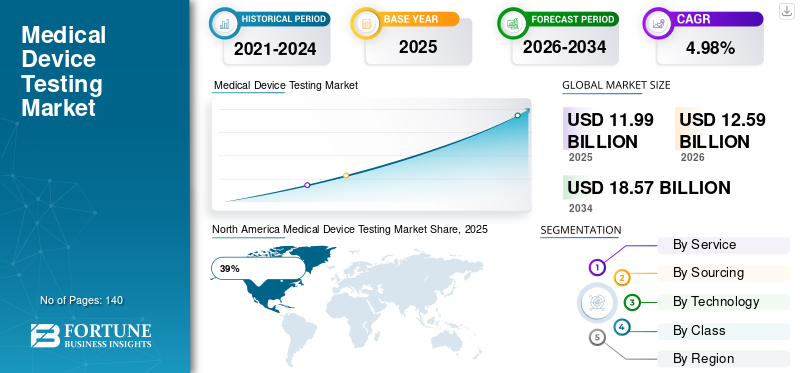
The global medical device testing market size was valued at USD 11.99 billion in 2025. The market is projected to grow from USD 12.59 billion in 2026 to USD 18.57 billion by 2034, exhibiting a CAGR of 4.98% during the forecast period. The market in North America dominated with a revenue share of 39% in 2025.

The increasing adoption of connected healthcare systems, implantable devices, diagnostic platforms, and wearable monitoring technologies has accelerated demand for comprehensive testing services. Medical device manufacturers are increasingly focusing on product validation, sterility assurance, biocompatibility assessment, electrical safety testing, and software verification to comply with global healthcare regulations. The market is also witnessing strong demand for outsourced testing solutions as manufacturers seek faster product approvals, reduced operational burden, and specialized expertise.
The United States medical device testing market remains one of the most advanced and highly regulated healthcare testing ecosystems globally. The country benefits from strong innovation in medical technology, extensive clinical research infrastructure, and stringent regulatory requirements for medical devices. Demand for testing services is increasing because manufacturers are launching advanced robotic surgery systems, AI-powered diagnostic platforms, remote patient monitoring devices, and minimally invasive surgical tools. U.S.-based testing laboratories are expanding capabilities in microbiological testing, wireless connectivity assessment, software validation, and electromagnetic compatibility testing. medical device testing market Research Report findings also highlight increasing investments in automation-driven testing laboratories and digital compliance management systems across the United States healthcare manufacturing sector.
Download Free sample to learn more about this report.
Medical Device Testing Market Key Takeaways
 Global Market Size & Forecast
- 2025 Market Size: USD 11.99 billion
- 2026 Market Size: USD 12.59 billion
- 2034 Forecast Market Size: USD 18.57 billion
- CAGR: 4.98% from 2026–2034
 Market Share
- North America dominated the medical device testing market with a 39% share in 2025.
- Testing services accounted for nearly 48% of the market share due to growing regulatory compliance requirements.
- Active implant medical devices held approximately 18% market share driven by increasing demand for advanced implantable healthcare technologies.
 Key Regional Highlights
North America
North America leads the medical device testing market with a 39% share, driven by advanced healthcare infrastructure, strict regulations, and growing adoption of digital health technologies.
Europe
Europe holds around 30% market share, supported by strong regulatory standards, healthcare modernization, and increasing demand for outsourced testing services.
Asia Pacific
Asia-Pacific captures 24% market share and is one of the fastest-growing regions due to expanding healthcare infrastructure, medical manufacturing, and healthcare digitization.
United Kingdom
The UK represents 22% of the European market, fueled by healthcare innovation, digital health adoption, and growing demand for cybersecurity and compliance testing.
Japan
Japan contributes 26% of the Asia-Pacific market, supported by advanced healthcare systems, medical technology innovation, and rising demand for quality testing services.
Read More

Medical Device Testing Market Latest Trends
The medical device testing market is experiencing rapid transformation due to technological innovation and stricter regulatory frameworks across developed and emerging economies. One of the major medical device testing market Trends is the integration of artificial intelligence and machine learning into testing environments. Automated testing systems are being used for predictive defect analysis, real-time quality monitoring, and digital documentation management. Medical device manufacturers are also investing heavily in cybersecurity testing for connected medical devices because hospitals and healthcare providers increasingly rely on cloud-connected systems and wireless patient monitoring platforms.
Download Free sample to learn more about this report.
Another important trend in the Medical Device Testing Industry Report is the rising demand for biocompatibility and sterilization validation services for implantable and wearable medical products. The expansion of telemedicine and home healthcare solutions has increased demand for portable diagnostic devices that require extensive durability and usability testing. In addition, regulatory agencies worldwide are strengthening guidelines for software-enabled medical technologies, creating greater demand for software validation and performance verification services. medical device testing market Forecast studies also indicate growing partnerships between contract research organizations and testing laboratories to accelerate device commercialization timelines.
Medical Device Testing Market Dynamics
DRIVER
Rising adoption of technologically advanced medical devices
The increasing use of technologically advanced healthcare devices is one of the strongest growth drivers for the medical device testing market. Healthcare providers worldwide are rapidly implementing connected monitoring systems, robotic-assisted surgical equipment, imaging platforms, and wearable diagnostic devices that require strict validation before commercialization. As device complexity increases, manufacturers require specialized testing for software performance, electrical safety, wireless communication, cybersecurity, and environmental reliability.
medical device testing market Insights further reveal that the expansion of chronic disease management programs and aging populations has increased the need for implantable and long-term monitoring devices. Regulatory authorities are also strengthening quality assurance standards for medical devices, compelling manufacturers to conduct extensive preclinical and post-market testing. In addition, healthcare providers are demanding higher device accuracy and patient safety standards, driving investment in advanced testing technologies. The increasing frequency of product recalls has further encouraged manufacturers to adopt comprehensive testing strategies throughout the product development lifecycle.
RESTRAINT
High cost associated with comprehensive testing procedures
The medical device testing market faces considerable restraints due to the high cost of advanced testing procedures and regulatory compliance requirements. Manufacturers developing innovative medical technologies often encounter significant expenses related to laboratory infrastructure, skilled personnel, software validation, biological assessment, and documentation management. Small and medium-sized medical device companies frequently struggle to maintain in-house testing capabilities because sophisticated equipment and compliance systems require substantial investment.
medical device testing market Outlook analysis also highlights delays in product approval caused by complex testing requirements and evolving international regulations. Many manufacturers must conduct repeated testing procedures to satisfy different regional regulatory frameworks, increasing operational costs and product launch timelines. Additionally, shortage of skilled testing professionals in specialized areas such as cybersecurity validation and biocompatibility testing creates operational challenges for testing service providers.
OPPORTUNITY
Expansion of outsourced testing services and digital healthcare technologies
The rapid expansion of outsourced testing services presents significant opportunities for participants in the medical device testing market. Medical device manufacturers increasingly prefer third-party testing providers to reduce operational complexity, access specialized expertise, and accelerate regulatory approvals. Outsourced testing laboratories offer cost-efficient services for sterility testing, microbiological analysis, packaging validation, and environmental testing, enabling manufacturers to focus on innovation and commercialization activities.
medical device testing market Opportunities are also expanding due to the growth of digital healthcare technologies such as remote patient monitoring systems, telehealth platforms, and wearable health devices. These technologies require extensive software validation, wireless communication testing, and cybersecurity assessment. Testing service providers are investing in automated laboratories, AI-enabled defect detection systems, and cloud-based compliance platforms to meet rising demand. Emerging healthcare markets in Asia-Pacific, Latin America, and the Middle East are also creating opportunities for international testing organizations seeking geographic expansion and long-term partnerships with regional device manufacturers.
CHALLENGE
Regulatory complexity and evolving compliance standards
Regulatory complexity remains a major challenge for companies operating in the medical device testing market. Manufacturers must comply with multiple regional standards related to safety, quality, sterilization, software validation, and risk management. Frequent updates to medical device regulations require testing organizations to continuously adapt laboratory procedures, documentation practices, and quality assurance systems. This creates additional operational burden for both manufacturers and third-party testing providers.
Medical Device Testing Industry Analysis indicates that cybersecurity compliance has become particularly challenging due to the increasing number of internet-connected healthcare devices. Testing organizations must evaluate software vulnerabilities, encryption standards, data privacy risks, and interoperability performance to ensure secure device operation. Another significant challenge involves managing product testing timelines while maintaining strict quality standards. Delays in testing or regulatory approval can affect product launches and market competitiveness.
Medical Device Testing Market Segmentation
By Service
Testing services account for approximately 48% of the medical device testing market Share due to the increasing need for product validation and regulatory compliance across healthcare manufacturing operations. Testing services include biocompatibility assessment, electrical safety testing, microbiological analysis, packaging validation, sterility assurance, and software verification. Medical device manufacturers rely heavily on testing solutions to identify defects, improve product reliability, and ensure patient safety before commercialization. medical device testing market Research Report findings show that testing services are particularly important for implantable devices, wearable technologies, and diagnostic imaging systems.
Inspection services represent nearly 27% of the medical device testing market Size because healthcare manufacturers require continuous quality monitoring throughout the production lifecycle. Inspection activities involve visual assessment, dimensional analysis, component verification, process auditing, and manufacturing quality evaluation. Medical device inspection is essential for identifying defects in raw materials, production processes, and finished products before devices reach healthcare facilities. medical device testing market Trends indicate increasing adoption of automated optical inspection systems and digital imaging technologies within medical manufacturing facilities.
Certification services hold approximately 25% of the medical device testing market Share due to increasing global emphasis on regulatory compliance and international quality standards. Certification processes validate whether medical devices meet regional and international healthcare regulations related to safety, performance, sterility, and manufacturing quality. Manufacturers require certification to access regulated healthcare markets and strengthen product credibility among hospitals and healthcare providers. medical device testing market Insights highlight growing demand for certification services for software-enabled medical devices, wearable health systems, and implantable technologies.
To know how our report can help streamline your business, Speak to Analyst
By Sourcing
In-house testing applications account for nearly 42% of the medical device testing market because large medical device manufacturers often maintain dedicated testing facilities to control product development timelines and intellectual property protection. In-house laboratories provide manufacturers with direct oversight of testing procedures, quality assurance systems, and compliance documentation. Major healthcare technology companies frequently establish specialized facilities for software validation, electrical safety testing, and environmental reliability assessment.
Outsourced testing services represent around 58% of the medical device testing market Share as manufacturers increasingly seek cost-effective and specialized compliance solutions. Third-party testing organizations provide expertise in sterility testing, microbiological analysis, biocompatibility evaluation, software validation, and certification support. Outsourcing allows manufacturers to reduce capital investment while accessing advanced laboratory technologies and experienced regulatory professionals.
By Technology
Active implant medical devices represent an important segment within the medical device testing market because of rising demand for pacemakers, neurostimulators, cochlear implants, and implantable cardiac monitoring systems. This segment accounts for nearly 18% of the technology market share due to strict requirements for electrical safety, software validation, and long-term performance testing. Testing providers focus on biocompatibility assessment, battery reliability, and electromagnetic compatibility to ensure uninterrupted device functionality. medical device testing market Trends indicate increasing adoption of connected implantable devices supporting remote patient monitoring.
Active medical devices account for approximately 24% of the medical device testing market Share because healthcare providers increasingly rely on powered diagnostic and therapeutic equipment. This segment includes infusion pumps, imaging systems, ventilators, surgical lasers, and patient monitoring technologies. Testing services emphasize electrical safety, thermal performance, software reliability, and operational efficiency under different clinical conditions. medical device testing market Analysis highlights rising investment in cybersecurity and interoperability testing for cloud-connected healthcare technologies.
Non-active medical devices contribute nearly 20% of the medical device testing market because hospitals and healthcare facilities continue to use surgical instruments, catheters, wound care products, and disposable medical supplies extensively. Although these devices are not electrically powered, they require rigorous testing for sterility assurance, packaging validation, material verification, and durability assessment. medical device testing market Insights show increasing demand for microbiological testing and quality inspection services in this segment. Manufacturers are investing in infection prevention technologies and advanced healthcare materials to improve patient safety.
In vitro diagnostic devices hold approximately 16% of the medical device testing market Share because of increasing demand for laboratory diagnostics, molecular testing systems, and point-of-care healthcare solutions. Testing services for IVD products include analytical validation, microbiological analysis, reagent stability testing, and software verification. medical device testing market Forecast analysis highlights rising demand for automated diagnostic systems and AI-powered laboratory technologies.
Ophthalmic devices represent nearly 8% of the medical device testing market due to increasing adoption of intraocular lenses, retinal imaging systems, and laser-assisted vision correction technologies. Testing procedures focus on optical performance, sterility assurance, long-term durability, and biocompatibility evaluation. Medical Device Testing Industry Report findings indicate growing demand for testing services associated with minimally invasive eye surgery technologies and smart ophthalmic healthcare devices. Aging populations and rising incidence of cataracts, glaucoma, and retinal disorders are supporting innovation in ophthalmic products. Manufacturers are increasingly prioritizing regulatory compliance and quality verification to strengthen product reliability and improve patient treatment outcomes.
Orthopedic and dental devices account for approximately 9% of the medical device testing market Share because of rising demand for implants, prosthetics, dental restorations, and fixation systems. Testing procedures involve mechanical strength evaluation, fatigue analysis, corrosion testing, and biocompatibility assessment to ensure long-term product durability and patient safety. medical device testing market Opportunities are increasing due to the adoption of advanced biomaterials and 3D printing technologies in orthopedic and dental manufacturing. Testing organizations are integrating robotic inspection systems and digital simulation platforms to improve product quality evaluation. Growing musculoskeletal disorders and expanding dental healthcare awareness continue driving testing demand in this segment.
Vascular devices contribute nearly 5% of the medical device testing market because healthcare providers increasingly use stents, catheters, grafts, and vascular access systems in cardiovascular treatment procedures. These devices require comprehensive testing for flow dynamics, pressure resistance, biocompatibility, and sterilization validation. medical device testing market Research Report findings show increasing investment in testing services for minimally invasive vascular technologies and drug-eluting cardiovascular devices. Regulatory authorities are strengthening long-term safety and performance requirements for cardiovascular products, increasing the need for advanced quality assessment capabilities. Rising cardiovascular disease prevalence and growing adoption of minimally invasive treatments continue supporting market growth.
By Class
Class I medical devices account for approximately 32% of the medical device testing market Share because this category includes low-risk healthcare products such as disposable supplies, handheld instruments, bandages, and examination tools. Although regulatory requirements are less complex than higher-risk categories, manufacturers still require sterility testing, packaging validation, and quality inspection services. medical device testing market Analysis indicates increasing demand for contamination control and material verification within the Class I segment. Rising healthcare infrastructure expansion and higher usage of disposable medical products are encouraging manufacturers to strengthen quality assurance strategies.
Class II devices represent nearly 44% of the medical device testing market because this category includes infusion pumps, patient monitoring systems, diagnostic imaging technologies, and surgical instruments requiring moderate regulatory oversight. Testing procedures focus on electrical safety, software validation, usability assessment, and performance verification. medical device testing market Trends highlight increasing demand for cybersecurity testing and interoperability assessment for connected healthcare technologies within this category. Manufacturers are increasingly outsourcing testing services to specialized laboratories to accelerate compliance approval and reduce operational burden.
Class III medical devices hold approximately 24% of the medical device testing market Share due to strict regulatory requirements for high-risk implantable and life-supporting technologies. This category includes pacemakers, heart valves, neurostimulators, and implantable defibrillators requiring extensive clinical validation and long-term reliability testing. medical device testing market Outlook remains strong for Class III products because healthcare providers continue adopting advanced implantable technologies for chronic disease management and surgical interventions. Testing organizations are heavily investing in biocompatibility assessment, software verification, and cybersecurity testing to ensure patient safety and regulatory compliance.
Medical Device Testing Market Regional Outlook
North America
North America Medical Device Testing Market, 2025 (%)
To get more information on the regional analysis of this market, Download Free sample
North America accounts for approximately 39% of the global medical device testing market Share due to strong healthcare infrastructure, advanced regulatory frameworks, and extensive medical technology innovation. The region benefits from the presence of major medical device manufacturers, specialized testing laboratories, and well-established healthcare research institutions. Regulatory standards related to product safety, software validation, and quality assurance remain highly stringent, creating sustained demand for advanced testing services.
medical device testing market Growth in North America is also supported by increasing adoption of connected healthcare systems, robotic surgery devices, and wearable monitoring technologies. Healthcare providers across the United States and Canada are investing heavily in digital health platforms that require extensive cybersecurity and interoperability testing. In addition, rising demand for minimally invasive surgical procedures and home healthcare devices continues to expand opportunities for specialized testing and certification services across the region.
Europe
Europe represents nearly 30% of the medical device testing market Share because of strong regulatory enforcement, growing healthcare modernization, and increasing medical device exports. Countries across the region are implementing stricter safety and quality standards for implantable devices, diagnostic platforms, and connected healthcare systems. European testing organizations are expanding capabilities in microbiological testing, software verification, and environmental compliance assessment.
medical device testing market Outlook for Europe remains positive due to increasing investments in digital healthcare technologies and sustainable medical manufacturing practices. The implementation of updated medical device regulations has encouraged manufacturers to adopt comprehensive testing procedures throughout product development cycles. Demand for outsourced testing services is also rising as manufacturers seek faster regulatory approvals and specialized expertise in compliance management.
Germany Medical Device Testing Market
Germany accounts for approximately 28% of the European medical device testing market due to its strong engineering expertise, advanced healthcare manufacturing ecosystem, and extensive medical technology exports. The country is home to numerous manufacturers specializing in diagnostic equipment, surgical instruments, orthopedic implants, and imaging technologies. German testing laboratories are highly focused on precision engineering, software validation, and automated inspection systems to support high-quality medical manufacturing.
medical device testing market Research Report analysis highlights increasing investments in Industry 4.0 technologies within Germany’s medical manufacturing sector. Companies are integrating AI-driven testing platforms, robotics, and digital compliance systems to improve operational efficiency and product reliability. The country also benefits from strong collaboration between research institutes, healthcare providers, and testing organizations. Rising demand for wearable health technologies and remote patient monitoring devices is creating additional opportunities for advanced testing and certification services.
United Kingdom Medical Device Testing Market
The United Kingdom holds nearly 22% of the European medical device testing market Share due to expanding healthcare innovation, strong clinical research capabilities, and growing adoption of digital health technologies. British medical device manufacturers are increasingly focusing on software-enabled healthcare solutions, portable diagnostic devices, and remote patient monitoring systems that require extensive testing and compliance verification.
medical device testing market Insights indicate rising investment in cybersecurity testing and software validation across the United Kingdom healthcare technology sector. Testing organizations are strengthening expertise in regulatory consulting, wireless communication assessment, and usability testing for connected healthcare devices. The country’s healthcare modernization initiatives and growing focus on patient safety are encouraging manufacturers to adopt comprehensive quality assurance strategies. Demand for outsourced testing services is also increasing among small and medium-sized medical device companies seeking specialized regulatory expertise.
Asia-Pacific
Asia-Pacific accounts for approximately 24% of the medical device testing market Share and is emerging as one of the fastest-growing regions due to expanding healthcare infrastructure, rising medical manufacturing activities, and increasing healthcare technology adoption. Countries across the region are investing heavily in domestic medical device production, regulatory modernization, and healthcare digitization initiatives.
medical device testing market Forecast analysis shows growing demand for outsourced testing services in Asia-Pacific as international manufacturers establish regional production facilities. Rising healthcare expenditure, increasing prevalence of chronic diseases, and growing demand for affordable diagnostic devices are supporting market expansion. Regional testing laboratories are also enhancing capabilities in sterilization validation, packaging assessment, and software testing to support the evolving healthcare technology landscape.
Japan Medical Device Testing Market
Japan contributes approximately 26% of the Asia-Pacific medical device testing market due to its advanced healthcare infrastructure, strong medical technology innovation, and aging population. Japanese manufacturers are highly focused on precision healthcare equipment, robotic surgery systems, and wearable monitoring devices that require comprehensive quality assessment and software validation.
medical device testing market Analysis highlights increasing investment in automated testing laboratories and AI-based quality monitoring systems across Japan’s healthcare manufacturing sector. Regulatory authorities in the country emphasize strict compliance standards for device safety, performance, and reliability. The growing adoption of telemedicine platforms and home healthcare technologies is creating additional demand for wireless communication testing and cybersecurity evaluation services. Japanese testing providers are also expanding partnerships with international healthcare manufacturers to strengthen global market competitiveness.
China Medical Device Testing Market
China represents nearly 35% of the Asia-Pacific medical device testing market Share because of its rapidly expanding medical manufacturing industry, growing healthcare investments, and rising demand for advanced diagnostic technologies. Domestic manufacturers are increasingly producing implantable devices, imaging equipment, and wearable healthcare systems for both domestic and international markets. This expansion has significantly increased demand for testing, inspection, and certification services.
medical device testing market Trends in China include the adoption of automated inspection systems, smart manufacturing technologies, and digital compliance management platforms. Government initiatives supporting healthcare modernization and local medical device innovation are encouraging investment in testing infrastructure. International testing organizations are also expanding operations in China to support growing export-oriented manufacturing activities. Rising healthcare awareness and increased focus on patient safety continue to strengthen demand for advanced testing solutions across the country.
Rest of World
Rest of World regions account for approximately 7% of the medical device testing market Share, supported by growing healthcare infrastructure development and increasing adoption of imported medical technologies. Countries in Latin America, the Middle East, and Africa are gradually strengthening healthcare regulations and quality assurance standards for medical devices.
medical device testing market Opportunities in these regions are expanding because governments are investing in hospital modernization, diagnostic infrastructure, and digital healthcare systems. International testing providers are increasingly entering emerging markets through strategic partnerships and regional laboratory expansion. Demand for certification and inspection services is particularly strong for imported medical devices that must comply with regional healthcare regulations. The expansion of private healthcare facilities and medical tourism activities is also contributing to long-term market development across emerging economies.
List of Top Medical Device Testing Companies
- Eurofins Scientific (Luxembourg)
- Intertek Group plc (UK)
- SGS Société Générale de Surveillance SA. (Switzerland)
- Bureau Veritas (France)
- TÜV SÜD (Germany)
Top Two Companies by Market Share
- Eurofins Scientific – 18%
- SGS Société Générale de Surveillance SA. – 15%
Investment Analysis and Opportunities
The medical device testing market is attracting significant investment due to increasing regulatory complexity and growing demand for technologically advanced healthcare devices. Investors are focusing on testing laboratories specializing in cybersecurity validation, biocompatibility assessment, and software verification because these services are becoming essential for connected healthcare technologies. Private equity firms and healthcare investors are also supporting expansion of automated testing facilities and digital compliance management platforms to improve operational efficiency.
medical device testing market Opportunities are expanding through mergers, acquisitions, and strategic partnerships between testing organizations and medical device manufacturers. Companies are investing heavily in AI-driven defect detection systems, robotic inspection technologies, and cloud-based quality assurance platforms to strengthen service capabilities. Emerging healthcare markets in Asia-Pacific and the Middle East are creating additional investment opportunities for international testing providers seeking geographic expansion.
New Product Development
Innovation within the medical device testing market is increasingly focused on automation, digitalization, and advanced analytics solutions. Testing providers are developing AI-enabled platforms capable of identifying manufacturing defects, predicting device failures, and improving compliance documentation accuracy. Automated robotic inspection systems are also being introduced to enhance precision in quality assurance processes for implantable devices and minimally invasive surgical instruments.
medical device testing market Trends further highlight the development of cloud-integrated testing environments that support remote collaboration, real-time monitoring, and centralized compliance management. Cybersecurity testing platforms are becoming more sophisticated as connected healthcare devices require advanced threat detection and vulnerability assessment capabilities. Companies are also introducing digital twin technologies that simulate device performance under different operating conditions, enabling manufacturers to optimize product reliability before commercialization.
Five Recent Developments (2023-2025)
- Eurofins Scientific expanded its medical device cybersecurity testing capabilities to support connected healthcare technologies.
- SGS Société Générale de Surveillance SA. launched advanced software validation services for AI-enabled medical devices.
- TÜV SÜD introduced automated robotic inspection systems for implantable medical device manufacturing facilities.
- Bureau Veritas expanded its biocompatibility testing laboratories to address rising demand for wearable healthcare devices.
- Intertek Group plc strengthened its wireless communication testing services for remote patient monitoring systems.
Report Coverage of Medical Device Testing Market
The medical device testing market Report provides comprehensive analysis of testing, inspection, and certification services across global healthcare manufacturing industries. The report evaluates major market drivers, restraints, opportunities, and challenges affecting industry expansion. It also examines regulatory developments, technological innovation, outsourcing trends, and investment activities shaping the competitive landscape.
Request for Customization to gain extensive market insights.
Medical Device Testing Industry Analysis within the report includes segmentation by type, application, and regional outlook. Detailed evaluation of North America, Europe, Asia-Pacific, and Rest of World markets highlights key growth areas, regulatory trends, and healthcare modernization initiatives. The report also profiles major testing organizations and examines strategic initiatives such as acquisitions, laboratory expansion, digital transformation, and new service development.
Frequently Asked Questions
Fortune Business Insights says that the global Medical Device Testing market value stood at USD 11.99 billion in 2025 and is projected to reach USD 18.57 billion by 2034.
The market is expected to exhibit a CAGR of 4.98% during the forecast period of 2026-2034.
The Testing services segment led the market, accounting for nearly 48% of the market share in 2025 due to increasing regulatory compliance requirements.
Key players include Eurofins Scientific, Intertek Group plc, SGS Société Générale de Surveillance SA, Bureau Veritas, and TÜV SÜD.
Major trends include the integration of AI and machine learning in testing and rising demand for cybersecurity, biocompatibility, and sterilization validation services.



- 2021-2034
- 2025
- 2021-2024
- 140
-

(Offer valid till 30th Sep 2026)
Get 30-60 hrs Free Customization
Expand Regional and Country Coverage, Segments Analysis, Company Profiles, Competitive Benchmarking, and End-user Insights.













.webp)






-
US +1 833 909 2966 ( Toll Free )
-
Get In Touch With Us