Medical Imaging Phantoms Market Size, Share & Industry Analysis, By Product, By Application (Calibration & Quality Assurance, Diagnostic Imaging, R&D), By End-use, and Regional Forecast, 2026-2034
 Download Free Sample
Medical Imaging Phantoms Market Overview
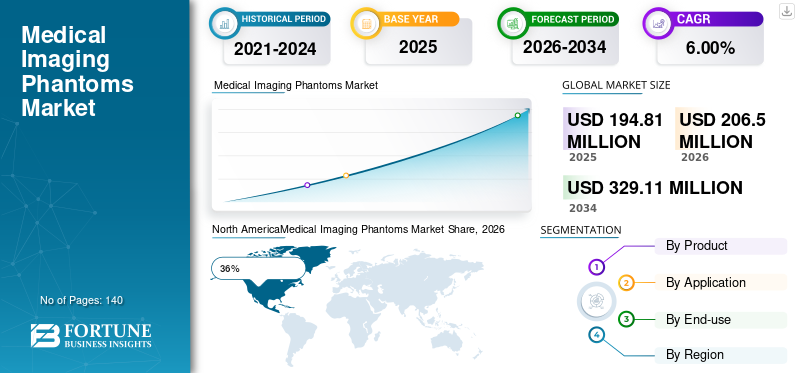
The global medical imaging phantoms market size was valued at USD 194.81 Million in 2025. The market is projected to grow from USD 206.5 Million in 2026 to USD 329.11 Million by 2034, exhibiting a CAGR of 6.00% during the forecast period.

The medical imaging phantoms market is experiencing substantial growth due to increasing demand for accurate diagnostic imaging, quality assurance procedures, and advanced medical imaging technologies across healthcare systems worldwide. Medical imaging phantoms are specialized objects designed to simulate human tissues and anatomical structures for calibration, testing, and optimization of imaging systems such as MRI, CT, ultrasound, PET, and X-ray equipment. medical imaging phantoms market Analysis indicates rising adoption of imaging quality control protocols and precision diagnostic standards within hospitals, research institutions, and diagnostic imaging centers. Technological advancements in imaging systems and increasing focus on patient safety are further strengthening demand for sophisticated phantom solutions globally.
The USA medical imaging phantoms market remains highly developed due to advanced healthcare infrastructure, extensive use of diagnostic imaging technologies, and strong investment in medical device innovation. medical imaging phantoms market Trends in the United States indicate growing demand for calibration and quality assurance phantoms designed to improve imaging accuracy and reduce diagnostic variability. Hospitals and imaging centers increasingly rely on imaging phantoms for compliance with regulatory standards and optimization of imaging equipment performance. Expansion of precision medicine initiatives and rising use of artificial intelligence in diagnostic imaging continue to support commercial demand for high-performance imaging phantom products throughout the country.
Download Free sample to learn more about this report.
Medical Imaging Phantoms Market Key Takeaways
 Global Market Size & Forecast
- 2025 Market Size: USD 194.81 Million
- 2026 Market Size: USD 206.50 Million
- 2034 Forecast Market Size: USD 329.11 Million
- CAGR: 6.00% from 2026-2034
 Market Share
- The market in North America dominated with a revenue share of 36% in 2025.
- Calibration & Quality Assurance phantoms dominated by application with a market share of approximately 46%.
- Hospitals & Diagnostic Imaging Centers dominated by end use with a market share of approximately 52%.
 Key Regional Highlights
North America
North America led the market with a 36% share, supported by advanced medical imaging infrastructure and strong demand for quality assurance solutions.
Asia-Pacific
Asia-Pacific accounted for 29% of the market, driven by expanding healthcare infrastructure and increasing adoption of advanced imaging technologies.
Europe
Europe held a 28% share, supported by established healthcare systems and growing demand for imaging quality management.
U.S
The U.S. remains a key market, supported by advanced diagnostic imaging infrastructure and strong adoption of medical imaging technologies.
Japan
Japan accounted for approximately 19% of the Asia-Pacific market, supported by advanced healthcare infrastructure and established diagnostic imaging capabilities.
Read More

Medical Imaging Phantoms Market Latest Trends
The medical imaging phantoms market is witnessing rapid technological transformation driven by increasing demand for advanced diagnostic imaging systems and improved quality assurance practices. One of the major medical imaging phantoms market Trends involves the development of anatomically realistic and multi-modality phantoms capable of supporting CT, MRI, PET, ultrasound, and hybrid imaging applications. Manufacturers are increasingly utilizing 3D printing technologies and tissue-equivalent materials to create highly accurate phantom models for clinical training, imaging optimization, and research applications. medical imaging phantoms market Insights reveal growing adoption of customized phantoms designed specifically for oncology imaging, cardiovascular diagnostics, and radiation therapy planning.
Download Free sample to learn more about this report.
Another significant trend shaping the Medical Imaging Phantoms Industry Report is the integration of artificial intelligence and digital simulation technologies within imaging quality assurance programs. Healthcare institutions are increasingly implementing advanced calibration procedures and automated imaging performance evaluation systems to improve diagnostic reliability. medical imaging phantoms market Research Report findings also indicate rising demand for phantoms that support low-dose imaging protocols and radiation safety optimization. Expansion of research activities related to precision diagnostics, image-guided interventions, and medical imaging standardization is expected to further strengthen market demand globally.
Medical Imaging Phantoms Market Dynamics
DRIVER
Increasing Demand for Imaging Quality Assurance and Diagnostic Accuracy
The growing emphasis on accurate diagnostic imaging and healthcare quality assurance is a major factor driving expansion of the medical imaging phantoms market. Hospitals, diagnostic imaging centers, and research laboratories increasingly rely on imaging phantoms to validate equipment performance, optimize imaging protocols, and maintain consistency in clinical diagnostics. medical imaging phantoms market Analysis indicates rising demand for calibration and testing solutions capable of improving image resolution, reducing diagnostic errors, and supporting advanced imaging applications. Expansion of chronic disease diagnosis and increasing use of imaging-guided treatment procedures are also contributing significantly to market growth.
Medical imaging equipment manufacturers are continuously introducing advanced diagnostic technologies requiring sophisticated phantom systems for performance validation and regulatory compliance. medical imaging phantoms market Growth is further supported by increasing awareness regarding patient safety, radiation dose optimization, and imaging standardization across healthcare facilities. Academic research institutions and medical device developers are also investing heavily in imaging simulation technologies and quality assurance programs. Rising adoption of artificial intelligence in medical imaging workflows and increasing complexity of imaging procedures continue to strengthen commercial demand for advanced phantom products globally.
RESTRAINT
High Development Costs and Limited Standardization
One of the major restraints affecting the medical imaging phantoms market is the high cost associated with developing anatomically accurate and technologically advanced phantom systems. Complex phantom manufacturing processes involving tissue-equivalent materials, precision engineering, and multi-modality compatibility often increase production expenses. medical imaging phantoms market Research Report findings indicate that smaller healthcare facilities and research laboratories may face budget limitations when adopting sophisticated imaging phantom technologies.
The market also experiences challenges related to limited standardization and compatibility across different imaging platforms. medical imaging phantoms market Trends reveal that varying regulatory requirements and equipment specifications can create operational complexity for manufacturers and healthcare providers. In addition, maintaining long-term durability and realistic tissue simulation characteristics within phantoms remains technically demanding. Rapid advancements in imaging technologies further require continuous product innovation and equipment compatibility updates, increasing research and development expenditures across the industry.
OPPORTUNITY
Expansion of Precision Diagnostics and Ai-Driven Imaging
Rapid growth in precision diagnostics and artificial intelligence-based imaging technologies is creating substantial opportunities for the medical imaging phantoms market. Healthcare providers and medical imaging companies are increasingly adopting advanced imaging systems requiring high-precision calibration and validation tools. medical imaging phantoms market Opportunities are particularly strong in oncology diagnostics, cardiovascular imaging, and image-guided therapy applications where accurate imaging performance is critically important.
Research institutions and medical device manufacturers are also investing heavily in AI training datasets and imaging simulation technologies that depend on advanced phantom systems. medical imaging phantoms market Outlook studies indicate increasing demand for customized phantoms supporting machine learning algorithms, automated imaging workflows, and precision radiology applications. Expansion of minimally invasive procedures and personalized healthcare initiatives is expected to further strengthen demand for innovative imaging phantom solutions. Manufacturers developing realistic, multi-functional, and digitally integrated phantom products are anticipated to gain significant competitive advantages within the evolving healthcare technology landscape.
CHALLENGE
Maintaining Realistic Tissue Simulation and Multi-Modality Compatibility
Maintaining realistic anatomical representation and multi-modality imaging compatibility remains a significant challenge within the medical imaging phantoms market. Imaging phantoms must accurately replicate human tissue characteristics across various imaging technologies while maintaining long-term durability and consistency. Medical Imaging Phantoms Industry Analysis indicates that developing phantoms capable of supporting MRI, CT, ultrasound, PET, and radiation therapy applications simultaneously requires highly advanced material engineering and manufacturing precision.
Manufacturers also face increasing pressure to deliver customizable and cost-efficient phantom systems suitable for diverse clinical and research applications. medical imaging phantoms market Trends reveal rising demand for phantoms designed specifically for pediatric imaging, oncology diagnostics, and minimally invasive procedure training. Continuous innovation in medical imaging technologies requires phantom manufacturers to frequently upgrade product designs and compatibility features. Regulatory compliance requirements, complex product validation procedures, and rising material costs further contribute to operational challenges across the global imaging phantom industry.
Medical Imaging Phantoms Market Segmentation
By Product
CT Phantoms account for approximately 38% of the medical imaging phantoms market and represent the largest product segment due to the widespread use of computed tomography systems across hospitals, diagnostic imaging centers, and research institutions. medical imaging phantoms market Analysis indicates that CT phantoms are extensively utilized for image quality assessment, equipment calibration, radiation dose optimization, and performance validation procedures. These phantoms help healthcare professionals evaluate image resolution, contrast sensitivity, geometric accuracy, and scanner consistency under controlled conditions. Rising demand for advanced diagnostic imaging, cancer screening programs, and precision healthcare solutions continues to strengthen adoption of CT imaging systems, thereby increasing demand for CT phantom products. Manufacturers are introducing anatomically realistic and tissue-equivalent phantom models to support modern imaging requirements and regulatory compliance standards. Continuous advancements in CT imaging technology, combined with growing emphasis on quality assurance and patient safety, are expected to sustain long-term growth within this segment.
By Application
Calibration & Quality Assurance phantoms account for approximately 46% of the medical imaging phantoms market and remain the largest segment due to extensive use in imaging equipment testing and performance validation. medical imaging phantoms market Analysis indicates that hospitals, diagnostic imaging centers, and healthcare laboratories increasingly rely on these phantoms to maintain imaging consistency, optimize equipment functionality, and comply with quality assurance standards. Calibration phantoms are widely utilized across CT, MRI, ultrasound, PET, and X-ray imaging systems to evaluate image quality, geometric accuracy, contrast resolution, and radiation dose performance. Manufacturers are introducing advanced quality assurance phantom models with enhanced tissue-equivalent properties and multi-modality compatibility. medical imaging phantoms market Trends reveal growing adoption of automated calibration systems and digital imaging evaluation tools integrated with phantom technologies.
Diagnostic Imaging phantoms represent approximately 34% of the medical imaging phantoms market and are extensively used for clinical imaging optimization, equipment evaluation, and radiology training applications. medical imaging phantoms market Insights indicate that these phantoms help healthcare professionals assess imaging performance under realistic anatomical conditions and improve diagnostic reliability. Diagnostic imaging phantoms are widely utilized in oncology imaging, neurological diagnostics, cardiovascular assessments, and image-guided procedures where high precision and image clarity are essential. Manufacturers are increasingly developing anatomically realistic diagnostic phantoms using advanced 3D printing technologies and tissue-simulating materials. medical imaging phantoms market Research Report findings reveal rising demand for patient-specific phantom models supporting personalized medicine and AI-based imaging applications.
R&D phantoms account for approximately 20% of the medical imaging phantoms market and are primarily utilized by research institutions, medical device manufacturers, and academic laboratories engaged in imaging technology development. medical imaging phantoms market Analysis indicates growing demand for experimental and customizable phantom systems designed for advanced imaging studies, radiation therapy research, and artificial intelligence training applications. Research organizations rely heavily on phantoms to validate imaging algorithms, optimize scanning protocols, and simulate complex anatomical structures. Manufacturers are focusing on developing highly customizable R&D phantom platforms capable of supporting emerging imaging modalities and precision diagnostic technologies.
To know how our report can help streamline your business, Speak to Analyst
By End-use
Hospitals & Diagnostic Imaging Centers account for approximately 52% of the medical imaging phantoms market and represent the largest end-use segment due to extensive utilization of imaging systems for patient diagnosis and treatment planning. medical imaging phantoms market Analysis indicates that healthcare facilities increasingly rely on imaging phantoms for calibration, quality assurance, radiation dose optimization, and equipment performance verification. Hospitals utilize these products across CT, MRI, ultrasound, and nuclear imaging departments to maintain diagnostic consistency and comply with regulatory standards. Growing patient volumes, increasing prevalence of chronic diseases, and expanding adoption of advanced imaging technologies continue to strengthen demand within this segment. Healthcare providers are investing heavily in imaging quality management programs to improve diagnostic accuracy, reduce variability, and enhance patient safety. Expansion of healthcare infrastructure and rising emphasis on precision medicine are expected to support long-term growth opportunities for imaging phantom manufacturers serving hospitals and diagnostic imaging centers globally.
Medical Imaging Phantoms Market Regional Outlook
North AmericaMedical Imaging Phantoms Market Share, 2026 (%)
To get more information on the regional analysis of this market, Download Free sample
North America
North America accounts for approximately 36% of the medical imaging phantoms market due to advanced healthcare infrastructure, high adoption of diagnostic imaging technologies, and strong investment in medical device innovation. medical imaging phantoms market Analysis indicates increasing use of sophisticated imaging quality assurance systems across hospitals, research institutions, and diagnostic imaging centers throughout the United States and Canada. The region benefits from extensive deployment of MRI, CT, PET, and hybrid imaging systems requiring regular calibration and performance testing.
medical imaging phantoms market Trends in North America reveal strong demand for AI-compatible phantom systems and advanced calibration technologies supporting precision diagnostics. Healthcare providers are increasingly focusing on imaging standardization, patient safety, and radiation dose optimization programs. Expansion of research activities related to oncology imaging, image-guided interventions, and minimally invasive diagnostics continues to strengthen market growth throughout the region.
Europe
Europe represents approximately 28% of the medical imaging phantoms market and remains a major center for medical imaging innovation and healthcare quality assurance practices. medical imaging phantoms market Research Report findings indicate rising demand for advanced imaging phantoms across radiology departments, academic research centers, and healthcare laboratories. European healthcare systems increasingly emphasize imaging accuracy, radiation safety, and compliance with standardized diagnostic procedures.
medical imaging phantoms market Insights reveal increasing investment in precision radiology, AI-driven imaging systems, and multi-modality imaging technologies across the region. Growth in healthcare modernization initiatives and expansion of advanced diagnostic services continue to support stable market demand. Manufacturers are also introducing customized phantom systems designed for specialized clinical and research applications, further strengthening commercial opportunities throughout Europe.
Germany medical imaging phantoms market
Germany contributes approximately 27% of Europe’s medical imaging phantoms market due to its advanced healthcare infrastructure and strong medical technology industry presence. medical imaging phantoms market Analysis indicates growing use of imaging quality assurance solutions across hospitals, radiology centers, and research institutions within the country. German healthcare providers prioritize precision diagnostics, imaging consistency, and advanced equipment calibration procedures to maintain high clinical standards.
The market also benefits from extensive research activities related to radiology innovation, artificial intelligence imaging, and personalized medicine applications. medical imaging phantoms market Trends reveal increasing demand for anatomically realistic phantom models supporting oncology imaging and radiation therapy planning. Expansion of medical device manufacturing and healthcare research funding continues to create favorable conditions for imaging phantom suppliers operating within Germany.
United Kingdom medical imaging phantoms market
The United Kingdom accounts for approximately 22% of Europe’s medical imaging phantoms market and remains an important regional market for imaging quality assurance technologies and healthcare innovation. medical imaging phantoms market Research Report findings indicate increasing demand for calibration phantoms, radiation dose monitoring systems, and imaging simulation technologies among hospitals and academic institutions. Healthcare providers are investing heavily in advanced imaging systems and precision diagnostic programs.
medical imaging phantoms market Outlook studies reveal growing adoption of AI-integrated imaging workflows and automated equipment validation procedures throughout the United Kingdom. Research organizations are increasingly utilizing customized phantoms for clinical imaging studies and simulation-based medical training. Expansion of healthcare digitalization initiatives and radiology modernization programs is expected to support long-term market growth within the country.
Asia-Pacific
Asia-Pacific holds approximately 29% of the medical imaging phantoms market and remains one of the fastest-growing regions due to expanding healthcare infrastructure and rising adoption of advanced diagnostic imaging technologies. medical imaging phantoms market Analysis indicates strong demand for quality assurance and calibration solutions across China, Japan, India, and Southeast Asian countries. Increasing healthcare expenditure and modernization of medical imaging facilities are significantly supporting regional market growth.
medical imaging phantoms market Trends reveal growing investments in radiology training, AI-driven diagnostics, and precision healthcare initiatives across Asia-Pacific. Governments and healthcare providers are increasingly implementing imaging quality control programs and expanding diagnostic imaging accessibility. Manufacturers are also strengthening regional distribution networks and introducing cost-effective phantom systems tailored to local healthcare requirements, supporting broader market penetration.
Japan medical imaging phantoms market
Japan represents approximately 19% of the Asia-Pacific medical imaging phantoms market due to its advanced medical imaging infrastructure and strong healthcare technology adoption. medical imaging phantoms market Insights indicate increasing demand for precision imaging calibration systems and anatomically accurate phantom models among hospitals and research laboratories. Japanese healthcare providers emphasize imaging quality assurance, radiation optimization, and advanced diagnostic accuracy within clinical practices.
The market is also supported by strong investment in medical imaging research, robotic healthcare technologies, and AI-assisted diagnostics. medical imaging phantoms market Research Report findings show growing use of imaging phantoms in oncology diagnostics, neurological imaging, and interventional radiology training applications. Expansion of healthcare innovation programs and aging population-related diagnostic demand continue to strengthen market opportunities across Japan.
China medical imaging phantoms market
China accounts for approximately 13% of the Asia-Pacific medical imaging phantoms market due to rapid expansion of healthcare infrastructure and increasing installation of advanced imaging systems across hospitals and diagnostic centers. medical imaging phantoms market Analysis highlights rising demand for imaging quality assurance products driven by healthcare modernization initiatives and expanding medical imaging accessibility throughout the country.
medical imaging phantoms market Trends reveal increasing adoption of AI-integrated imaging systems and precision diagnostic technologies within Chinese healthcare facilities. Government support for healthcare infrastructure development and domestic medical device manufacturing is further strengthening market growth. Expansion of radiology departments, research laboratories, and medical education programs continues to create substantial commercial opportunities for imaging phantom manufacturers operating in China.
Rest of World
The Rest of World region accounts for approximately 7% of the medical imaging phantoms market and includes growing opportunities across Latin America, the Middle East, and Africa. medical imaging phantoms market Insights indicate increasing healthcare investments and gradual modernization of diagnostic imaging infrastructure within emerging economies. Hospitals and diagnostic centers are increasingly adopting calibration and quality assurance systems to improve imaging reliability and patient safety.
medical imaging phantoms market Outlook studies reveal rising demand for affordable and durable imaging phantom products suitable for expanding healthcare systems in developing regions. Increasing awareness regarding imaging standardization and diagnostic accuracy is encouraging adoption of advanced quality assurance solutions. Growth in healthcare infrastructure projects and medical education programs is expected to strengthen long-term market opportunities throughout the Rest of World region.
List of Top Medical Imaging Phantoms Companies
- BARTEC Top Holding GmbH
- Gold Standard Phantoms
- IBA Worldwide
- Kyoto Kagaku Co., Ltd.
- Leeds Test Objects
- Mirion Technologies, Inc.
- PTW Freiburg GmbH
- Pure Imaging Phantoms
- RSD Radiology Support Devices
Top Two Companies by Market Share
- Kyoto Kagaku Co., Ltd. – 18%
- IBA Worldwide – 14%
Investment Analysis and Opportunities
The medical imaging phantoms market is attracting significant investment due to increasing demand for advanced diagnostic imaging systems, quality assurance technologies, and precision healthcare solutions. medical imaging phantoms market Opportunities are particularly strong in AI-assisted radiology, oncology imaging, and image-guided therapy applications. Healthcare providers and medical device manufacturers are investing heavily in advanced phantom technologies capable of supporting multi-modality imaging and automated calibration workflows.
Manufacturers are also expanding research and development activities focused on anatomically realistic phantom models, 3D printing technologies, and tissue-equivalent materials. medical imaging phantoms market Analysis indicates growing investment in simulation-based medical training and personalized diagnostic technologies. Expansion of healthcare modernization initiatives and increasing adoption of advanced imaging systems across emerging economies are expected to create favorable commercial opportunities for phantom manufacturers worldwide.
New Product Development
Innovation remains a major competitive factor within the medical imaging phantoms market as manufacturers focus on improving anatomical realism, imaging compatibility, and quality assurance efficiency. medical imaging phantoms market Trends reveal increasing introduction of multi-modality phantoms capable of supporting MRI, CT, ultrasound, PET, and radiation therapy applications within a single platform. Companies are also utilizing advanced 3D printing technologies to create patient-specific phantom systems for precision diagnostics and personalized medicine research.
Manufacturers are investing heavily in AI-compatible phantom models and digitally integrated calibration systems designed to support automated imaging workflows. medical imaging phantoms market Research Report findings indicate growing development of pediatric imaging phantoms, oncology simulation models, and low-dose imaging validation systems. Continuous innovation in imaging simulation technologies and tissue-equivalent material engineering is expected to support long-term market competitiveness globally.
Five Recent Developments (2023-2025)
- Major imaging phantom manufacturers introduced advanced 3D-printed anatomical phantom systems during 2023.
- Several companies launched AI-compatible calibration phantoms for precision radiology applications in 2024.
- Healthcare research institutions expanded adoption of multi-modality imaging phantom technologies during 2024.
- Manufacturers developed low-dose imaging validation phantoms for radiation optimization programs in 2025.
- Medical imaging companies strengthened partnerships with hospitals and research laboratories for customized phantom development between 2023 and 2025.
Report Coverage
The medical imaging phantoms market Report provides comprehensive analysis of imaging quality assurance technologies, calibration systems, and diagnostic simulation solutions utilized across healthcare facilities and research institutions worldwide. medical imaging phantoms market Research Report coverage includes segmentation by type, product, end-use, regional outlook, competitive landscape, and technological innovation trends influencing market development.
Request for Customization to gain extensive market insights.
Medical Imaging Phantoms Industry Analysis also examines market dynamics including drivers, restraints, opportunities, and challenges affecting commercial demand for imaging phantom systems globally. The report highlights advancements in AI-driven diagnostics, imaging standardization, 3D printing technologies, and precision radiology applications. Regional analysis evaluates healthcare modernization initiatives, imaging infrastructure expansion, and medical research investments shaping market growth worldwide.
Frequently Asked Questions
Fortune Business Insights says that the global market value stood at USD 194.81 million in 2025 and is projected to reach USD 329.11 million by 2034.
The market is expected to exhibit a CAGR of 6.00% during the forecast period of 2026-2034.
Calibration & Quality Assurance was the leading application segment, accounting for approximately 46% of the market, driven by extensive use in imaging equipment testing and performance validation.
Key players include BARTEC Top Holding GmbH, Gold Standard Phantoms, IBA Worldwide, Kyoto Kagaku Co., Ltd., Leeds Test Objects, and Mirion Technologies, Inc.
Major trends include the development of anatomically realistic, multi-modality phantoms using 3D printing and tissue-equivalent materials, along with AI and digital simulation integration for imaging quality assurance. North America held the largest regional share at approximately 36%.



- 2021-2034
- 2025
- 2021-2024
- 140
-

(Offer valid till 15th Oct 2026)
Get 30-60 hrs Free Customization
Expand Regional and Country Coverage, Segments Analysis, Company Profiles, Competitive Benchmarking, and End-user Insights.













.webp)






-
US +1 833 909 2966 ( Toll Free )
-
Get In Touch With Us