Medical Injection Molding Market Size, Share & Industry Analysis By Material (Plastics, Metals), By System (Hot Runner, Cold Runner), By Product (Medical Equipment Components, Consumables, Patient Aids, Orthopedics Instruments) and Regional Forecast, 2026-2034
 Download Free Sample
Medical Injection Molding Market Overview
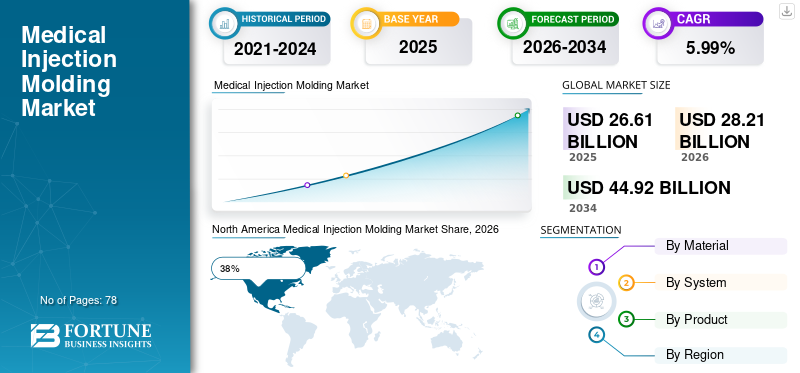
The medical injection molding market size was valued at USD 25.37 billion in 2025. The market is projected to grow from USD 26.90 billion in 2026 to USD 42.87 billion by 2034, exhibiting a CAGR of 6% during the forecast period.

The medical injection molding market is experiencing strong expansion due to increasing demand for precision-manufactured medical devices, disposable healthcare products, and advanced polymer-based components. medical injection molding technologies are widely utilized for producing surgical instruments, diagnostic equipment parts, drug delivery devices, and patient monitoring accessories with high dimensional accuracy and sterility compliance. The medical injection molding market report highlights rising adoption of biocompatible plastics, micro molding technologies, and automated production systems to improve manufacturing efficiency and product quality. Growing healthcare infrastructure investments, increasing surgical procedures, and expanding demand for single-use medical consumables continue supporting medical injection molding market growth across global healthcare manufacturing industries.
The U.S. medical injection molding market remains one of the largest contributors due to advanced healthcare infrastructure, increasing medical device manufacturing activity, and strong adoption of precision healthcare technologies. More than 71% of medical device manufacturers in the United States rely on injection molding processes for disposable medical products and complex device components. Demand for minimally invasive surgical instruments, wearable healthcare devices, and customized polymer-based implants continues expanding rapidly across the country. medical injection molding market insights indicate increasing deployment of automated molding systems, cleanroom manufacturing environments, and high-performance engineering plastics within the USA healthcare manufacturing ecosystem. Rising hospital admissions and healthcare technology modernization continue strengthening the medical injection molding market outlook in the United States.
Download Free sample to learn more about this report.
medical injection molding market Key Takeaways
 Global Market Size & Forecast
- 2025 Market Size: USD 25.37 Billion
- 2026 Market Size: USD 26.90 Billion
- 2034 forecast Market Size: USD 42.87 Billion
- CAGR: 6% from 2026-2034
 Market Share
- The market in North America dominated with a regional share of 38% in 2025.
- Hot runner systems held approximately 62% share of the global market.
- medical equipment components accounted for nearly 34% share of the market.
 Key Regional Highlights
North America
North America led the market with a 38% regional share, supported by advanced healthcare manufacturing.
Europe
Europe accounted for 29% of the market, driven by medical device production and technological adoption.
Asia-Pacific
Asia-Pacific held 26% share, supported by expanding healthcare infrastructure and manufacturing capabilities.
U.S.
The U.S. remains a major market, supported by strong medical device manufacturing and advanced molding technologies.
Japan
Japan accounted for 19% of the Asia-Pacific market, supported by advanced healthcare technology and precision manufacturing.
Read More

medical injection molding market Latest trends
The medical injection molding market trends landscape is evolving significantly due to rising healthcare automation, increasing use of advanced polymer materials, and growing demand for precision medical manufacturing. one of the strongest trends involves increasing adoption of micro injection molding technologies capable of manufacturing highly intricate medical device components with micron-level precision. nearly 48% of medical device manufacturers now integrate micro molding processes into production workflows for wearable healthcare devices and minimally invasive surgical instruments. Sustainable medical manufacturing is becoming another important trend within the medical injection molding market forecast environment. Healthcare companies increasingly prefer recyclable polymer materials and energy-efficient molding systems to reduce manufacturing waste and improve environmental compliance. approximately 41% of medical manufacturers are implementing sustainable material sourcing and low-emission production technologies.
Automation and robotics integration are also transforming the medical Injection molding industry analysis ecosystem. Smart molding systems equipped with AI-based monitoring software and robotic part handling technologies improve manufacturing consistency and reduce contamination risks in cleanroom production environments. More than 53% of large-scale manufacturers now utilize automated molding equipment for high-volume medical consumable production. Another important trend involves increasing demand for customized medical devices and patient-specific healthcare products. The medical injection molding market research report highlights growing deployment of precision molding systems for orthopedic implants, diagnostic cartridges, drug delivery devices, and wearable patient monitoring technologies worldwide.
Download Free sample to learn more about this report.
medical injection molding market Dynamics
DRIVER
Increasing Demand for Disposable medical Devices and Precision Healthcare Components.
The medical injection molding market growth trajectory is strongly driven by rising healthcare demand for disposable medical consumables, surgical instruments, and high-precision diagnostic components. Hospitals, clinics, and medical device manufacturers increasingly rely on injection molding technologies because of their ability to produce lightweight, sterile, and cost-efficient healthcare products in large volumes. Nearly 67% of disposable medical products including syringes, IV components, and diagnostic cartridges are manufactured using injection molding processes. medical injection molding market analysis indicates increasing demand for minimally invasive surgical devices and wearable healthcare equipment requiring complex polymer component manufacturing. Expanding global healthcare infrastructure and rising chronic disease prevalence continue accelerating demand for advanced medical molding technologies worldwide.
RESTRAINT
High Tooling Costs and Strict Regulatory Compliance Requirements.
High production setup expenses and complex healthcare regulations remain major barriers within the medical injection molding market outlook landscape. medical-grade injection molds require high-precision engineering, advanced material compatibility testing, and strict contamination control systems, increasing initial manufacturing costs significantly. approximately 39% of small and medium-sized manufacturers report financial challenges associated with cleanroom infrastructure and FDA-compliant production requirements. medical Injection Molding industry report findings indicate that frequent product validation procedures and strict documentation standards increase operational complexity for healthcare manufacturers. Regulatory approval delays for newly developed medical components also affect production timelines. Rising raw material costs and quality assurance expenses continue limiting profitability for smaller medical molding suppliers operating in highly regulated healthcare markets.
OPPORTUNITY
Expansion of Wearable Healthcare Devices and Minimally Invasive Technologies.
The growing adoption of wearable healthcare systems and minimally invasive medical procedures is creating substantial opportunities within the medical injection molding market opportunities ecosystem. More than 44% of healthcare technology companies are increasing investment in compact medical devices requiring precision-molded polymer components. Smart insulin delivery systems, portable diagnostic devices, wearable biosensors, and robotic-assisted surgical instruments continue generating strong demand for advanced medical molding capabilities. medical injection molding market research report analysis highlights increasing use of biocompatible thermoplastics and micro molding systems for next-generation healthcare applications. Emerging healthcare markets across Asia-Pacific and Latin America are also witnessing rising demand for affordable disposable medical products and diagnostic equipment, creating additional growth opportunities for medical injection molding manufacturers globally.
CHALLENGE
Maintaining Sterility and Precision In High-Volume Production Environments.
Ensuring contamination-free manufacturing and dimensional accuracy remains a significant challenge within the medical injection molding market analysis landscape. medical device manufacturers require highly controlled cleanroom environments and precision production systems to meet strict healthcare safety standards. approximately 34% of manufacturers identify contamination control and quality consistency as major operational concerns affecting medical component production. Even minor defects in molded medical products can create significant patient safety risks and regulatory compliance issues. medical injection molding market Insights also highlight challenges associated with maintaining consistent polymer flow, temperature control, and mold precision during large-scale manufacturing operations. Increasing demand for miniaturized healthcare devices further complicates production processes requiring ultra-high precision molding capabilities and advanced inspection technologies.
medical injection molding market Segmentation
By Material
Hot runner systems account for nearly 62% of the global medical injection molding market share due to their ability to reduce material waste, improve production speed, and maintain high manufacturing consistency. medical manufacturers increasingly utilize hot runner technologies for disposable syringes, IV components, surgical instrument handles, and diagnostic cartridges requiring high-volume precision production. medical injection molding market trends indicate that approximately 57% of large healthcare manufacturing facilities rely on hot runner systems because of reduced cycle times and enhanced automation compatibility. These systems also improve dimensional accuracy and reduce contamination risks in cleanroom production environments. North America and Europe remain leading markets for advanced hot runner medical molding technologies integrated with robotic manufacturing systems and AI-based process monitoring solutions.
Cold runner systems contribute approximately 38% of the medical injection molding market Size due to their flexibility in material selection and suitability for low-volume customized medical production. Manufacturers frequently utilize cold runner molding systems for specialized healthcare products, prototype development, and multi-material component manufacturing. medical Injection Molding industry analysis reveals that nearly 46% of medium-sized medical device companies prefer cold runner systems because of lower tooling complexity and reduced initial equipment costs. These systems are commonly used for orthopedic device components, patient aid accessories, and customized surgical products. Demand for cold runner technologies remains strong in emerging healthcare manufacturing economies due to lower operational investment requirements and adaptable production capabilities.
To know how our report can help streamline your business, Speak to Analyst
By Product
medical equipment components account for nearly 34% of the medical injection molding market share because of increasing production of diagnostic systems, patient monitoring devices, and minimally invasive surgical instruments. Precision-molded polymer components are widely utilized in imaging systems, laboratory analyzers, infusion pumps, and robotic surgical equipment. approximately 61% of medical equipment manufacturers utilize injection molding technologies for lightweight and high-durability device production. medical injection molding market forecast analysis highlights rising demand for compact healthcare electronics and wearable diagnostic technologies requiring precision polymer manufacturing. Increasing healthcare automation and smart medical device adoption continue driving strong component manufacturing demand worldwide.
Consumables contribute around 31% of the medical injection molding market Size due to rising global demand for disposable healthcare products including syringes, catheters, IV connectors, specimen containers, and diagnostic cartridges. Hospitals and diagnostic laboratories increasingly prioritize single-use consumables to reduce infection risks and improve patient safety standards. Nearly 69% of disposable medical products are manufactured using injection molding technologies because of cost efficiency and large-scale production capabilities. medical injection molding market research report findings indicate growing investment in sterile manufacturing systems and high-speed molding equipment for consumable production. Increasing vaccination programs and diagnostic testing activity continue strengthening consumable demand globally.
Patient aids account for approximately 18% of the medical injection molding market outlook due to growing demand for mobility support devices, respiratory accessories, rehabilitation equipment, and wearable healthcare products. Injection molding technologies enable lightweight and ergonomic product manufacturing suitable for long-term patient use. approximately 52% of patient aid manufacturers rely on polymer molding systems for customized and mass-produced healthcare accessories. medical injection molding market analysis indicates increasing adoption of smart wearable devices and portable patient monitoring systems integrated with precision-molded plastic components. Aging population growth and expanding home healthcare services continue supporting demand for patient aid manufacturing technologies worldwide.
Orthopedics instruments contribute nearly 17% of the medical injection molding market share because of increasing orthopedic procedures, sports injury treatments, and joint replacement surgeries globally. Injection molding technologies are extensively utilized for producing surgical guides, implant packaging systems, rehabilitation components, and precision orthopedic tools. Nearly 49% of orthopedic device suppliers utilize high-performance thermoplastic molding systems for durable and biocompatible instrument manufacturing. medical injection molding market opportunities continue expanding with rising adoption of minimally invasive orthopedic procedures and patient-specific implant technologies. Advanced polymer materials and precision molding systems remain critical for next-generation orthopedic healthcare manufacturing.
medical injection molding market Regional outlook
North America
North America Medical Injection Molding Market Share, 2026 (%)
To get more information on the regional analysis of this market, Download Free sample
North America dominates the medical injection molding market outlook with approximately 38% global market share due to advanced healthcare manufacturing infrastructure, rising medical device production, and strong adoption of automated molding technologies. The United States remains the leading contributor because of increasing demand for disposable healthcare products, minimally invasive surgical devices, and wearable medical technologies. Canada and Mexico are also witnessing increasing healthcare manufacturing investments and medical component production activity. approximately 64% of North American medical device manufacturers utilize automated injection molding systems integrated with robotic quality inspection technologies. medical injection molding market Insights indicate rising demand for biocompatible polymers, cleanroom molding systems, and micro injection molding technologies across regional healthcare manufacturing facilities. Increasing healthcare spending and growing surgical procedure volumes continue strengthening medical molding demand throughout North America.
Europe
Europe represents nearly 29% of the global medical injection molding market Size due to strong healthcare infrastructure, increasing medical technology innovation, and advanced polymer manufacturing capabilities. Countries including Germany, the United Kingdom, France, and Italy remain major regional contributors to precision healthcare component production. approximately 58% of European medical device manufacturers utilize injection molding systems for diagnostic equipment components and disposable healthcare consumables. medical injection molding market trends reveal increasing adoption of sustainable polymer materials and energy-efficient molding technologies throughout Europe’s healthcare manufacturing ecosystem. Rising investment in orthopedic devices, laboratory diagnostics, and patient monitoring equipment continues strengthening regional demand for precision medical molding systems. Strict healthcare quality standards also encourage manufacturers to deploy advanced automated molding solutions.
Germany Medical Injection Molding Market
Germany accounts for nearly 22% of the European medical injection molding market share due to advanced medical engineering capabilities and strong healthcare manufacturing infrastructure. medical device companies across Germany increasingly utilize precision molding systems for surgical instruments, diagnostic cartridges, and wearable healthcare devices. approximately 54% of German healthcare manufacturers deploy automated cleanroom molding systems integrated with robotic quality control technologies. medical injection molding market research report findings indicate rising demand for biocompatible polymers and micro molding systems across Germany’s precision healthcare manufacturing sector. Increasing orthopedic device production and healthcare technology exports continue supporting market expansion within the country.
United Kingdom Medical Injection Molding Market
The United Kingdom contributes approximately 18% of the European medical injection molding market outlook due to rising healthcare innovation, increasing demand for disposable medical products, and expanding diagnostic device manufacturing activity. Hospitals, research institutions, and healthcare technology companies continue increasing adoption of molded medical components for patient monitoring systems and surgical equipment. Around 51% of healthcare device manufacturers in the United Kingdom rely on precision injection molding technologies for lightweight and sterile healthcare product manufacturing. medical injection molding market growth is further supported by increasing investment in wearable healthcare devices and home-based patient monitoring technologies.
Asia-Pacific
Asia-Pacific holds approximately 26% of the global medical injection molding market share and remains one of the fastest-growing regional healthcare manufacturing hubs due to increasing medical device production, expanding healthcare infrastructure, and rising demand for disposable healthcare products. China, Japan, India, South Korea, and Southeast Asian countries continue generating strong demand for precision healthcare component manufacturing technologies. approximately 72% of healthcare manufacturers within Asia-Pacific utilize injection molding systems for consumable and diagnostic product production. medical injection molding market forecast analysis highlights increasing investment in automated molding facilities, biocompatible polymer production, and smart healthcare manufacturing technologies. Rapid urbanization, growing hospital infrastructure, and increasing healthcare accessibility continue strengthening regional demand for advanced medical molding systems.
Japan Medical Injection Molding Market
Japan contributes nearly 19% of the Asia-Pacific medical injection molding market Size due to strong healthcare technology innovation and advanced precision manufacturing capabilities. Japanese medical manufacturers increasingly deploy micro molding systems and automated cleanroom technologies for wearable devices, diagnostic products, and minimally invasive surgical instruments. approximately 59% of medical device suppliers in Japan utilize high-performance thermoplastic molding systems for precision healthcare component production. medical Injection Molding industry analysis highlights rising investment in robotic manufacturing systems and compact healthcare electronics across Japan’s medical technology sector.
China Medical Injection Molding Market
China accounts for approximately 39% of the Asia-Pacific medical injection molding market share supported by large-scale healthcare manufacturing capacity, increasing medical consumable demand, and expanding healthcare infrastructure investments. Chinese manufacturers increasingly produce disposable syringes, IV systems, diagnostic cartridges, and patient monitoring components using automated injection molding technologies. Nearly 76% of large healthcare manufacturing facilities in China utilize robotic molding systems for high-volume medical production operations. medical injection molding market opportunities continue expanding with rising healthcare exports, growing domestic medical device demand, and increasing government support for healthcare manufacturing modernization initiatives.
Rest of World
Rest of World represents around 7% of the global medical injection molding market share driven by increasing healthcare modernization, rising medical consumable demand, and expanding diagnostic infrastructure across Latin America, the Middle East, and Africa. Countries including Brazil, Saudi Arabia, South Africa, and the United Arab Emirates continue witnessing growing adoption of disposable healthcare products and precision medical device manufacturing technologies. approximately 47% of healthcare manufacturers within these regions utilize injection molding systems for diagnostic consumables and patient aid production. medical injection molding market analysis highlights increasing investment in local healthcare manufacturing facilities, sterile production systems, and medical technology imports supporting healthcare infrastructure development across emerging economies.
List of Top medical Injection Molding Companies
- C&J Industries
- All-Plastics.
- HTI Plastics.
- The Rodon Group
- EVCO Plastics
- Majors Plastics
- Proto Labs
- Rosti Group AB
- Currier Plastics, Inc.
- Formplast GmbH
- H&K Müller GmbH & Co. KG
- Hehnke GmbH & Co KG
- TR Plast Group
- D&M Plastics, LLC.
Top Two Companies by Market Share
- C&J Industries: approximately 6.5%
- Biomerics: approximately 5.8%
Investment analysis and opportunities
The medical injection molding market opportunities landscape continues attracting strong investment from healthcare manufacturers, polymer suppliers, automation companies, and medical device developers. Increasing demand for disposable medical products, wearable healthcare devices, and precision diagnostic equipment is encouraging large-scale investment in automated molding systems and cleanroom manufacturing infrastructure. approximately 52% of healthcare manufacturing investments are directed toward advanced injection molding technologies and medical-grade polymer processing facilities.
medical device companies increasingly invest in robotic molding systems, AI-based quality inspection technologies, and micro molding capabilities to improve manufacturing precision and operational efficiency. medical injection molding market research report analysis indicates rising investment in biocompatible polymer materials and sustainable healthcare manufacturing solutions designed to reduce environmental impact and production waste.
Emerging healthcare economies across Asia-Pacific and Latin America continue presenting strong commercial opportunities because of expanding hospital infrastructure, rising healthcare accessibility, and increasing local medical device manufacturing activity. Healthcare technology firms are also investing heavily in customized molding systems for wearable biosensors, orthopedic implants, and minimally invasive surgical instruments. medical injection molding market forecast findings further highlight growing opportunities linked to smart healthcare devices, home-based patient monitoring systems, and precision diagnostic technologies requiring advanced polymer manufacturing capabilities.
New Product Development
Innovation within the medical injection molding market trends environment is increasingly focused on precision polymer engineering, automation integration, and sustainable healthcare manufacturing technologies. Manufacturers are launching advanced micro molding systems capable of producing miniature healthcare components with ultra-high dimensional accuracy for wearable devices and minimally invasive surgical equipment. Nearly 56% of large healthcare manufacturers now integrate AI-powered process monitoring systems into injection molding operations to improve production consistency and defect detection.
Biocompatible and recyclable polymer development remains a major product innovation area. Healthcare manufacturers increasingly utilize medical-grade thermoplastics resistant to contamination, sterilization procedures, and chemical degradation. medical injection molding market Insights indicate rising deployment of antimicrobial polymer materials for patient-contact medical products and hospital consumables.
Automation and robotics technologies continue transforming product development strategies across healthcare manufacturing facilities. Smart molding systems integrated with robotic assembly lines, automated inspection cameras, and predictive maintenance software improve cleanroom production efficiency and quality control accuracy. medical injection molding market analysis also highlights increasing development of customized orthopedic devices, patient-specific surgical components, and lightweight wearable healthcare products manufactured through precision injection molding technologies. Advanced cooling systems, rapid prototyping tools, and energy-efficient molding equipment continue supporting next-generation healthcare manufacturing innovation worldwide.
Five Recent Developments (2023-2025)
- In 2023, Proto Labs expanded automated medical injection molding capabilities for rapid healthcare component production.
- In 2023, Biomerics introduced advanced micro molding technologies for minimally invasive surgical devices.
- In 2024, Currier Plastics, Inc. launched sustainable medical-grade polymer packaging solutions for healthcare applications.
- In 2024, EVCO Plastics upgraded robotic cleanroom molding facilities for precision healthcare manufacturing operations.
- In 2025, Rosti Group AB expanded production of wearable healthcare device components using advanced thermoplastic molding technologies.
report Coverage of medical injection molding market
The medical injection molding market report provides comprehensive analysis of healthcare manufacturing technologies, precision polymer processing systems, and medical device production trends shaping the global market. The report evaluates major segments including hot runner and cold runner molding technologies while examining healthcare applications across medical equipment components, consumables, patient aids, and orthopedic instruments. medical injection molding market analysis covers automation adoption, biocompatible material usage, cleanroom manufacturing systems, and healthcare device innovation trends influencing competitive positioning among global manufacturers.
Request for Customization to gain extensive market insights.
The report includes extensive regional assessment across North America, Europe, Asia-Pacific, and Rest of World markets with detailed country-level analysis for the United States, Germany, United Kingdom, Japan, and China. medical injection molding market Insights additionally examine healthcare infrastructure modernization, surgical procedure growth, disposable medical product demand, and wearable healthcare device adoption trends supporting market expansion.
The medical Injection Molding industry report further investigates regulatory compliance requirements, contamination control standards, robotic manufacturing integration, and sustainable polymer development affecting healthcare production operations. Competitive benchmarking of leading manufacturers, product innovation strategies, and healthcare technology investments are incorporated throughout the study. The report additionally evaluates future opportunities linked to minimally invasive surgical devices, precision diagnostics, smart healthcare technologies, and automated cleanroom manufacturing systems shaping the global medical injection molding market outlook.
Frequently Asked Questions
Fortune Business Insights says that the global market value stood at USD 25.37 billion in 2025 and is projected to reach USD 42.87 billion by 2034.
The market is expected to exhibit a CAGR of 6% during the forecast period of 2026-2034.
Hot runner systems were the leading system segment, accounting for nearly 62% of the market, due to reduced material waste, faster production, and high manufacturing consistency.
Key players include C&J Industries, All-Plastics, HTI Plastics, The Rodon Group, EVCO Plastics, and Majors Plastics.
Major trends include rising adoption of micro injection molding and increasing use of sustainable materials, automation, and robotics in medical manufacturing. North America led the market with approximately 38% share.



- 2021-2034
- 2025
- 2021-2024
- 78
-

(Offer valid till 30th Sep 2026)
Get 30-60 hrs Free Customization
Expand Regional and Country Coverage, Segments Analysis, Company Profiles, Competitive Benchmarking, and End-user Insights.









-
US +1 833 909 2966 ( Toll Free )
-
Get In Touch With Us