Metal Screw Fasteners Market Size, Share & Industry Analysis, By Material (Stainless Steel, Carbon Steel), By End-use (Automotive, Construction, Electrical & Electronics, Machinery & Equipment), By Country and Regional Forecast, 2026-2034
 Download Free Sample
Metal Screw Fasteners Market Overview
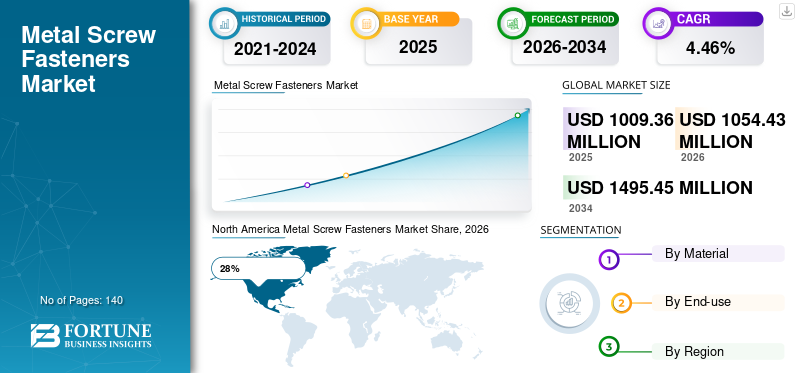
The global metal screw fasteners market size was valued at USD 1009.36 billion in 2025. The market is projected to grow from USD 1054.43 billion in 2026 to USD 1495.45 billion by 2034, exhibiting a CAGR of 4.46% during the forecast period.

The metal screw fasteners market is witnessing steady expansion due to rising demand from industrial manufacturing, automotive assembly, infrastructure projects, and advanced machinery production. Metal screw fasteners are essential components used for joining, securing, and reinforcing structures across multiple sectors. Growing industrial automation, increasing construction activity, and expanding production of consumer electronics are supporting market penetration globally. Manufacturers are focusing on corrosion-resistant materials, precision threading technologies, and high-strength fastening solutions to improve product performance. The metal screw fasteners market report highlights increasing adoption of customized fastening systems, automated installation methods, and durable metal alloys that enhance operational efficiency across industrial environments.
The United States metal screw fasteners market continues to benefit from large-scale industrial manufacturing, transportation equipment production, aerospace activities, and commercial construction projects. Domestic demand remains strong due to rising investments in infrastructure modernization and factory automation. Automotive manufacturing hubs across Michigan, Ohio, and Texas generate substantial consumption of metal screw fasteners for vehicle assembly operations. Electrical equipment manufacturing and renewable energy installations also contribute significantly to market demand. The metal screw fasteners market analysis indicates that demand for stainless steel and specialty alloy fasteners is increasing across the United States due to durability requirements, corrosion resistance standards, and long-term structural performance expectations.
Download Free sample to learn more about this report.
Metal Screw Fasteners Market Key Takeaways
 Global Market Size & Forecast
- 2025 Market Size: USD 1,009.36 Billion
- 2026 Market Size: USD 1,054.43 Billion
- 2034 Forecast Market Size: USD 1,495.45 Billion
- CAGR: 4.46% from 2026-2034
 Market Share
- The market in Asia-Pacific dominated with a revenue share of 39% in 2025.
- Stainless steel dominated by material with a market share of approximately 58%
- Automotive dominated by end use with a market share of approximately 34%.
 Key Regional Highlights
Asia-Pacific
Asia-Pacific led the market with a 39% share, supported by expanding industrial production and construction activities.
North America
North America accounted for 28% of the market, driven by strong automotive, manufacturing, and infrastructure demand.
Europe
Europe held a 25% share, supported by established automotive and industrial manufacturing sectors.
U.S
The U.S. remains a key market, supported by strong demand from automotive, construction, and industrial applications.
Japan
Japan accounted for approximately 16% of the Asia-Pacific market, supported by its established automotive and machinery manufacturing industries.
Read More

Metal Screw Fasteners Market Latest Trends
The metal screw fasteners market trends are increasingly influenced by automation, lightweight manufacturing, and advanced material engineering. Manufacturers are adopting smart production systems equipped with robotic threading and inspection technologies to improve consistency and reduce production waste. The growing popularity of electric vehicles is creating demand for specialized metal screw fasteners capable of supporting lightweight vehicle architectures while maintaining structural integrity.
Download Free sample to learn more about this report.
Another major trend involves the increasing use of stainless steel fasteners in construction, marine, and industrial applications where corrosion resistance is critical. Companies are introducing coated and treated fasteners with enhanced environmental resistance to withstand extreme temperatures and humidity conditions. Digital inventory management systems are also transforming distribution networks, enabling manufacturers and industrial buyers to track fastener usage and procurement requirements more efficiently.
Metal Screw Fasteners Market Dynamics
DRIVER
Rising Demand from Automotive and Infrastructure Industries.
The metal screw fasteners market growth is strongly supported by increasing production across automotive and infrastructure sectors. Modern vehicles require thousands of fastening components to secure engines, interiors, electrical systems, and body structures. Growing production of passenger vehicles, commercial trucks, and electric vehicles continues to generate substantial demand for high-strength screw fasteners. Infrastructure development projects including bridges, rail systems, airports, industrial facilities, and commercial buildings require durable fastening systems capable of handling heavy structural loads. Rapid urbanization across developing economies has accelerated residential and commercial construction activities, increasing procurement volumes for metal screw fasteners. The metal screw fasteners market outlook remains positive as governments continue investing in transportation networks, smart cities, and industrial corridors that depend heavily on reliable fastening technologies.
RESTRAINT
Volatility in Raw Material Prices.
Fluctuating prices of steel, stainless steel, nickel, and other alloy materials remain a significant restraint for market participants. Manufacturing costs are directly influenced by raw material availability and global commodity pricing trends. Unexpected increases in steel prices can affect profitability and disrupt production planning for fastener manufacturers. Supply chain disruptions and trade restrictions may further increase procurement costs and extend delivery timelines. Small and medium-sized manufacturers often face greater challenges in absorbing cost fluctuations compared with larger organizations that possess stronger purchasing capabilities. The metal screw fasteners market research report identifies pricing pressure as a major concern because customers frequently demand cost-efficient solutions while maintaining strict quality standards. These factors can limit operational flexibility and create challenges for long-term contract negotiations.
OPPORTUNITY
Expansion of Renewable Energy and Industrial Automation.
Renewable energy projects are creating substantial opportunities for the metal screw fasteners market. Solar farms, wind power installations, battery manufacturing facilities, and energy storage systems require specialized fastening solutions designed for long-term durability and environmental resistance. Industrial automation is simultaneously driving demand for precision fasteners used in robotics, automated assembly lines, and intelligent manufacturing equipment. The adoption of Industry 4.0 technologies has increased requirements for highly engineered fastening products that ensure mechanical stability and operational reliability. Manufacturers developing customized solutions for renewable energy and automated production systems are expected to secure competitive advantages. The metal screw fasteners market opportunities continue to expand as industrial facilities modernize equipment and increase automation investments worldwide.
CHALLENGE
Increasing Competition and Product Standardization.
One of the primary challenges facing manufacturers is intense competition resulting from product standardization and the availability of low-cost alternatives. Numerous regional and international suppliers compete within similar product categories, creating pricing pressure throughout the value chain. Buyers often prioritize cost efficiency, making product differentiation difficult. Maintaining quality certifications, compliance standards, and precision manufacturing capabilities requires continuous investment in technology and workforce training. Counterfeit products and low-quality imports can also affect brand reputation and market stability. The Metal Screw Fasteners Industry analysis indicates that manufacturers must continuously innovate through advanced coatings, specialized materials, and customized engineering solutions to maintain competitiveness and strengthen customer relationships.
Metal Screw Fasteners Market Segmentation
By Material
Stainless steel accounts for approximately 58% of the metal screw fasteners market share due to its superior corrosion resistance, high tensile strength, and durability. These fasteners are extensively utilized in marine structures, commercial construction, industrial equipment, renewable energy projects, and food processing facilities where exposure to moisture and chemicals is common. Growing demand for long-lasting fastening systems has strengthened adoption across developed and emerging economies. Stainless steel screw fasteners require lower maintenance compared with conventional alternatives, making them attractive for critical infrastructure applications.
Carbon steel represents nearly 42% of the metal screw fasteners market share and remains a preferred material due to affordability, versatility, and mechanical strength. These fasteners are widely used in machinery manufacturing, automotive assembly, industrial equipment, and general construction activities. Carbon steel fasteners offer cost-effective solutions for applications where extreme corrosion resistance is not essential. Manufacturers frequently apply protective coatings and surface treatments to improve durability and environmental performance. Rising industrial production and expanding machinery manufacturing activities continue supporting demand for carbon steel screw fasteners.
To know how our report can help streamline your business, Speak to Analyst
By End-use
The automotive sector accounts for approximately 34% of the metal screw fasteners market share. Vehicles contain thousands of fastening components used in engines, chassis systems, interiors, electrical assemblies, and safety structures. Increasing production of electric vehicles and lightweight transportation platforms has accelerated demand for advanced fastening technologies. Manufacturers require high-performance screw fasteners capable of maintaining structural integrity under vibration, temperature fluctuations, and mechanical stress. Automotive suppliers continue investing in precision-engineered fasteners designed to improve assembly efficiency and vehicle durability.
Construction applications contribute nearly 29% of the metal screw fasteners market share. Commercial buildings, industrial facilities, residential projects, transportation infrastructure, and energy installations require large volumes of fastening components. Demand is increasing due to urban development projects and modernization of public infrastructure. Stainless steel and coated screw fasteners are commonly used in construction environments where weather resistance and structural reliability are critical. Contractors increasingly prefer high-strength fastening systems that simplify installation while maintaining long-term performance standards. The metal screw fasteners market analysis highlights construction as a major consumption sector.
Electrical and electronics applications account for approximately 18% of the metal screw fasteners market share. Consumer electronics, industrial controls, telecommunications equipment, data centers, and electrical distribution systems require precision fastening solutions. Miniaturization trends have increased demand for compact and highly engineered screw fasteners that support intricate component assemblies. Manufacturers prioritize dimensional accuracy, reliability, and corrosion resistance to ensure product quality and operational performance. Growing production of smartphones, computers, smart appliances, and industrial electronics continues driving demand across this segment.
Machinery and equipment applications represent around 19% of the metal screw fasteners market share. Industrial machinery, agricultural equipment, mining systems, manufacturing tools, and automated production lines depend on secure fastening solutions. Equipment manufacturers require durable screw fasteners capable of handling continuous mechanical stress and demanding operating conditions. Increasing industrial automation and equipment modernization programs have expanded demand for specialized fastening products. Precision-engineered screw fasteners improve maintenance efficiency and support equipment reliability.
Metal Screw Fasteners Market Regional Outlook
North America
North America Metal Screw Fasteners Market Share, 2026 (%)
To get more information on the regional analysis of this market, Download Free sample
North America represents approximately 28% of the metal screw fasteners market share and remains a major production and consumption center. The region benefits from strong automotive manufacturing, aerospace production, industrial machinery development, and infrastructure modernization initiatives. The United States dominates regional demand due to extensive manufacturing operations and large-scale construction projects. Growing investments in renewable energy infrastructure and industrial automation systems further support market expansion. Demand for stainless steel fasteners continues increasing due to durability requirements in transportation, industrial, and energy applications. Construction activity across commercial and residential sectors contributes significantly to procurement volumes. Manufacturers are increasingly adopting automated fastening systems that improve production efficiency and quality control. Regional suppliers are also investing in advanced coating technologies to enhance corrosion resistance and product lifespan.
Europe
Europe accounts for nearly 25% of the metal screw fasteners market share, supported by advanced manufacturing industries, engineering excellence, and strong regulatory standards. Germany, France, Italy, and the United Kingdom represent major consumption centers due to extensive automotive production and industrial equipment manufacturing. Demand for high-strength and corrosion-resistant fasteners remains particularly strong across transportation and infrastructure applications. The region is witnessing increasing adoption of sustainable manufacturing practices and recyclable materials. European producers are investing in precision engineering technologies that improve product consistency and operational efficiency. Renewable energy installations including offshore wind farms and solar facilities are generating additional demand for specialized fastening systems designed for harsh environmental conditions.
Germany metal screw fasteners market
Germany accounts for approximately 31% of the European metal screw fasteners market share. The country's strong automotive manufacturing sector, machinery production capabilities, and industrial engineering expertise drive substantial demand. German manufacturers require precision fastening systems for vehicle assembly, factory equipment, renewable energy infrastructure, and transportation projects. High-quality standards encourage adoption of advanced stainless steel and specialty alloy fasteners. The metal screw fasteners market research report identifies Germany as a leading innovation center where manufacturers continuously develop improved fastening technologies to support industrial productivity, product durability, and manufacturing efficiency across multiple sectors.
United Kingdom metal screw fasteners market
The United Kingdom represents nearly 18% of the European metal screw fasteners market share. Construction modernization, transportation projects, aerospace activities, and industrial manufacturing contribute significantly to demand. Investments in renewable energy infrastructure, particularly offshore wind projects, have increased consumption of corrosion-resistant fastening systems. Industrial equipment manufacturers continue adopting precision screw fasteners to improve reliability and assembly efficiency. The metal screw fasteners market Insights indicate growing demand for specialized fastening solutions across engineering and industrial sectors. Quality compliance requirements and advanced manufacturing standards further support adoption of high-performance metal screw fasteners throughout the United Kingdom.
Asia-Pacific
Asia-Pacific leads the metal screw fasteners market with approximately 39% market share. The region benefits from large-scale manufacturing operations, extensive infrastructure development, growing automotive production, and rapid industrialization. China, Japan, India, South Korea, and Southeast Asian economies represent major demand centers for fastening products across multiple industries. Construction activities remain a primary growth driver as governments invest in transportation networks, industrial parks, urban housing developments, and commercial infrastructure. Electronics manufacturing also contributes significantly to market demand due to the region's dominant role in global consumer electronics production. Fastener manufacturers are expanding production capacities to meet increasing domestic and export requirements.
Japan metal screw fasteners market
Japan contributes approximately 16% of the Asia-Pacific metal screw fasteners market share. The country's advanced automotive, electronics, robotics, and machinery industries generate consistent demand for precision fastening products. Japanese manufacturers emphasize quality, dimensional accuracy, and long-term reliability, supporting adoption of specialized screw fasteners. Investments in factory automation and smart manufacturing continue driving demand for engineered fastening systems. The Metal Screw Fasteners Industry analysis highlights Japan's leadership in high-precision manufacturing, where fastening components play a critical role in maintaining product performance and operational efficiency across technologically advanced production environments.
China metal screw fasteners market
China accounts for nearly 35% of the Asia-Pacific metal screw fasteners market share. The country serves as a global manufacturing hub for automotive products, consumer electronics, industrial machinery, and construction materials. Massive infrastructure development programs continue generating significant demand for fastening systems. Domestic producers are expanding manufacturing capabilities and adopting advanced production technologies to improve competitiveness. The metal screw fasteners market Size in China benefits from extensive industrial activity, export-oriented manufacturing, and strong government support for infrastructure development. Growing renewable energy installations and electric vehicle production further strengthen long-term demand for metal screw fasteners.
Rest of World
The Rest of World region holds approximately 8% of the metal screw fasteners market share. Latin America, the Middle East, and Africa contribute to market demand through industrial development, energy projects, transportation infrastructure, and commercial construction activities. Countries investing in manufacturing diversification and industrial modernization are increasing procurement of fastening products. Oil and gas facilities, mining operations, logistics centers, and utility infrastructure require durable fastening systems capable of operating under demanding environmental conditions. Stainless steel products remain particularly popular due to corrosion resistance advantages. Regional governments continue supporting infrastructure development initiatives that create additional opportunities for fastener suppliers.
List of Top Metal Screw Fasteners Companies
- Hilti Middle East FZE
- Fischer Middle East FZE
- Sika AG
- Stanley Black & Decker
- Ancon Building Products
- Bossard Group
- Fastenal Middle East
- Alkhorayef Fasteners
- Al Mutlaq Fasteners
- Qatar Fasteners Factory
Top Two Companies with Highest Market Share
- Stanley Black & Decker – 12% Market Share
- Bossard Group – 9% Market Share
Investment Analysis and Opportunities
The metal screw fasteners market is attracting investment from manufacturers seeking to expand production capacity, improve automation, and develop advanced fastening technologies. Investments in robotic manufacturing systems are helping companies increase production efficiency while maintaining strict quality standards. Industrial expansion across Asia-Pacific and the Middle East is creating opportunities for new manufacturing facilities and regional distribution centers.
Growing demand from renewable energy projects has encouraged investment in corrosion-resistant and high-strength fastening products. Wind turbine installations, solar power facilities, and battery manufacturing plants require specialized fasteners capable of supporting long-term structural performance. Investors are also focusing on digital inventory platforms that improve supply chain visibility and customer service capabilities.
New Product Development
Innovation remains a key competitive factor within the metal screw fasteners market. Manufacturers are introducing high-performance stainless steel fasteners featuring advanced anti-corrosion coatings designed for marine, energy, and industrial applications. These products offer improved durability and reduced maintenance requirements, making them attractive for long-term infrastructure projects.
Companies are also developing lightweight fastening solutions for electric vehicles and transportation equipment. Advanced alloy compositions improve strength-to-weight ratios while supporting sustainability objectives. Precision-engineered micro fasteners are gaining popularity in electronics manufacturing, where compact dimensions and high reliability are essential.
Recent Developments (2023-2025)
- Stanley Black & Decker expanded industrial fastening product portfolios targeting automotive and infrastructure applications during 2024.
- Bossard Group introduced advanced smart fastening solutions with digital monitoring capabilities in 2025.
- Sika AG strengthened construction fastening offerings through new engineered anchoring technologies in 2024.
- Hilti Middle East FZE expanded regional distribution and technical support operations across major construction markets in 2023.
- Fastenal Middle East increased warehouse automation and inventory management capabilities to improve supply chain efficiency during 2025.
Report Coverage Of Metal Screw Fasteners Market
The metal screw fasteners market report provides extensive coverage of industry structure, demand patterns, product categories, application sectors, regional developments, and competitive dynamics. The report evaluates market performance across stainless steel and carbon steel product segments while examining demand from automotive, construction, electrical & electronics, and machinery industries.
The metal screw fasteners market analysis includes detailed assessment of supply chain developments, manufacturing technologies, industrial investment trends, and evolving customer requirements. Regional evaluations cover North America, Europe, Asia-Pacific, and Rest of World markets with emphasis on industrial growth drivers and sector-specific demand patterns. Market share analysis highlights the contribution of major application industries and leading geographic regions.
Request for Customization to gain extensive market insights.
The metal screw fasteners industry report also examines competitive positioning among key manufacturers, technological innovation strategies, and product development activities. Coverage extends to investment opportunities, emerging application areas, sustainability initiatives, and advancements in fastening technologies. The report provides valuable metal screw fasteners market Insights for manufacturers, distributors, investors, procurement professionals, and industrial stakeholders seeking comprehensive understanding of current market conditions and future growth opportunities.
Frequently Asked Questions
Fortune Business Insights says that the global market value stood at USD 1,009.36 billion in 2025 and is projected to reach USD 1,495.45 billion by 2034.
The market is expected to exhibit a CAGR of 4.46% during the forecast period of 2026-2034.
Stainless steel led the material segment with approximately 58% market share, driven by its superior corrosion resistance, high tensile strength, and durability.
Key players include Stanley Black & Decker, Bossard Group, Hilti Middle East FZE, Fischer Middle East FZE, Sika AG, and Ancon Building Products.
Major trends include automated and smart fastening systems and growing demand for lightweight fasteners for electric vehicles. Asia-Pacific led with approximately 39% market share.



- 2021-2034
- 2025
- 2021-2024
- 140
-

(Offer valid till 15th Oct 2026)
Get 30-60 hrs Free Customization
Expand Regional and Country Coverage, Segments Analysis, Company Profiles, Competitive Benchmarking, and End-user Insights.


















-
US +1 833 909 2966 ( Toll Free )
-
Get In Touch With Us