Metal Stadium Seating Market Size, Share & Industry Analysis, By Material Type (Aluminum, Stainless Steel, Carbon Steel), By Seating Arrangement (Fixed Seating, Removable Seating, Modular Seating), By Application Area (Sports Stadiums, Concert Venues, Multipurpose Arenas), By Design Type (Chair Style, Bleacher Style, Tiered Seating), By Age Group (Adults, Youth, Children) and Regional Forecast, 2026-2034
 Download Free Sample
Metal Stadium Seating Market Overview
The metal stadium seating market size was valued at USD 2.69 billion in 2025. The market is projected to grow from USD 2.84 billion in 2026 to USD 4.47 billion by 2034, exhibiting a CAGR of 5.79% during the forecast period.

The Metal Stadium Seating Market is developing around the modernization of sports venues, replacement of aging spectator infrastructure, premium seating upgrades, and demand for durable seating systems. Metal seating is valued for structural strength, longevity, maintenance efficiency, and suitability for high-traffic venues. Aluminum, stainless steel, and carbon steel are the principal material categories, serving fixed, removable, and modular seating arrangements. Stadium operators increasingly evaluate seating based on durability, spectator comfort, accessibility, installation efficiency, corrosion resistance, and visual integration. The Metal Stadium Seating Market Report also examines demand from sports stadiums, concert venues, and multipurpose arenas, with procurement increasingly influenced by lifecycle performance and customization requirements.
The USA Metal Stadium Seating Market is supported by renovation programs, professional sports facilities, university stadiums, municipal venues, arenas, and entertainment infrastructure. Replacement of older seating is an important purchasing factor because venue owners increasingly seek improved spectator comfort, appearance, accessibility, and operational reliability. Metal seating remains relevant where heavy public use requires robust structural performance.
U.S. stadium projects also create opportunities for customized seating, branded finishes, premium chair configurations, and beam-mounted solutions. The Metal Stadium Seating Market Analysis for the United States therefore emphasizes modernization, venue redevelopment, spectator-experience improvements, and flexible procurement. Major suppliers compete through engineering capabilities, project management, installation support, customization, and product durability. Hussey Seating, for example, highlights fixed stadium solutions emphasizing comfort, durability, branded customization, and weather-resistant designs.
Download Free sample to learn more about this report.
Metal Stadium Seating Market Key Takeaways
 Global Market Size & Forecast
- 2025 Market Size: USD 2.69 Billion
- 2026 Market Size: USD 2.84 Billion
- 2034 Forecast Market Size: USD 4.47 Billion
- CAGR: 5.79% from 2026-2034
 Market Share
- The market in North America dominated with a revenue share of 36% in 2025.
- Aluminum dominated by material type with a market share of approximately 46%.
- Sports stadiums dominated by application area with a market share of approximately 55%.
 Key Regional Highlights
North America
North America led the market with a 36% share, supported by stadium modernization and strong demand for durable seating systems.
Europe
Europe accounted for 29% of the market, driven by stadium renovation projects and investments in sports infrastructure.
Asia-Pacific
Asia-Pacific held a 26% share, supported by expanding sports infrastructure and development of new stadiums and arenas.
U.S
The U.S. remains a key market, supported by extensive sports and entertainment infrastructure and ongoing venue modernization.
Japan
Japan accounted for approximately 18% of the Asia-Pacific market, supported by established sports facilities and demand for advanced stadium seating solutions.
Read More

Metal Stadium Seating Market Latest Trends
The Metal Stadium Seating Market Trends are increasingly centered on improved spectator comfort, architectural integration, sustainability, and flexible seating configurations. Stadium owners are moving beyond basic seating replacement and considering seats as part of the broader venue experience. Ergonomic contours, improved spacing, cup-holder integration, premium finishes, customized colors, and branded components are becoming relevant specifications for new installations and renovations.
Another important trend is the use of lightweight yet structurally capable materials. Aluminum remains attractive because it can combine durability with manageable installation weight, while stainless steel is selected for applications requiring strong corrosion resistance. Manufacturers are also exploring recycled-content materials, improved protective coatings, and designs that simplify maintenance.
Download Free sample to learn more about this report.
Flexible venue utilization is influencing seating procurement as arenas increasingly host sports, concerts, exhibitions, entertainment programs, and community events. Modular and retractable configurations can help operators adapt floor areas and seating layouts. Smart venue concepts are also encouraging experimentation with occupancy monitoring, digital identification, maintenance tracking, and connected spectator services. The Metal Stadium Seating Market Outlook consequently favors suppliers capable of combining engineering, aesthetics, sustainability, customization, and operational flexibility. Current industry evidence also shows continuing interest in sustainability and technological integration within stadium seating.
Metal Stadium Seating Market Dynamics
Drivers
Modernization of stadium infrastructure and demand for durable spectator seating.
A major driver of Metal Stadium Seating Market Growth is the continuous modernization of sports and entertainment infrastructure. Stadium operators must maintain seating systems that can withstand repeated public use, weather exposure, cleaning cycles, and demanding operating environments. Metal seating provides structural durability and can support long-term venue operations, making it attractive for major renovation and replacement projects.
Professional sports organizations, universities, municipalities, entertainment operators, and multipurpose venue owners are increasingly evaluating seating as an investment in spectator experience. Modern products can improve ergonomics, appearance, accessibility, cleaning efficiency, and space utilization. Metal components can also be integrated into beam-mounted and other specialized configurations. The replacement of outdated seating creates recurring opportunities for manufacturers and installation contractors. B2B procurement increasingly considers lifecycle performance rather than only initial acquisition cost. This environment supports the Metal Stadium Seating Market Size by generating demand from both new construction and renovation projects. Hussey Seating's current stadium portfolio illustrates continued emphasis on fixed seating engineered for demanding outdoor environments.
Restraints
High project complexity and competition from alternative seating materials.
The Metal Stadium Seating Industry faces restraints related to procurement complexity, installation requirements, material selection, and competition from plastic and composite seating. Metal systems can require detailed engineering, anchoring, structural assessment, transportation planning, and professional installation, particularly for large or specialized stadium projects. These requirements can extend project timelines and increase coordination between seating suppliers, architects, contractors, and venue operators.
Plastic and composite seating products can provide lower weight and different cost or design advantages, creating competition in projects where extreme structural durability is not the primary requirement. Metal products may also face challenges related to corrosion protection, surface maintenance, thermal characteristics, and transportation weight. Budget-conscious venues may prioritize simpler seating alternatives when project specifications permit. Supply-chain variability for steel, aluminum, fasteners, coatings, and fabricated components can further affect purchasing decisions. The Metal Stadium Seating Market Analysis therefore shows that suppliers must balance durability with installation efficiency, design flexibility, and procurement economics to remain competitive.
Opportunities
Expansion of stadium renovation, premium seating, and flexible venue infrastructure.
Stadium renovation represents a strong opportunity for companies participating in the Metal Stadium Seating Market. Many venue owners are seeking to modernize spectator areas without completely rebuilding existing structures. Seating replacement can be combined with improved accessibility, premium hospitality zones, upgraded circulation, and refreshed visual identity. This creates opportunities for suppliers capable of delivering phased installations while minimizing disruption to venue operations.
Premium seating is another attractive opportunity. Clubs, universities, arenas, and entertainment venues can use upgraded chair designs to differentiate hospitality areas and improve the spectator experience. Modular and removable systems provide additional potential because multipurpose facilities require flexibility between events. Sustainable product development can also attract venue operators with environmental procurement requirements. Suppliers can expand through customized manufacturing, installation services, replacement components, refurbishment programs, and lifecycle support. The Metal Stadium Seating Market Opportunities are particularly relevant where manufacturers can combine structural engineering with architectural design, digital configuration, and project-specific solutions.
Challenges
Meeting diverse safety, accessibility, durability, and venue-design requirements.
Manufacturers face significant challenges because stadium seating projects vary widely in architecture, climate, capacity, circulation design, and spectator requirements. A product suitable for an indoor arena may not be appropriate for an exposed outdoor stadium. Suppliers must account for structural loads, anchoring, corrosion exposure, cleaning requirements, evacuation pathways, accessibility, and local building expectations.
Customization can further complicate manufacturing because stadium owners may request specific dimensions, colors, seat spacing, branding, premium finishes, or installation configurations. Large projects also require coordination with architects, engineers, contractors, venue managers, and event schedules. Delays in one part of a construction project can affect seating installation and commissioning. Manufacturers therefore need strong project-management capabilities and reliable component availability. The Metal Stadium Seating Market Forecast is also influenced by the ability of suppliers to respond to increasingly sophisticated procurement criteria. Companies that cannot combine engineering quality, customization, delivery reliability, and after-sales support may find it difficult to compete for major venue projects.
Metal Stadium Seating Market Segmentation
By Material Type
Aluminum represents an estimated 46 share of the material segment. Its combination of structural capability, relatively low weight, corrosion resistance, and fabrication flexibility makes it widely suitable for stadium seating applications. Aluminum can be used for frames, supports, standards, bleacher structures, and other seating components where manageable installation weight is important.
Stainless Steel accounts for an estimated 31 share of the material segment. It is selected primarily for applications requiring strong corrosion resistance, durability, premium appearance, and long-term performance. Stainless steel can be particularly attractive in demanding outdoor environments, coastal locations, premium hospitality areas, and venues where maintenance requirements must be minimized.
Carbon Steel represents an estimated 23 share of the material segment. Its strength and fabrication versatility make it suitable for structural seating components, supports, frames, standards, and heavy-duty stadium applications. Carbon steel can be engineered for robust seating structures where strength and load-bearing performance are major considerations.
To know how our report can help streamline your business, Speak to Analyst
By Seating Arrangement
The segment represents an estimated 48 share of the Metal Stadium Seating Market. Demand is supported by stadium renovation projects, replacement of aging seating, new sports infrastructure, and improvements in spectator comfort. Procurement decisions increasingly consider corrosion resistance, accessibility, maintenance requirements, installation efficiency, and integration with existing concrete or steel structures.
The removable seating segment holds an estimated 27 share of the Metal Stadium Seating Market. Its demand is connected with venue flexibility, temporary event requirements, renovation projects, and facilities that need to transform seating areas between events. Aluminum components can be especially suitable where relatively manageable handling and transportation are important. Suppliers are focusing on quick installation, secure locking mechanisms, modular components, and compact storage. The Metal Stadium Seating Market Analysis indicates that removable systems can provide stadium operators with greater operational flexibility while reducing the need for permanent structural changes.
This segment represents an estimated 25 share of the Metal Stadium Seating Market. Demand is influenced by the need to maximize venue utilization while maintaining efficient installation and maintenance. Modular solutions can also support phased stadium development because seating areas can be expanded as venue requirements change. Manufacturers are developing lighter components, simplified connections, improved corrosion protection, and customized configurations. For B2B buyers, the Metal Stadium Seating Market Opportunities within modular seating include event flexibility, replacement of individual components, easier transportation, and scalable venue design.
By Application Area
Sports stadiums account for an estimated 55 share of the Metal Stadium Seating Market by application area. New stadium construction contributes demand, while renovation and replacement projects create continuing opportunities for manufacturers. Operators increasingly seek seating with improved ergonomics, accessibility, visibility, branding options, and corrosion resistance. Premium hospitality sections are also encouraging the adoption of upgraded chair-style metal seating. The Metal Stadium Seating Market Report identifies stadium renovation as an important commercial opportunity because seating replacement can be undertaken as part of wider modernization without necessarily rebuilding the entire venue.
Concert venues represent an estimated 21 share of the Metal Stadium Seating Market. Product selection is influenced by spectator comfort, visual appearance, durability, acoustic-area configuration, cleaning efficiency, and installation requirements. Premium seating can be particularly important in entertainment venues because operators often differentiate standard and hospitality areas. Metal seating can also be integrated with upholstered surfaces, armrests, cup holders, and customized finishes. The Metal Stadium Seating Market Trends indicate that flexible configurations are becoming increasingly valuable as entertainment venues seek to host concerts, cultural programs, sporting events, and corporate functions within the same facility.
The multipurpose arena segment holds an estimated 24 share of the Metal Stadium Seating Market. Operators increasingly evaluate seating based on changeover time, storage requirements, structural reliability, and ease of maintenance. Modular metal components can support faster venue transformation and efficient space utilization. Premium seating zones can also be designed to provide enhanced comfort and hospitality functionality. The Metal Stadium Seating Market Insights show that suppliers serving multipurpose arenas can differentiate themselves through customized engineering, rapid installation, flexible configurations, and integrated seating solutions.
By Design Type
The chair-style segment represents an estimated 44 share of the Metal Stadium Seating Market by design type. Demand is closely associated with venue modernization and the development of premium spectator areas. Metal frames provide structural support while manufacturers can combine metal components with polymer, fabric, or upholstered surfaces. The Metal Stadium Seating Market Analysis indicates that customization is becoming increasingly important as stadium operators seek seating that complements architectural designs and venue branding.
The segment accounts for an estimated 32 share of the Metal Stadium Seating Market. Aluminum is particularly relevant for bleacher applications because of its corrosion resistance and manageable structural weight. Carbon steel can also be used where heavy-duty structural performance is required. Buyers typically evaluate durability, platform design, guardrails, access stairs, seating spacing, and compliance with applicable safety requirements. The Metal Stadium Seating Industry Analysis shows that bleacher-style systems remain important in institutional and community-level facilities where practical functionality is prioritized.
Tiered seating holds an estimated 24 share of the Metal Stadium Seating Market. Demand is influenced by new stadium construction, arena redevelopment, and the need to improve spectator visibility. Manufacturers must consider structural loading, accessibility, circulation, row spacing, guardrails, and installation requirements. Tiered systems can also be combined with chair-style or bench-style seating depending on venue specifications. The Metal Stadium Seating Market Outlook points toward continued opportunities for suppliers that can provide engineered systems tailored to complex venue architecture.
By Age Group
The adult segment represents an estimated 70 share of the Metal Stadium Seating Market by age group. Demand spans professional sports, concerts, university venues, municipal facilities, and multipurpose arenas. Premium seating areas can include additional comfort features and customized finishes, while standard seating emphasizes durability and efficient capacity. Manufacturers increasingly provide different configurations to meet venue-specific requirements.
The youth segment accounts for an estimated 20 share of the Metal Stadium Seating Market. Demand is connected with educational infrastructure, community sports participation, and development of dedicated youth facilities. Suppliers can address this segment through adaptable seating dimensions, secure construction, easy maintenance, and flexible layouts. B2B procurement teams increasingly seek seating systems that can accommodate multiple audience groups without extensive venue modifications.
This segment represents an estimated 10 share of the Metal Stadium Seating Market. Although smaller than adult and youth applications, children's seating provides opportunities for customized venue design. Family-oriented stadium areas can combine child-friendly seating with adjacent adult seating to create practical spectator zones. Manufacturers can differentiate through flexible designs, durable finishes, easy cleaning, and safety-focused construction.
Metal Stadium Seating Market Regional Outlook
North America
North America Metal Stadium Seating Market Share, 2025 (%)
To get more information on the regional analysis of this market, Download Free sample
North America holds an estimated 36 share of the global Metal Stadium Seating Market. The region benefits from extensive professional sports infrastructure, university athletics, municipal venues, indoor arenas, and entertainment facilities. Renovation and replacement activity is particularly relevant because established stadiums periodically require seating upgrades to improve spectator experience, accessibility, aesthetics, and operational performance.
The United States remains the dominant market within the region, supported by professional sports, collegiate athletics, concerts, and multipurpose facilities. Canada also contributes through sports venues, recreational facilities, and entertainment infrastructure. Buyers increasingly evaluate seating based on lifecycle durability, weather resistance, installation efficiency, and customization.
The region provides strong opportunities for premium chair-style seating, beam-mounted systems, fixed seating, and modular solutions. Current supplier activity demonstrates continuing investment in stadium seating portfolios and project capabilities. Hussey Seating has expanded its offerings through selected Camatic product intellectual property, designs, and tooling, strengthening its portfolio for outdoor stadium applications.
Europe
Europe accounts for an estimated 29 share of the Metal Stadium Seating Market. The region's extensive football, rugby, athletics, entertainment, and multipurpose venue infrastructure creates a substantial installed base requiring maintenance, replacement, and modernization. Stadium operators increasingly view seating upgrades as part of broader venue redevelopment programs.
European buyers commonly prioritize design quality, durability, accessibility, sustainability, and integration with architectural environments. Premium hospitality areas create demand for enhanced seating designs, while general spectator zones continue to require robust and easy-to-maintain systems. Germany and the United Kingdom represent important country-level markets within the regional assessment.
The European Metal Stadium Seating Market Forecast is influenced by stadium modernization, entertainment infrastructure, sports investment, and premium spectator experiences. Suppliers can strengthen competitiveness through customized manufacturing, engineering support, phased installation, sustainable materials, and maintenance services. Competition is also encouraging manufacturers to improve product aesthetics while maintaining structural performance.
Germany Metal Stadium Seating Market
Europe’s market Germany represents an estimated 24 share of the European Metal Stadium Seating Market. Demand is supported by football stadiums, multipurpose arenas, municipal sports facilities, university venues, and entertainment infrastructure. Venue operators require durable seating systems capable of supporting intensive use while maintaining appearance and functional reliability.
German procurement tends to place strong emphasis on engineering quality, structural performance, safety, accessibility, and long-term maintenance. Metal seating therefore remains relevant for both renovation and new-development projects. Aluminum and stainless steel can attract buyers seeking corrosion resistance and modern appearance, while carbon steel can support heavy-duty structural applications.
The Germany Metal Stadium Seating Market also benefits from the country's established industrial supply chain and engineering capabilities. Manufacturers can target opportunities through customized seat configurations, improved surface treatments, modular installation, and replacement programs. Premium hospitality and spectator-experience improvements provide additional avenues for suppliers serving professional and multipurpose venues.
United Kingdom Metal Stadium Seating Market
Europe’s market The United Kingdom represents an estimated 19 share of Europe's Metal Stadium Seating Market. Football remains an important demand generator, while rugby, athletics, concerts, universities, and multipurpose entertainment venues provide additional opportunities. Stadium renovation programs frequently include seating replacement, premium-area upgrades, accessibility improvements, and visual modernization.
UK buyers commonly seek durable products capable of operating under variable weather conditions. Corrosion resistance, drainage, protective finishes, maintenance requirements, and installation efficiency can therefore influence purchasing decisions. Commercial venues also place importance on branding and spectator comfort.
The United Kingdom Metal Stadium Seating Market Opportunities extend to premium seating, modular systems, hospitality areas, and refurbishment projects. Suppliers offering project planning, customized manufacturing, installation support, and replacement components can improve their competitiveness. The country's established sports and entertainment infrastructure also creates recurring demand for modernization rather than relying exclusively on new stadium construction.
Asia-Pacific
Asia-Pacific represents an estimated 26 share of the global Metal Stadium Seating Market. The region is supported by stadium construction, sports infrastructure modernization, urban development, entertainment venues, and increasing investment in multipurpose facilities. China, Japan, India, Australia, and Southeast Asian economies provide varied opportunities.
New venues can generate demand for large-scale fixed seating, while multipurpose facilities can favor removable and modular systems. Climate conditions also influence material selection, particularly where high humidity, rainfall, heat, or coastal exposure can affect corrosion and fabric performance.
The Asia-Pacific Metal Stadium Seating Market Insights show opportunities for manufacturers capable of combining competitive manufacturing with strong engineering and installation support. Local production and regional distribution can help reduce logistical complexity. Premium hospitality seating, modern architectural designs, sustainable materials, and flexible configurations are becoming increasingly relevant to major venue projects.
Japan Metal Stadium Seating Market
Asia-Pacific market Japan represents an estimated 18 share of the Asia-Pacific Metal Stadium Seating Market. The country has an established sports and entertainment infrastructure and a strong preference for precision engineering, reliability, clean aesthetics, and efficient space utilization. Stadiums, arenas, educational facilities, and entertainment venues provide demand for durable seating solutions.
Japanese procurement can favor compact and carefully engineered seating systems that optimize available space while maintaining spectator comfort. Stainless steel and aluminum can attract premium projects because of durability and corrosion resistance. Modular configurations are also relevant where venues need flexibility for different events.
The Japan Metal Stadium Seating Market Analysis identifies opportunities for premium chair-style seating, architectural customization, improved maintenance systems, and technologically enhanced venue solutions. Suppliers that emphasize quality control, reliable installation, ergonomic design, and long-term service can address the requirements of Japanese venue operators.
China Metal Stadium Seating Market
Asia-Pacific market China represents an estimated 39 share of the Asia-Pacific Metal Stadium Seating Market. Large urban populations, sports infrastructure development, entertainment venues, and multipurpose complexes support demand for stadium seating. The country also benefits from a broad manufacturing ecosystem for metal components, fabrication, coatings, fasteners, and seating structures.
Large sports venues can create demand for fixed seating, while multipurpose arenas may require removable or modular configurations. Buyers increasingly evaluate seating through durability, appearance, installation efficiency, spectator comfort, and project customization.
The China Metal Stadium Seating Market Opportunities include domestic stadium development, renovation, premium hospitality seating, export-oriented manufacturing, and customized architectural projects. Manufacturers with scalable production capabilities can serve both domestic and international customers. Continued development of entertainment and sports infrastructure provides an important market environment for metal seating suppliers.
Rest of World
Rest of World accounts for an estimated 9 share of the Metal Stadium Seating Market and includes South America, the Middle East, and Africa. Demand differs significantly by country but is connected with sports infrastructure, stadium renovation, tourism, hospitality, public events, and entertainment development.
South American markets benefit from strong football culture and established stadium infrastructure. Renovation projects can generate demand for replacement seating and modernization. The Middle East provides opportunities through premium sports venues, large entertainment developments, hospitality projects, and climate-oriented outdoor infrastructure. Durable coatings, corrosion resistance, shade integration, and heat-conscious design can influence procurement.
Africa represents a diverse opportunity landscape, with demand affected by sports investment, infrastructure availability, project financing, and local distribution capabilities. The Rest of World Metal Stadium Seating Market Outlook therefore favors suppliers capable of offering scalable products, regional partnerships, customized engineering, and installation support.
List of Top Metal Stadium Seating Companies
- Spectator Seating (US)
- Hussey Seating Company (US)
- Irwin Seating Company (US)
- Camatic Seating (AU)
- KHS America (US)
- Gared Holdings (US)
- SICO America (US)
- Arena Seating (US)
- Row One Seating (US)
Top Two Companies by Market Share
- Hussey Seating Company: 14
- Irwin Seating Company: 11
Investment Analysis and Opportunities
Investment activity in the Metal Stadium Seating Market is increasingly focused on renovation projects, premium spectator environments, modular seating, sustainable materials, and specialized engineering. Stadium owners frequently require replacement programs that can be completed in phases, creating opportunities for suppliers with installation expertise and project-management capabilities.
Manufacturers can invest in lightweight aluminum structures, corrosion-resistant finishes, recycled-content materials, ergonomic designs, modular components, and digitally configured seating solutions. Premium hospitality areas represent another attractive investment segment because stadium operators seek to improve spectator comfort and differentiate high-value spaces.
Aftermarket opportunities are also important. Replacement components, seat repairs, protective coatings, upgraded hardware, and maintenance services can create recurring commercial relationships. Regional expansion provides additional opportunities where sports infrastructure is developing rapidly. The Metal Stadium Seating Market Research Report identifies strong strategic potential for businesses combining manufacturing with engineering, installation, customization, maintenance, and long-term venue support.
New Product Development
New product development in the Metal Stadium Seating Market is concentrating on improved durability, spectator comfort, structural efficiency, sustainability, and venue flexibility. Manufacturers are developing seating systems with reinforced frames, corrosion-resistant finishes, improved ergonomics, and customized configurations designed for demanding sports and entertainment environments.
Integration between metal structures and other seating materials is also expanding. Products can combine metal supports with polymer backs, upholstered components, ergonomic contours, cup holders, and branding features. This enables suppliers to deliver differentiated seating without sacrificing structural performance.
Flexible seating represents another innovation area. Removable and modular systems can help multipurpose venues transition between sports, concerts, exhibitions, and community events. Digital technologies are also influencing product development through potential applications in occupancy management, maintenance monitoring, and connected venue operations. Sustainability remains relevant through recyclable materials, longer product lifecycles, repairable components, and improved manufacturing practices. These innovations are shaping the Metal Stadium Seating Market Trends and creating opportunities for premium and technically differentiated products.
Five Recent Developments (2023-2025)
- 2023: Hussey Seating strengthened its position in spectator seating through continued development of fixed and telescopic solutions for sports and multipurpose venues.
- 2024: Hussey Seating announced an agreement to acquire selected Camatic Seating intellectual property, trademarks, designs, and tooling, expanding its outdoor stadium seating portfolio.
- 2024: Hussey Seating announced its partnership with the National Federation of State High School Associations as an exclusive fixed and telescopic seating solutions partner.
- 2024: Hussey Seating continued expanding its stadium project portfolio, including large-scale replacement and modernization work at established sports venues.
- 2025: Hussey and Camatic continued presenting an integrated seating portfolio combining Camatic designs with Hussey engineering and manufacturing capabilities.
Report Coverage of Metal Stadium Seating Market
The Metal Stadium Seating Market Report covers material type, seating arrangement, application area, design type, age group, and regional demand. Material analysis includes aluminum, stainless steel, and carbon steel, while seating arrangement assessment includes fixed, removable, and modular systems. Application analysis covers sports stadiums, concert venues, and multipurpose arenas.
The report also evaluates chair-style, bleacher-style, and tiered seating configurations, together with requirements associated with adults, youth, and children. Regional coverage includes North America, Europe, Asia-Pacific, South America, and broader international markets. Country-level assessment focuses on major markets such as Germany, the United Kingdom, Japan, and China.
Request for Customization to gain extensive market insights.
The Metal Stadium Seating Market Analysis also considers competitive positioning, product development, investment opportunities, procurement trends, customization, sustainability, durability, and technological integration. The Metal Stadium Seating Industry Report is intended for manufacturers, distributors, stadium operators, architects, contractors, investors, procurement professionals, and venue-development organizations seeking practical Metal Stadium Seating Market Insights and Metal Stadium Seating Market Opportunities.
Frequently Asked Questions
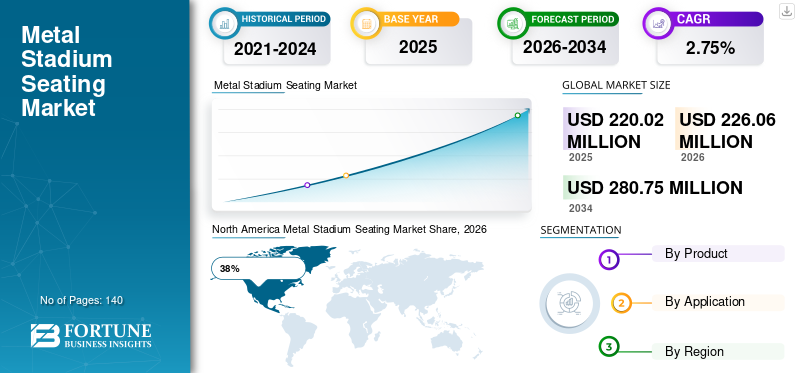
Fortune Business Insights says that the global market value stood at USD 220.02 million in 2025 and is projected to reach USD 280.75 million by 2034.
The market is expected to exhibit a CAGR of 2.75% during the forecast period of 2026-2034.
Bleachers and grandstands led the product segment with nearly 49% market share, while outdoor stadiums dominated the application segment with nearly 58% share.
Key players include Southern Bleacher, Inc., GT Grandstands, Sturdisteel, E&D Specialty Stands, Inc., DANT CLAYTON, and American Aluminum Seating, Inc.
Major trends include growing adoption of lightweight aluminum and modular seating systems, along with ergonomic comfort and recyclable-metal solutions. North America accounted for approximately 38% of the market.


- 2021-2034
- 2025
- 2021-2024
- 140
-

(Offer valid till 15th Oct 2026)
Get 30-60 hrs Free Customization
Expand Regional and Country Coverage, Segments Analysis, Company Profiles, Competitive Benchmarking, and End-user Insights.









-
US +1 833 909 2966 ( Toll Free )
-
Get In Touch With Us