Methyl Acetate Market Size, Share & Industry Analysis, By Grade (Industrial grade, Pharmaceutical grade, and Food grade), Purity (= 99% Purity, 90–99% Purity, and < 90% purity), Sales Channel (Direct and Indirect), End-use Industry and Regional Forecast, 2026-2034
 Download Free Sample
Methyl Acetate Market Overview
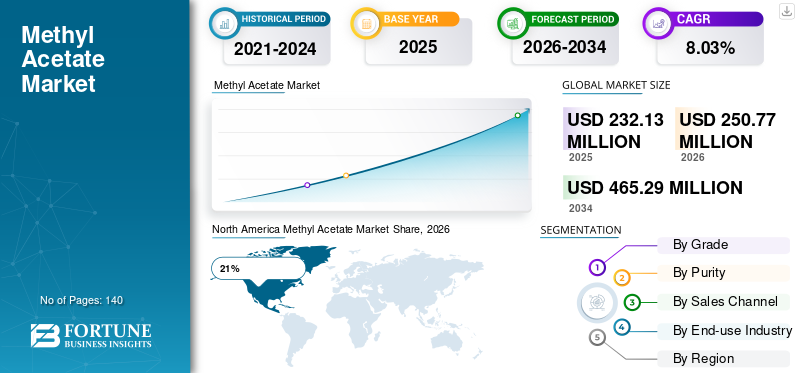
The methyl acetate market size was valued at USD 232.13 million in 2025. The market is projected to grow from USD 250.77 million in 2026 to USD 465.29 million by 2034, exhibiting a CAGR of 8.03% during the forecast period.

The methyl acetate market is witnessing strong demand across industrial manufacturing, coatings, adhesives, pharmaceuticals, packaging, and specialty chemical sectors. Methyl acetate is widely recognized as a fast-evaporating solvent with favorable solvency characteristics, making it suitable for low-VOC formulations and environmentally compliant production processes. Growing industrialization, increasing demand for high-performance coatings, and rising usage in chemical intermediates are supporting market expansion. Manufacturers are focusing on improving production efficiency and purity standards to meet evolving end-user requirements. The methyl acetate market report indicates increasing adoption in sustainable solvent applications, particularly where rapid drying and reduced residue formation are critical operational requirements.
The United States represents one of the most established regional markets for methyl acetate due to the presence of advanced chemical manufacturing infrastructure and strong demand from coatings, adhesives, and pharmaceutical industries. Industrial users increasingly prefer methyl acetate because it offers efficient solvent performance while helping manufacturers meet environmental compliance requirements. Demand remains particularly strong in automotive coatings, specialty packaging, printing inks, and industrial cleaning applications. The country also benefits from extensive research activities focused on developing next-generation solvent technologies. The USA methyl acetate market Analysis highlights growing consumption among manufacturers seeking alternatives to conventional solvents while maintaining production quality and operational efficiency.
Download Free sample to learn more about this report.
Methyl Acetate Market Key Takeaways
 Global Market Size & Forecast
- 2025 Market Size: USD 232.13 Million
- 2026 Market Size: USD 250.77 Million
- 2034 Forecast Market Size: USD 465.29 Million
- CAGR: 8.03% from 2026-2034
 Market Share
- The market in Asia-Pacific dominated with a revenue share of 45% in 2025.
- Industrial grade dominated by grade with a market share of approximately 62%.
- 90–99% purity dominated by purity with a market share of approximately 44%.
 Key Regional Highlights
Asia-Pacific
Asia-Pacific led the market with a 45% share, supported by expanding industrial manufacturing and growing demand for solvents.
Europe
Europe accounted for 24% of the market, driven by established chemical manufacturing and increasing demand from coatings and pharmaceutical industries.
North America
North America held a 21% share, supported by strong demand from automotive, construction, and specialty chemical applications.
U.S
The U.S. remains a key market, supported by established chemical manufacturing and demand for industrial and specialty solvents.
Japan
Japan accounted for approximately 16% of the Asia-Pacific market, supported by advanced manufacturing capabilities and demand for high-quality chemical products.
Read More

methyl acetate market Latest Trends
One of the most significant methyl acetate market trends is the growing shift toward environmentally responsible solvent solutions. Manufacturers in paints, coatings, adhesives, and packaging industries are increasingly replacing conventional solvents with methyl acetate due to its favorable environmental profile and effective performance characteristics. Rising sustainability initiatives across industrial sectors are encouraging adoption of low-emission solvent technologies.
Download Free sample to learn more about this report.
Another notable trend in the methyl acetate market is increasing demand for high-purity grades used in pharmaceutical production, electronics manufacturing, and specialty chemical applications. Market participants are investing in advanced purification systems and process optimization technologies to meet stringent quality requirements. Additionally, rising demand for flexible packaging, industrial coatings, and automotive refinishing products is creating new opportunities for methyl acetate suppliers. The market is also witnessing technological advancements in production methods designed to enhance yield efficiency, reduce waste generation, and support long-term sustainability objectives throughout the chemical value chain.
methyl acetate market Dynamics
DRIVER
Rising Demand for Paints, Coatings, and Adhesives
The primary growth driver of the methyl acetate market is increasing consumption within paints, coatings, and adhesive manufacturing industries. Rapid urbanization, infrastructure development projects, and expanding automotive production continue to create substantial demand for solvent-based formulations. Methyl acetate provides fast evaporation rates, excellent solvency performance, and compatibility with multiple resin systems, making it highly attractive for industrial formulators.
Construction activities across developed and developing economies are supporting demand for architectural coatings, industrial paints, and protective surface treatments. Automotive manufacturers rely on advanced coating technologies that require efficient solvents capable of delivering superior finish quality and reduced processing time. In the adhesives sector, methyl acetate contributes to faster curing and improved bonding performance. These advantages have strengthened its position within industrial production processes. The methyl acetate market Research Report identifies increasing investments in infrastructure, transportation, and manufacturing sectors as major contributors to rising solvent consumption across global markets.
RESTRAINT
Volatility in Raw Material Pricing
One of the key restraints affecting the methyl acetate market growth is the fluctuation of raw material prices, particularly methanol and acetic acid. Since these feedstocks play a critical role in methyl acetate production, pricing instability can directly impact manufacturing costs and profit margins. Producers often face challenges in maintaining competitive pricing structures when input costs experience sudden increases.
Global supply chain disruptions, energy price fluctuations, transportation expenses, and geopolitical uncertainties can further influence raw material availability. Small and medium-sized manufacturers may be particularly vulnerable to these cost pressures due to limited procurement flexibility. Additionally, contractual obligations with industrial buyers sometimes restrict the ability of producers to transfer increased costs to customers. As a result, manufacturers must focus on process efficiency, supply diversification, and strategic sourcing initiatives to maintain operational stability and market competitiveness despite ongoing raw material volatility.
OPPORTUNITY
Expansion of pharmaceutical and specialty chemical applications
The growing pharmaceutical and specialty chemical industries present significant opportunities for the methyl acetate market. High-purity methyl acetate is increasingly utilized as a solvent and processing aid in pharmaceutical manufacturing due to its favorable chemical characteristics and compatibility with sensitive formulations. Expanding healthcare infrastructure and increasing pharmaceutical production are generating new demand channels for specialty-grade products.
Specialty chemical manufacturers are also incorporating methyl acetate into advanced formulations used in electronics, personal care products, laboratory applications, and precision cleaning processes. As industries continue to prioritize quality, consistency, and regulatory compliance, suppliers capable of delivering premium-grade methyl acetate can strengthen their market position. Emerging applications in advanced materials manufacturing and specialty coatings further expand growth opportunities. The methyl acetate market outlook suggests that innovation-driven industries will remain important contributors to future demand development.
CHALLENGE
Stringent Regulatory and Safety Requirements
The methyl acetate market faces ongoing challenges associated with regulatory compliance and operational safety requirements. Although methyl acetate is widely accepted across industrial applications, manufacturers must comply with evolving environmental standards, workplace safety regulations, transportation guidelines, and chemical handling requirements. Compliance efforts often require substantial investments in monitoring systems, safety infrastructure, and employee training programs.
Manufacturers operating across multiple regions must navigate varying regulatory frameworks and product registration requirements. Failure to meet regulatory standards can result in operational disruptions, penalties, or market access limitations. Additionally, storage and transportation considerations remain important because methyl acetate is a highly flammable chemical compound. Companies must continually invest in risk management strategies, process optimization technologies, and compliance programs to ensure safe production and distribution while maintaining competitiveness within the global Methyl Acetate Industry Analysis landscape.
methyl acetate market Segmentation
By Grade
Industrial grade methyl acetate accounts for approximately 62% market share and represents the largest product segment within the methyl acetate market. This grade is extensively used in paints, coatings, adhesives, inks, cleaning products, and industrial processing applications. Manufacturers value industrial-grade material because it provides strong solvency performance at a cost-effective price point suitable for large-scale production environments. Demand remains particularly high among automotive coating manufacturers, construction material suppliers, and packaging producers. Industrial-grade methyl acetate supports efficient production cycles due to its rapid evaporation characteristics and compatibility with numerous industrial formulations. Market participants continue expanding manufacturing capacity to meet growing demand from infrastructure development, industrial manufacturing, and consumer goods production sectors. The methyl acetate market Size for industrial-grade products is expected to remain dominant as industrial users prioritize operational efficiency and formulation flexibility.
Pharmaceutical-grade methyl acetate holds nearly 24% market share and is gaining importance due to expanding pharmaceutical manufacturing activities worldwide. This segment requires stringent purity standards and quality control measures to ensure compliance with regulatory requirements. Pharmaceutical companies use methyl acetate in synthesis processes, formulation development, and specialized production applications. The increasing prevalence of chronic diseases and growing demand for advanced therapeutic products are encouraging pharmaceutical manufacturers to expand production capabilities. Consequently, suppliers of pharmaceutical-grade methyl acetate are investing in purification technologies, quality assurance systems, and regulatory certifications. The methyl acetate market Forecast indicates rising demand from contract manufacturing organizations and pharmaceutical research facilities seeking reliable high-purity solvent solutions. Enhanced traceability and quality management systems continue to strengthen growth prospects within this segment.
Food-grade methyl acetate represents approximately 14% market share and serves specialized applications within food processing and flavoring industries. The compound's distinctive characteristics make it suitable for select formulation and processing activities where regulatory compliance and product safety are essential considerations. Food manufacturers increasingly emphasize ingredient quality and production consistency, encouraging demand for certified food-grade solvent products. Suppliers operating within this segment must comply with strict food safety standards and quality verification procedures. Although comparatively smaller than industrial and pharmaceutical segments, food-grade methyl acetate continues to benefit from growing processed food production and evolving consumer preferences. The methyl acetate market opportunities within this segment are supported by increasing demand for specialty ingredients and advanced food manufacturing technologies.
To know how our report can help streamline your business, Speak to Analyst
By Purity, Sales Channel, and End-use Industry
The 99% purity segment accounts for around 41% market share and remains a preferred choice for pharmaceutical, electronics, and specialty chemical applications. End users require highly refined material to ensure product consistency, manufacturing reliability, and regulatory compliance. The segment benefits from rising demand for advanced formulations requiring superior solvent quality.
Manufacturers serving this category focus heavily on purification technology, analytical testing, and quality assurance procedures. Growth is particularly strong among electronics manufacturers and pharmaceutical companies where even minor impurities can affect production outcomes. The methyl acetate market Insights indicate that premium-grade products will continue gaining importance as industries pursue increasingly sophisticated manufacturing processes.
The 90–99% purity category holds approximately 44% market share and represents the largest purity segment. This range offers an effective balance between performance and affordability, making it suitable for coatings, adhesives, industrial cleaning, and packaging applications.
Industrial buyers frequently select this grade because it delivers dependable solvent performance while supporting cost-efficient operations. Expanding construction activity, automotive manufacturing, and flexible packaging production are major demand contributors. Suppliers continue developing customized product offerings tailored to specific industrial requirements, strengthening the segment's competitive position within the broader methyl acetate market Analysis.
The below 90% purity segment accounts for nearly 15% market share and primarily serves non-critical industrial applications where ultra-high purity is not required. Bulk manufacturing operations and large-scale industrial processing facilities often utilize this category due to its economic advantages.
Demand remains concentrated in general-purpose cleaning, degreasing, and industrial solvent applications. Although this segment faces competitive pressure from higher-purity alternatives, it continues to maintain relevance among cost-sensitive industries. Growth opportunities exist in emerging industrial markets where affordability remains a key purchasing factor.
methyl acetate market Regional Outlook
North America
North America Methyl Acetate Market Share, 2025 (%)
To get more information on the regional analysis of this market, Download Free sample
North America accounts for approximately 21% of the global methyl acetate market Share. The region benefits from a well-developed chemical manufacturing sector, advanced industrial infrastructure, and strong demand from coatings, adhesives, pharmaceuticals, and packaging industries. Environmental regulations encouraging the use of low-emission solvent technologies have further strengthened market adoption.
Industrial modernization initiatives and growing investment in specialty chemical manufacturing continue supporting regional demand. The United States remains the largest contributor due to extensive industrial activity and strong research capabilities. Regional manufacturers focus on product innovation, sustainable production methods, and supply chain resilience to maintain competitiveness. The Methyl Acetate Industry Report highlights stable demand from automotive, healthcare, and construction sectors as key drivers of long-term market development.
Europe
Europe holds around 24% market share within the global methyl acetate market. Demand is supported by advanced automotive manufacturing, construction activity, industrial coatings production, and specialty chemical industries. Strict environmental regulations have encouraged manufacturers to adopt solvent technologies aligned with sustainability objectives.
Countries across the region continue investing in industrial modernization and environmentally responsible manufacturing practices. The market also benefits from robust pharmaceutical production and increasing demand for specialty chemicals. Producers are prioritizing operational efficiency and compliance with evolving regulatory standards. The methyl acetate market Research Report identifies strong innovation capabilities and advanced manufacturing infrastructure as major strengths supporting European market performance.
Germany Methyl Acetate Market
Germany accounts for approximately 29% of the European market and serves as a major manufacturing hub for chemicals, automotive products, industrial coatings, and specialty materials. Demand for methyl acetate remains strong due to extensive industrial production activities and increasing focus on environmentally responsible solvent solutions. German manufacturers emphasize quality, technological advancement, and operational efficiency.
The country's advanced automotive industry creates significant demand for coatings, adhesives, and specialty formulations utilizing methyl acetate. Pharmaceutical production and industrial chemical processing also contribute substantially to consumption. Companies continue investing in research initiatives aimed at improving solvent performance and sustainability. The Germany methyl acetate market Analysis indicates consistent demand across industrial applications supported by the country's strong manufacturing base and export-oriented economy.
United Kingdom Methyl Acetate Market
The United Kingdom represents approximately 18% of the European methyl acetate market. Demand is primarily driven by pharmaceuticals, packaging, coatings, specialty chemicals, and industrial manufacturing sectors. The country's emphasis on advanced manufacturing technologies and sustainable industrial practices supports ongoing market development.
Manufacturers increasingly adopt methyl acetate in applications requiring efficient solvent performance and compliance with environmental standards. Pharmaceutical production remains an important demand contributor, supported by extensive research and development activities. Packaging and printing industries also generate steady consumption due to growing demand for high-performance inks and adhesives. The United Kingdom methyl acetate market outlook remains favorable as industries continue seeking solvent solutions that balance performance, quality, and regulatory compliance.
Asia-Pacific
Asia-Pacific dominates the methyl acetate market with approximately 45% market share. Rapid industrialization, expanding construction activities, increasing automotive production, and strong chemical manufacturing capabilities contribute to the region's leadership position. Major economies continue investing heavily in infrastructure development and industrial expansion.
Growing demand for paints, coatings, adhesives, packaging materials, and consumer products is supporting widespread methyl acetate consumption. Regional manufacturers benefit from extensive production capacity and favorable manufacturing economics. The methyl acetate market trends indicate strong growth potential throughout Asia-Pacific as industrial output and urbanization continue expanding across multiple countries.
Japan Methyl Acetate Market
Japan contributes approximately 16% of the Asia-Pacific methyl acetate market. The country's sophisticated manufacturing sector, advanced electronics industry, and high-quality pharmaceutical production create strong demand for premium solvent products. Japanese manufacturers prioritize precision, consistency, and technological innovation.
Demand is particularly significant within electronics manufacturing, specialty coatings, industrial cleaning, and pharmaceutical applications. Companies continue investing in advanced production technologies designed to improve efficiency and reduce environmental impact. The Japan methyl acetate market Research Report highlights increasing use of high-purity solvent grades across technology-intensive industries requiring stringent quality standards and reliable process performance.
China Methyl Acetate Market
China accounts for approximately 47% of the Asia-Pacific methyl acetate market and represents the largest regional consumer and producer. Rapid industrial expansion, large-scale manufacturing operations, and strong demand from construction, automotive, packaging, and chemical industries drive substantial market activity.
Domestic producers continue expanding production capacity to meet growing demand for environmentally compliant solvent products. Infrastructure projects, export-oriented manufacturing, and increasing consumer goods production support ongoing consumption growth. The China methyl acetate market Size remains significant due to the country's extensive industrial base and strategic position within global chemical supply chains.
Rest of World
The Rest of World region accounts for approximately 10% market share. Demand originates from developing industrial sectors across Latin America, the Middle East, and Africa. Increasing investment in manufacturing, construction, packaging, and chemical processing facilities is gradually strengthening regional consumption levels.
Governments across several emerging economies are encouraging industrial diversification and infrastructure development, creating favorable conditions for methyl acetate adoption. Growth opportunities are particularly evident in coatings, adhesives, and specialty chemical applications. The methyl acetate market opportunities within these regions are supported by expanding industrial activity and rising demand for modern manufacturing inputs.
List of Top Methyl Acetate Companies
- BASF (Germany)
- Thermo Fisher Scientific Inc. (US)
- Merck KGaA (Germany)
- Celanese Corporation (US)
- Eastman Chemical Company (US)
Top Two Companies by Market Share
- Celanese Corporation – 18%
- Eastman Chemical Company – 15%
Investment Analysis and Opportunities
Investment activity within the methyl acetate market continues to increase as manufacturers seek to expand production capacity, improve product quality, and enhance supply chain efficiency. Companies are allocating resources toward advanced purification systems, process optimization technologies, and sustainable manufacturing practices. Growing demand from coatings, pharmaceutical, packaging, and specialty chemical industries supports long-term investment attractiveness.
Emerging economies present significant opportunities for capacity expansion due to rising industrialization and infrastructure development. Investors are also focusing on specialty-grade methyl acetate production, particularly for pharmaceutical and electronics applications where quality requirements are more stringent. Strategic partnerships, technology licensing agreements, and production facility upgrades are becoming increasingly common. The methyl acetate market outlook suggests strong investment potential in environmentally compliant solvent technologies and high-purity product segments serving advanced manufacturing industries.
New Product Development
Innovation remains a major focus area within the methyl acetate market as manufacturers pursue higher performance, improved sustainability, and enhanced application versatility. Companies are developing advanced solvent formulations designed to support low-emission coatings, specialty adhesives, and precision cleaning applications. Research efforts emphasize purity enhancement, production efficiency, and environmental performance improvements.
Several producers are introducing customized grades tailored for pharmaceutical manufacturing, electronics production, and specialty chemical synthesis. Advanced purification technologies are enabling suppliers to achieve tighter quality specifications and greater consistency across production batches. Manufacturers are also exploring bio-based production pathways and energy-efficient processing techniques to support sustainability objectives. These innovations are strengthening competitiveness while expanding the range of industrial applications served by methyl acetate products.
Five Recent Developments (2023–2025)
- Celanese Corporation expanded solvent production capabilities to support increasing industrial demand.
- Eastman Chemical Company enhanced specialty solvent offerings for coatings and adhesive applications.
- BASF increased investment in sustainable chemical manufacturing technologies.
- Merck KGaA expanded high-purity solvent solutions targeting pharmaceutical and laboratory markets.
- Thermo Fisher Scientific strengthened specialty chemical distribution networks supporting research and industrial customers.
Report Coverage of methyl acetate market
The methyl acetate market Report provides detailed analysis of industry structure, market dynamics, competitive landscape, product segmentation, regional performance, and emerging growth opportunities. The report evaluates demand trends across coatings, adhesives, pharmaceuticals, packaging, specialty chemicals, and industrial manufacturing sectors.
Request for Customization to gain extensive market insights.
Coverage includes analysis of market drivers, restraints, opportunities, and challenges influencing industry development. The report also examines purity segments, grade classifications, end-use industries, and regional demand patterns. Company profiles, strategic developments, investment activities, and innovation trends are assessed to provide a comprehensive understanding of market conditions. The methyl acetate market Forecast section highlights evolving industry requirements, technological advancements, and growth opportunities across developed and emerging economies.
Frequently Asked Questions
Fortune Business Insights says that the global market value stood at USD 232.13 million in 2025 and is projected to reach USD 465.29 million by 2034.
The market is expected to exhibit a CAGR of 8.03% during the forecast period of 2026-2034.
Industrial grade led the grade segment with approximately 62% market share, supported by its extensive use in paints, coatings, adhesives, inks, and industrial processing.
Key players include BASF, Thermo Fisher Scientific Inc., Merck KGaA, Celanese Corporation, and Eastman Chemical Company.
Major trends include the shift toward environmentally responsible, low-emission solvents and rising demand for high-purity methyl acetate. Asia-Pacific led with approximately 45% market share.



- 2021-2034
- 2025
- 2021-2024
- 140
-

(Offer valid till 15th Oct 2026)
Get 30-60 hrs Free Customization
Expand Regional and Country Coverage, Segments Analysis, Company Profiles, Competitive Benchmarking, and End-user Insights.


-
US +1 833 909 2966 ( Toll Free )
-
Get In Touch With Us