Micropump Market Size, Share & Industry Analysis, By Product Type (Mechanical Micropumps and Non-Mechanical Micropumps), By Application (Drug Delivery, Dialysis & Renal Care Devices, Diagnostics & Analytical Devices, and Others), By End User (Hospitals & Specialty Clinics, Biotechnology & Pharmaceutical Companies, and Others), and Regional Forecast, 2026-2034
 Download Free Sample
Micropump Market Analysis, 2026-2034
 Listen to Audio Version
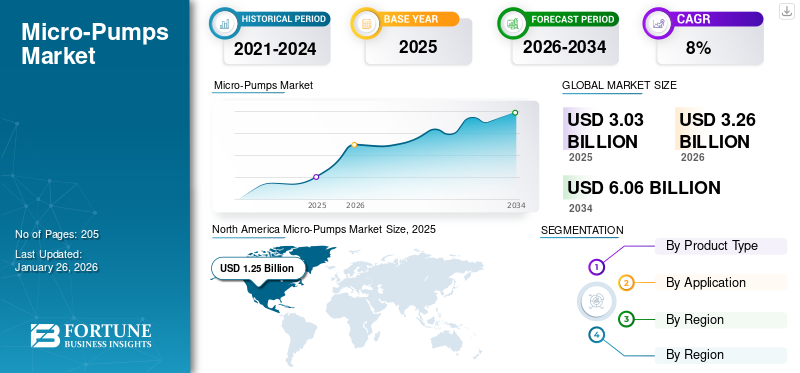
The global micropump market size was valued at USD 3.03 billion in 2025 and is projected to grow from USD 3.26 billion in 2026 to USD 6.06 billion by 2034, exhibiting a CAGR of 8% during the forecast period. North America dominated the micropump market with a market share of 33.57% in 2025. The industry growth is driven by precision drug delivery, miniaturized medical devices, microfluidics innovation, point-of-care diagnostics, biotechnology expansion, and advanced healthcare technologies.
Micropumps are small, package-sized fluid management devices that are capable of precisely controlling and conveying very low volumes of liquids or gases, usually within the microliter to milliliter range. These pumps are extensively used in drug delivery, devices used in dialysis and renal care, diagnostic instruments, and analytical instruments. Micropumps enable high dosing accuracy, compatibility with miniaturization, smaller reagent consumption, as well as integration across wearable and portable medical technologies. The market’s growth is attributed to increasing demand for point-of-care diagnostics, a rising shift in preference for wearable devices, and growing investments in pharmaceutical and biotechnology research.
The market is highly competitive, with major players such as KNF Neuberger GmbH, TTP Ventus Ltd., Bartels Mikrotechnik GmbH, and Xavitech AB holding considerable market share. Broad product portfolios, strong partnerships, and continuous investment in innovation have enabled these companies to maintain their dominance in the global market.
The global micropump market is transitioning from a niche microfluidics component segment into an essential enabling technology supporting next-generation medical devices, biotechnology platforms, laboratory automation, and precision fluid management systems. Demand is increasingly driven by the healthcare industry's shift toward miniaturized, portable, and patient-centric technologies that require highly accurate fluid delivery under tightly controlled operating conditions. As manufacturers prioritize device miniaturization without compromising performance, micropumps are becoming integral components across numerous diagnostic, therapeutic, and analytical applications.
Medical technology remains the primary contributor to the micropump market size. Drug delivery systems, insulin pumps, wearable infusion devices, dialysis equipment, and implantable medical technologies increasingly depend on compact pumping mechanisms capable of delivering precise fluid volumes while maintaining long-term operational reliability. Continuous innovation in chronic disease management and personalized medicine further reinforces demand for advanced micropump technologies with improved dosing accuracy and energy efficiency.
Technological advancement continues reshaping the competitive landscape. Manufacturers are investing in piezoelectric actuation, electroosmotic pumping, microelectromechanical systems (MEMS), and low-power microfluidic architectures to improve flow precision, reduce device footprints, and enhance system integration. Simultaneously, biotechnology companies are incorporating micropumps into laboratory automation, organ-on-chip platforms, molecular diagnostics, and life science research equipment requiring highly controlled microfluidic environments.
Download Free sample to learn more about this report.
Micropump Market Key Takeaways
 Market Size & Forecast
- 2025 Market Size: USD 3.03 billion
- 2026 Market Size: USD 3.26 billion
- 2034 Forecast Market Size: USD 6.06 billion
- CAGR: 8% from 2026–2034
 Market Share
- North America dominated the micropump market with a 33.57% share in 2025.
- Mechanical segment led the market with a 70.64% share in 2026 due to high precision and reliability in healthcare applications.
- Drug delivery segment held a 66.58% share in 2026, driven by rising demand for chronic disease management therapies.
 Key Regional Highlights
North American
North America led the market with USD 1.35 billion in 2026, supported by strong adoption of advanced drug delivery systems and product approvals.
Europe
Europe reached USD 0.84 billion in 2025, driven by strong healthcare infrastructure and increasing adoption of wearable drug delivery systems.
Asia Pacific
Asia Pacific is a high-growth region, supported by expanding healthcare infrastructure and rapid adoption of connected medical devices.
U.S.
Market estimated at USD 1.21 billion in 2026, driven by strong insulin pump adoption and advanced biotech innovations.
Japan
Market estimated at USD 0.14 billion in 2026, supported by aging population needs and advanced healthcare technology adoption.
Read More

Key Market Dynamics
Market Trends
Shift toward Adoption of Smart, Miniaturized, and Integrated Pumps is a Key Market Trend
One of the most notable trends in the global micropump market is the preference for the adoption of fully integrated smart pumping systems. Instead of distributing only pumps alone, manufacturers are delivering pre-engineered subsystems that include the pump, sensors, control electronics, and ready-to-use software interfaces. This approach shortens integration timelines for OEMs, cuts development expenses, and enhances reliability by validating system-level performance before deployment. In healthcare, the shift is especially evident with the rise of wearable and smart drug delivery pumps and point-of-care diagnostics, both of which demand compact, energy-efficient, and intelligent pumps capable of precise dosing and fluid management in real-world applications.
- In August 2023, CEME Group and Micropump announced a partnership agreement to offer an integrated and advanced fluid control system, which can be utilized in a wide range of industrial as well as healthcare applications.
The micropump market is increasingly shaped by the convergence of microfluidics, miniaturized electronics, and precision healthcare technologies. Medical device manufacturers are transitioning toward compact, wearable, and implantable systems that require highly accurate fluid control while minimizing power consumption and device footprint. This trend is accelerating the integration of micropumps into next-generation drug delivery systems, continuous monitoring devices, and portable diagnostic equipment.
Microelectromechanical systems (MEMS)-based micropumps continue gaining commercial traction because they offer improved reliability, lower energy requirements, and enhanced flow precision. Advances in piezoelectric actuation, electroosmotic pumping, and valve-less pump architectures are enabling manufacturers to develop quieter, smaller, and more efficient fluid management systems suitable for highly sensitive medical and laboratory applications.
Another notable trend is the expansion of point-of-care diagnostics and lab-on-a-chip platforms. Healthcare providers increasingly require decentralized diagnostic technologies capable of delivering rapid analytical results with minimal sample volumes. Micropumps play a critical role in maintaining precise reagent transport and controlled fluid movement within these integrated microfluidic platforms.
Download Free sample to learn more about this report.
Market Drivers
Growth Miniaturization of Life-Science Instruments and Point-of-Care Expansion to Propel Market Growth
The growing move toward compact, portable, and automated life-science systems is a major driver for the use of micropumps. Handheld drug-delivery units, benchtop analyzers, wearable diagnostics, and microfluidic pump systems rely on highly precise, low-flow pumping with minimal pulsation and strong chemical compatibility. Moreover, as manufacturers redesign equipment for home use and decentralized care, micropumps make it possible to achieve accurate dosing, conserve reagents, and maintain consistent flow at microliter to milliliter levels.
- In October 2020, TTP Ventus and Sensirion AG entered into a strategic collaboration for the development of a cutting-edge microfluidic driver. The companies are developing this new technology for applications in laboratory and analytical testing.
The micropump market is primarily driven by the rapid adoption of precision drug delivery technologies across modern healthcare systems. Pharmaceutical manufacturers and medical device companies increasingly require highly accurate microfluidic control to support wearable infusion pumps, insulin delivery devices, implantable therapies, and controlled-release treatment platforms. Micropumps enable precise dosing while reducing device size, making them essential components within next-generation patient-centric healthcare solutions.
The expansion of microelectromechanical systems (MEMS) and microfluidic technologies is further accelerating market growth. These technologies enable compact, energy-efficient fluid handling systems with exceptional flow accuracy, supporting continuous innovation in diagnostic equipment, laboratory automation, and life science instrumentation. As point-of-care diagnostics become more widely adopted, demand for reliable miniature pumping solutions continues increasing across decentralized healthcare environments.
Biotechnology and pharmaceutical research also represent significant demand drivers. Drug discovery, genomics, cell analysis, and laboratory automation increasingly depend on precise fluid manipulation to improve analytical consistency and experimental reproducibility. Micropumps play a critical role in maintaining controlled microfluidic environments for these advanced research applications.
Market Restraints
Cost and Integration Complexity to Deter Market Growth
The cost of the product coupled with its integration complexity is prominently expected to hamper the micropump market growth. Despite technical advantages, the total cost of ownership and integration effort can slow adoption, especially for price-sensitive, high-volume devices. In addition, ensuring long life under aggressive solvents, biofouling, and sterilization cycles adds design complexity.
- In March 2024, InfuTronix recalled its estimated 52,000 infusion pumps from the market due to micro pump malfunction. Moreover, the device also faced irregular flow rates along with leakages.
In order to deal with such a situation, it has become critical to integrate advanced micro pump technology in medical devices, which further leads to an increase in overall cost.
Despite favorable long-term demand fundamentals, the micropumps market faces several structural challenges that constrain broader commercial adoption. High product development and manufacturing costs remain among the most significant barriers. Precision fabrication processes, microelectromechanical systems manufacturing, advanced materials, and stringent quality assurance requirements increase production expenses compared with conventional pumping technologies. These costs can limit adoption in price-sensitive healthcare markets and emerging economies.
Regulatory complexity presents another important constraint. Micropumps incorporated into drug delivery systems, implantable medical devices, and diagnostic instruments must satisfy rigorous safety, reliability, and performance standards before commercialization. Lengthy clinical validation, regulatory approvals, and product certification processes extend development timelines while increasing research and compliance expenditures for manufacturers.
Technical integration challenges also influence market adoption. Micropumps must consistently maintain precise flow rates, low power consumption, chemical compatibility, and long operational lifecycles while operating within compact device architectures. Achieving these performance requirements under varying environmental and operating conditions requires sophisticated engineering and extensive product testing.
Market Opportunities
Rising Adoption of Wearables and Connected Drug Delivery Devices Offers Lucrative Opportunity
Increasing adoption of wearable and connected devices worldwide is estimated to offer a substantial opportunity for market growth. These solutions require highly precise miniature pumps that can deliver accurate doses of medication safely in home or outpatient settings. Moreover, these pumps are well-suited for this role due to their compact design, precision, and adaptability. At the same time, diagnostic tools and biotech laboratories are increasingly adopting single-use fluid pathways to minimize contamination and accelerate testing, further boosting the need for micro pump modules.
The micropumps market presents substantial opportunities as healthcare systems increasingly prioritize precision medicine, decentralized diagnostics, and minimally invasive treatment technologies. Growing demand for wearable therapeutic devices, implantable drug delivery systems, and home healthcare solutions is creating new application areas requiring compact, energy-efficient, and highly reliable fluid management technologies. Manufacturers capable of delivering accurate dosing performance while reducing device size are well positioned to capture expanding commercial demand.
Biotechnology represents another attractive growth opportunity. Increasing investment in genomics, cell therapy, biologics manufacturing, and laboratory automation is expanding demand for advanced microfluidic platforms requiring precise fluid handling. Micropumps are becoming critical components within organ-on-chip technologies, high-throughput screening systems, and molecular diagnostic instruments, supporting broader adoption across pharmaceutical research and life science laboratories.
The expansion of personalized medicine further strengthens long-term market potential. Advanced therapeutic approaches require individualized drug administration, continuous monitoring, and programmable infusion technologies that depend on highly accurate micropump systems. This trend is expected to encourage greater collaboration between medical device manufacturers, biotechnology companies, and pharmaceutical developers.
MARKET CHALLENGES
Stringent Government Regulations to Offer Substantial Challenge for the Market
One of the biggest challenges for the micropumps market is the strict regulatory requirements for medical devices. Micropumps are often part of drug delivery systems or diagnostic equipment, making it mandatory to meet tough standards for safety, quality, and reliability. This extra testing for biocompatibility, sterilization, and electronic safety makes the development process longer and more expensive for manufacturers. Smaller companies, in particular, face difficulties because of the high cost and time needed to meet these requirements.
Segmentation Analysis
By Product Type
Superior Accuracy and Durability of Mechanical Pumps Positively Impact Segment Growth
On the basis of product type, the market is divided into mechanical and non-mechanical pumps.
To know how our report can help streamline your business, Speak to Analyst
Mechanical Micropumps
The mechanical segment accounted for the highest micropumps market share in 2026, representing 70.64% of the total market share, supported by its strong presence in healthcare and reputation for accuracy, durability, and versatility. Moreover, their proven capability to manage diverse fluids, from viscous medications to biological solutions, makes them the preferred option for device manufacturers. Further, their widespread applications in insulin pumps, dialysis systems, and laboratory analyzers fuel their adoption across hospitals and clinics.
Mechanical micropumps account for the largest micropumps market share because of their proven reliability, precise flow control, and broad commercial adoption across medical devices, biotechnology instruments, and laboratory automation systems. Their ability to deliver controlled fluid volumes under varying operating conditions makes them suitable for applications requiring continuous dosing accuracy and dependable long-term performance. Established manufacturing processes and extensive clinical validation further reinforce their dominant position within regulated healthcare environments.
Healthcare remains the largest consumer of mechanical micropumps. Drug infusion systems, insulin pumps, dialysis equipment, implantable medical devices, and portable infusion technologies increasingly depend on mechanically actuated pumping mechanisms capable of maintaining stable flow rates while operating under compact form factors. Continuous expansion of wearable healthcare devices further strengthens demand for reliable miniature pumping technologies.
- For instance, in December 2022, Micropump, Inc. announced a strategic collaboration with Kelair Pumps Australia Pty Ltd. to consolidate their distribution channel in Australia.
Non-Mechanical Micropumps
Non-mechanical micropumps are expected to register the fastest micropumps market growth due to their simplified architecture, absence of moving mechanical components, and exceptional suitability for advanced microfluidic systems. Technologies including electroosmotic, electrowetting, electrohydrodynamic, magnetohydrodynamic, and acoustic pumping enable precise fluid manipulation while reducing mechanical wear and maintenance requirements.
Research institutions and biotechnology companies increasingly adopt non-mechanical micropumps within lab-on-chip platforms, DNA sequencing, molecular diagnostics, organ-on-chip systems, and biomedical research where ultra-small fluid volumes require exceptional control. Their compatibility with semiconductor fabrication processes also supports integration into highly miniaturized analytical devices.
By Application
Increasing Adoption of Drug Delivery Devices Boost Segment’s Growth
Based on application, the market is segmented into drug delivery, dialysis & renal care devices, diagnostics & analytical devices, and others.
Drug Delivery
The drug delivery segment captured the largest share of the market in 2025. In 2026, the segment is anticipated to dominate with a 66.58% share. The growth of the drug delivery segment is attributed to an increasing prevalence of chronic conditions such as diabetes, cancer, and autoimmune diseases. Wearable insulin pumps, patch injectors for biologics, and implantable delivery systems majorly depend on micropumps to provide highly accurate, repeatable dosing with minimal error. Further, rising demand for self-administered treatments and the transition from hospital-centered care to home-based therapy further strengthen the segment’s growth.
- According to the Association of Diabetes Care & Education Specialists, an estimated 0.35 to 0.51 million people in the U.S. use insulin pumps for drug delivery.
Drug delivery represents the largest application segment within the micropumps market, supported by the rapid expansion of precision therapeutics, wearable healthcare devices, and minimally invasive treatment technologies. Modern drug administration increasingly requires highly accurate microfluidic control to deliver consistent medication volumes while improving patient compliance and therapeutic effectiveness. Micropumps have therefore become essential components within infusion systems, insulin pumps, pain management devices, chemotherapy delivery platforms, and implantable therapeutic systems.
Growing prevalence of diabetes, cardiovascular diseases, neurological disorders, and cancer is expected to sustain long-term demand. As personalized medicine and home-based healthcare continue expanding globally, drug delivery will remain the dominant contributor to micropumps market growth.
Dialysis & Renal Care Devices
Dialysis and renal care devices represent a significant application segment because treatment systems require highly reliable fluid circulation and precise flow regulation throughout extended operating periods. Micropumps play a critical role in maintaining controlled movement of blood, dialysate, and therapeutic fluids while ensuring consistent treatment performance.
Increasing incidence of chronic kidney disease continues supporting investment in advanced dialysis technologies. Healthcare providers are gradually expanding home dialysis programs that depend on compact, portable equipment incorporating miniature pumping systems capable of delivering dependable long-term performance.
Diagnostics & Analytical Devices
The diagnostics & analytical devices segment is expected to grow at a CAGR of 9.5% over the forecast period. Diagnostics and analytical devices continue driving significant micropump adoption as laboratory systems become increasingly automated and miniaturized. Clinical analyzers, molecular diagnostic platforms, immunoassay systems, DNA sequencing equipment, and point-of-care testing devices require highly accurate fluid transport to ensure analytical precision and repeatable test results.
Growing demand for rapid diagnostics and decentralized testing is encouraging manufacturers to integrate compact microfluidic architectures into laboratory instruments. Micropumps enable precise reagent dispensing, sample preparation, and controlled fluid sequencing while reducing reagent consumption and improving workflow efficiency.
By End User
Hospitals & Specialty Clinics are Leading End Users as they are Primary Customers for Micropump-Enabled Medical Devices.
Based on end user, the market is segmented into hospitals & specialty clinics, biotechnology & pharmaceutical companies, and others.
Hospitals & Specialty Clinics
The hospitals & specialty clinics segment dominated the global micropumps market with a market share of 56.38% in 2026, due to a substantial installed base of dialysis machines, infusion pumps, and analytical instruments in these facilities. With the rising number of patients undergoing chronic therapies such as insulin delivery and renal care, hospitals remain the most important customers for micro pump-enabled medical devices. The ability to provide advanced monitoring, routine maintenance, and integrated services within these settings consolidates their market share. For 2026, the segment is set to hold 56.38% market share.
Hospitals and specialty clinics account for the largest micropumps market share because they represent the primary deployment environment for infusion systems, dialysis equipment, implantable therapeutic devices, and advanced diagnostic platforms. Healthcare providers prioritize highly reliable micropump technologies capable of supporting continuous patient care while complying with stringent safety and performance standards.
Growing investment in minimally invasive treatments, precision medicine, and digital healthcare continues encouraging healthcare institutions to adopt increasingly sophisticated medical devices incorporating miniature pumping systems. Expansion of outpatient treatment centers and ambulatory care facilities further supports demand for portable and wearable therapeutic technologies.
Biotechnology & Pharmaceutical Companies
Biotechnology & pharmaceutical companies are projected to grow at a CAGR of 8.3% during the study period. Biotechnology and pharmaceutical companies represent one of the fastest-growing end-user segments within the micropumps market. Drug discovery, biologics manufacturing, laboratory automation, and precision analytical research increasingly require highly controlled microfluidic environments supported by advanced pumping technologies.
Micropumps contribute to high-throughput screening, cell culture systems, molecular diagnostics, organ-on-chip platforms, and pharmaceutical manufacturing processes where accurate fluid handling directly affects research quality and production consistency. Investment in precision medicine, gene therapy, and biologics continues expanding application opportunities.
Regional Insights
By geography, the market is categorized into Europe, North America, Asia Pacific, Latin America, and the Middle East & Africa.
North America Micro-Pumps Market Size, 2025 (USD Billion)
To get more information on the regional analysis of this market, Download Free sample
North America Micropumps Market Analysis:
North America held the leading share of the market, valued at USD 1.25 billion in 2025, and continued its dominance in 2026, reaching USD 1.35 billion. The factors fostering the dominance of the region include considerable adoption of drug delivery devices, technological advancements, and product approvals. In 2026, the U.S. market is estimated to reach USD 1.21 billion.
- For instance, in November 2023, PSG Biotech announced the launch of Quattroflow QB2-SD, a single-use micropump.
North America represents the largest micropumps market, supported by advanced healthcare infrastructure, strong medical device manufacturing capabilities, and sustained investment in biotechnology innovation. Demand is reinforced by widespread adoption of precision drug delivery systems, laboratory automation, and point-of-care diagnostics. Established regulatory frameworks, robust research funding, and continued commercialization of wearable medical technologies strengthen long-term micropumps market growth across the region.
United States Micropumps Market:
The United States dominates the regional micropumps market through its concentration of medical device manufacturers, biotechnology companies, and pharmaceutical innovators. Growing investment in precision medicine, minimally invasive therapies, and advanced diagnostic platforms continues accelerating micropump adoption. Strong research collaboration between healthcare providers, academic institutions, and life science companies supports technological advancement and sustained commercialization across diverse healthcare applications.
Europe Micropumps Market Analysis:
Europe is projected to witness notable growth with a growth rate of 7.3%, and touch a valuation of USD 0.84 billion in 2025. This is primarily due to the extensive healthcare infrastructure and the growing adoption of wearable and connected drug delivery devices. Backed by these factors.
Europe maintains a significant micropumps market share owing to its established medical technology sector, advanced healthcare systems, and strong focus on biomedical research. Demand is supported by increasing adoption of microfluidic technologies, laboratory automation, and portable healthcare devices. Continued investment in precision manufacturing, regulatory compliance, and healthcare innovation reinforces Europe's competitive position within the global industry.
Germany Micropumps Market:
The Germany market is projected to reach USD 0.21 billion by 2026. Germany represents one of Europe's leading micropumps markets because of its globally recognized medical device industry, precision engineering expertise, and advanced manufacturing capabilities. Pharmaceutical innovation, laboratory automation, and increasing deployment of wearable healthcare technologies continue supporting demand. Strong collaboration among research institutes, industrial manufacturers, and healthcare organizations accelerates product development while strengthening domestic production capabilities.
United Kingdom Micropumps Market:
The UK market is projected to reach USD 0.12 billion by 2026. The United Kingdom continues expanding its market through increasing investment in biotechnology, precision diagnostics, and life science research. Growing adoption of laboratory automation, personalized medicine, and microfluidic diagnostic technologies supports sustained demand. Strong academic research capabilities, healthcare innovation initiatives, and expanding biotechnology commercialization continue reinforcing long-term market development across the country.
Asia-Pacific Micropumps Market Analysis:
Asia Pacific is expected to exhibit the fastest CAGR during the forecast period. The market in Asia Pacific is estimated to reach USD 0.65 billion in 2025. In the region, the Japan market is projected to reach USD 0.14 billion by 2026, the China market is projected to reach USD 0.28 billion by 2026, and the India market is projected to reach USD 0.1 billion by 2026.
Asia-Pacific is expected to register the fastest market growth due to expanding healthcare expenditure, increasing medical device production, and rapidly growing biotechnology industries. Governments continue supporting domestic healthcare manufacturing and biomedical research through favorable investment policies. Rising demand for portable medical technologies, improved diagnostic infrastructure, and pharmaceutical manufacturing expansion further strengthen regional market opportunities.
Japan Micropumps Market:
Japan remains a technologically advanced micropumps market supported by strong expertise in precision engineering, medical electronics, and microelectromechanical systems manufacturing. Healthcare providers increasingly adopt compact diagnostic equipment, infusion technologies, and laboratory automation systems requiring miniature fluid management solutions. Continued innovation in medical robotics, biotechnology, and precision healthcare strengthens long-term demand for advanced micropump technologies.
China Micropumps Market:
China is rapidly expanding its micropumps market through substantial investment in domestic medical device manufacturing, biotechnology research, and pharmaceutical production. Government initiatives supporting healthcare modernization and advanced manufacturing continue encouraging local innovation. Growing demand for precision drug delivery systems, laboratory instrumentation, and diagnostic equipment is strengthening China's position within the global supply chain.
Latin America Micropumps Market Analysis:
Latin America and the Middle East & Africa are anticipated to record moderate growth. In 2025, Latin America will seize USD 0.14 billion due to the region’s developing healthcare infrastructure and rising demand for drug delivery devices. In the Middle East & Africa, the GCC is set to capture USD 0.07 billion in 2025.
Latin America is gradually strengthening its micropumps market as healthcare infrastructure improves and investment in medical technology increases. Demand is supported by expanding pharmaceutical manufacturing, greater access to diagnostic services, and increasing adoption of portable healthcare devices. Although market penetration remains comparatively moderate, continued healthcare modernization and biotechnology investment are expected to support sustainable long-term growth.
Middle East & Africa Micropumps Market Analysis (60 Words)
The Middle East and Africa micropumps market is developing steadily through increasing healthcare investment, expanding diagnostic capabilities, and gradual adoption of advanced medical technologies. Governments continue strengthening healthcare infrastructure while encouraging biotechnology research and medical device procurement. Continued modernization of healthcare systems and improving access to precision medical technologies are expected to support future market expansion.
Micropumps Industry Competitive Landscape
Innovation, R&D, and Partnerships are Underpinning the Dominance of Leading Firms
The global market is characterized by large companies with global presence and small and mid-size firms with a strong presence. R&D, innovation in micropumps, and partnering with domestic organizations to expand regional presence are strategies opted by market participants for their development. Medtronic plc, Insulet Corporation, Tandem Diabetes Care, Debiotech SA, and Sensile Medical are a few big names recognized for their innovation in the market.
Apart from these, TTP Ventus, Bartels Mikrotechnik GmbH, Dolomite Microfluidics, and Xavitech AB are also striving to cement their position via the introduction of novel devices, early approvals from regulatory bodies, and other strategic initiatives.
The micropumps market remains moderately consolidated, with competition led by specialized microfluidics manufacturers, medical device component suppliers, precision engineering companies, and microelectromechanical systems (MEMS) technology developers. Competitive positioning is increasingly determined by engineering precision, regulatory expertise, application-specific customization, and manufacturing scalability rather than production volume alone. As demand shifts toward highly integrated medical and analytical systems, suppliers capable of delivering reliable, miniaturized fluid management solutions continue strengthening their market position.
Technical complexity and regulatory validation continue creating significant barriers to entry. Product development requires expertise in precision manufacturing, microfabrication, biocompatible materials, and medical quality management systems. Consequently, established manufacturers retain competitive advantages through proven engineering capabilities, regulatory certifications, and long-standing customer relationships.
Strategic partnerships increasingly connect micropump manufacturers with pharmaceutical companies, medical device OEMs, biotechnology firms, and research institutions to accelerate product development and commercialization. Competitive differentiation is expected to shift toward intelligent fluid management, MEMS-enabled innovation, application-specific customization, and scalable manufacturing. Companies capable of combining precision engineering, regulatory expertise, and advanced microfluidic integration are expected to strengthen their market share as demand expands across global healthcare, biotechnology, and analytical instrumentation industries.
LIST OF KEY MICROPUMPS COMPANIES PROFILED
- Medtronic plc. (Ireland)
- Insulet Corporation (U.S.)
- Tandem Diabetes Care (U.S.)
- Debiotech SA (Switzerland)
- Sensile Medical (Switzerland)
- Ypsomed AG (Switzerland)
- SOOIL Development (South Korea)
- Medela AG (Switzerland)
- TTP Ventus (U.K.)
- Micropump Inc. (U.S.)
Latest Micropumps Industry Developments
- July 2025: Medtronic plc. secured CE Mark for expanded indications of its MiniMed™ 780G insulin delivery system, broadening use for younger children, pregnant women, and people with type 2 diabetes. The strategic objective was to expand precision insulin therapy and strengthen automated diabetes management. Capabilities involved included intelligent insulin delivery algorithms, integrated continuous glucose monitoring compatibility, and advanced micropump-based infusion technology.
- May 2025: Insulet Corporation reported continued expansion of its Omnipod® platform, supported by accelerating international adoption and increased manufacturing capacity. The initiative focused on scaling tubeless automated insulin delivery while improving patient access across global markets. Capabilities included wearable micropump technology, automated insulin infusion, digital diabetes management, and cloud-connected therapy integration.
- September 2025: Ypsomed AG expanded development programs for its wearable injection and infusion platform portfolio, supporting pharmaceutical partners developing next-generation self-administration therapies. The strategic purpose was to strengthen large-volume subcutaneous drug delivery capabilities. Technologies involved included precision infusion systems, wearable injector platforms, connected drug delivery solutions, and advanced micropump integration.
REPORT COVERAGE
Request for Customization to gain extensive market insights.
Report Scope & Segmentation
|
ATTRIBUTE |
DETAILS |
|
Study Period |
2021-2034 |
|
Base Year |
2025 |
|
Estimated Year |
2026 |
|
Forecast Period |
2026-2034 |
|
Historical Period |
2021-2024 |
|
Growth Rate |
CAGR of 8% from 2026-2034 |
|
Unit |
Value (USD Billion) |
|
Segmentation |
By Product Type, Application, End User, and Region |
|
By Product Type |
· Mechanical Micropumps o Piezoelectric Micropumps o Peristaltic Micropumps o Others · Non-Mechanical Micropumps |
|
By Application |
· Drug Delivery · Dialysis and Renal Care Devices · Diagnostics & Analytical Devices · Others |
|
By End User |
· Hospitals & Specialty Clinics · Biotechnology & Pharmaceutical Companies · Others |
|
By Geography |
· North America (By Product Type, Application, End User, and Country) o U.S. § By Product Type o Canada § By Product Type · Europe (By Product Type, Application, End User, and Country/Sub-region) o Germany § By Product Type o U.K. § By Product Type o France § By Product Type o Spain § By Product Type o Italy § By Product Type o Scandinavia § By Product Type o Rest of Europe § By Product Type · Asia Pacific (By Product Type, Application, End User, and Country/Sub-region) o China § By Product Type o Japan § By Product Type o India § By Product Type o Australia § By Product Type o Southeast Asia § By Product Type o Rest of Asia Pacific § By Product Type · Latin America (By Product Type, Application, End User, and Country/Sub-region) o Brazil § By Product Type o Mexico § By Product Type o Rest of Latin America § By Product Type · Middle East & Africa (By Product Type, Application, End User, and Country/Sub-region) o GCC § By Product Type o South Africa § By Product Type o Rest of the Middle East & Africa § By Product Type |
Frequently Asked Questions
Fortune Business Insights says that the global market value stood at USD 3.03 billion in 2025 and is projected to reach USD 6.06 billion by 2034.
In 2025, the market value stood at USD 3.03 billion.
The market is expected to exhibit a CAGR of 8% during the forecast period of 2026-2034.
The mechanical pump segment led the market by product type.
The key factors driving the market are the rising adoption of wearable drug delivery devices and the installed base of dialysis machines.
Medtronic plc, Insulet Corporation, Tandem Diabetes Care, Debiotech SA, and Sensile Medical are some of the prominent players in the market.
North America dominated the market in 2026.



- 2021-2034
- 2025
- 2021-2024
- 205
Get 30-60 hrs Free Customization
Expand Regional and Country Coverage, Segments Analysis, Company Profiles, Competitive Benchmarking, and End-user Insights.













.webp)






Related Reports
-
US +1 833 909 2966 ( Toll Free )
-
Get In Touch With Us