Military Fitness Training Equipment Market Size, Share & Industry Analysis, By Equipment Type (Strength Training Equipment, Cardio Conditioning Equipment, Functional & Tactical Training Equipment and Others), By Application (Basic Training, Special Operations, Pre-deployment Training and Others), By End User (Army, Navy, Air Force, Special Forces, Defense Academies/Training Schools and Others), By Distribution Channel (Direct Sales, Distributors and Online Retail), and Regional Forecast, 2026-2034
 Download Free Sample
Military Fitness Training Equipment Market Size and Future Outlook
 Listen to Audio Version
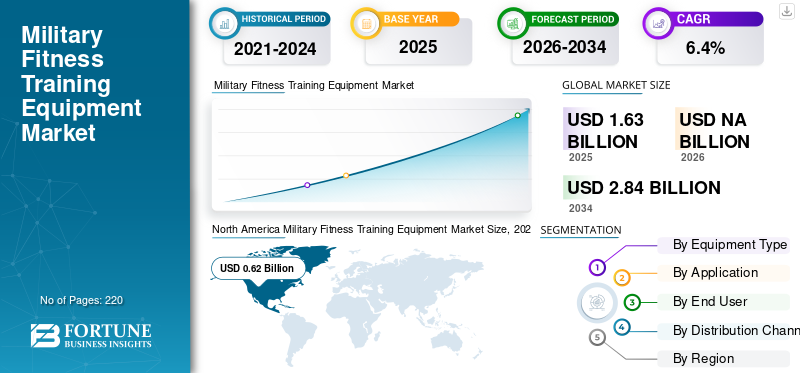
The military fitness training equipment market size was valued at USD 1.63 billion in 2025. The market is projected to grow from USD 1.73 million in 2026 to USD 2.84 billion by 2034, exhibiting a CAGR of 6.4% during the forecast period. North America dominated the military fitness training equipment market with a market share of 38.04% in 2025.
The market is expected to grow steadily due to expanding physical readiness programs across armed forces, integration of portable gym systems in forward bases and rising demand for reliable power in rugged training devices. These specialized batteries, leveraging advanced lithium-ion polymer and emerging solid-state technologies. Moreover, the emphasis on uninterrupted training during remote deployments and sustainable energy for field gyms amid global operational tempo is driving market growth.
- For instance, in October 2024, U.S. Army Garrison Poland completed a USD 1.2 million fitness equipment upgrade across 10 sites, including Camp Kosciuszko and Powidz, delivering new treadmills and machines to fitness centers before winter.
Key players such as Eleiko, Life Fitness, Technogym, Rogue Fitness and Escape Fitness are focusing on innovations such as containerized mobile gyms for rapid deployment, and AI-integrated performance trackers.
Download Free sample to learn more about this report.
MILITARY FITNESS TRAINING EQUIPMENT MARKET KEY TAKEAWAYS
 Global Market Size & Forecast
- 2025 Market Size: USD 1.63 billion
- 2026 Market Size: USD 1.73 million
- 2034 Forecast Market Size: USD 2.84 billion
- CAGR: 6.40% from 2026–2034
 Market Share
- North America dominated the military fitness training equipment market with a market share of 38.04% in 2025.
- The functional & tactical training equipment segment is anticipated to rise with a steady growth rate and a CAGR of 7.2% over the forecast period.
- The special operations segment is projected to grow at a steady CAGR of 7.9% over the forecast period.
 Key Regional Highlights
North America
North America dominated the market with a 38.04% share in 2025, supported by strong defense investments and advanced training infrastructure.
Europe
Europe is projected to grow at a CAGR of 7.6% during 2026–2034, driven by modernization of military training programs.
Asia Pacific
Asia Pacific is expected to witness the fastest growth, supported by increasing military modernization and regional defense investments.
U.S.
The U.S. market was valued at approximately USD 0.57 billion in 2025, driven by ongoing investments in military fitness and readiness programs.
Japan
The Japan market reached USD 0.06 billion in 2025, accounting for approximately 3.6% of global revenue.
Read More

MILITARY FITNESS TRAINING EQUIPMENT MARKET TRENDS
Shift Toward Modular Containerized Gyms and AI-Integrated Performance Tracking is a Prominent Market Trend
The shift toward modular, containerized fitness systems and AI-enhanced performance analytics is gaining traction in military training applications, driven by demands for rapid deployability, holistic soldier readiness, and resilient apparatus in forward operating environments. These systems feature weatherproof, shock-mounted frames with integrated sensors and AI platforms for real-time biometric monitoring, adaptive workout prescription and injury prevention analytics. Such evolution enhances training effectiveness against extreme climates and operational stresses while optimizing physical performance in combat preparation scenarios.
- For instance, in December 2025, Germany's Bundeswehr awarded PSM GmbH (Rheinmetall-KNDS JV) a USD 140.8 million contract for nine advanced AGSP firing/combat training simulators for Puma IFVs, with Rheinmetall handling USD 139.6 million as key subcontractor; deliveries start mid-2027, featuring modular, containerized designs for realistic "train-as-you-fight" platoon training.
MARKET DYNAMICS
MARKET DRIVERS
Download Free sample to learn more about this report.
Rise in Defense Budget and Investment in Fitness Infrastructure is Expected to Drive Market Growth
A primary driver for military fitness training equipment market growth is the global surge in defense budgets and accelerated investment in soldier readiness infrastructure across armed forces.
- For instance, according to the Stockholm International Peace Research Institute (SIPRI), worldwide military expenditure hit USD 2.44 trillion in 2024, up 6.8% from 2023.
Such spending fuels demand for durable, modular training systems including shock-resistant rigs, outdoor gyms, and portable containers optimized for extreme field conditions, supporting holistic programs. In addition, there is an increase in the investment in training infrastructure and facilities for military readiness. For instance, in 2023, the U.K. invests USD 765 million in the Defence Training Estate to modernize aging facilities across 156,000 hectares, ensuring safe, secure training for U.K. forces and allies such as 10,000+ Ukrainian troops under Operation Interflex. Upgraded gyms and physical training centers in these sites will drive procurement of advanced fitness gear which drives the growth of the market during the forecast period.
MARKET RESTRAINTS
High Development Costs and Stringent Military Standards to Limit Market Expansion
High development costs and stringent military standards act as key barriers that slower the market growth. These factors raise entry hurdles for equipment manufacturers and limit procurement scalability for armed forces. Advanced military fitness gear, such as sensor-equipped machines or VR training systems, demands heavy R&D investment for durability in harsh conditions. Maintenance costs and ongoing expenses, including parts, software updates, and specialist labor, straining budgets in resource-limited militaries. Military procurement enforces rigorous testing, certifications and compliance to meet operational needs, safety and tactical specs which is expected to hamper market growth.
MARKET OPPORTUNITIES
Growing Integration into Holistic Fitness Programs Presents Market Growth Opportunities
Growing integration of military fitness equipment into holistic fitness programs offers key growth opportunities by aligning training with comprehensive soldier wellness strategies. Militaries increasingly adopt programs combining physical training, mental resilience, nutrition, and recovery, using advanced equipment such as multi-functional treadmills, resistance machines with biofeedback, and recovery pods. This integration boosts U.S.ge across bases and units, driving repeat procurement, presenting market opportunities during the forecast period.
MARKET CHALLENGES
Regulatory Barriers and Supply Chain Issues Acts a Challenge for Market
Stringent military standards require extensive testing, certification, and compliance, delaying product deployment and raising costs. Complex procurement processes involve multi-level approvals and paperwork, slowing adoption of innovations. Global disruptions increase manufacturing expenses and component shortages, complicating reliable delivery to remote or deployed units. Geopolitical tensions are expected to spike demand unpredictably, testing supply integrity and creating complex challenges for the market growth.
Segmentation Analysis
By Equipment Type
Focus on Soldier Combat Readiness and Muscle Endurance to Propel Strength Training Equipment Segmental Growth
Based on the equipment type, the market is divided into strength training equipment, cardio conditioning equipment, functional & tactical training equipment, and others.
The strength training equipment segment is anticipated to account for the largest military fitness training equipment market share. This segmental growth is due to increased focus on soldier combat readiness and muscle endurance. Rising defense budgets worldwide support procurement of durable racks, weights and resistance gear tailored for tactical training driving segment growth.
The functional & tactical training equipment segment is anticipated to rise with a steady growth rate and a CAGR of 7.2% over the forecast period.
By Application
Mandatory Recruit Onboarding Programs During Geopolitical Tensions Propels Basic Training Segmental Growth
By application, the market is segmented into basic training, special operations, pre-deployment training, and others.
The basic training segment is anticipated to account for the largest market share, due to mandatory onboarding programs for recruits worldwide, emphasizing foundational strength, endurance and functional fitness. Rising enlistment during the growing geopolitical tensions increases demand for scalable, cost-effective gear such as bodyweight rigs, basic weights, and obstacle courses designed for large cohorts.
The special operations segment is projected to grow at a steady CAGR of 7.9% over the forecast period.
To know how our report can help streamline your business, Speak to Analyst
By End User
Increased Troop Numbers and Tech-Enhanced Training Initiatives Push Army Segment Growth
Based on end user, the market is segmented into army, navy, air force, special forces, defense academies/training schools, and others.
Army account for the largest market share due to its massive troop numbers and emphasis on standardized physical training programs worldwide. Heightened focus on combat readiness amid conflicts drives adoption of tech-enhanced gear, such as sensor-integrated weights, to track soldier performance and reduce injuries. Moreover, the army sector is promoting initiatives for extensive soldier training and holistic wellness. Such efforts are driving massive procurement of strength machines, cardio gear, free weights, and recovery tools.
- For instance, in September 2024, the U.S. Army will roll out its Holistic Health and Fitness (H2F) initiative to all soldiers following successful pilots in combat brigades. The U.S. Army will roll out its Holistic Health and Fitness (H2F) initiative to all soldiers following successful pilots in combat brigades.
The special forces segment is expected to grow with a fastest growth rate of CAGR of 8.6% over the forecast period.
By Distribution Channel
Streamlined Tender Contracts and Defense Budget Growth Supports Direct Scales Segment Growth
Based on energy density, the market is segmented into direct sales, distributors and online retail.
The direct sales segment leads the market by capturing the largest share through tender-based contracts and long-term vendor partnerships with defense agencies. Growth stems from streamlined procurement processes that favor trusted suppliers. Rising defense budgets enable direct deals for customized, durable equipment suited to army bases and special operations.
The online retail segment is projected to emerge as the fastest-growing at a CAGR of 7.9% over the forecast period.
Military fitness training equipment Market Regional Outlook
By geography, the market is segmented into North America, Europe, Asia Pacific, Latin America and Middle East & Africa.
North America
North America Military Fitness Training Equipment Market Size, 2025 (USD Billion)
To get more information on the regional analysis of this market, Download Free sample
North America dominated the market in 2025 with a valuation of USD 0.62 billion, growing to USD 0.65 billion in 2026, due to massive U.S. defense budgets exceeding, funding programs such as the Army's Holistic Health and Fitness (H2F) initiative. Early adoption of smart tech, such as AI-driven trackers and VR simulators, enhances soldier performance metrics across large bases which is expected to propel regional market growth.
U.S Military Fitness Training Equipment Market
Based on North America’s strong contribution, the U.S. market can be approximated at around USD 0.57 billion in 2025. The U.S. market is growing due to increased emphasis on soldier readiness and physical fitness standards amid ongoing global deployments and evolving mission demands. Increased defense budgets under President Trump's administration support modernization programs, enabling procurement of advanced, durable equipment. U.S. navy sector is investing in fitness equipment and education to enhance sailor physical readiness and well-being.
- For instance, in February 2025, Eleiko received a five-year contract to lead the U.S. Navy's Operational Fitness & Fueling System (NOFFS), providing on-site training in strength and conditioning, Olympic weightlifting, performance psychology, and injury prevention for MWR professionals and active-duty personnel.
Europe
Europe is projected to record a growth rate of 7.6% during 2026 to 2034, which is the second highest among all region. Europe shows steady expansion through NATO standardization of physical training regimens, boosting demand for portable rigs in multinational exercises. Countries such as the U.K. and Germany invest in injury-prevention equipment during aging forces and urban warfare training needs. EU defense pacts increase bulk tenders for compliant, rugged systems deployable in field ops.
- For instance, in October 2025, Solus Power secured a U.K. MOD contract to develop next-generation portable battery systems optimized for soldier-worn gear and extreme environments.
U.K. Military Fitness Training Equipment Market
The U.K. market in 2025 was at USD 0.09 billion, representing roughly 5.7% of global revenues.
France Military Fitness Training Equipment Market
France market reached USD 0.08 billion in 2025, equivalent to around 4.9% of global sales.
Asia Pacific
Asia Pacific market was at USD 0.40 billion in 2025 and is expected to be the fastest growing region in the market. In the region, India and China are both estimated to reach USD 0.09 billion and USD 0.16 billion, respectively in 2025. Asia Pacific leads as the fastest-growing region in the market, fueled by aggressive military modernization across key nations such as India, China and others. Ongoing border tensions, naval expansions, including China's carrier fleet growth and Indonesia's archipelago defense focus, require specialized endurance gear for shipboard and amphibious training, accelerating portable equipment adoption.
Japan Military Fitness Training Equipment Market
The Japan market in 2025 was at USD 0.06 billion, accounting for roughly 3.6% of global revenues.
China Military Fitness Training Equipment Market
China’s market is projected to be one of the largest worldwide, with 2025 valued at USD 0.16 billion, representing roughly 9.7% of global sales.
India Military Fitness Training Equipment Market
The India market in 2025 was at USD 0.09 billion, accounting for roughly 5.4% of global revenues.
Rest of the World
Latin America in Rest of the World exhibits steady market growth during 2026-2034, supported by defense modernization efforts and peacekeeping operations across Brazil, Colombia, and Chile. The Latin America market was at USD 0.17 billion in 2025, due to Brazilian and Mexican army upgrades, and increase in mobile fitness units for counter-narcotics operations. Moreover, Middle East & Africa increased budgets prioritize cost-effective strength gear, with the U.S. aid programs accelerating basic physical training infrastructure.
Latin America Military Fitness Training Equipment Market
The Latin America market is projected to reach around USD 0.06 billion in 2025, representing roughly 3.7% of global revenues.
COMPETITIVE LANDSCAPE
Key Industry Players
Focus on Smart Tech-Integrated and Rugged Strength Equipment by Key Players to Propel Market Progress
The military fitness equipment market remains consolidated, led by major players such as Eleiko, Life Fitness, Technogym, Rogue Fitness, Escape Fitness, and Torque Fitness, which command significant shares through innovations in durable, high-capacity racks, sensor-equipped weights, and modular training systems. These firms advance market growth with strategic contracts from defense agencies such as the U.S. Navy's NOFFS and Army H2F programs, emphasizing development of portable strength gear, AI performance trackers and injury-preventive designs for soldier training, basic PT and tactical gyms across army, navy and air force platform. Other prominent players such as Matrix Fitness, Precor, and others focus on scalable production of fast-deployable rigs, VR-enhanced conditioning modules, and extreme-environment solutions for field operations.
LIST OF KEY MILITARY FITNESS TRAINING EQUIPMENT COMPANIES PROFILED
- Eleiko (Sweden)
- Life Fitness (U.S.)
- Technogym (Italy)
- Rogue Fitness (U.S.)
- Escape Fitness (U.K.)
- Torque Fitness (U.S.)
- Precor (U.S.)
- Matrix Fitness (U.S.)
- Hammer Strength (U.S.)
- IndigoFitness (U.K.)
KEY INDUSTRY DEVELOPMENTS
- February 2026: Eleiko was awarded a five-year Indefinite Delivery, Indefinite Quantity (IDIQ) contract with the U.S. Navy to supply precision-crafted bars, plates, dumbbells, racks, platforms, and benches for global training facilities.
- February 2026: Eleiko secured a new four-year contract as the sole provider of training equipment to the Danish Defence Forces (DALO) supplying over 200 products including container outdoor gyms, Precor strength machines, cardio gear, bars, plates, racks, and benches for bases, facilities, and navy ships.
- February 2025: Eleiko was awarded a five-year contract to lead education for the U.S. Navy's Operational Fitness & Fueling System (NOFFS), strengthening its role in training MWR fitness professionals and active-duty personnel.
- December 2024: Technogym refurbished high-performance training facilities at Keogh Barracks for the British Army's 2nd Battalion Ranger Regiment, more than doubling gym capacity for elite soldiers. The upgrades feature performance-specific equipment optimized for operational readiness, rehabilitation, recovery, and strength conditioning for around 300 Rangers, 150 signals personnel, and 60 medical staff.
- August 2021: DLA Troop Support issued a solicitation for the Army Combat Fitness Test (ACFT) equipment set, worth up to USD 13 million, as part of the Holistic Health and Fitness (H2F) System initiative.
Request for Customization to gain extensive market insights.
Report Scope & Segmentation
| ATTRIBUTE | DETAILS |
| Study Period | 2021-2034 |
| Base Year | 2025 |
| Estimated Year | 2026 |
| Forecast Period | 2026-2034 |
| Historical Period | 2021-2024 |
| Growth Rate | CAGR of 6.4% from 2026-2034 |
| Unit | Value (USD Billion) |
| Segmentation | By Equipment Type, Application, End User, Distribution Channel, and Region |
| By Equipment Type |
|
| By Application |
|
| By End User |
|
| By Distribution Channel |
|
| By Geography |
|
Frequently Asked Questions
According to Fortune Business Insights, the global market value stood at USD 1.63 billion in 2025 and is projected to reach USD 2.84 billion by 2034.
In 2025, the North America market value stood at USD 0.62 billion.
The market is expected to exhibit a CAGR of 6.4% during the forecast period of 2025-2034.
By application, the basic training segment is expected to lead the market.
The rise in defense budget and investment in fitness infrastructure are driving market expansion.
Eleiko, Life Fitness, Technogym, Rogue Fitness and Escape Fitness are some of the major players in the global market.
North America dominated the market in 2025.



- 2021-2034
- 2025
- 2021-2024
- 220
Get 30-60 hrs Free Customization
Expand Regional and Country Coverage, Segments Analysis, Company Profiles, Competitive Benchmarking, and End-user Insights.




















Related Reports
-
US +1 833 909 2966 ( Toll Free )
-
Get In Touch With Us