Millet Snacks Market Size, Share & Industry Analysis, By Processing Technology (Baked, Extruded, Fried, and Popped/Puffed), By Product Type (Chips and Crisps, Puffs, Bakery Snacks, Namkeens / Savory Mixes, and Ready-to-Eat & Instant Mixes), By Millet Variety (Pearl Millet, Finger Millet, Foxtail Millet, Sorghum, and Multi-millet Blends), By Distribution Channel (Supermarkets & Hypermarkets, Health & Wellness Stores, Online / D2C, and Others), and Regional Forecast, 2026-2034
 Download Free Sample
(Offer valid till 15th Oct 2026)

Millet Snacks Market Size & Future Outlook
 Listen to Audio Version
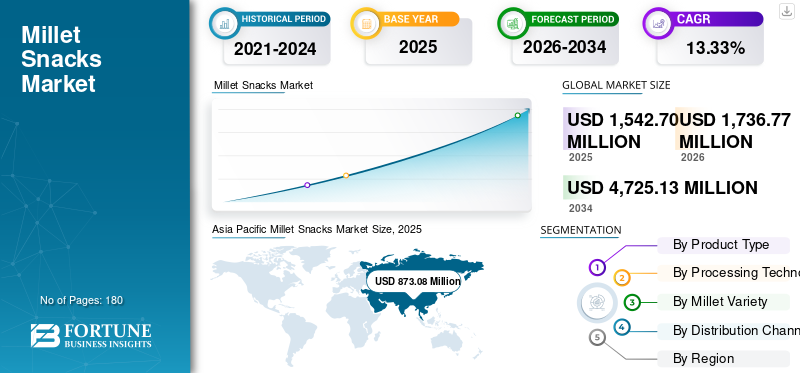
The global millet snacks market size was valued at USD 1,542.70 million in 2025. The market is projected to grow from USD 1,736.77 million in 2026 to USD 4,725.13 million by 2034, exhibiting a CAGR of 13.33% during the forecast period. Asia Pacific dominated the millet snacks market with a market share of 56.59% in 2025.
Millet snacks are savory or baked packaged foods made entirely or partly from millet grains, such as pearl millet, finger millet, sorghum, or a mix of small millets. These snacks include chips, crisps, puffs, namkeens, crackers, and instant mixes. They are made as a whole-grain, gluten-free, and high-fiber option. Millet has a mild flavor and high starch profile, making it suitable for adding to multigrain snacks without affecting their texture. The market for millet based snacks is growing rapidly as people are opting for healthy foods, clean-label products, and ancient grains, as well as gluten-free options. Millet is also popular because it is drought-resistant and environment-friendly.
Companies such as Tata Consumer Products, ITC Limited, and Slurrp Farm are some of the key players operating in this market. Product line expansion is the key strategy adopted by the companies which is boosting product sales and supporting the overall market growth.
Download Free sample to learn more about this report.
Millet Snacks Market Key Takeaways
 Global Market Size & Forecast
- 2025 Market Size: USD 1,542.70 Million
- 2026 Market Size: USD 1,736.77 Million
- 2034 Forecast Market Size: USD 4,725.13 Million
- CAGR: 13.33% from 2026–2034
 Market Share
- Asia Pacific dominated the millet snacks market with a 56.59% share in 2025.
- Fried snacks are expected to grow at a CAGR of 13.42% during the forecast period.
- Namkeens / savory mixes are expected to grow at a CAGR of 14.58% during the forecast period.
 Key Regional Highlights
Asia Pacific
Asia Pacific led the market with a valuation of USD 873.08 million in 2025.
North America
North America reached a market value of USD 262.44 million in 2025.
Europe
Europe recorded a market valuation of USD 207.53 million in 2025.
U.S.
The millet snacks market reached USD 232.25 million in 2025.
Japan
The millet snacks market was valued at approximately USD 30.39 million in 2025, accounting for around 1.97% of global revenue.
Read More

MILLET SNACKS MARKET TRENDS
Clean-Label Reformulation to Accelerate Millet Inclusion in Snack Portfolios
The global market is changing as more companies focus on clean-label recipes and ancient grains into popular snack brands. More snack makers are adding millet to their multigrain chips, baked crackers, and puffs. This helps boost fiber and whole-grain content while keeping the snacks tasty and appealing. The popularity of plant-based and gluten free diets is helping millets gain traction, especially in developed countries. In emerging markets, more people are buying packaged versions of traditional millet snacks as modern retail stores become more common.
MARKET DYNAMICS
MARKET DRIVERS
Download Free sample to learn more about this report.
Rising Health Awareness to Drive Demand for Millet Snacks in the Market
The global market for millet snacks is growing as more people choose healthier, nutrient-rich options. As people learn more about whole grains, fiber, low glycemic index, and gluten-free options, millet is becoming a popular alternative to snacks made from wheat or corn. The increasing incidence of lifestyle disorders such as obesity and diabetes is accelerating demand for better-for-you snack formats, particularly baked and extruded variants. Millet is also drought-resistant and needs fewer resources to grow than other major grains, which fits with the trend of climate-friendly food choices. In emerging markets, government programs and food security efforts are making millet more available and familiar to consumers. At the same time, modern retail and the growth of online shopping are making it easier for people to buy packaged millet snacks. New products, like multigrain blends, clean-label snacks, and options for children, are attracting more customers and propelling the millet snacks market growth in both developing and developed regions.
MARKET RESTRAINTS
Limited Consumer Awareness Restricts Mainstream Millet Snack Adoption
The global market faces low consumer awareness and inconsistent demand outside the main regions where millet is produced. In developed countries, millet is not as well-known as quinoa, oats, or chickpeas. This leads to slower sales and makes retailers more hesitant to stock millet snacks. Millet snacks are often marketed as premium, clean-label products, making their cost more than regular corn or wheat snacks. Supply chains are often fragmented, especially in Africa and parts of Asia. This creates differences in grain quality and processing, making it difficult for companies to expand internationally. All these factors slow the adoption of millet snacks, even though they are seen as healthy and good for the environment.
MARKET OPPORTUNITIES
Formalization of Traditional Millet Snacks Into Mainstream Packaged Formats to Present as a Growth Opportunity
As major snack companies look to offer healthier options, millet stands out as a versatile ancient grain that works well in baked chips, puffs, and multigrain crackers. Bringing millet snacks from niche health brands into mainstream products could help boost sales quickly. There are also untapped opportunities in school nutrition programs, healthy snacks, and clean-label products for kids. In emerging markets, the formalization of traditional millet snacks into branded packaged formats presents strong growth opportunity. As modern retailers offer millet snacks under their own brands, it helps make these products more affordable and supports growth across the category.
Segmentation Analysis
By Processing Technology
Easy Scalability and Compatibility with Healthy Snack Trends Drives the Dominant Share of Extruded Processing Technology
By processing technology, the market is segmented into baked, extruded, fried, and popped/puffed.
The extruded segment held the largest millet snacks market share in 2025. Extrusion processing is the top choice in the market as it is scalable, efficient to produce, and yields snacks with consistent texture and shape. Extrusion enables manufacturers to incorporate millet flour into expanded type of snacks including curls, rings, and multigrain puffs while maintaining desirable crunch and uniformity. This technology also makes it easier to add nutrients, coat snacks with flavors, and create cleaner-label products. Furthermore, it uses less oil than frying, which fits with healthier snack trends.
Fried snacks hold the second largest share of the market, and is expected to grow at a CAGR of 13.42% during the forecast period. Fried snacks are often bought frequently because of their strong flavors and people’s snacking habits. In emerging markets, frying remains affordable and well-suited for small- and medium-sized manufacturers. Although there are significant concerns about the consumption of fried foods and their impact on health, it is still very popular in the mass market.
By Product Type
Greater Format Familiarity and Retail Visibility Drive Chips Category Leadership
Based on product type, the market is segmented into chips and crisps, puffs, bakery snacks, namkeens / savory mixes, and ready-to-eat & instant mixes.
Chips and crisps held the largest market share in 2025. Chips and crisps are the top products in the market due to greater consumer familiarity and are easy to swap with other snacks people already consume. Brands can add millet to baked or fried chips without significantly altering the taste. This allows them to offer a healthier option compared to regular potato or corn chips.
Namkeens / savory mixes hold the second-largest share of the market and is expected to grow at a CAGR of 14.58% during the forecast period. This is mainly because consumers in Asia and parts of Africa have a long tradition of eating millet-based snacks. Namkeens are not as internationally popular as chips, but they still have a strong market share. This is because people in millet-producing areas have long-standing habits of consuming them, and more stores in cities are now selling them.
By Millet Variety
High Production Scale and Climate Resilience Drives Pearl Millet Leadership
As per millet variety, the market is classified into pearl millet, finger millet, foxtail millet, sorghum (jowar), and multi-millet blends.
The pearl millet segment led the global market in 2025. Pearl millet is the most widely grown millet in the world. Its high yields, ability to thrive in dry climates, and widespread farming in India and Sub-Saharan Africa helps it differentiate against other grains. Because pearl millet can handle drought and needs few resources, it is a dependable crop in semi-arid areas. This means food processor can count on a steady supply of raw materials. For snack makers, pearl millet’s starch and mild taste make it easy to use in products like chips, puffs, and multigrain mixes.
Sorghum (Jowar) segment accounted for the second largest market share in 2025 and is expected to register a CAGR of 13.22% during the forecast period. Sorghum (jowar) is widely grown all over the globe and is already used in both food and animal feed markets. Sorghum is grown widely in the U.S., India, and Africa. Its steady supply and growing demand for gluten free ancient grain are helping it gain popularity.
To know how our report can help streamline your business, Speak to Analyst
By Distribution Channel
High Retail Footfall and Shelf Visibility Drives Supermarket Channel’s Leadership
According to distribution channel, the market is segregated into supermarkets & hypermarkets, health & wellness stores, online / D2C, and others.
The supermarkets and hypermarkets segment led the global market in 2025. Supermarkets and hypermarkets are the main channels for distributing millet snacks as they offer large-scale distribution, strong shelf visibility, and help expand the category to a wider audience. These stores attract many shoppers, display products in an organized way, and give brands national exposure. This helps millet snacks compete directly with regular chips and multigrain snacks.
Online / D2C segment accounted for the second largest market share in 2025 and is expected to register CAGR of 14.08% during the forecast period. This growth is fueled by health-conscious and niche consumers seeking clean-label and specialty products. E-commerce platforms help smaller millet brands avoid traditional retail barriers and reach their target customers directly. Even though online sales volumes are still lower than the ones in supermarkets, online channels offer higher margins and allow for quicker innovation.
Millet Snacks Market Regional Outlook
By geography, the market is categorized into Europe, North America, Asia Pacific, South America, and the Middle East & Africa.
Asia Pacific
Asia Pacific Millet Snacks Market Size, 2025 (USD Million)
To get more information on the regional analysis of this market, Download Free sample
The Asia Pacific market was valued at USD 873.08 million in 2025 and it is the leading region in the market. It is the largest regional market for millet snacks, mainly driven by India, where millet is a traditional food, and government support is increasing. Traditional savory millet-based foods like namkeens remain popular, while modern packaged snacks emerging as the fastest growing segment. With growth in disposable incomes, the demand in this region is expected to keep growing, especially as traditional loose snacks are getting replaced by packaged branded products.
India Millet Snacks Market
The India market in 2025 was valued around USD 600.68 million, accounting for roughly 38.94% of global market demand. India leads the market in demand for millet based snacks consumption due to easy access to raw materials and a long history of traditional consumption. Government support for millets and growing health awareness in cities are helping branded packaged snacks become more popular. Namkeens and fried snacks are still the most popular, but baked and extruded options are also quickly gaining ground in modern stores and online shopping.
China Millet Snacks Market
China’s market in 2025 was valued around USD 59.85 million, representing roughly 3.88% of global market share. China’s market is growing as part of the broader health and functional food sector. Urban consumers are looking for whole-grain and low-glycemic foods, which is helping this category grow slowly. Online channels are important to find these products and for promoting them as premium options.
Japan Millet Snacks Market
The Japan market in 2025 reached a valuation of around USD 30.39 million, accounting for roughly 1.97% of global market revenues.
North America
The market in North America reached a valuation of USD 262.44 million in 2025. The market in North America is growing quickly, but it remains a small part of the broader healthy snacks category. Gluten-free, whole-grain, and ancient-grain options are popular among consumers in the region. Most new products sold in the region are baked chips, extruded puffs, and multigrain crackers, and tare often promoted as clean-label snacks. The U.S. makes up for the largest market in the region.
U.S. Millet Snacks Market
In 2025, the U.S. market reached USD 232.25 million. Gluten-free, clean-label, and ancient grain trends are shaping the U.S. market. Millet is usually included in multigrain chips and baked puffs rather than sold on its own. Most millet-based products are sold in supermarkets, with strong support from online sales. Growth stays strong as companies update their product lines and more people choose healthier snacks.
Europe
The European market reached a valuation of USD 207.53 million in 2025. In Europe, the market is organized and focused on health, with millet mostly used in multigrain and private-label snacks rather than sold on its own. Germany, the U.K., and France are the main markets, supported by the popularity of organic and gluten-free products. Most millet snacks are sold in supermarkets where private-label brands help increase the sales. The market is growing steadily owing to the interest in fiber, whole-grain benefits, and sustainability. However, growth is limited by established snack markets and strong competition from other ancient grains, such as quinoa and spelt.
Germany Millet Snacks Market
The market in Germany in 2025 reached around USD 50.43 million, representing roughly 3.27% of global market revenues. Germany leads the market in Europe, due to high demand for organic and whole-grain products. Private-label multigrain crackers and baked snacks are the popular products in the country. The market is growing steadily, but growth is limited due to its maturity and competition from other ancient grains.
U.K. Millet Snacks Market
The U.K. market reached approximately USD 38.97 million in 2025, equivalent to around 2.53% of global market sales.
South America and Middle East & Africa
Over the forecast period, South America is expected to experience a significant growth in this market. The South America market in 2025 recorded USD 70.47 million. South America's market is still developing, and Brazil holds the biggest share. Most millet is used in multigrain chips and baked crackers rather than sold as the main ingredient. The market is growing as more people seek gluten-free foods and modern retail stores expand, however consumer awareness is till limited. Health trends are helping the category grow, but strong competition from grains such as corn and quinoa is impacting market growth. Middle East & Africa region reached a valuation of USD 129.18 million in 2025. The Middle East and Africa market is split between African countries, where millet is a traditional food, and Gulf countries, where modern retail shapes demand. Strong consumer awareness in Africa helps consumers shift from loose millet to packaged snacks happen slowly. In GCC countries, millet is found in premium multigrain and clean-label products. Urbanization, more organized retail, and focus on sustainability are helping the market grow, but price concerns and supply chain issues still limit market expansion.
UAE Millet Snacks Market
UAE market is set to grow at a CAGR of 12.22% during the forecast period. The overall market is still in a very early growth stage. It focuses on premium products, and millet is mainly used in clean-label and multigrain snacks. People in the UAE are major snack consumers, and have well-organized retail stores which is boosting the sales of packaged millet snacks. Growth in online shopping and increasing number of health-conscious expatriates are driving product sales.
COMPETITIVE LANDSCAPE
Key Industry Players
Fragmented Regional Presence and Health Positioning Are Intensifying the Competitive Differentiation
The global millet snacks market is fragmented and it includes regional traditional snac(k makers, new health-focused brands, and some large packaged food companies that offer millet as part of their multigrain products. In India and parts of Africa, local companies lead the market for namkeens and fried snacks. They benefit from sourcing ingredients locally and having strong distribution in traditional retail channels. Private-label products are becoming increasingly common in developed markets, especially in supermarkets. Large multinational snack companies are slowly adding millet to their ancient-grain or multigrain product lines. Barriers to entry are moderate as extrusion and baking technology is widely available. Overall, competition in this market depends more on brand positioning and retail access.
LIST OF KEY MILLET SNACKS COMPANIES PROFILED IN REPORT
- Tata Consumer Products (India)
- ITC Limited (India)
- Slurrp Farm (India)
- Nature’s Path Foods (Canada)
- Kellanova (U.S.)
- PepsiCo (U.S.)
- General Mills (U.S.)
- Bob’s Red Mill Natural Foods (U.S.)
- The Hain Celestial Group (U.S.)
- Freedom Foods Group (Australia)
KEY INDUSTRY DEVELOPMENTS
- January 2026: RiteBite Max Protein, a snack brand from Zydus Wellness, has launched a new range of millet wafer protein bars to match changing dietary preferences. Each bar offers a wafer texture, 10 grams of protein, and millets like jowar. This responds to the rising interest in protein and a return to traditional grains.
- January 2026: WellBe Foods has introduced a new range of millet-based snacks. The lineup features five traditional favorites, namely Millet Nippatu, Millet Kodbale, Millet Chakli, Millet Tengolu, and Millet Chivda.
- October 2025: PepsiCo India launched Kurkure Jowar Puffs, entering the millet snacks category. The shifting consumer preferences towards health create an opportunity for PepsiCo India to reinvent traditional grains, making them appealing and relevant for today’s generation.
- November 2024: Ramoji Group introduced Sabala Millets, a new venture focused on millet-based products for health-conscious customers. In its first phase, the brand released 45 items, including regional millet khichdi, cookies, health bars, munchies, and noodles.
- August 2023: Tata Soulfull has expanded its snack range with the launch of Ragi Bites Choco Sticks. These snacks feature a chocolate cream filling inside a crunchy millet wafer. The product is part of the company’s main brand, Ragi Bites.
REPORT COVERAGE
The global millet snacks market forecast provides an in-depth study of market size & forecast by all the market segments included in the report. The market analysis includes details on the market dynamics and market trends expected to drive the market during the forecast period. It offers information on the market insights, technological advancements, new product launches, key industry developments, and details on partnerships, mergers & acquisitions. The industry also encompasses detailed competitive landscape with information on the market segmentation, market share and profiles of key operating players.
Request for Customization to gain extensive market insights.
Report Scope & Segmentation
| ATTRIBUTE | DETAILS |
| Study Period | 2021-2034 |
| Base Year | 2025 |
| Estimated Year | 2026 |
| Forecast Period | 2026-2034 |
| Historical Period | 2021-2024 |
| Growth Rate | CAGR of 13.33% from 2026-2034 |
| Unit | Value (USD Million) |
| Segmentation | By Processing Technology, By Millet Variety, By Product Type, By Distribution Channel, and Region |
| By Processing Technology |
|
| By Millet Variety |
|
| By Product Type |
|
| By Distribution Channel |
|
| By Region |
|
Frequently Asked Questions
Fortune Business Insights says that the global market value stood at USD 1,542.70 million in 2025 and is projected to reach USD 4,725.13 million by 2034.
In 2025, Asia Pacifics market value stood at USD 873.08 million.
The market is expected to exhibit a CAGR of 13.33% during the forecast period.
By product type, chips and crisps segment led the global market in 2025.
Rising health awareness drives millet snack adoption.
Tata Consumer Products, ITC Limited, and Slurrp Farm are few of the players in the millet snacks market.
Asia Pacific held the largest market share in 2025.
Clean-label reformulation accelerates millet inclusion in snack portfolios.



- 2021-2034
- 2025
- 2021-2024
- 180
-
(Offer valid till 15th Oct 2026)
Get 30-60 hrs Free Customization
Expand Regional and Country Coverage, Segments Analysis, Company Profiles, Competitive Benchmarking, and End-user Insights.




















Related Reports
-
US +1 833 909 2966 ( Toll Free )
-
Get In Touch With Us