Minibar Refrigerators Market Size, Share & Industry Analysis, By Technology (Absorption, Compression), By Application (Transportation, Hospitality, Offices, Household) and Regional Forecast, 2026-2034
 Download Free Sample
Minibar Refrigerators Market Overview
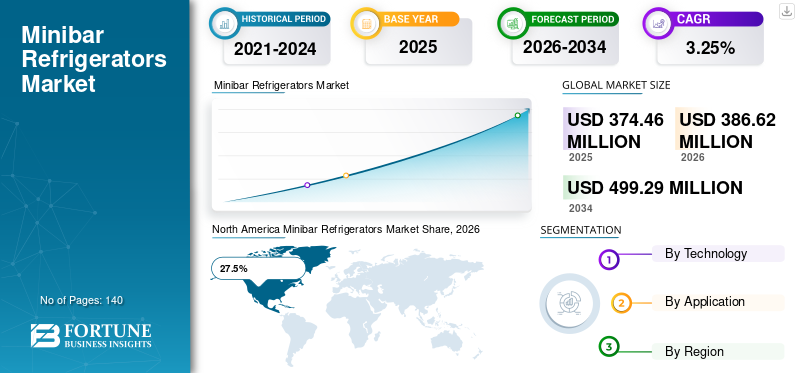
The minibar refrigerators market size was valued at USD 374.46 million in 2025. The market is projected to grow from USD 386.62 million in 2026 to USD 499.29 million by 2034, exhibiting a CAGR of 3.25% during the forecast period.

The minibar refrigerators market is witnessing steady expansion due to rising demand from hotels, resorts, serviced apartments, cruise ships, offices, and modern households. Compact cooling solutions are increasingly preferred because they offer convenience, energy efficiency, and space optimization. The growing hospitality sector continues to be the primary consumer of minibar refrigerators, with premium accommodation providers focusing on enhanced guest experiences. Technological advancements such as silent cooling systems, smart sensors, automated inventory tracking, and eco-friendly refrigerants are reshaping the industry landscape. The minibar refrigerators market report highlights increasing adoption across commercial and residential sectors, supported by urbanization, compact living trends, and growing consumer preference for premium refrigeration appliances.
The United States minibar refrigerators market remains a major contributor to global demand, supported by strong hotel infrastructure, luxury tourism, business travel activities, and rising household adoption. Compact refrigerators are increasingly used in apartments, dormitories, entertainment rooms, and office spaces. Hotel chains continue upgrading room amenities with energy-efficient minibar units featuring low-noise operation and smart temperature management. Growing demand for premium guest experiences and sustainable refrigeration technologies is supporting market expansion. The United States Minibar Refrigerators industry analysis also identifies increasing deployment across healthcare lounges, corporate facilities, and recreational vehicles, creating a broader application base for manufacturers and distributors.
Download Free sample to learn more about this report.
Minibar Refrigerators Market Key Takeaways
 Global Market Size & Forecast
- 2025 Market Size: USD 374.46 Million
- 2026 Market Size: USD 386.62 Million
- 2034 Forecast Market Size: USD 499.29 Million
- CAGR: 3.25% from 2026-2034
 Market Share
- The market in Europe dominated with a revenue share of 30.9% in 2025.
- Absorption technology dominated by technology with a market share of approximately 56.8%.
- Hospitality dominated by application with a market share of approximately 48.3%.
 Key Regional Highlights
Europe
Europe led the market with a 30.9% share, supported by strong hospitality infrastructure and growing tourism.
North America
North America accounted for 27.5% of the market, driven by demand for premium hospitality and compact refrigeration solutions.
Asia-Pacific
Asia-Pacific held a 25.4% share, supported by expanding tourism, hospitality, and urban development.
U.S
The U.S. remains a key market, supported by strong demand for hospitality amenities and compact refrigeration appliances.
Japan
Japan accounted for approximately 18% of the Asia-Pacific market, supported by advanced hospitality infrastructure and growing demand for compact appliances.
Read More

Minibar Refrigerators Market Latest Trends
The minibar refrigerators market trends indicate a growing shift toward smart and sustainable cooling solutions. Hotels increasingly prefer intelligent minibar systems integrated with occupancy sensors, automated inventory tracking, wireless monitoring, and energy-saving technologies. These advanced systems improve operational efficiency while enhancing customer convenience. Silent absorption technology continues gaining popularity among luxury hotels where guest comfort remains a priority. Manufacturers are also introducing touch-control panels, digital temperature displays, and advanced insulation materials to improve performance.
Download Free sample to learn more about this report.
Another important trend within the minibar refrigerators market analysis is the increasing demand for environmentally friendly models utilizing low-energy cooling systems and eco-conscious refrigerants. Compact living arrangements and urban apartments are creating opportunities for stylish minibar refrigerators designed for residential use. The transportation sector is also expanding adoption, particularly in campervans, cruise ships, yachts, and premium travel vehicles. Furthermore, customization options including glass doors, designer finishes, LED lighting, and modular storage compartments are becoming important purchasing factors. The minibar refrigerators market forecast suggests that innovation, sustainability, and silent operation will remain central priorities influencing future product development and purchasing decisions.
Minibar Refrigerators Market Dynamics
DRIVER
Rising Demand from The Global Hospitality Industry
The primary driver supporting the minibar refrigerators market growth is the continuous expansion of the hospitality sector. Hotels, resorts, luxury accommodations, serviced apartments, and boutique properties increasingly view minibar refrigerators as essential guest amenities. Travelers expect convenient access to chilled beverages, snacks, and personal food storage within their rooms, making minibar installations a standard feature across premium properties. The increase in international tourism, business travel, cruise vacations, and luxury hospitality investments has generated sustained demand for modern minibar refrigeration systems.
Hotel operators are focusing on guest satisfaction, which directly influences occupancy rates and customer retention. Advanced minibar refrigerators equipped with smart monitoring systems help hotels manage inventory efficiently while reducing operational losses. Furthermore, luxury accommodations increasingly select silent absorption models that eliminate compressor noise and improve room comfort. The minibar refrigerators Industry report identifies hospitality modernization programs, hotel construction activities, and premium travel experiences as critical factors driving product adoption across developed and emerging economies.
RESTRAINT
Growing Preference for Centralized Hospitality Services
A significant restraint affecting the minibar refrigerators market size is the growing trend among hotels to reduce in-room minibar services. Several hospitality operators are replacing traditional minibar systems with centralized vending stations, digital ordering platforms, and room-service alternatives. This approach reduces labor costs associated with minibar stocking, maintenance, and inventory management. Hotels seeking operational efficiency may limit minibar installations, particularly within budget and mid-scale accommodation categories.
Additionally, minibar refrigerators require regular servicing, cleaning, and energy consumption management. Hotels operating large property portfolios often face considerable maintenance expenditures. Some operators also report product wastage, inventory shrinkage, and monitoring challenges associated with conventional minibar systems. Environmental regulations targeting appliance energy consumption further increase compliance requirements for manufacturers. These factors can slow purchasing decisions among cost-sensitive customers. The minibar refrigerators market research report indicates that suppliers must continue improving efficiency, reliability, and operational value to overcome these market limitations.
OPPORTUNITY
Expansion of Smart and Connected Minibar Technologies
One of the most promising opportunities within the minibar refrigerators market opportunities landscape is the integration of smart technologies. Modern hospitality operators increasingly seek connected minibar systems capable of real-time inventory management, automated billing, remote diagnostics, and predictive maintenance. These solutions reduce manual labor while improving operational accuracy. Smart refrigeration platforms also support data-driven hospitality management by providing valuable consumption insights.
Beyond hospitality, residential consumers are showing interest in intelligent compact refrigerators featuring mobile connectivity, digital controls, and energy optimization functions. Premium apartments, luxury residences, entertainment rooms, and home offices represent expanding target markets. Cruise ships, yachts, and recreational vehicles are also adopting technologically advanced minibar units designed for mobility and efficiency. Manufacturers investing in artificial intelligence, Internet of Things integration, and sustainable cooling technologies are expected to secure competitive advantages within the evolving minibar refrigerators market outlook.
CHALLENGE
Rising Production and Component Costs
Manufacturers operating within the minibar refrigerators market face challenges related to increasing production costs. Raw materials including steel, aluminum, insulation materials, electronic components, compressors, and specialized cooling systems have experienced pricing volatility. Supply chain disruptions and transportation costs further affect production economics. These factors create pricing pressures across the industry.
The transition toward environmentally compliant refrigeration systems also requires substantial investment in research, testing, certification, and manufacturing upgrades. Producers must balance sustainability goals with affordability to remain competitive. In addition, consumer expectations regarding silent operation, energy efficiency, and smart connectivity require continuous technological innovation. Smaller manufacturers may encounter difficulties maintaining profitability while funding product development initiatives. The minibar refrigerators market insights suggest that companies capable of optimizing supply chains and introducing cost-efficient technologies will be better positioned to address these operational challenges.
Minibar Refrigerators Market Segmentation
By Technology
Absorption technology remains the dominant segment within the minibar refrigerators market share structure, accounting for approximately 56.8% of total installations. Hotels and luxury accommodations strongly prefer absorption-based refrigerators because of their silent operation and minimal vibration. These units enhance guest comfort while maintaining reliable cooling performance. The absence of mechanical compressors significantly reduces operational noise, making them ideal for hospitality environments where guest experience is a primary concern. The minibar refrigerators market analysis indicates that absorption models continue gaining traction across cruise ships, premium resorts, executive suites, and healthcare hospitality facilities. Manufacturers are improving thermal efficiency and reducing energy consumption through advanced insulation materials and optimized cooling systems. Sustainable refrigerant adoption further strengthens the attractiveness of absorption technology. Despite increasing competition from alternative cooling methods, absorption refrigerators maintain leadership due to their reliability, silent performance, and suitability for luxury hospitality applications.
Compression technology represents approximately 28.4% of the minibar refrigerators market. These systems provide superior cooling efficiency and temperature consistency compared with many alternative solutions. Compression-based minibar refrigerators are increasingly utilized in offices, residential spaces, transportation applications, and premium hospitality environments where powerful cooling performance is required. Modern compressor minibars incorporate noise-reduction technologies, enabling broader acceptance within hospitality settings. Their ability to maintain stable temperatures under varying environmental conditions makes them attractive for commercial users. The Minibar Refrigerators industry analysis highlights growing demand for energy-efficient compressor systems featuring advanced inverter technology and environmentally responsible refrigerants. As manufacturers continue improving acoustic performance, compression-based models are expected to strengthen their position across multiple end-user segments.
To know how our report can help streamline your business, Speak to Analyst
By Application
The transportation segment accounts for approximately 18.7% of the minibar refrigerators market size. Demand is increasing across cruise ships, yachts, recreational vehicles, campervans, luxury buses, trains, and private aircraft. Travelers increasingly expect premium onboard amenities, encouraging operators to install compact refrigeration systems capable of storing beverages and refreshments. The expansion of recreational tourism and luxury transportation services continues supporting market growth. Transportation operators prioritize durable, energy-efficient, and vibration-resistant minibar refrigerators designed for mobile environments. The minibar refrigerators market research report identifies cruise tourism development, recreational vehicle adoption, and premium travel experiences as key factors influencing purchasing decisions within this application segment.
Hospitality remains the largest application category, representing approximately 48.3% of the minibar refrigerators market share. Hotels, resorts, serviced apartments, and luxury accommodations continue investing heavily in guest room upgrades. Minibar refrigerators serve as essential amenities that improve customer satisfaction while generating ancillary revenue opportunities. The growing number of international travelers and premium accommodation developments contributes significantly to segment expansion. Smart minibar systems featuring automated inventory tracking and digital billing capabilities are becoming increasingly popular among hospitality operators. The minibar refrigerators market forecast identifies hospitality modernization initiatives and luxury tourism expansion as major factors supporting continued segment dominance.
The office segment contributes nearly 15.6% of the minibar refrigerators market. Corporate workplaces increasingly utilize compact refrigeration units within executive cabins, conference rooms, employee lounges, and collaborative workspaces. These refrigerators support workplace convenience by providing accessible beverage and snack storage. Modern office designs emphasize employee comfort and wellness, encouraging investment in premium workplace amenities. Compact refrigerator installations are also increasing within coworking facilities and business centers. The minibar refrigerators market outlook highlights corporate infrastructure development and employee experience enhancement as important growth catalysts within this application category.
The household segment accounts for approximately 17.4% of the minibar refrigerators market. Rising urbanization and compact apartment living have increased consumer demand for space-efficient refrigeration appliances. Homeowners frequently install minibar refrigerators in bedrooms, entertainment areas, home offices, and personal lounges. Residential consumers increasingly value stylish designs, energy efficiency, and smart functionality. Manufacturers are responding with aesthetically appealing models featuring glass doors, LED lighting, and digital controls. The minibar refrigerators market opportunities within residential applications continue expanding as consumers seek convenient cooling solutions for modern living environments.
Minibar Refrigerators Market Regional Outlook
North America
North America Minibar Refrigerators Market Share, 2025 (%)
To get more information on the regional analysis of this market, Download Free sample
North America holds approximately 27.5% of the global minibar refrigerators market share. The region benefits from strong hospitality infrastructure, widespread business travel activity, and growing residential demand for compact refrigeration products. Hotels across the United States and Canada continue investing in upgraded guest room amenities to remain competitive within the premium accommodation sector.
The increasing popularity of recreational vehicles, luxury transportation services, and home entertainment spaces supports broader market expansion. Corporate offices and coworking environments are also contributing to product demand. Sustainability initiatives and energy-efficiency standards encourage manufacturers to introduce environmentally responsible refrigeration technologies across North American markets.
Europe
Europe represents approximately 30.9% of the minibar refrigerators market size, making it the leading regional market. The region's established hospitality industry, strong tourism activity, and focus on sustainable appliances support consistent product adoption. Hotels increasingly deploy smart minibar systems featuring automated monitoring and energy-efficient operation.
European consumers also demonstrate strong interest in premium compact refrigeration solutions for residential applications. Environmental regulations encourage adoption of eco-friendly refrigerants and low-energy technologies. Innovation in silent cooling systems and advanced hospitality management platforms continues driving competitive differentiation across the European market.
Germany minibar refrigerators market
Germany accounts for approximately 28.6% of Europe's minibar refrigerator demand. Strong urbanization trends and widespread adoption of compact living concepts contribute significantly to market development. Hotels, business accommodations, and serviced apartments continue investing in modern minibar installations designed to improve guest experiences while maintaining energy efficiency.
Residential consumers increasingly purchase minibar refrigerators for entertainment rooms, home offices, and compact apartments. German buyers prioritize product durability, environmental performance, and engineering quality. Manufacturers operating within Germany focus heavily on sustainability compliance, advanced cooling efficiency, and smart connectivity features. The country's robust tourism sector and premium hospitality infrastructure further strengthen demand for technologically advanced minibar refrigeration solutions.
United Kingdom minibar refrigerators market
The United Kingdom contributes approximately 22.8% of Europe's minibar refrigerator market. The country's hospitality sector remains a major consumer of compact refrigeration systems, particularly within hotels, boutique accommodations, and business travel facilities. Property operators increasingly upgrade room amenities to enhance customer satisfaction and differentiate service offerings.
Urban residential consumers also represent an expanding customer base. Compact apartments and multifunctional living spaces create demand for space-efficient refrigeration products. The United Kingdom Minibar Refrigerators Industry report highlights increasing adoption of smart refrigeration technologies, silent cooling systems, and energy-efficient appliance designs. Continued investment in tourism infrastructure and premium accommodation developments supports long-term market activity.
Asia-Pacific
Asia-Pacific holds approximately 25.4% of the global minibar refrigerators market share. Rapid urbanization, expanding tourism industries, and rising disposable incomes contribute to growing demand. Hotels across China, Japan, India, and Southeast Asia continue modernizing facilities through deployment of advanced minibar solutions.
Residential adoption is also increasing as consumers seek compact refrigeration products suitable for apartments and smaller homes. Manufacturers actively introduce affordable, energy-efficient models tailored to regional requirements. Smart appliance adoption and sustainability initiatives further support market development across Asia-Pacific countries.
Japan minibar refrigerators market
Japan represents approximately 18.7% of the Asia-Pacific minibar refrigerator market. The country maintains strong demand through its hospitality industry, business accommodations, capsule hotels, and premium residential sectors. Space optimization remains a major purchasing factor due to compact living environments.
Japanese consumers value energy efficiency, reliability, and advanced technology integration. Manufacturers respond by developing highly efficient refrigerators featuring intelligent temperature controls and low-noise performance. Demand also benefits from tourism activities, luxury accommodations, and corporate hospitality investments throughout major urban centers.
China minibar refrigerators market
China accounts for approximately 34.2% of the Asia-Pacific minibar refrigerator market. Rapid expansion of hotels, serviced apartments, and tourism infrastructure supports substantial product demand. Growing middle-class consumption and urban apartment development also contribute to rising residential adoption.
Manufacturers increasingly integrate smart technologies including wireless monitoring, automated cooling optimization, and digital controls. The transportation sector, particularly cruise tourism and recreational travel, creates additional market opportunities. China's extensive manufacturing ecosystem further strengthens its position as both a major consumer and producer within the global minibar refrigerator industry.
Rest of World
The Rest of World region accounts for approximately 16.2% of the global minibar refrigerators market. Growth is supported by tourism expansion, hotel construction projects, and increasing adoption of compact appliances across emerging economies. Countries within the Middle East, Latin America, and Africa continue investing in hospitality infrastructure to attract international visitors.
Luxury resorts, business hotels, and serviced accommodations increasingly incorporate minibar refrigerators as standard guest amenities. Residential adoption is also gradually expanding due to urbanization and changing consumer lifestyles. Manufacturers targeting these regions focus on affordability, durability, and energy efficiency to address diverse customer requirements and environmental conditions.
List of Top Minibar Refrigerators Companies
- ISM Makine Elektrik Sanayi ve Ticaret A.Ş.
- Dometic Group AB (PUBL)
- Felix Storch (Summit Appliance)
- Minibar Systems
- Indel B S.p.A.
- HISENSE
- OMNITEC SYSTEMS SL
- Royal Minibars
- TEFCOLD A/S
- Koolatron
- Bartech
Top Two Companies by Market Share
- Dometic Group AB (PUBL) – 17.8%
- Indel B S.p.A. – 14.3%
Investment Analysis and Opportunities
The minibar refrigerators market presents attractive investment opportunities driven by hospitality modernization, tourism infrastructure development, and smart appliance adoption. Investors are increasingly targeting manufacturers focused on energy-efficient refrigeration technologies, connected appliance platforms, and sustainable cooling systems. Hotel renovation programs across developed and emerging economies continue generating long-term procurement demand.
Opportunities are particularly strong within smart minibar development, where automation, remote monitoring, and predictive maintenance capabilities deliver operational benefits for hospitality operators. Residential demand for premium compact refrigeration products also creates new revenue channels. Manufacturers expanding production capabilities, investing in sustainable materials, and enhancing digital functionality are positioned to capture growing market opportunities. Strategic partnerships between hospitality providers and appliance manufacturers further strengthen investment prospects throughout the Minibar Refrigerators Industry.
New Product Development
Innovation remains a major competitive factor within the minibar refrigerators market. Manufacturers are launching products featuring advanced insulation technologies, silent compressor systems, and intelligent energy management platforms. Smart minibar refrigerators equipped with occupancy sensors, automated billing functions, and wireless connectivity are becoming increasingly common in premium hospitality environments.
New product development also emphasizes sustainability. Companies are introducing environmentally friendly refrigerants, recyclable materials, and highly efficient cooling mechanisms that reduce electricity consumption. Glass-door models with customizable lighting, modular storage compartments, and touch-control interfaces are attracting commercial and residential customers alike. The minibar refrigerators market trends indicate continued innovation focused on convenience, sustainability, and enhanced user experience.
Five Recent Developments (2023-2025)
- Dometic expanded its portfolio of energy-efficient minibar refrigerators designed for luxury hospitality properties.
- Indel B introduced upgraded smart minibar systems featuring enhanced inventory monitoring capabilities.
- HISENSE launched compact premium refrigerator models targeting hospitality and residential users.
- TEFCOLD strengthened its commercial refrigeration offerings through expanded minibar product distribution networks.
- OMNITEC SYSTEMS developed integrated minibar solutions compatible with smart hotel room management platforms.
Report Coverage of Minibar Refrigerators Market
The minibar refrigerators market report provides comprehensive analysis of technology trends, application developments, competitive positioning, investment opportunities, regional demand patterns, and product innovation strategies. The study evaluates market dynamics affecting manufacturers, distributors, hospitality operators, and institutional buyers. Detailed assessment of absorption and compression technologies highlights their respective performance characteristics and adoption trends.
Request for Customization to gain extensive market insights.
The report further examines transportation, hospitality, office, and household applications while identifying regional growth patterns across North America, Europe, Asia-Pacific, and Rest of World markets. Company profiling, market share assessment, innovation tracking, and investment analysis provide strategic insights for stakeholders. The minibar refrigerators market research report supports business decision-making through detailed evaluation of operational trends, technological advancements, customer preferences, and future industry opportunities.
Frequently Asked Questions
Fortune Business Insights says that the global market value stood at USD 374.46 million in 2025 and is projected to reach USD 499.29 million by 2034.
The market is expected to exhibit a CAGR of 3.25% during the forecast period of 2026-2034.
Absorption technology led the technology segment with approximately 56.8% of total installations, supported by its silent operation and minimal vibration, particularly in hospitality settings.
Key players include Dometic Group AB (PUBL), Indel B S.p.A., ISM Makine Elektrik Sanayi ve Ticaret A.Ş., Felix Storch (Summit Appliance), Minibar Systems, and HISENSE.
Major trends include the adoption of smart, connected minibar systems and growing demand for sustainable, energy-efficient cooling technologies. Europe held the largest regional share at 30.9%.



- 2021-2034
- 2025
- 2021-2024
- 140
-

(Offer valid till 15th Oct 2026)
Get 30-60 hrs Free Customization
Expand Regional and Country Coverage, Segments Analysis, Company Profiles, Competitive Benchmarking, and End-user Insights.

















-
US +1 833 909 2966 ( Toll Free )
-
Get In Touch With Us