Mining Lubricants Market Size, Share & Industry Analysis, By Type (Mineral Oil Lubricants, Synthetic Lubricants, and Bio-Based Lubricants), By Application (Coal Mining, Iron Ore Mining, Bauxite Mining, Rare Earth Mineral, and Precious Metal Mining, and Others) and Regional Forecast, 2026-2034
 Download Free Sample
KEY MARKET INSIGHTS
 Listen to Audio Version
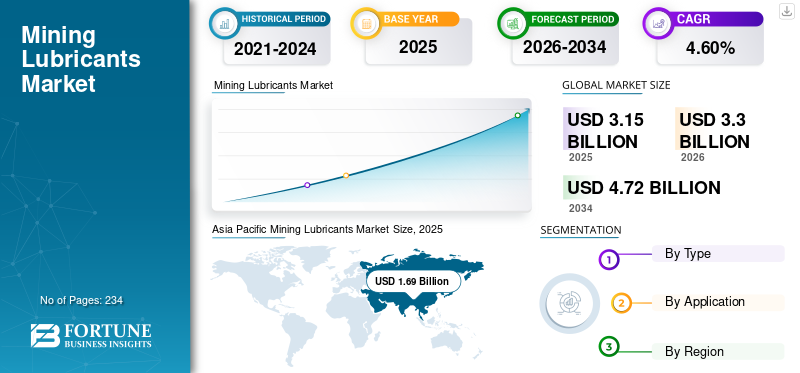
The global mining lubricants market size of USD 3.15 billion in 2025 and is projected to expand from USD 3.30 billion in 2026 to USD 4.72 billion by 2034, growing at a CAGR of 4.60% over the forecast period. Asia Pacific dominated the mining lubricants market with a market share of 53.75% in 2025.
Mining lubricants are specially formulated oil, greases, or lubricating compounds used in the mining industry to reduce friction, heat, and wear in various mining equipment and machinery. They are used in various mining machines such as turbines, compressors, hydraulic systems, bearings, open and closed gears, pneumatic tools, mining transmissions, machine tool slideways, and others. These lubricants are designed to withstand the harsh operating conditions typically found in mining operations, such as extreme temperatures, heavy loads, and exposure to dust and contaminants. They play a crucial role in maintaining the efficiency and longevity of mining equipment, including drills, crushers, conveyors, and other machines. They provide proper lubrication to moving oats and components, ultimately contributing to mining operations' overall productivity and reliability. The growing petrochemicals industry, significant demand for raw materials and minerals, technological advancement in lubricant formulation, and environmental regulation are anticipated to drive market growth during the forecast period.
Download Free sample to learn more about this report.
Mining Lubricants MARKET KEY TAKEAWAYS
 Market Size & Forecast
- 2025 Market Size: USD 3.15 billion
- 2026 Market Size: USD 3.30 billion
- 2034 Forecast Market Size: USD 4.72 billion
- CAGR: 4.60% from 2026–2034
 Market Share
- Asia Pacific dominated the mining lubricants market with a 53.75% share in 2025.
- Coal mining application segment dominated with a 56.1% share in 2026.
- Mineral oil lubricants segment led the market due to low cost and easy availability.
 Key Regional Highlights
North American
North America is growing steadily due to strong oil & gas production and mining equipment demand.
Europe
Europe is the second-leading region, supported by rising demand for minerals, metals, and infrastructure development.
Asia Pacific
Asia Pacific held USD 1.69 billion in 2025 and USD 1.77 billion in 2026, driven by strong mining activity and rich mineral reserves.
U.S.
Growth supported by advanced mining operations and high demand for industrial-grade lubricants in oil & gas activities.
Japan
Stable demand driven by industrial manufacturing and limited but highly efficient mining and processing operations.
Read More

Mining Lubricants Market Trends
Emerging Automated Lubrication System Provides Beneficial Market Opportunities
The adoption of automated lubrication systems in the mining industry is driven by their ability to enhance equipment efficiency, improve safety, reduce environmental impact, optimize lubricant usage, provide real-time monitoring, save operational time, and offer remote control.
Automated lubrication systems ensure that mining machinery and equipment receive the right amount of lubrication at the right time, reducing friction and wear and tear. This results in improved equipment efficiency and extended machinery lifespan, reducing downtime for maintenance and repair. Traditional manual lubrication methods in mining can be hazardous due to the harsh operation conditions. Automated systems minimize the need for manual intervention, reducing the risk of accidents and injuries. Moreover, these systems are designed to prevent over-lubrication, which can lead to environmental pollution. This makes them a more sustainable and environmentally friendly choice.
Many regions have strict regulations regarding lubricant usage and environmental impact. Automated systems help mining companies comply with these regulations by ensuring proper lubricant application and minimizing spillage. Such factors contribute to the market's growth by increasing the efficiency and sustainability of mining operations. Asia Pacific witnessed a growth from USD 1.69 Billion in 2025 to USD 1.77 Billion in 2026.
Download Free sample to learn more about this report.
Mining Lubricants Market Growth Factors
Growing Demand for Better-Quality Mining Lubricants Drives Market Growth
High-quality lubricants are essential for the mining industry to ensure the smooth operation of heavy machinery and equipment. These lubricants reduce friction and wear and tear on machine components, leading to better overall equipment performance as mining companies seek to optimize their operations. Additionally, when mining equipment is well-lubricated, it experiences less maintenance. This increases productivity, as machinery is operational for extended periods, increasing the demand for high-quality lubricants.
In recent years, the mining industry has been increasingly focused on environmental sustainability. High-quality lubricants often have more environmentally friendly formulations, reducing the release of harmful emissions and contaminants. This environmental consciousness leads mining companies to adopt better lubricants to meet regulatory requirements and reduce their environmental footprint. Hence, the increased demand for better-quality mining lubricants drives the market.
RESTRAINING FACTORS
Stringent Government Regulations to Hamper Market Growth
Many governments impose strict environmental regulations on the mining industry to minimize its ecological footprint. These regulations often limit the types and quantities of lubricants and other chemicals used in mining operations. For instance, certain rules may need to be followed for using biodegradable or environmentally friendly lubricants to reduce soil and water contamination. Mining is a hazardous industry, and government agencies often implement strict health and safety standards to protect workers. These regulations may require specific lubricants with certain properties, such as fire resistance, to enhance safety. Using the wrong lubricants can lead to accidents and injuries, making compliance a crucial but potentially limiting option in the market.
Segmentation Analysis
By Type Analysis
Mineral Oil Segment Lubricants Segment Accounted for the Largest Share Due to its Superior Properties
Based on type, the market is segmented into mineral oil lubricants, synthetic lubricants, and bio-based lubricants.
The mineral oil lubricants segment held the largest mining lubricants market share due to low manufacturing costs and easy availability. The upsurge in investment in the R&D activities in the mining sector is boosting the segment growth during the forecast period.
Synthetic lubricants play a significant role in encouraging the growth of the market. Synthetic lubricants have a longer service life, reducing the need for frequent oil changes and maintenance. This can lead to cost savings and increased mining operation productivity, which drive market growth.
Bio-based lubricants are biodegradable and have a lower environmental impact than traditional petroleum-based lubricants. They help reduce the risk of soil and water contamination in mining operations.
By Application Analysis
To know how our report can help streamline your business, Speak to Analyst
Coal Mining Segment Accounted for the Largest Share Due to its High Demand
Based on application, the market is segmented into coal mining, iron ore mining, bauxite mining, rare earth minerals, precious metal mining, and others.
The coal mining segment is expected to hold the largest market share during the forecast period due to the increasing demand for coal and the need for efficient extraction and processing. This growth has led to advancement in lubricant technology specifically tailored to the coal mining industry.
- The coal mining segment is expected to hold a 56.1% share in 2022.
The iron ore mining segment is expected to grow at a significant growth rate during the forecast period. The growth is associated with the global demand for steel and infrastructure development. As long as this demand persists, the need for mining lubricants in the iron ore mining sector will continue to expand, leading to opportunities for lubricant manufacturers to innovate and meet the specific requirements of this industry. This factor supports the growth of the segment.
The bauxite mining segment is anticipated to account for considerable market growth during the forecast period. The aluminum industry heavily relies on bauxite as raw material. Growth in the aluminum industry, driven by infrastructure development and the automotive sector, can lead to increased bauxite mining, thus increasing the demand for mining lubricants.
Regional Analysis
Geographically, the market is studied across North America, Europe, Asia Pacific, Latin America, and the Middle East & Africa.
Asia Pacific
Asia Pacific Mining Lubricants Market Size, 2025 (USD Billion)
To get more information on the regional analysis of this market, Download Free sample
The Asia Pacific held the dominant share in 2026 valuing at USD 1.77 Billion and also took the leading share in 2025 with USD 1.69 Billion. Asia Pacific is prosperous and has rich mineral resources. The exploration and extraction of these resources have led to increased mining activities, creating a consistent demand for lubricants to maintain and operate the equipment.
- In China, the coal mining segment is estimated to hold a 47.3% market share in 2022.
Europe
Europe accounted for the second leading region in the market and is projected to witness significant market growth due to the increased demand for minerals and metals and infrastructural development.
To know how our report can help streamline your business, Speak to Analyst
North America
North America is anticipated to grow considerably during the forecast period due to the region's high production and processing of oil & gas. Latin America and the Middle East & Africa are expected to grow significantly, which can be associated with the rising oilfield drilling and mining activities.
KEY INDUSTRY PLAYERS
Growing Market Players Focus on Increasing the Production Capacity
The key industry players in the mining lubricants are Exxon Mobil Corporation, Shell, Lubrication Engineers, Whitmore Manufacturing LLC., and Chevron Corporation. The key market players have adopted growth strategies, including improving global presence by merger & acquisition, new product launch, capacity improvement, and investment to gain competitive advantage.
LIST OF KEY COMPANIES PROFILED
- Exxon Mobil Corporation (U.S.)
- Shell (U.K.)
- Lubrication Engineers (U.S.)
- Whitmore Manufacturing LLC. (U.S.)
- Chevron Corporation (U.S.)
- PETRONAS Lubricants International (Malaysia)
- Kluber Lubrication India Private Limited (India)
- FUCHS (Germany)
- CASTROL LIMITED (India)
- Valvoline Global Operations (U.S.)
KEY INDUSTRY DEVELOPMENTS:
- November 2022: Shell in the U.K., U.S., Switzerland, and Sweden acquired PANOLIN Group's eco-friendly lubricants (ECLs) business, bringing a range of biodegradable lubricants. The transaction included the ECL product formulations, PANOLIN brand, technical expertise and technology, intellectual property, an international customer base, and a product portfolio – for hydraulics, universal tractor gear oils, transmissions, turbine oils, biodegradable engine oils, chainsaw oils, and greases for machine lubrication, including leading OEM approved products.
- September 2020: Total S.A. acquired Lubrilog SAS. This acquisition will create value for both Total and its customers. It will strengthen Total Lubrifiants’ position in the industrial lubricants market, bringing expertise for critical applications in key sectors such as mining, cement, and materials. In particular, Lubrilog specializes in producing very high-quality lubricants for the lubrication of open gear drives in the raw materials industries.
REPORT COVERAGE
The research report provides both qualitative & quantitative insights on mining lubricants across the world. Quantitative insights include market sizing in terms of value (USD Billion) & volume (Kilotons) across each segment, sub-segment, and region profiled in the scope of study. Also, it provides market analysis and growth rates of segments, sub-segment, and key counties across each region. Qualitative insight covers the elaborative analysis of key market drivers, restraints, growth opportunities, and mining lubricants industry trends related to the market. The competitive landscape section covers detailed company profiling of the key players operating in the industry.
Request for Customization to gain extensive market insights.
Report Scope & Segmentation
|
ATTRIBUTE |
DETAILS |
|
Study Period |
2021-2034 |
|
Base Year |
2025 |
|
Estimated Year |
2026 |
|
Forecast Period |
2026-2034 |
|
Historical Period |
2021-2024 |
|
Growth Rate |
CAGR of 4.60% from 2026-2034 |
|
Unit |
Volume (Kiloton), Value (USD Billion) |
|
Segmentation |
By Type
|
|
By Application
|
|
|
By Geography
|
Frequently Asked Questions
According to Fortune Business Insights, the global mining lubricants market size was valued at USD 3.15 billion in 2025 and is projected to grow from USD 3.3 billion in 2026 to USD 4.72 billion by 2034, exhibiting a CAGR of 4.60% during the forecast period.
Growing at a CAGR of 4.60%, the market will exhibit steady growth in the forecast period.
Mining lubricants are used to reduce friction, wear, and heat in heavy mining equipment and machinery such as compressors, turbines, gears, drills, crushers, conveyors, and hydraulic systems. They enhance efficiency and extend the lifespan of mining equipment, even under extreme operating conditions.
The market is driven by increasing demand for high-performance and environmentally friendly lubricants, growth in global mining activities, technological advancements in lubrication systems, and stringent environmental and safety regulations promoting efficient lubricant use.
Asia Pacific dominates the mining lubricants market, accounting for 53.75% of the global market share in 2025. The region’s rich mineral resources and high volume of mining activities drive the consistent demand for mining lubricants.
Mineral oil-based lubricants hold the largest market share due to their cost-effectiveness and wide availability. However, synthetic and bio-based lubricants are gaining traction due to their performance benefits and environmental compliance.
Coal mining is the leading application segment in the mining lubricants market. It holds the largest share owing to high global coal demand and the need for efficient equipment performance in extraction and processing.
One of the key trends is the adoption of automated lubrication systems that offer real-time monitoring, remote control, optimized lubricant use, and enhanced safety. These systems reduce downtime, prevent over-lubrication, and comply with environmental standards.
Major companies operating in the market include Exxon Mobil Corporation, Shell, Chevron Corporation, Lubrication Engineers, Whitmore Manufacturing LLC., FUCHS, CASTROL LIMITED, PETRONAS Lubricants International, Valvoline, and Kluber Lubrication India. These players focus on capacity expansion, acquisitions, and sustainable product innovations.



- 2021-2034
- 2025
- 2021-2024
- 234
Get 30-60 hrs Free Customization
Expand Regional and Country Coverage, Segments Analysis, Company Profiles, Competitive Benchmarking, and End-user Insights.


















Related Reports
-
US +1 833 909 2966 ( Toll Free )
-
Get In Touch With Us