Modular Refineries Market Size, Share & Industry Analysis, By Capacity (Less than 1,000 BPD, 1,000–5,000 BPD, 5,001–10,000 BPD, 10,001–30,000 BPD, and Above 30,000 BPD), By Complexity (Hydroskimming Refineries, Conversion Refineries, Deep Conversion Refineries, Full-Conversion Modular Refineries, & Others), By Mobility Type (Fixed, Portable, Mobile Containerized, & Others) By Application (Oil Field Development, Remote Fuel Supply, Defense & Military, Industrial Operations, Government Programs), By Crude Type (Light Crude Oil, Medium Crude Oil, Heavy Crude Oil), & Regional Forecast, 2026-2034
 Download Free Sample
Modular Refineries Market Size and Future Outlook
 Listen to Audio Version
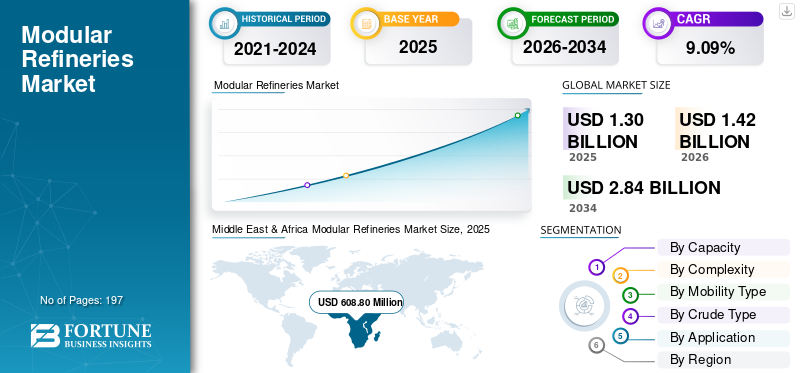
The global modular refineries market size was valued at USD 1,302.58 million in 2025. The market is projected to grow from USD 1,421.24 million in 2026 to USD 2,849.95 million by 2034, exhibiting a CAGR of 9.09% during the forecast period. Middle East & Africa dominated the modular refineries market with a market share of 46.73% in 2025.
Modular refineries are compact, prefabricated crude oil processing facilities designed in standardized modules that can be easily transported, assembled, expanded, and commissioned at project sites with lower capital investment and shorter construction timelines compared to conventional refineries. These refinery systems are used to process crude oil into petroleum products such as diesel, gasoline, kerosene, jet fuel, naphtha, and fuel oil across remote production areas, developing economies, and regions with limited refining infrastructure.
The demand for modular refineries is experiencing strong growth due to increasing global energy demand, rising investments in localized fuel production capabilities, and growing efforts by governments to reduce dependency on imported refined petroleum products. Expanding crude oil exploration and production activities, particularly in Africa, the Middle East, Asia Pacific, and Latin America, are driving the adoption of modular refinery systems for monetizing stranded or underutilized crude oil reserves. Additionally, the ability of modular refineries to operate efficiently in remote regions, offer phased capacity expansion, and reduce project execution risks is accelerating their deployment across both public and private sector projects.
The global market is moderately fragmented and characterized by the presence of modular process technology providers, engineering procurement and construction (EPC) contractors, refinery equipment manufacturers, and specialized downstream engineering firms. Key market participants including VFuels LLC, Ventech Engineers International LLC, Axens SA, Chemex Global LLC, McDermott International Ltd., and several regional modular refinery developers are focusing on strengthening their market positions through technological innovation, strategic collaborations, and expansion into high-growth energy markets. Major companies are increasingly investing in advanced modular process units, transportable refinery systems, integrated automation platforms, and multi-feedstock processing technologies to enhance operational efficiency and project scalability.
Download Free sample to learn more about this report.
Modular Refineries Market Key Takeaways
 Global Market Size & Forecast
- 2025 Market Size: USD 1,302.58 million
- 2026 Market Size: USD 1,421.24 million
- 2034 Forecast Market Size: USD 2,849.95 million
- CAGR: 9.09% from 2026–2034
 Market Share
- Middle East & Africa dominated the modular refineries market with a 46.73% share in 2025.
- The 1,000–5,000 BPD segment held a 35.86% market share in 2025.
- Asia Pacific
 Key Regional Highlights
Asia Pacific
Asia Pacific reached USD 336.57 million in 2025.
Europe
Europe reached USD 71.59 million in 2025.
North America
North America accounted for USD 111.11 million in 2025.
U.S
Valued at USD 90.86 million in 2025.
Japan
Emerging market for modular refineries.
Read More

Modular Refineries Market Trends
Rising Deployment of Modular Refineries in Remote and Oil-Producing Regions to be a New Market Trend
The increasing development of crude oil reserves in remote and infrastructure-constrained regions is significantly driving the deployment of modular refineries across Africa, Latin America, the Middle East, and parts of Asia Pacific. Governments and independent oil producers are increasingly adopting modular refinery systems to monetize stranded crude oil reserves and improve regional fuel accessibility without investing in large conventional refining infrastructure. The shorter installation timelines, lower capital expenditure requirements, and operational flexibility of modular refineries make them highly suitable for underserved regions with growing fuel demand.
For instance, In July 2025, Cameroon officially launched the CSTAR 30,000 BPD modular refinery project in the Kribi industrial-port zone to reduce fuel imports and strengthen national energy autonomy following the prolonged shutdown of the country’s conventional refinery infrastructure.
MARKET DYNAMICS
MARKET DRIVERS
Download Free sample to learn more about this report.
Rising Investments in Regional Fuel Security and Domestic Refining Capacity are Driving Market Growth
The increasing focus on strengthening domestic fuel production capabilities and reducing dependence on imported refined petroleum products is significantly driving the modular refineries market growth. Governments and private sector operators across developing economies are increasingly investing in modular refinery development to improve energy security, support industrialization, and ensure stable fuel availability in remote and underserved regions. Modular refineries offer shorter construction timelines, lower capital expenditure requirements, phased refining capacities expansion capabilities, and operational flexibility compared to conventional large-scale refineries, making them highly suitable for emerging downstream markets. The growing deployment of full conversion refinery systems, bitumen refinery configurations, and 30,000 BPD modular refinery projects for both government refinery and private refinery applications is further accelerating industry growth across multiple geographic regions.
Additionally, advancements in small-scale crude oil production sites are propelling investment in regionally focused refineries capable of monetizing stranded oil reserves and promoting energy security through localized processing. The shift toward local fuel blending and distribution networks is reducing transport costs and boosting demand for modular refining systems across Africa, the Middle East, Asia Pacific, and Latin America. Moreover, OEM-driven turnkey delivery models offered by engineering procurement and construction (EPC) firms and equipment manufacturers are lowering entry barriers for emerging market operators and supporting faster modular refinery project execution. The increasing participation of public and private sector players is further strengthening the global modular refineries industry and helping discover growth in the modular refineries sector.
For instance, in July 2025, Cameroon officially launched the CSTAR 30,000 BPD modular refinery project in the Kribi industrial zone to strengthen domestic fuel production capacity and reduce reliance on imported petroleum products.
MARKET RESTRAINTS
High Feedstock Supply Risk and Infrastructure Constraints are Limiting Market Expansion
The market faces significant challenges related to inconsistent crude oil feedstock supply, limited supporting infrastructure, and operational logistics constraints, particularly in remote and politically unstable regions. Many modular refinery projects depend on localized crude sourcing and transportation networks, making operations vulnerable to pipeline disruptions, supply shortages, storage limitations, and fluctuating crude production volumes. Additionally, inadequate transportation infrastructure, unstable power supply systems, and limited access to skilled technical labor can increase operational costs and delay project commissioning timelines. The lack of expansion of ancillary systems such as power storage and water treatment infrastructure further limits operational independence and affects long-term refinery efficiency in isolated production environments.
Regulatory uncertainties, financing challenges, fluctuating crude oil prices, and rising environmental compliance requirements may further impact investment decisions and long-term project viability for modular refinery operators. Increasing pressure to reduce carbon footprints and comply with sulfur reduction regulations, wastewater treatment standards, and cleaner fuel mandates is creating additional operational challenges, particularly for smaller operators lacking advanced refining technologies and distillation units.
For instance, in 2025 and early 2026, Nigerian modular refinery operators including Waltersmith Modular Refinery, Edo Refinery, Aradel Refinery, Duport Modular Refinery, and OPAC Refinery highlighted operational difficulties linked to delayed crude allocation, feedstock supply shortages, and infrastructure bottlenecks, which affected refinery utilization rates and project scalability. Industry reports from the Nigerian Midstream and Downstream Petroleum Regulatory Authority (NMDPRA) indicated that only Waltersmith, Edo Refinery, and Aradel Refinery remained operational during parts of 2025–2026, while OPAC and Duport experienced shutdowns associated with crude supply and operational challenges.
MARKET OPPORTUNITIES
Increasing Adoption of Mobile and Containerized Refinery Systems is Creating Growth Opportunities
The growing demand for flexible, rapidly deployable, and transportable refining infrastructure is creating substantial growth opportunities in the market. Mobile containerized refinery systems are increasingly being adopted for remote oil field operations, temporary fuel supply projects, military applications, and decentralized industrial facilities where conventional refinery infrastructure may not be economically feasible. These modular systems offer advantages such as rapid installation, scalability, lower maintenance requirements, phased refining capacities expansion, and easier relocation capabilities.
Furthermore, advancements in modular refinery development, compact refining technologies, hydroprocessing systems, process automation, distillation units, and remote monitoring systems are improving operational efficiency and enabling broader adoption across emerging markets. Rising fuel import dependence across developing economies is encouraging governments and private operators to expand refining capacity in underserved regions and monetize stranded oil reserves through localized processing infrastructure. Increasing investments in localized fuel distribution networks and phased modular refinery projects are further supporting market opportunities across both government refinery and private refinery operations.
The market is also benefiting from increased participation from public and private sector players including engineering procurement and construction (EPC) firms, OEM manufacturers, and equipment suppliers that provide turnkey refinery deployment solutions. These integrated delivery models lower project complexity and support faster commercialization across emerging downstream markets.
For instance, in July 2025, Indonesia’s sovereign wealth fund Danantara announced an approximately USD 8 billion engineering, procurement, and construction agreement with KBR Inc. to develop 17 modular refineries across the country as part of a broader strategy to strengthen domestic fuel supply infrastructure and improve refining flexibility in underserved regions. The project highlights the increasing global focus on scalable and modular refining systems that can be deployed faster and expanded incrementally based on regional fuel demand.
MARKET CHALLENGES
Environmental Compliance and Product Quality Regulations are Emerging Challenges
The market is increasingly facing challenges related to environmental compliance, emissions management, and evolving fuel quality regulations across global markets. Refinery operators are required to comply with increasingly stringent sulfur reduction standards, emissions regulations, wastewater treatment requirements, and operational safety frameworks, which can increase project development costs and technological complexity. Smaller modular refinery operators may face difficulties in integrating advanced desulfurization units, emission control systems, water treatment technologies, and modern environmental management solutions while maintaining cost competitiveness.
Additionally, growing global energy transition goals and increasing pressure to reduce carbon footprints are compelling refinery operators to adopt cleaner refining technologies and energy-efficient modular systems. The integration of advanced hydroprocessing technologies, cleaner distillation units, and environmentally optimized modular refinery development models is becoming increasingly important across both public and private refinery projects. However, these upgrades often require higher capital expenditure and technical expertise, creating operational challenges for emerging market operators.
Varying regional refining standards, certification requirements, and environmental regulations can further complicate project approvals and delay commercialization timelines across multiple geographic regions. Despite these challenges, ongoing innovation in compact refining technologies and environmentally optimized refinery engineering continues to support the long-term evolution of the modular refineries industry.
For instance, in March 2025, the Nigerian Midstream and Downstream Petroleum Regulatory Authority (NMDPRA) announced plans to engage modular refinery operators in retrofitting their facilities with hydroprocessing and desulfurization technologies to achieve the targeted 50 ppm sulfur specification for gasoline and diesel fuels in line with evolving environmental regulations and cleaner fuel standards.
Segmentation Analysis
By Capacity
1,000–5,000 BPD Segment Dominated Market Owing to Its Operational Flexibility and Lower Capital Requirements
Based on capacity, the global market is segmented into less than 1,000 BPD, 1,000–5,000 BPD, 5,001–10,000 BPD, 10,001–30,000 BPD, and above 30,000 BPD.
The 1,000–5,000 BPD segment dominated the market, accounting for approximately 35.86% modular refineries market share in 2025, driven by its strong adoption across emerging economies, remote oil-producing regions, and decentralized fuel supply projects. These modular refinery systems provide an optimal balance between refining output, investment feasibility, deployment speed, and operational scalability, making them highly suitable for governments and independent oil operators seeking cost-effective downstream infrastructure. The increasing deployment of low-capacity modular refineries in Africa, Latin America, and parts of Asia Pacific to support localized diesel and gasoline production is further strengthening segment growth.
The 10,001–30,000 BPD segment is emerging as the fastest-growing category and is projected to grow at a CAGR of approximately 10.73% during the forecast period. Growth is driven by increasing investments in medium-scale modular refinery projects capable of supporting regional fuel distribution networks, industrial fuel demand, and national energy security initiatives. These systems offer higher refining complexity, improved product yield flexibility, and phased expansion capabilities while maintaining lower development timelines compared to conventional refinery infrastructure.
By Complexity
Hydroskimming Refineries Segment Dominated Market Due to Their Lower Complexity and Faster Deployment Capabilities
Based on complexity, the global market is segmented into hydroskimming refineries, conversion refineries, deep conversion refineries, full-conversion modular refineries,
The hydroskimming refineries segment dominated the market, accounting for approximately 38.57% share in 2025, primarily due to their relatively simple processing configuration, lower investment costs, and suitability for diesel-oriented fuel production in developing economies. Hydroskimming modular refineries are widely deployed in remote and infrastructure-constrained regions where demand for basic petroleum products such as diesel, kerosene, and fuel oil remains high. Their lower operational complexity and rapid installation capabilities continue to support adoption across Africa and parts of Asia Pacific.
The full-conversion modular refineries segment is projected to witness the fastest growth, expanding at a CAGR of approximately 11.10% during the forecast period. Increasing environmental regulations, rising demand for cleaner transportation fuels, and growing investments in higher-value petroleum product production are encouraging operators to adopt advanced modular refining configurations with integrated upgrading and conversion technologies.
By Mobility Type
Fixed Segment Dominate Market Owing to Their Higher Processing Stability and Long-Term Operational Use
Based on mobility type, the market is segmented into fixed, portable, mobile containerized, and others.
The fixed segment dominated the market, accounting for approximately 56.07% share in 2025, driven by rising investments in permanent decentralized refining infrastructure and long-term regional fuel production projects. Fixed modular refineries offer greater processing stability, larger throughput capabilities, and improved integration with storage, transportation, and downstream distribution infrastructure. Governments and national oil companies are increasingly deploying fixed modular refinery systems to strengthen domestic fuel supply chains and reduce dependence on imported refined products.
The mobile containerized segment is expected to witness strong growth, registering a CAGR of approximately 11.32% during the forecast period. The growth is driven by increasing demand for rapidly deployable refining systems for remote oil fields, military fuel supply operations, temporary industrial projects, and emergency fuel infrastructure applications.
By Crude Type
Medium Crude Oil Segment Dominated Market Due to Its Wide Availability and Refining Compatibility
Based on crude type, the global market is segmented into light crude oil, medium crude oil, heavy crude oil, and others.
The medium crude oil segment dominated the market, accounting for approximately 39.30% share in 2025, supported by the widespread availability of medium crude reserves across major oil-producing regions including the Middle East, Africa, and Latin America. Modular refineries processing medium crude oil offer balanced refining economics, stable product yields, and compatibility with various refinery configurations, making them highly suitable for decentralized refining projects. Increasing regional refining investments and localized fuel production initiatives are further contributing to segment expansion.
The heavy crude oil segment is projected to witness notable growth, expanding at a CAGR of approximately 10.27% during the forecast period. The growth is driven by the rising efforts to monetize heavy crude reserves through modular upgrading technologies and increasing investments in refining infrastructure capable of processing lower-grade crude feedstocks in resource-rich regions.
To know how our report can help streamline your business, Speak to Analyst
By Application
Oil Field Development Segment Dominated Market Owing to Rising Demand for Localized Fuel Processing Solutions
Based on application, the global market is segmented into oil field development, remote fuel supply, defense & military, industrial operations, government programs, and others.
The oil field development segment dominated the market, accounting for approximately 31.20% share in 2025, driven by increasing upstream crude production activities and the growing need to monetize crude oil directly at or near production sites. Modular refineries are increasingly deployed in remote oil-producing regions to support localized fuel processing, reduce transportation costs, and improve operational efficiency for upstream operators. Their rapid deployment capability and lower capital intensity make them highly suitable for greenfield and isolated oil field projects.
The government programs segment is projected to witness the fastest growth, registering a CAGR of approximately 10.93% during the forecast period. The growth is primarily driven by increasing government investments in domestic refining infrastructure, fuel import substitution initiatives, and national energy security programs across developing economies.
Modular Refineries Market Regional Outlook
By geography, the market is categorized into Europe, North America, Asia Pacific, Latin America, and the Middle East & Africa.
Middle East & Africa
Middle East & Africa Modular Refineries Market Size, 2025 (USD Million)
To get more information on the regional analysis of this market, Download Free sample
The Middle East & Africa region dominated the global market, accounting for approximately USD 608.80 million in 2025. The market in the region is growing due to increasing crude oil production activities, rising investments in domestic refining infrastructure, and growing government focus on reducing dependence on imported refined petroleum products across African and Middle Eastern economies. The countries across the region are increasingly deploying modular refinery systems to monetize stranded crude reserves, improve regional fuel accessibility, and strengthen downstream energy security. Additionally, the lower capital investment requirements and rapid deployment capabilities of modular refineries are supporting adoption across remote oil-producing regions and emerging industrial corridors. Increasing government-backed refinery development programs and partnerships with private downstream operators are further contributing to regional market growth.
Nigeria Modular Refineries
The Nigeria market was valued at approximately USD 173.76 million in 2025. The market is expanding due to rising investments in decentralized refining infrastructure, growing domestic fuel demand, and increasing government support for modular refinery deployment aimed at reducing fuel import dependence and improving localized fuel production capacity.
Saudi Arabia Modular Refineries
The Saudi Arabia market was valued at approximately USD 109.95 million in 2025. Growth is driven by increasing investments in downstream diversification projects, regional fuel supply infrastructure expansion, and rising focus on flexible refining systems capable of supporting remote industrial and energy development initiatives.
Asia Pacific
Asia Pacific accounted for approximately USD 336.57 million in 2025. The market is witnessing significant growth due to increasing energy demand, expanding industrialization, and rising investments in localized fuel production infrastructure across emerging economies such as China, India, Indonesia, and Malaysia. Governments and private operators are increasingly deploying modular refinery systems to support regional fuel supply networks, reduce transportation costs, and improve refining accessibility in remote regions. Additionally, growing investments in mobile containerized refinery systems and phased refining infrastructure projects are supporting market expansion across the region.
China Modular Refineries Market
The Chinese market was valued at approximately USD 93.77 million in 2025. The growth is driven by increasing investments in compact refining technologies, regional industrial fuel demand, and growing adoption of modular processing systems for localized downstream operations.
India Modular Refineries Market
The Indian market was estimated at around USD 71.80 million in 2025. The market is growing due to rising industrial fuel consumption, increasing investments in decentralized energy infrastructure, and expanding demand for flexible refining systems across remote industrial and mining regions.
North America
North America accounted for approximately USD 111.11 million in 2025. The market in North America is growing due to increasing demand for flexible refining infrastructure, rising investments in remote oil field development, and growing focus on fuel supply resilience across industrial and energy sectors. The region is also witnessing increasing adoption of mobile and skid-mounted refining systems for temporary operations and specialized industrial fuel applications. Additionally, technological advancements in modular refining automation and process optimization are supporting market growth across the U.S. and Canada.
U.S. Modular Refineries Market
The U.S. market was estimated at approximately USD 90.86 million in 2025. The market is supported by rising demand for compact refining infrastructure, increasing deployment of modular processing systems in remote oil-producing regions, and growing investments in flexible downstream energy solutions.
Europe
Europe accounted for approximately USD 71.59 million in 2025. The market growth in Europe is supported by increasing investments in energy resilience infrastructure, niche refining projects, and portable fuel processing systems for industrial and defense-related applications. Additionally, growing focus on decentralized energy systems and strategic fuel reserve capabilities is supporting limited but steady deployment of modular refining technologies across the region.
Germany Modular Refineries Market
The German market was estimated at approximately USD 16.21 million in 2025. The market is supported by increasing industrial energy infrastructure investments and growing interest in compact fuel processing technologies for strategic and specialized industrial applications.
U.K. Modular Refineries Market
The U.K. market was estimated at around USD 12.40 million in 2025. The growth is driven by expanding commercial rooftop solar installations, favorable renewable energy incentives, and increasing demand for hybrid inverter solutions integrated with smart energy management systems.
Latin America
Latin America accounted for approximately USD 174.51 million in 2025. The market is primarily driven by increasing crude oil production activities, rising fuel demand, and growing investments in regional refining capacity expansion across Brazil, Argentina, Colombia, and Venezuela. Governments and independent energy operators are increasingly adopting modular refinery systems to improve domestic fuel supply security, support remote industrial operations, and monetize regional crude oil resources more efficiently.
Brazil Modular Refineries Market
The Brazil market was estimated at around USD 48.05 million in 2025. The growth is supported by increasing regional fuel demand, expanding downstream investments, and rising adoption of modular refining systems for localized petroleum product supply and industrial fuel applications.
COMPETITIVE LANDSCAPE
KEY INDUSTRY PLAYERS
Leading Companies are Expanding Modular Refinery Technologies and Flexible Downstream Infrastructure to Strengthen Market Position
The global modular refineries market is moderately fragmented, characterized by the presence of refinery engineering companies, modular process technology providers, EPC contractors, and specialized downstream infrastructure developers competing through technological innovation, project execution capabilities, and integrated refining solutions. Leading participants such as VFuels LLC, Ventech Engineers International LLC, Axens SA, Chemex Global LLC, McDermott International Ltd., and others maintain strong market positions through diversified portfolios of modular refinery systems, skid-mounted process units, containerized refining solutions, and advanced downstream engineering capabilities.
For instance, in July 2025, KBR Inc. secured a major engineering, procurement, and construction agreement associated with the development of multiple modular refinery projects in Indonesia aimed at strengthening localized refining infrastructure and improving regional fuel supply capabilities.
LIST OF KEY MODULAR REFINERIES COMPANIES PROFILED IN REPORT
- VFuels LLC (U.S.)
- Ventech Engineers International LLC (U.S.)
- Axens SA (France)
- Chemex Global LLC (U.S.)
- McDermott International LLC (U.S.)
- KBR Inc. (U.S.)
- Neste Engineering Solutions (Finland)
- Lummus Technology LLC (U.S.)
- Honeywell UOP (U.S.)
- Prosernat S.A. (France)
KEY INDUSTRY DEVELOPMENTS
- January 2026: VFuels LLC announced the expansion of its modular refinery engineering portfolio with upgraded compact refining systems designed for rapid deployment across remote oil-producing regions. The enhanced systems incorporated advanced automation capabilities, modular scalability, and improved fuel processing efficiency to support decentralized refining infrastructure development.
- November 2025: Honeywell UOP introduced advanced modular hydroprocessing technologies aimed at improving sulfur reduction capabilities and cleaner fuel production across modular refinery applications. The development focused on supporting compliance with evolving low-sulfur fuel regulations and improving operational efficiency for compact refining facilities.
- September 2025: Ventech Engineers International LLC expanded its skid-mounted refinery solutions portfolio with integrated modular process units designed for phased refinery expansion and flexible crude processing operations. The systems were developed to support lower-capital downstream projects and regional fuel supply infrastructure deployment.
- July 2025: KBR Inc. secured a large-scale EPC agreement linked to the development of modular refinery infrastructure projects in Indonesia. The project focused on strengthening localized refining capabilities, improving fuel accessibility, and supporting distributed downstream energy infrastructure development.
- March 2025: Axens SA expanded its modular refining technology offerings with advanced compact conversion and hydroprocessing solutions aimed at improving product yield flexibility and environmental compliance across small and medium-capacity refinery projects.
REPORT COVERAGE
The global modular refineries market analysis provides an in-depth study of the market size & forecast by all the market segments included in the report. It contains details on the market dynamics and market trends expected to drive the market during the forecast period. It offers information on technological advancements, new product launches, key industry developments, and partnerships, mergers & acquisitions. The market research report also includes a detailed competitive landscape, providing market share and profiles of key players.
Request for Customization to gain extensive market insights.
Report Scope & Segmentation
| ATTRIBUTE | DETAILS |
| Study Period | 2021-2034 |
| Base Year | 2025 |
| Estimated Year | 2026 |
| Forecast Period | 2026-2034 |
| Historical Period | 2021-2024 |
| Growth Rate | CAGR of 9.09% from 2026-2034 |
| Unit | Value (USD Million) |
| Segmentation | By Capacity, By Complexity, By Mobility Type, By Crude Type, By Application, and By Region |
| By Capacity |
|
| By Complexity |
|
| By Mobility Type |
|
| By Crude Type |
|
| By Application |
|
| By Region |
|
Frequently Asked Questions
Fortune Business Insights says that the global market value stood at USD 1,302.58 million in 2025 and is projected to reach USD 2,849.95 million by 2034.
The market is expected to exhibit a CAGR of 9.09% during the forecast period (2026-2034).
The medium crude oil segment led the market in terms of crude type.
Rising deployment of modular refineries in remote and oil-producing regions.
VFuels LLC, Axens SA, KBR Inc., McDermott International Ltd. are the top players in the market.
The Middle East & Africa held the market share in 2025.



- 2021-2034
- 2025
- 2021-2024
- 197
Get 30-60 hrs Free Customization
Expand Regional and Country Coverage, Segments Analysis, Company Profiles, Competitive Benchmarking, and End-user Insights.



















Related Reports
-
US +1 833 909 2966 ( Toll Free )
-
Get In Touch With Us