Motorsports Market Size, Share & Industry Analysis, By Racing Type (Formula, Motorcycle, Stock Car, and Rally & Off-road), By Revenue Source (Sponsorship & Advertising, Media & Broadcasting Rights, Ticketing & Event Revenue), By Fuel Technology (ICE and Electric), By Motorsport Infrastructure & Services (Racing Events & Circuit Operations, Media Production & Digital Streaming, Racing Analytics & AI Technologies, Vehicle Engineering), By End-user (Racing Teams, Motorsport Governing Bodies, Automotive Manufacturers, Media, Fans & Corporate Sponsors), and Regional Forecast, 2026-2034
 Download Free Sample
(Offer valid till 15th Oct 2026)

Motorsports Market Size and Future Outlook
 Listen to Audio Version
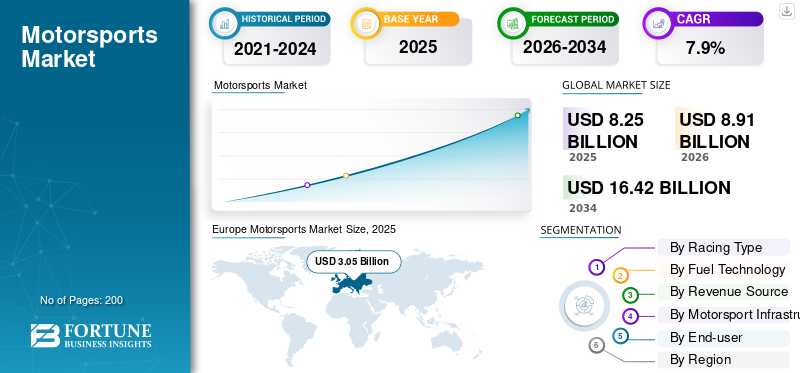
The global motorsports market size was valued at USD 8.25 billion in 2025 and is projected to grow from USD 8.91 billion in 2026 to USD 16.42 billion by 2034, exhibiting a CAGR of 7.9% during the forecast period. Europe dominated the motorsports market with a market share of 36.97% in 2025.
Motorsports refers to an organized competitive racing activities involving automobiles, motorcycles, and specialized racing vehicles across professional circuits, tracks, and off-road venues, generating revenues through events, sponsorships, broadcasting, and team operations. Market growth is driven by rising global viewership, increasing sponsorship investments, expanding media rights revenues, growing popularity of international racing events, technological innovation, electric racing adoption, and enhanced digital fan engagement experiences.
Major players in the market include Formula One Group, NASCAR, Dorna Sports-MotoGP, Fédération Internationale de l'Automobile (FIA), and Formula E Operations Ltd., competing through global event portfolios, media rights expansion, fan engagement initiatives, technological innovation, and sustainable racing developments.
Download Free sample to learn more about this report.
MOTORSPORTS MARKET KEY TAKEAWAYS
 Global Market Size & Forecast
- 2025 Market Size: USD 8.25 billion
- 2026 Market Size: USD 8.91 billion
- 2034 Forecast Market Size: USD 16.42 billion
- CAGR: 7.9% from 2026–2034
 Market Share
- Europe dominated the market with a 36.97% share in 2025.
- The Formula Racing segment held the largest market share in 2025.
- The ICE segment held the largest market share in 2025.
 Key Regional Highlights
Europe
Dominated the market in 2025, supported by its strong racing heritage, leading teams, advanced engineering capabilities, and major international championships.
North America
Held the second-largest market share, driven by extensive sponsorship networks, strong media rights revenues, and a large motorsports fan base.
Asia Pacific
Projected to grow at the fastest 10.3% CAGR, supported by rising motorsports participation, expanding racing infrastructure, and increasing sponsorship investments.
U.S.
The market is projected to reach USD 2.50 billion by 2026, accounting for 28.0% of global revenue.
Japan
The market is projected to reach USD 0.38 billion by 2026, accounting for 4.3% of global revenue.
Read More

MOTORSPORTS MARKET TRENDS
Growth of Zero-Emission Racing and Sustainable Competition Formats to Drive Market Growth
The industry is witnessing an increasing adoption of zero-emission racing formats as organizers, manufacturers, and sponsors prioritize sustainability goals. Electric racing championships are gaining visibility while showcasing advanced battery, powertrain, and energy management technologies. These competitions provide manufacturers with opportunities to demonstrate innovation in real-world performance environments. Growing environmental awareness among consumers and regulators is encouraging investments in eco-friendly racing initiatives, making sustainable motorsports an important trend shaping future competition formats and technology development strategies.
- In June 2025, Zero Emission Industries partnered with Honda Racing Corporation USA to support the first hydrogen fuel cell-powered vehicle competing at the Pikes Peak International Hill Climb. The company’s portable FTcase hydrogen refueling system enabled off-grid fueling, advancing hydrogen-powered motorsports and demonstrating practical solutions for zero-emission racing applications.
Expansion of Virtual Racing Platforms and Interactive Racing Experiences to Propel Market Growth
Virtual racing platforms are becoming an increasingly important component of motorsports engagement strategies. Organizers are integrating sports competitions, simulation technologies, augmented reality features, and interactive racing experiences to attract younger audiences. Fans can participate directly through online competitions and immersive digital environments. Racing media platforms are also expanding content offerings to enhance audience engagement beyond traditional event viewing. These market trends is creating new revenue opportunities while strengthening fan loyalty and global accessibility within the motorsports ecosystem.
- In May 2026, Hyundai Motor launched the Hyundai N Racing Simulator, a virtual racing platform developed with LG Electronics, Sony, Logitech, and Next Level Racing. Designed to replicate real-world N vehicle performance, the simulator strengthens esports engagement, interactive racing experiences, and digital motorsports participation.
MARKET DYNAMICS
MARKET DRIVERS
Download Free sample to learn more about this report.
Rising Global Sponsorship Investments Strengthen Revenue Generation
Increasing sponsorship spending from automotive manufacturers, technology companies, financial institutions, and consumer brands is driving motorsports market growth. Sponsors leverage racing events to enhance brand visibility, engage global audiences, and showcase technological capabilities. The growing commercial value of international motorsports championships has resulted in larger sponsorship agreements across teams, venues, and event organizers. As fan engagement expands through digital platforms and broadcasting channels, sponsorship revenues continue to support race operations, infrastructure development, and innovation throughout the professional racing ecosystem.
- In June 2026, Aprilia Racing and Monster Energy announced a multi-year sponsorship partnership, with Monster Energy becoming the team's title sponsor from 2027. The agreement strengthens brand visibility across MotoGP, enhances fan engagement initiatives, and reflects growing sponsorship investments within the global market.
Expanding Global Fan Base Accelerates Event Participation
The growing popularity of motorsports among diverse demographic groups is increasing attendance, viewership, and engagement globally. Major racing series continue to attract millions of spectators through live events and digital broadcasts. Emerging markets are witnessing rising interest in formula racing, motorcycle racing, and other competitive formats. Improved accessibility through streaming services and social media platforms has broadened audience reach, creating stronger demand for racing events, merchandise, media rights, and related services across the global motorsports industry.
- In December 2025, Formula 1 reported a record-breaking season with a global fanbase of 827 million, total race attendance of 6.7 million, and 19 sold-out events. Strong growth in audience engagement, media reach, and commercial partnerships further reinforced Formula 1’s leadership within the global market.
MARKET RESTRAINTS
High Operational Costs Limit Participation and Expansion
Motorsports activities involve substantial expenditures related to vehicle development, team management, logistics, safety compliance, race circuit operations, and event organization. Professional racing teams continuously invest in advanced technologies and performance enhancements to remain competitive. Rising operational expenses can create financial challenges for smaller teams, independent organizers, and emerging racing categories. These cost pressures may restrict market entry, reduce competitive diversity, and limit expansion opportunities in certain regions despite growing global interest in motorsports events.
MARKET OPPORTUNITIES
Rising Investments in Racing Infrastructure and New Event Venues
Governments and private investors are increasingly funding motorsports infrastructure projects to attract tourism, international events, and economic development opportunities. New circuits, upgraded facilities, and modern race management systems are expanding the industry's operational capacity. Many countries are investing in motorsports venues to strengthen their position within international motorsports calendars. Growing infrastructure development creates opportunities for event organizers, technology providers, racing teams, and service companies while supporting long-term market expansion across both established and emerging racing destinations.
- In June 2026, McLaren Racing announced progress toward developing a fully circular Formula 1 car through its Circular Car Roadmap initiative with Deloitte. The program aims to increase circular material usage, reduce emissions and waste, and advance sustainability across motorsports operations and vehicle development.
Growing Commercialization of Racing Media Platforms and Digital Content to Bolster Market Growth
The increasing value of digital broadcasting, streaming services, and exclusive content distribution is creating significant growth opportunities across the market. Racing organizations are expanding partnerships with media companies to reach broader audiences and generate recurring revenue streams. Enhanced data analytics, personalized content, and direct-to-consumer platforms are improving audience engagement and monetization capabilities. As global consumption of sports content continues to rise, racing media platforms are expected to become increasingly important contributors to industry revenues.
- In April 2026, The Race Media launched The Race Extra, a dedicated editorial and social content platform focused on Formula 1 culture, fan experiences, lifestyle content, and brand collaborations. The initiative expands motorsports media coverage beyond on-track action, strengthening audience engagement and commercial storytelling opportunities across the global racing ecosystem.
MARKET CHALLENGES
Balancing Sustainability Goals with Traditional Racing Expectations May Hamper Market Growth
The industry faces the challenge of advancing sustainability initiatives while maintaining the performance characteristics and excitement that attract motorsports audiences. Transitioning toward alternative fuels, electric technologies, and environmentally responsible operations requires significant investments and technological adaptation. Stakeholders must balance regulatory requirements, fan expectations, competitive integrity, and commercial viability. Successfully managing this transition is essential for ensuring long-term growth while preserving the appeal and authenticity of motorsports competitions globally.
Segmentation Analysis
By Racing Type
High Global Audience Reach and Manufacturer Participation Sustain Formula Racing Segment Demand
Based on racing type, the market is segmented into formula racing, motorcycle racing, stock car racing, and rally & off-road racing.
The formula racing segment dominates the market due to its extensive global fan base, premium sponsorship ecosystem, and strong media rights revenues. Major international championships attract substantial investments from automotive manufacturers, technology partners, and broadcasters. The segment benefits from advanced vehicle innovation, prestigious racing calendars, and widespread commercial partnerships. Growing audience engagement through digital platforms, expanding race hosting activities, and increasing adoption of sustainable racing technologies further strengthen the segment's leadership position across the global market.
- In May 2026, Formula 1 partnered with Mumbai Falcons to launch the F1 Sim Racing India Open 2026, creating a national virtual racing competition aimed at developing emerging talent. The initiative expands grassroots motorsports participation, strengthens fan engagement, and supports the growth of the sim racing ecosystem in India.
The stock car racing segment holds the second-largest motorsports market share and is projected to expand at a CAGR of 7.0% during the forecast period. Strong regional fan loyalty, expanding broadcasting revenues, growing sponsorship investments, and modernization of race experiences continue to support segment growth across key markets.
To know how our report can help streamline your business, Speak to Analyst
By Fuel Technology
Growing Electrification Initiatives and Sustainable Racing Investments Advances ICE Segment
Based on fuel technology, the market is segmented into ICE and electric.
The ICE segment dominates the market due to its longstanding presence across major racing categories, extensive race infrastructure, and widespread participation in professional championships. Most formula racing, stock car racing, motorcycle racing, and rally competitions continue to rely on high-performance internal combustion technologies. Established supply chains, proven vehicle performance, strong fan acceptance, and significant investments in existing race circuit operations support the segment's leadership. Continuous advancements in fuel efficiency and sustainable fuel integration further contribute to the segment's sustained market position.
The electric segment is projected to register the fastest growth, expanding at a CAGR of 11.7% during the forecast period. Rising investments in zero-emission racing, increasing manufacturer participation, supportive sustainability initiatives, and growing interest in eco-friendly motorsports are accelerating adoption across emerging electric racing championships globally.
- In April 2026, Formula E unveiled its next-generation GEN4 race car, capable of speeds exceeding 335 kph and featuring 100% reusable design elements. The launch highlights accelerating innovation in zero-emission racing, advanced electric vehicle technologies, and sustainable motorsports development globally.
By Revenue Source
Strong Commercial Partnerships and Global Brand Visibility Propels Sponsorship & Advertising Segment Growth
Based on revenue source, the market is segmented into sponsorship & advertising, media & broadcasting rights, ticketing & event revenue, merchandising & licensing, and team & manufacturer investments.
The sponsorship & advertising segment dominates the market due to its critical role in funding racing teams, events, and championships. Global brands leverage motorsports platforms to enhance visibility, engage passionate fan communities, and showcase products across international markets. The extensive reach of major racing events, combined with growing digital engagement and media exposure, continues to attract substantial corporate investments. Long-term sponsorship agreements, title partnerships, and promotional collaborations further reinforce the segment's leading contribution to overall motorsports revenues.
- In January 2026, Astemo announced continued sponsorship of Astemo REAL RACING and Astemo Pro Honda SI Racing for the 2026 season. The initiative reinforces investments in professional racing teams, supports motorsports technology development, and strengthens fan engagement across Japan’s automobile and motorcycle racing championships.
The team & manufacturer investments segment is projected to register the fastest growth, expanding at a CAGR of 9.4% during the forecast period. Increasing investments in vehicle innovation, electric racing technologies, performance optimization, and global competition expansion are encouraging greater financial commitments from manufacturers and racing organizations globally.
By Motorsport Infrastructure & Services
Expanding Global Racing Calendars and Circuit Investments Sustain Racing Events & Circuit Operations Segment Leadership
Based on motorsport infrastructure & services, the market is segmented into racing events & circuit operations, media production & digital streaming, racing analytics & AI technologies, vehicle engineering & performance systems, and fan engagement & esports platforms.
The racing events & circuit operations segment accounts for the largest market share owing to its central role in organizing, hosting, and managing motorsports competitions globally. Revenue generation from race hosting fees, ticket sales, sponsorships, venue operations, and event-related tourism significantly contributes to segment growth. Continuous expansion of international racing calendars, investments in modern racing infrastructure, and increasing audience attendance further strengthen demand. The segment remains the foundation of the professional racing ecosystem, supporting multiple stakeholders across the motorsports value chain.
The racing analytics & AI technologies segment is projected to witness the fastest growth, registering a CAGR of 9.9% during the forecast period. Increasing adoption of artificial intelligence for performance optimization, predictive analytics, race strategy development, vehicle telemetry monitoring, and fan engagement solutions is accelerating investments across global motorsports organizations.
- In February 2026, Oracle Red Bull Racing extended its title partnership with Oracle through a multi-year agreement focused on AI-powered race strategy, advanced simulations, and hybrid powertrain development. The collaboration highlights growing adoption of data-driven performance technologies and artificial intelligence across professional motorsports.
By End-user
Expanding Sponsorship Spending and Fan Engagement Reinforces Fans & Corporate Sponsors Segment Growth
Based on end-user, the market is segmented into racing teams, motorsport governing bodies, automotive manufacturers, media & broadcasting companies, and fans & corporate sponsors.
The fans & corporate sponsors segment accounts for the largest market share due to its direct contribution to revenue generation and commercial sustainability across the motorsports ecosystem. Fans drive demand through ticket purchases, subscriptions, merchandise spending, and digital engagement, while corporate sponsors provide substantial funding for teams, events, and championships. Growing global viewership, increasing brand partnerships, and expanding audience participation across physical and digital platforms continue to strengthen the segment. The rising commercialization of international motorsports further reinforces its dominant market position.
The automotive manufacturers segment is projected to register the fastest growth, expanding at a CAGR of 9.1% during the forecast period. Increasing investments in vehicle innovation, electric racing technologies, performance testing, and brand promotion through competitive racing platforms are driving greater manufacturer participation across global motorsports championships.
- In November 2025, Mahindra Racing committed as a manufacturer to Formula E’s GEN4 era through 2030, reinforcing its long-term investment in electric motorsports. The initiative supports advanced EV technology development, sustainable mobility innovation, and the expansion of zero-emission racing on a global stage.
Motorsports Market Regional Outlook
By geography, the market is categorized into Europe, North America, Asia Pacific, South America, and the Middle East & Africa.
Asia Pacific
Europe Motorsports Market Size, 2025 (USD Billion)
To get more information on the regional analysis of this market, Download Free sample
Asia Pacific is projected to be the fastest-growing regional market, expanding at a CAGR of 10.3% during the forecast period. Rising disposable incomes, growing interest in international motorsports, and increasing investments in racing infrastructure are driving market expansion. China, Japan, India, and Southeast Asian nations are witnessing greater fan engagement and event participation. Expanding automotive manufacturing activities, increasing sponsorship spending, and growing adoption of digital racing platforms are further accelerating regional growth and creating new opportunities across the motorsports ecosystem.
- In February 2026, McLaren Automotive announced plans to expand its McLaren Trophy racing series into the Asia Pacific region, supporting its strategy to build a global customer racing platform. The initiative aims to increase participation, develop emerging racing talent, and strengthen motorsports engagement across international markets.
China Motorsports Market
China’s market is estimated at around USD 0.43 billion in 2026, accounting for roughly 4.8% of global market revenues. Growth is supported by expanding racing infrastructure, increasing international event hosting, rising manufacturer participation, growing digital fan engagement, and government-backed automotive innovation initiatives.
Japan Motorsports Market
The Japanese market is estimated at around USD 0.38 billion in 2026, accounting for roughly 4.3% of global market revenues. Growth is driven by strong automotive industry involvement, established racing culture, advanced engineering capabilities, growing sustainable racing investments, and continued support for international championships.
India Motorsports Market
The Indian market is estimated at around USD 0.16 billion in 2026, accounting for roughly 1.8% of global market revenues. Growth is fueled by rising motorsports awareness, increasing sponsorship investments, expanding racing events, growing youth participation, and rapid adoption of digital and virtual racing platforms.
Europe
Europe accounts for the largest share of the global market, supported by its long-established racing heritage, concentration of leading racing teams, and presence of major championships. The region hosts some of the world's most prestigious racing events and circuits, attracting significant sponsorship, media rights, and tourism revenues. Strong participation from automotive manufacturers, advanced engineering capabilities, and continued investments in sustainable racing technologies further strengthen market growth. The presence of governing bodies and a mature motorsports infrastructure reinforces Europe's dominant position.
- In April 2026, BMW M Motorsport and ROWE Racing launched the “United by Performance” mentoring initiative in the GT World Challenge Europe. The program combines experienced and emerging drivers to accelerate talent development, strengthen competitive performance, and support long-term growth within professional GT racing.
Germany Motorsports Market
The German market is estimated at around USD 0.54 billion in 2026, accounting for roughly 6.0% of global market revenues. Growth is supported by premium automotive manufacturers, advanced motorsport engineering, strong racing heritage, investments in sustainable technologies, and continuous participation in global racing championships.
U.K. Motorsports Market
The U.K. market is estimated at around USD 0.82 billion in 2026, accounting for roughly 9.3% of global market revenues. Growth is driven by the concentration of leading racing teams, world-class engineering expertise, major circuit operations, innovation centers, and a strong international motorsports presence.
North America
North America holds the second-largest market share owing to its strong commercial motorsports ecosystem, extensive sponsorship networks, and large fan base. The region benefits from the popularity of stock car racing, drag racing industry, and other professional racing competitions that generate substantial revenues through broadcasting, ticketing, and advertising. Well-developed racing infrastructure, high corporate participation, and continuous investments in fan engagement technologies support market expansion. The growing adoption of advanced analytics and digital content platforms further contributes to the region's sustained market position.
- In March 2026, TOYOTA GAZOO Racing World Rally Team launched a new North American rally program and debuted the GR Corolla Rally RC2 in the American Rally Association Championship. The initiative expands Toyota’s motorsports presence, supports vehicle development under real racing conditions, and strengthens rally participation across North America.
U.S. Motorsports Market
The U.S. market is estimated at around USD 2.50 billion in 2026, accounting for roughly 28.0% of global market revenues. Growth is supported by extensive sponsorship spending, strong media rights revenues, large fan audiences, established racing series, and continuous investments in motorsports entertainment experiences.
South America
South America's market is experiencing steady growth supported by increasing fan interest, expanding regional championships, and rising investments in racing events. Brazil and Argentina continue to play important roles in promoting motorsports participation and talent development. Growing digital media accessibility is helping organizers reach broader audiences and attract new sponsors. Improvements in racing infrastructure, increasing corporate partnerships, and the rising popularity of international racing competitions are gradually strengthening the region's contribution to the global industry.
- In December 2025, TCR South America Banco BRB announced plans for a 26-car grid for the 2026 season, supported by new vehicle introductions and expanded manufacturer participation. The development strengthens regional motorsports competition, increases team involvement, and enhances the championship’s international profile across South America.
Brazil Motorsports Market
The Brazil market is estimated at around USD 0.32 billion in 2026, accounting for roughly 3.6% of global market revenues. Growth is supported by racing culture, sponsorship activity, tourism, broadcasting, and event commercialization.
Middle East & Africa
The Middle East & Africa represents the fourth-largest regional market, driven by substantial investments in premium racing infrastructure and global event hosting capabilities. Several countries are actively positioning themselves as international motorsports destinations through world-class circuits and high-profile racing events. Growing tourism strategies, government support, and increasing private-sector participation continue to attract international championships. The expansion of race circuit operations, sponsorship activities, and fan engagement initiatives, combined with growing interest in sustainable racing formats, is supporting long-term regional market development.
- In January 2026, Bentley Motors debuted the new Supersports in Dubai and premiered Supersports: FULL SEND, featuring motorsports athlete Travis Pastrana. The launch combined performance-focused brand storytelling, customer engagement initiatives, and motorsports-inspired experiences, strengthening Bentley’s connection with global automotive and racing enthusiasts.
UAE Motorsports Market
The UAE market is estimated at around USD 0.24 billion in 2026, accounting for roughly 2.7% of global market revenues. Growth is driven by Formula 1 exposure, luxury motorsport participation, tourism investments, circuit infrastructure, and premium brand sponsorships.
COMPETITIVE LANDSCAPE
Key Industry Players
Global Media Rights Expansion and Sustainable Racing Innovation Define Competitive Landscape
The global motorsports market is moderately consolidated, with leading organizations and championship operators controlling a significant share of global revenues through race hosting, media rights, sponsorships, and event management. Key players, including Formula One Group, NASCAR, MotoGP, FIA, and Formula E, compete through global event portfolios, audience expansion strategies, and technological innovation. To strengthen competitive positioning, companies are investing in digital fan engagement, racing industry analysis, sustainable competition formats, and interactive racing experiences. Strategic partnerships, international event expansion, and investments in zero-emission racing technologies continue shaping the competitive landscape.
- In July 2025, Formula E and ABB extended their strategic global partnership, reinforcing long-term collaboration in electric motorsports. The renewed agreement focuses on technology innovation, digital fan engagement, electrification awareness, and year-round brand activation, supporting the continued growth of the global zero-emission racing ecosystem.
LIST OF KEY MOTORSPORTS COMPANIES PROFILED IN REPORT
- Formula One Group (U.S.)
- NASCAR (U.S.)
- Dorna Sports – MotoGP (Spain)
- Fédération Internationale de l'Automobile (FIA) (France)
- Formula E Operations Ltd. (U.K.)
- Speedway Motorsports, LLC (U.S.)
- Penske Corporation (U.S.)
- Hendrick Motorsports (U.S.)
- Red Bull Racing (U.K.)
- Ferrari S.p.A. (Italy)
- Mercedes-AMG PETRONAS Formula One Team (U.K.)
- McLaren Racing Ltd. (U.K.)
- Team Penske (U.S.)
- World Rally Championship Promoter GmbH (Germany)
- SRO Motorsports Group (France)
KEY INDUSTRY DEVELOPMENTS
- June 2026: TOYOTA GAZOO Racing unveiled the GRMN Corolla, a high-performance model refined through Nürburgring testing and Super Taikyu Series competition. The vehicle incorporates motorsports-derived aerodynamics, suspension upgrades, and enhanced engine performance, demonstrating how racing technologies continue to influence advanced production vehicle development.
- April 2026: Acura announced an expanded motorsports strategy with a multi-race presence in the NTT INDYCAR SERIES, including its first appearance at the Indianapolis 500. The initiative aims to strengthen brand visibility, capitalize on growing race audiences, and expand Acura’s footprint across major motorsports platforms.
- January 2026: Bentley Motors unveiled the Bentayga X Concept at the FAT Ice Race and announced a multi-year partnership with FAT International. The collaboration supports motorsports culture, grassroots electric karting initiatives, and fan engagement activities, strengthening Bentley’s presence in experiential racing events.
- January 2026: bp and the Audi Revolut F1 Team strengthened their technology partnership ahead of the 2026 Formula 1 season, jointly developing advanced sustainable racing fuels and powertrain solutions. The collaboration highlights growing innovation in motorsports, sustainable fuel adoption, and next-generation performance engineering for formula racing.
- December 2025: TOYOTA GAZOO Racing announced its 2026 motorsport program, expanding participation across SUPER GT, SUPER FORMULA, rally championships, grassroots racing, and e-motorsports. The program emphasizes talent development, sustainable motorsports initiatives, vehicle innovation, and broader fan engagement to strengthen motorsports growth globally.
- July 2025: Porsche announced the development of its next-generation 911 Cup race car for the 2026 season, featuring improvements in aerodynamics, electronics, braking systems, and drivability. The vehicle was extensively tested using renewable eFuel blends, reinforcing Porsche’s commitment to sustainable racing innovation and global one-make racing championships.
REPORT COVERAGE
The global motorsports market analysis provides an in-depth study of the market size & forecast by all the market segments included in the market report. It includes details on the market dynamics and trends expected to drive the market over the forecast period. It offers information on technological advancements, new product launches, key automotive industry developments, and details on partnerships, mergers, and acquisitions. The market report scope also encompasses a detailed competitive landscape with information on the market share and profiles of key operating players.
Request for Customization to gain extensive market insights.
Report Scope & Segmentation
| ATTRIBUTE | DETAILS |
| Study Period | 2021-2034 |
| Base Year | 2025 |
| Estimated Year | 2026 |
| Forecast Period | 2026-2034 |
| Historical Period | 2021-2024 |
| Growth Rate | CAGR of 7.9% from 2026-2034 |
| Unit | Value (USD billion) |
| Segmentation | By Racing Type, By Revenue Source, By Fuel Technology, By Motorsport Infrastructure & Services, By End-user, and By Region |
| By Racing Type |
|
| By Revenue Source |
|
| By Fuel Technology |
|
| By Motorsport Infrastructure & Services |
|
| By End-user |
|
| By Region |
|
Frequently Asked Questions
Fortune Business Insights says that the global market value stood at USD 8.25 billion in 2025 and is projected to reach USD 16.42 billion by 2034.
In 2025, the Europe’s market value stood at USD 3.05 billion.
The market is expected to exhibit a CAGR of 7.9% during the forecast period of 2026-2034.
The formula racing segment leads the market by racing type.
Rising global sponsorship investments strengthen revenue generation.
Top players in the market include Formula One Group, NASCAR, DornaSports-MotoGP, Fédération Internationale de l'Automobile (FIA), and Formula E Operations Ltd.
Europe holds the largest share of the market.



- 2021-2034
- 2025
- 2021-2024
- 200
-
(Offer valid till 15th Oct 2026)
Get 30-60 hrs Free Customization
Expand Regional and Country Coverage, Segments Analysis, Company Profiles, Competitive Benchmarking, and End-user Insights.




















Related Reports
-
US +1 833 909 2966 ( Toll Free )
-
Get In Touch With Us