Mulching Materials Market Size, Share & Industry Analysis, By Type (Organic, Inorganic, and Synthetic), By Application (Commercial agriculture, Horticulture and Floriculture, Commercial Landscaping, and Residential and DIY), and Regional Forecast, 2026 - 2034
 Download Free Sample
(Offer valid till 15th Oct 2026)

Mulching Materials Market Size and Future Outlook
 Listen to Audio Version
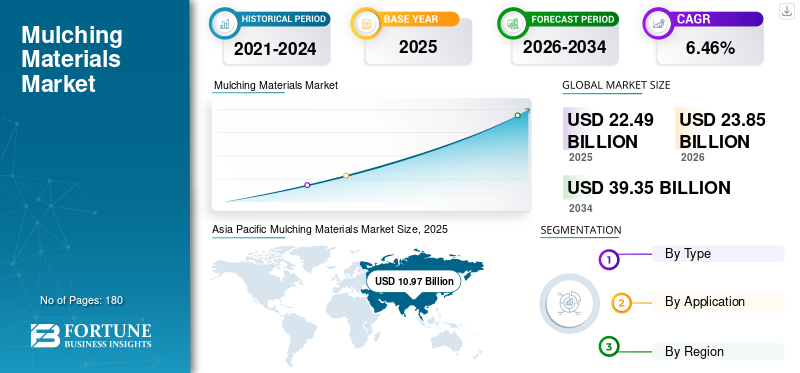
The global mulching materials market size was valued at USD 22.49 billion in 2025. The market is projected to grow from USD 23.85 billion in 2026 to USD 39.35 billion by 2034, exhibiting a CAGR of 6.46% during the forecast period. Asia Pacific dominated the mulching materials market with a market share of 6.8% in 2025.
Mulching materials are added to the top of the soil to help retain moisture, control temperature, prevent weed growth, and improve soil moisture and health. These materials can be organic, such as wood chips, straw, bark, compost, and leaves. They can also be inorganic mulching, such as plastic films, rubber, or gravel. The mulch market is growing rapidly as more people adopt sustainable farming and landscaping practices. As more farmers learn about the benefits of saving water, protecting soil, and improving crop yields, demand for mulch is increasing. The rise of horticulture, urban gardening, and landscaping projects, along with government support for eco-friendly farming, is driving the popularity of mulch materials worldwide.
Companies such as BASF SE, Berry Global Inc., Novamont S.p.A., and RKW Group, among others, are some of the key players operating in this market. Strategic initiatives such as partnerships, capacity expansions, and product diversification are the key strategies that are boosting product sales and supporting market growth.
Download Free sample to learn more about this report.
Mulching Materials Market Takeaways
 Market Size & Forecast
- 2025 Market Size: USD 22.49 billion
- 2026 Market Size: USD 23.85 billion
- 2034 Forecast Market Size: USD 39.35 billion
- CAGR: 6.46% from 2026–2034
 Market Share
- Asia Pacific dominated the mulching materials market with a 46.8% share in 2025.
- The organic type segment is expected to grow at a CAGR of 6.60% during the forecast period.
- The horticulture and floriculture segment is projected to grow at a CAGR of 7.07% through 2034.
 Key Regional Highlights
North America
North America reached a market value of USD 5.26 billion in 2025, supported by advanced agricultural technologies and increasing demand for crop protection solutions.
Europe
Europe recorded a market valuation of USD 2.61 billion in 2025, benefiting from strong environmental regulations and sustainable agriculture initiatives.
Asia Pacific
Asia Pacific led the global market with a valuation of USD 10.97 billion in 2025, driven by extensive agricultural activities and growing adoption of sustainable farming practices.
U.S.
The market reached USD 4.57 billion in 2025, driven by widespread use of mulching materials in commercial farming and landscaping applications.
Japan
The market was valued at approximately USD 1.05 billion in 2025, accounting for 4.46% of global revenues, supported by intensive horticulture and high-value crop cultivation.
Read More

MULCHING MATERIALS MARKET TRENDS
Increasing Preference for Eco-Friendly Mulch Films Driving Product Innovation
The mulching materials market is shifting toward biodegradable, sustainable products as regulations and consumer preferences drive demand for eco-friendlier options. More companies are using advanced polymer technologies to make mulch films stronger and longer-lasting. Colored mulch films are becoming more popular because they help control soil temperature and light reflection, thereby improving crop growth. The growth of greenhouse farming and protected cultivation is also increasing demand for mulching products. Digital agriculture and precision farming are driving more farmers to use mulch in their crop management, fuelling the mulching materials market growth.
MARKET DYNAMICS
MARKET DRIVERS
Download Free sample to learn more about this report.
Increasing Adoption of Sustainable Farming Practices Accelerating Demand for Mulching Materials
The mulching materials market is growing as more farmers adopt sustainable practices and seek ways to boost crop yields. Farmers are increasingly using mulch to keep soil moist, regulate temperature, and reduce weed growth. This helps them achieve higher yields and lower costs. Concerns about water shortages, especially in dry areas, are making mulching solutions even more popular. The market is also growing as more people engage in horticulture, landscaping, and greenhouse farming. Government programs that encourage modern farming and soil conservation are helping more people use mulching materials. As organic farming becomes more popular, more people are seeking biodegradable, natural mulch materials.
MARKET RESTRAINTS
High Cost of Advanced Mulch Products and Environmental Concerns Over Plastic Waste Limiting Wider Market Adoption
A key challenge for the market is the high upfront cost of some mulching materials, especially plastic films and newer biodegradable mulching films. Getting rid of non-biodegradable plastic mulch raises environmental concerns, leading to regulations in some areas. Many small-scale farmers in developing countries are unaware of these products, limiting their use. Installing and removing mulch often requires significant manual labor, complicating operations. The supply and consistency of mulch can be affected when raw materials, especially for organic types, are not always available. All of these issues make it difficult for the market to grow, especially in areas where farmers are price-sensitive and have limited access to new technology.
MARKET OPPORTUNITIES
Growing Shift Toward Biodegradable Solutions and Expanding Use in Modern Agriculture Creating New Growth Potential
There are many opportunities to develop and use biodegradable, eco-friendly mulch materials to help address plastic waste. New advances in materials science now make it possible to produce mulch films that break down naturally, reducing both disposal costs and environmental impact. There are also new growth opportunities as these materials are used more in urban landscaping, gardening, and turf management. Using mulch materials together with precision agriculture and smart farming can make farming more efficient and encourage more people to adopt these practices.
Segmentation Analysis
By Type
Superior Durability and Cost Efficiency Benefits Driving Dominance of the Synthetic Segment
The market is segmented by type into organic, inorganic, and synthetic.
The synthetic segment held the largest mulching materials market share in 2025, since it is durable, cost-effective, and performs reliably in large-scale farming. Polyethylene films are popular because they help soil retain moisture, suppress weeds, and regulate temperature, which can boost crop yields. Their consistent quality and easy use make them a good fit for machine-based farming, especially in developed countries.
The organic type holds the second-largest market share and is expected to grow at a CAGR of 6.60% during the forecast period, as it is environmentally friendly and improves soil health over time. Materials such as wood chips, compost, and leaves add nutrients to the soil as they break down, improving soil structure and supporting healthy microbes. Because of these benefits, organic mulching is especially popular in organic farming and home gardening.
By Application
To know how our report can help streamline your business, Speak to Analyst
Large-Scale Cultivation Needs and Yield Optimization Requirements Driving Dominance of Commercial Agriculture
Based on application, the market is segmented into commercial agriculture, horticulture and floriculture, commercial landscaping, and residential and DIY.
The commercial agriculture segment accounted for the largest market share in 2025, as it operates on a large scale and aims to maximize crop yield and efficiency. Farmers in this sector often use mulch materials, especially synthetic ones, to keep soil moist, control temperature, and prevent weeds. This helps boost productivity and lowers labor and irrigation costs. Mechanized farming also encourages the use of mulch films because they are compatible with modern farm equipment. Additionally, increasing demand for high-quality produce and the need for year-round cultivation are driving the use of mulching in crops such as vegetables, fruits, and cash crops.
Horticulture and floriculture make up the second-largest share of the market, which is expected to grow at a CAGR of 7.07% during the forecast period. This is due to more people wanting fruits, vegetables, ornamental plants, and flowers, both at home and abroad. Mulching materials are commonly used in this area to improve soil and help plants grow better. This is especially important for valuable crops and decorative plants. Organic mulch is especially popular here because it enriches the soil and supports sustainable farming methods.
Mulching Materials Market Regional Outlook
By region, the market is categorized into Europe, North America, Asia Pacific, South America, and the Middle East & Africa.
Asia Pacific
Asia Pacific Mulching Materials Market Size, 2025 (USD Billion)
To get more information on the regional analysis of this market, Download Free sample
The Asia Pacific market was valued at USD 10.97 billion in 2025 and is the leading region in the world. The Asia Pacific region is seeing the fastest growth in the market, driven by major agricultural economies such as China and India. A growing population, rising food demand, and government support for modern farming are the main drivers of demand for mulching materials. Plastic mulch films are popular because they are affordable and help increase crop yields while saving water. The growth of horticulture and the adoption of protected farming methods are also increasing demand for mulching materials. Overall, rapid agricultural modernization and increasing investments in farming infrastructure are accelerating market expansion.
India Mulching Materials Market
The India market in 2025 was valued at around USD 2.23 billion, accounting for roughly 9.90% of global market revenues.
China Mulching Materials Market
China’s market in 2025 was valued at around USD 4.63 billion, representing roughly 4.67% of the global share. China is a major market for mulching materials. This is boosted by the country’s large-scale farming and government support for modern agricultural methods. China produces mulch materials at a low cost and uses them widely for many different crops. But concerns about plastic waste have made people pay more attention to biodegradable options.
Japan Mulching Materials Market
The Japanese market in 2025 reached a valuation of around USD 1.05 billion, accounting for roughly 4.46% of global market revenues.
North America
The market in North America reached a valuation of USD 5.26 billion in 2025. The market in North America is well-established, due to advanced farming methods and widespread use of plastic mulch films in the U.S. and Canada. People in the region are highly aware of soil conservation, water management, and ways to improve crop yields. Commercial farms and greenhouses drive much of the demand, while landscaping and gardening also support market growth. New rules and sustainability efforts are likely to shape how products are developed and used in the future.
U.S. Mulching Materials Market
In 2025, the U.S. market reached USD 4.57 billion. The U.S. market is well established, with the key factors being large-scale commercial farming and modern agricultural technology adoption among farmers in this country. Plastic mulch is commonly used in growing fruits and vegetables to boost yields, manage weeds, and improve irrigation efficiency. Farmers are adopting mulching materials because they are more aware of soil conservation and want to use resources efficiently. In addition, landscaping and gardening also play a pivotal role in driving demand for mulching materials. Environmental concerns and regulatory pressures are encouraging the development and adoption of biodegradable mulch solutions. Ongoing innovation and reliable distribution networks are helping the U.S. market grow steadily.
Europe
The European market reached a valuation of USD 2.61 billion in 2025. Europe’s market is shaped by strict regulations and a strong commitment to sustainability. Germany, France, and Italy are leading markets, owing to their use of eco-friendly farming methods and biodegradable mulch films. The region’s push to reduce plastic use is accelerating the development of organic mulch materials. However, strict environmental regulations can increase manufacturers' compliance costs.
Germany Mulching Materials Market
The market in Germany in 2025 reached around USD 0.55 billion, representing roughly 2.43% of global market revenues. The market in Germany is growing due to a strong focus on sustainability and environmentally friendly farming methods. Mulch is mainly used in horticulture and organic farming in Germany to help improve soil health and support urban green spaces.
U.K. Mulching Materials Market
The U.K. market reached approximately USD 0.30 billion in 2025, equivalent to around 1.34% of global market sales.
South America and Middle East & Africa
Over the forecast period, South America is expected to experience significant growth in this market. The South America market in 2025 recorded USD 2.52 billion. The market in South America is experiencing steady growth as agricultural activity expands in countries such as Brazil and Argentina. A strong focus on export crops, such as fruits and vegetables, is leading more farmers in the region to adopt mulching techniques to boost yields and quality. Plastic mulch is the most common choice because it is affordable and works well.
As more people learn about sustainable farming and gradually adopt modern agricultural products, the market is expected to continue growing. The Middle East & Africa region reached a valuation of USD 1.12 billion in 2025. The mmarket in the Middle East and Africa is growing as these regions seek better ways to manage water in arid areas. Countries such as Israel, the UAE, and Saudi Arabia are using mulching to boost crop yields and reduce water loss. Greenhouse farming and protected agriculture are important areas where the market is expanding. However, limited awareness, high dependency on imports, and cost sensitivity in parts of Africa can hinder adoption.
UAE Mulching Materials Market
The UAE market is set to grow at a CAGR of 5.32% during the forecast period. The UAE market is growing as the country is adopting advanced ways to manage water and support sustainable farming in its dry climate. But the market relies heavily on imports, which can affect prices. Even so, more investment in controlled environment farming and a stronger focus on sustainability are likely to support steady growth in the UAE market.
COMPETITIVE LANDSCAPE
Key Industry Players
Rising Environmental Regulations and Demand for Sustainable Solutions Driving Competition Among Players
The mulching materials market includes a range of global polymer makers, agricultural input firms, and local suppliers. These companies compete in both synthetic and biodegradable product segments. Major companies including BASF SE, Berry Global Inc., Novamont S.p.A., and RKW Group are developing new products, particularly biodegradable and sustainable mulch films, to meet evolving environmental regulations. Large companies rely on strong distribution networks, advanced manufacturing, and research and development investments to stay ahead of their competitors. Regional companies, particularly in Asia-Pacific, compete by keeping costs down and using locally available raw materials.
LIST OF MULCHING MATERIALS COMPANIES PROFILED IN REPORT
- Berry Global Inc. (U.S.)
- BASF SE (Germany)
- RKW Group (Germany)
- Novamont S.p.A. (Italy)
- Armando Alvarez Group (Spain)
- Kuraray Co., Ltd. (Japan)
- Ab Rani Plast Oy (Finland)
- Trioplast Industrier AB (Austria)
- Coveris Holdings S.A. (U.S.)
- Ohio Mulch (U.S.)
KEY INDUSTRY DEVELOPMENTS
- December 2025: Novamont announced that its Mater-Bi mulch film now meets the requirements of the EU Fertilizer Regulation 2019/1009. This certification is an important step in confirming the environmental and agronomic benefits of biodegradable mulch films.
- November 2025: China Petroleum and Chemical Corporation introduced a successful pilot of polybutylene succinate co-terephthalate biodegradable mulch film in China. It helps to address the plastic pollution in China.
- October 2025: ENRICH ENVIRONMENTAL LIMITED, a company that makes mulching materials, has introduced Enrich Landscape Mulch to the market. This product offers a practical and sustainable way to use every part of the composting process and supports moisture retention.
- March 2024: Blue Skies and the FRESHPPACT team have started testing new alternatives to plastic mulch on pineapple farms. The University of Northampton is leading trials of farm mulch made from coconut coir by Coco360 and biodegradable mulch from CSIR South Africa.
- October 2023: Mondi, a global leader in sustainable packaging and paper, is supporting farmers by partnering with Cotesi, a company that produces twine, nets, and ropes from both synthetic and natural materials for agricultural use. Together, they aim to replace traditional plastic mulch film with a paper-based solution called Advantage Kraft Mulch.
REPORT COVERAGE
The global mulching materials market research provides an in-depth study of the market size & forecast by all the market segments included in the report. The mulching materials market analysis includes details on the market dynamics and market trends expected to drive the market during the forecast period. It offers information on the technological advancements, new product launches, key industry developments, and details on partnerships, mergers & acquisitions. The mulching materials market forecast also encompasses a detailed competitive landscape with information on the market segmentation, market share, and profiles of key operating players.
Request for Customization to gain extensive market insights.
Report Scope & Segmentation
| ATTRIBUTE | DETAILS |
| Study Period | 2021-2034 |
| Base Year | 2025 |
| Estimated Year | 2026 |
| Forecast Period | 2026-2034 |
| Historical Period | 2021-2024 |
| Growth Rate | CAGR of 6.46% from 2026-2034 |
| Unit | Value (USD Billion) |
| Segmentation | By Type, By Application, and Region |
| By Type |
|
| By Application |
|
| By Region |
|
Frequently Asked Questions
Fortune Business Insights says that the global market value stood at USD 22.49 billion in 2025 and is projected to reach USD 39.35 billion by 2034.
In 2025, the Asia Pacifics market value stood at USD 10.97 billion.
The market is expected to exhibit a CAGR of 6.46% during the forecast period.
By application, the commercial agriculture segment led the global market in 2025.
Rising adoption of sustainable farming practices and the need for higher crop productivity are accelerating demand for mulching materials.
BASF SE, Berry Global Inc., Novamont S.p.A., and RKW Group are a few of the players in the mulching materials market.
Asia Pacific held the largest market share in 2025.
Increasing preference for eco-friendly mulch films and precision farming practices is driving product innovation and market evolution.



- 2021-2034
- 2025
- 2021-2024
- 180
-
(Offer valid till 15th Oct 2026)
Get 30-60 hrs Free Customization
Expand Regional and Country Coverage, Segments Analysis, Company Profiles, Competitive Benchmarking, and End-user Insights.

















Related Reports
-
US +1 833 909 2966 ( Toll Free )
-
Get In Touch With Us