Multiple Effect Distillation Market Size, Share & Industry Analysis, By Type (Batch Distillation and Continuous Distillation), By Technology (Thermal Distillation and Membrane Distillation), By End User (Municipal, Industrial, Power Generation, and Others), and Regional Forecast, 2026-2034
 Download Free Sample
KEY MARKET INSIGHTS
 Listen to Audio Version
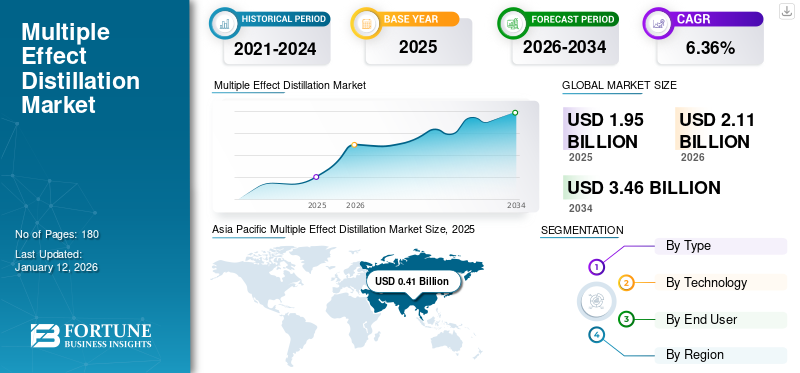
The global multiple effect distillation market size was valued at USD 1.95 billion in 2025. The market is projected to grow from USD 2.11 billion in 2026 to USD 3.46 billion by 2034, exhibiting a CAGR of 6.36% during the forecast period. Asia Pacific dominated the multiple effect distillation market with a share of 20.95% in 2025.
Multiple Effect Distillation (MED) is a thermal desalination technology that uses low-pressure steam and electricity to produce distilled water from seawater, and it is considered a preferred technology in the growing desalination market due to its lower energy consumption compared to traditional methods. MED offers lower energy consumption, simple operation, and high reliability compared to other desalination technologies such as Multi-Stage Flash (MSF). MED is used for producing distilled and potable water and in applications where steam or waste heat from power production or chemical processes are available.
- In March 2025, the Government of Cyprus announced plans to subsidize the construction of private desalination plants at hotels to facilitate tourism operations in the country.
The Multiple Effect Distillation (MED) market is driven by increasing global water scarcity, growing industrial and municipal water demands, and the rising operational cost of traditional water sources, making MED an attractive and efficient desalination technology.
Alfa Laval is a prominent player in the multiple-effect distillation market, offering solutions such as the MEP (Multi-Effect Plate) evaporator and TVC (Thermo Vapour Compression) systems for freshwater generation, particularly for marine and power plant applications.
Download Free sample to learn more about this report.
Multiple Effect Distillation Market Key Takeaways
 Market Size & Forecast
- 2025 Market Size: USD 1.95 billion
- 2026 Market Size: USD 2.11 billion
- 2034 Forecast Market Size: USD 3.46 billion
- CAGR: 6.36% from 2026–2034
 Market Share
- Asia Pacific dominated the multiple effect distillation market with a share of 20.95% in 2025.
- Continuous distillation held the largest market share due to its efficiency in large-scale water treatment and desalination applications.
- Membrane distillation emerged as the leading technology segment owing to its lower energy consumption and operational efficiency.
 Key Regional Highlights
Asia Pacific
Asia Pacific accounted for USD 0.41 billion in 2025 and continues to benefit from rapid urbanization, industrialization, and increasing demand for clean water solutions.
North America
North America generated USD 0.23 billion in 2025, driven by rising water scarcity concerns, population growth, and demand for sustainable water treatment technologies.
Europe
Europe reached USD 0.24 billion in 2025, supported by growing investments in desalination plants, water reuse projects, and water infrastructure development.
U.S.
Increasing freshwater demand across industrial sectors, including pharmaceuticals, food & beverages, and manufacturing, is supporting the adoption of multiple effect distillation systems.
Japan
Growing focus on water security, advanced desalination technologies, and industrial wastewater management is contributing to market expansion in the country.
Read More

MARKET DYNAMICS
MARKET DRIVERS
Increasing Demand for Sustainable Water Desalination Solutions to Drive Market Growth
The market for multiple effect distillation is driven by the need for efficient, reliable, and sustainable water desalination solutions, particularly in regions facing water scarcity, with MED's low energy consumption and ability to utilize low-grade heat being key advantages. Increasing global population and climate change are leading to water scarcity in many regions, making desalination technologies such as MED increasingly important. The need for clean water for both municipal and industrial purposes is a major driver, with MED offering a reliable solution for producing high purity water.
- In October 2024, Beam Global announced the launch of the BeamWell water desalination solution to provide clean water and electricity in the U.S.
MARKET RESTRAINTS
Environmental Concerns Related to Brine Disposal Restrain Market Growth
Environmental concerns regarding brine disposal, a highly concentrated salt stream produced during desalination, are a major restraint on the multiple effect distillation market growth, impacting marine ecosystems and requiring costly disposal solutions. Desalination processes, such as MED, produce a concentrated salt solution (brine) as a byproduct that needs to be disposed of. Environmental regulations and public pressure are increasingly focused on reducing the environmental impact of desalination, including brine disposal. Some industries are exploring ZLD systems that aim to minimize or eliminate liquid discharge, including brine, by recovering valuable resources from the wastewater stream.
MARKET OPPORTUNITIES
Increasing Scarcity of Freshwater Creates Lucrative Opportunities
The increasing scarcity of freshwater, coupled with the growing demand for water, creates significant market opportunities for Multiple Effect Distillation (MED), offering a sustainable and potentially lucrative business venture. The world's population is growing, positively affecting demand for water for agriculture, industry, and domestic use.
- In December 2024, Tetra Technologies, Inc. introduced Oasis total desalination solution for end-to-end water treatment and desalination to reuse water extracted from oil & gas
Such developments in the market are expected to create lucrative opportunities in the coming years.
MULTIPLE EFFECT DISTILLATION MARKET TRENDS
Expansion of Industrial Activities to Positively Impact the Market Growth
The expansion of industrial activities globally is one of the major trend leading to the adoption of Multiple Effect Distillation (MED) systems, as industries face increasing demand for high-purity water and efficient wastewater treatment solutions. As manufacturing operations scale up in sectors such as chemicals, pharmaceuticals, food and beverage, and energy, the need for reliable and energy-efficient distillation technologies becomes critical. MED offers a cost-effective solution for processing large volumes of water, enabling industries to recover resources, meet regulatory standards, and reduce environmental impact. Its ability to operate using waste heat and its compatibility with zero liquid discharge systems make it an attractive choice for industrial facilities aiming to optimize water usage and minimize discharge. This growing industrial footprint, especially in water-stressed regions, is fueling significant investment in MED systems as part of broader sustainability and operational efficiency goals.
Download Free sample to learn more about this report.
Segmentation Analysis
By Type
Continuous Distillation Leads due to Increasing Demand for Clean Water and Spirits in Large Scale Applications
Based on type, the market is classified into batch distillation and continuous distillation.
Continuous distillation dominated the market for multiple-effect distillation, particularly due to large-scale applications such as water treatment and desalination owing to its efficiency and capacity. The market for distillation systems, encompassing batch, continuous, and multiple-effect distillation, is experiencing growth, driven by increasing demand for distilled water, spirits, and chemicals, with continuous distillation dominating large-scale applications and batch distillation favored for smaller, flexible processes.
Batch distillation is commonly used for small-scale operations, specialty chemicals, pharmaceutical intermediates, and solvent recovery, offering flexibility and the ability to handle varying compositions. Furthermore, continuous distillation is more suitable for large-scale operations, fractional distillation of petroleum, and bulk petrochemicals, where the feed water composition is relatively stable. The market for distillation systems is projected to grow, with factors such as the increasing demand for distilled water and spirits being key drivers.
By Technology
Low Energy Consumption and Efficiency Makes Membrane Distillation Dominant
Based on technology, the market is classified into thermal distillation and membrane distillation.
Membrane distillation emerged as dominating segment owing to the efficiency and lower energy consumption. The market demand for desalination technologies, including thermal distillation (multi-effect distillation and multi-stage flash) and membrane distillation, is driven by increasing water scarcity and the need for reliable freshwater sources, with membrane distillation gaining traction for its improved energy efficiency and adaptability.
- In April 2023, Heliovis announced plans to develop the world’s first thermal water desalination plant to treat drinking water; the plant is located in Qarat al Milh, Oman. Hence, technological development by the market players in distillation technology will propel market growth over the forecast period.
By End User
Municipal is the Leading End User Owing to Increasing for Clean Water Scarcity
Based on end user, the market is segmented into municipal, industrial, power generation, and others.
The municipal segment dominated the market, driven by the growing demand for drinking water and the need for reliable water supplies in urban areas. Moreover, the demand for multiple effect distillation in power generation sector is expected to increase in region such as the Middle East & Africa which are mainly operating on the thermal energy. The countries in this region are expected to integrate multiple effect distillation systems to utilize low grade waste heat for seawater desalination to enhance freshwater and electricity production simultaneously. Furthermore, others include applications such as agriculture, mining, and aquaculture.
The growth of industrial and utility sectors, particularly the increasing demand for distilled water and the adoption of desalination techniques, will drive the growth of the multiple-effect distillation (MED) market across globe in coming years.
Multiple Effect Distillation Market Regional Outlook
By region, the market is categorized into North America, Europe, Asia Pacific, Latin America, and the Middle East & Africa.
North America
Asia Pacific Multiple Effect Distillation Market Size, 2025 (USD Billion)
To get more information on the regional analysis of this market, Download Free sample
In 2025, North America held 11.82% of the global market share, reaching a valuation of USD 0.23 billion, and is projected to grow to USD 0.25 billion in 2026. The demand for multiple effect distillation systems in North America is expected to grow, driven by rising water scarcity, population growth, and increasing awareness about clean water consumption. Increasing water scarcity and pollution, along with climate change, are driving the need for desalination technologies such as MED. The growing water requirements of industries such as pharmaceuticals, food and beverages, and manufacturing, particularly in fast-developing economies, also contribute to the demand for water desalination.
- In March 2025, Ocean Well Co announced the development of new deep-sea desalination technology which is under testing in California, U.S. Moreover, the company plans to develop a water farm anchored to the ocean floor near Malibu.
Europe
The market in Europe reached USD 0.24 billion in 2025, representing 12.30% of total market revenue, and is projected to reach USD 0.25 billion in 2026. The multiple effect distillation market in Europe is expected to grow due to increasing water scarcity, climate change, and government initiatives for water infrastructure development and desalination plant construction. Desalination is becoming a conventional method for water treatment globally, driven by the need to address water scarcity caused by population growth and climate change. Europe is also facing water scarcity challenges, leading to the need for innovative solutions such as desalination. Governments are announcing investment plans for water reuse, desalination plant construction, and water infrastructure improvements.
- In September 2023, the Government of Spain announced an investment of USD 12.85 million to tackle drought afflict in the country due to low rainfall. The inclination of the government towards improving water infrastructure is expected to propel market growth in the region over the forecast period.
Asia Pacific
Asia Pacific dominated the market with a valuation of USD 0.41 billion in 2025 and is projected to reach USD 0.44 billion in 2026. The market in Asia Pacific is experiencing growth due to rising urbanization, industrialization, and the need for clean water, particularly in coastal areas facing water scarcity and saltwater intrusion. Rapid urbanization and industrial growth in China, India, and Japan are driving up the demand for clean water and effective wastewater treatment, boosting the need for MED.
Several pacific island countries are heavily reliant on desalination to meet their entire water needs, making Asia Pacific a key market for desalination systems.
Latin America
In 2025, Latin America generated USD 0.09 billion, contributing 4.80% to global market revenue, and is projected to grow to USD 0.1 billion in 2026. The Latin American MED market is expected to grow due to increasing water scarcity, rapid urbanization, and industrialization, driving demand for desalination technologies such as MED, which is a thermal desalination method. As cities and industries expand, water demand increases, leading to a need for reliable and efficient water sources, including desalinated water. Latin American economies are experiencing growth, leading to increased industrial activity and a higher demand for water, which can be met through desalination.
Middle East & Africa
The Middle East & Africa region captured 50.12% of the global market in 2025, generating USD 0.97 billion in revenue, and is projected to reach USD 1.07 billion in 2026. The Middle East & Africa is experiencing significant growth due to water scarcity, increasing population, and rising industrial and agricultural demands, making desalination a crucial solution. The region faces severe water scarcity, with many countries having limited access to freshwater resources. Saudi Arabia, Algeria, the UAE, and Egypt, are heavily reliant on desalinated water for both municipal and industrial use.
COMPETITIVE LANDSCAPE
Key Industry Players
Key Companies are Focused on Government Desalination Contracts to Augment Market Share
The global multiple effect distillation market is fragmented with companies such as AquaSwiss, Veolia, Bram-Cor, Syntegon, and others, which account for a minimal market share. For instance, in December 2024, Heisco-IHI JV announced a contract worth USD 563 million to upgrade the Doha West Distillation Station located in Kuwait. Under this contract, the company will upgrade steam boilers, thermal units, control systems, and auxiliary systems to enhance the efficiency of the facility. Increasing focus on the acquisition of large-scale government desalination contracts for government facilities has supported the companies’ share in the market.
LIST OF KEY MULTIPLE EFFECT DISTILLATION COMPANIES PROFILED
- ALFA LAVAL (Sweden)
- AquaSwiss (Switzerland)
- Veolia (France)
- Bram-Cor (Italy)
- Syntegon (Germany)
- GEA (Germany)
- Stilmas (Italy)
- E-CHUNG (Taiwan)
- Puretech (U.S.)
- BWT Holding GmbH (Austria)
- Sulzer (Switzerland)
- MECO (India)
KEY INDUSTRY DEVELOPMENTS
- January 2025: The Government of Jordan announced a 30-year contract with Meridiam to desalinate the water of the Red Sea in the Gulf of Aqaba and water supplies to Aqaba and Amman with the capacity to cater water needs of 3 million people.
- September 2024: Siemens, TAQA, and SUEZ announced collaboration for water desalination in emerging countries with development of several desalination units and an industrial demonstration unit.
- June 2024: Government of Tamil Nadu, India announced plans to construct desalination plants in Thoothukudi, India to meet the water demands from new industrial end-users in the region.
- March 2024: The government of Algeria announced the development of 7 new desalination plants between 2025 and 2030. This project will support ongoing large-scale projects located in Cap-blanc (Oran), Fouka 2 (Tipasa), Cap-Djenat 2 (Boumerdes), Bejaïa and El Tarf with the capacity of 300,000 m3/day.
- April 2022: Veolia introduced Barrel, an integrated Reverse Osmosis (RO) technology which is suitable for wastewater reuse and low pressure RO applications. This technology will empower sustainable source of fresh water.
REPORT COVERAGE
Request for Customization to gain extensive market insights.
Report Scope & Segmentation
|
ATTRIBUTE |
DETAILS |
|
Study Period |
2021-2034 |
|
Base Year |
2025 |
|
Estimated Year |
2026 |
|
Forecast Period |
2026-2034 |
|
Historical Period |
2021-2024 |
|
Growth Rate |
CAGR of 6.36% from 2026-2034 |
|
Unit |
Value (USD Billion) |
|
Segmentation |
By Type
|
|
By Technology
|
|
|
By End User
|
|
|
By Region
|
Frequently Asked Questions
Fortune Business Insights says that the global market value stood at USD 1.95 billion in 2025 and is projected to reach USD 3.46 billion by 2034.
In 2025, the market value stood at USD 0.41 billion.
The market is expected to exhibit a CAGR of 6.36% during the forecast period of 2026-2034.
The utility segment led the market by end user.
The key factor driving the market is increasing demand for sustainable water desalination solutions to drive market growth.
ALFA LAVAL, AquaSwiss, Veolia Bram-Cor, and Syntegon, and others are the top players in the market.
Asia Pacific dominated the market in 2025 by holding the largest share.



- 2021-2034
- 2025
- 2021-2024
- 180
Get 30-60 hrs Free Customization
Expand Regional and Country Coverage, Segments Analysis, Company Profiles, Competitive Benchmarking, and End-user Insights.



















Related Reports
-
US +1 833 909 2966 ( Toll Free )
-
Get In Touch With Us