Nanogrid Market Size, Share, and Industry Analysis, By Type (DC Nanogrid and AC Nanogrid), By Application (Residential, Commercial, and Industrial), and Regional Forecast, 2026-2034
 Download Free Sample
KEY MARKET INSIGHTS
The global nanogrid market is expanding owing to the escalating demand for renewable energy installation. Nanogrids are small energy systems, usually serving a single building. They use renewable energy and can work either independently or connected to the main power grid. The grids link up power sources and distribute energy within the building. When several nanogrids are connected, they form a microgrid, allowing them to share power. A nanogrid consists of local power production, such as wind or solar, at least one household appliance such as a refrigerator or lighting, a gateway, a controller, and energy storage. These components work together to generate and manage energy within a building.

In June 2021, Awesense and vadimUS recently announced a partnership aimed at tackling obstacles encountered by electric utilities in the integration of nanogrids, along with addressing power quality challenges for commercial and industrial (CandI) facilities. This collaboration combines the Awesense Digital Energy Platform with VadimUS’ VadiMAP turnkey solution. In essence, the goal is to bridge the divide concerning renewable energy for utilities and CandI customers. The issue of power quality is increasingly significant. Renewables and distributed energy resources (DERs) can help reduce the strain on the centralized grid, although it is necessary to have the proper infrastructure and systems in place to support the transition.
Nanogrid Market Driver
Surging Demand for Renewable Energy to Lead the Market Growth
The rising demand for the installation of renewable energy in households and small commercial purposes has led to the growth of the nanogrid market. The energy systems offer a solution by efficiently using renewable sources such as solar and wind to generate power locally. This reduces reliance on traditional fossil fuels, lowers carbon emissions, and supports the global shift toward clean energy. Moreover, the government's efforts to provide subsidies and tax benefits for the adoption of renewable energies have also supported the growth of the market.
- As per the Department for Energy Security and Net Zero in 2023, the U.K. government announced that it would add USD 7.86 million to its renewable energy subsidies, bringing the total budget for the current auction to USD 282 million.
Nanogrid Market Restraint
High Initial Cost for the Installation of Nanogrids to Constrain the Market Growth
Setting up a nanogrid involves significant investment in components such as renewable energy systems including solar panels, energy storage systems, controllers, and installation infrastructure. These upfront costs act as a barrier, particularly for small businesses, households, or communities with limited budgets.
Nanogrid Market Opportunity
Development of Advanced Storage Systems to Provide Growth Opportunities
The development of battery energy storage systems (BESS) of different types, such as lead acid, lithium-ion, flow batteries, and others, has improved the efficiencies of nanogrids. BESS stores excess energy generated by renewable sources such as solar or wind during periods of high production and releases it when production is low, ensuring a steady energy supply. Moreover, the integration of fuel cells with nanogrids has also been effective in providing power during emergencies
- For instance, U.S. Michigan-based Sesame Solar is creating the world’s first fully-renewable mobile nanogrid for disaster relief. Their units, which can be set up in 15 minutes, serve as mobile command centers, medical units, kitchens, or temporary housing. The systems use solar and battery storage and have green hydrogen fuel cells as backup power.
Segmentation
|
By Type |
By Application |
By Geography |
|
|
|
Key Insights
The report covers the following key insights:
- Key Emerging Trends – For Major Countries
- Latest Technological Advancement
- Insight on Regulatory Landscape
- Porters Five Forces Analysis
- Impact of COVID-19 on the market
Analysis by Type
Based on type, the market is divided into DC nanogrid and AC nanogrid.
AC nanogrids have a significant presence in the market due to their compatibility with traditional AC power systems and infrastructure. It is widely used in residential, commercial, and small industrial settings where AC appliances and systems are standard. Additionally, many buildings and facilities are already set up for AC power, which drives the demand for AC nanogrids.
Analysis by Application
On the basis of application, the market is fragmented into residential, commercial, and industrial.
The residential segment holds a major share in the market owing to the growing inclination toward clean energy technologies. The residential sector mostly requires less power than the commercial and industrial sectors, which leads to the high deployment of nanogrids in the residential sector. Moreover, nanogrids allow homes to generate, store, and manage their energy independently of the main grid. This can be especially valuable during power outages or in areas with unreliable grid infrastructure.
Regional Analysis
Request for Customization to gain extensive market insights.
Based on region, the market has been studied across North America, Europe, Asia Pacific, Latin America, and the Middle East & Africa.
North America accounted for the largest share of the global nanogrid market in 2023. Nanogrids in North America are increasingly seen as a solution for enhancing energy resilience, particularly in areas prone to natural disasters or with unreliable grid infrastructure. They provide backup power and improve the reliability of the energy supply during emergencies.
Europe is the second leading market. The demand for power in individual homes and standalone buildings in remote areas has necessitated the demand for nanogrids. Furthermore, Europe is committed to reducing carbon emissions and increasing the use of renewable energy. Nanogrids support these goals by enabling localized energy production and consumption, integrating renewable sources such as solar and wind, and enhancing energy efficiency.
The Asia Pacific is anticipated to grow considerably over the forecast period owing to the growing focus of the region on integrating renewable energy sources into nanogrids. Solar power is a common choice due to its suitability for many parts of the region, including countries with high solar irradiance.
Key Players Covered
The global nanogrid market is fragmented due to the presence of a large number of group and standalone providers.
The report includes the profiles of the following key players:
- Village Infrastructure (U.K.)
- TimberRock Energy Solutions (U.S.)
- Flexenclosure (Sweden)
- Alpha Group (U.K.)
- NRG Energy (U.S.)
- Trama TechAmbiental (Spain)
- VIA Motors (U.S.)
- Odyne Systems (U.S.)
- Emerson Network Power (U.S.)
Key Industry Developments
- In March 2024, Ann Arbor is investing USD 333,000 in a mobile solar power station with fold-out solar panels to enhance emergency preparedness. The station will provide backup power for critical services during disruptions. It includes an 8-kilowatt solar array, 45 kilowatt hours of battery storage, and a hydrogen fuel cell backup. The city will test if it can power Fire Station 3 near Veterans Memorial Park without a gas generator.
- In September 2023, Sesame Solar and Watergen partnered to create mobile nanogrids that provide power and drinking water. Sesame Solar's system uses solar energy and green hydrogen to generate off-grid power, while Watergen’s technology extracts and purifies water from the air. Together, they ensure a steady supply of deionized water for hydrogen production, improving Sesame Solar's nanogrids.


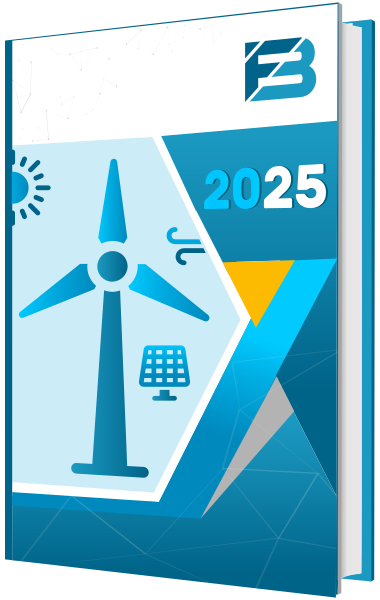
- 2021-2034
- 2025
- 2021-2024
- 70
-

(Offer valid till 15th Oct 2026)
Get 30-60 hrs Free Customization
Expand Regional and Country Coverage, Segments Analysis, Company Profiles, Competitive Benchmarking, and End-user Insights.

















-
US +1 833 909 2966 ( Toll Free )
-
Get In Touch With Us