Natural Food Colors Market Size, Share & Industry Analysis, By Ingredient (Beta Carotene, Lycopene, Anthocyanin), By Form (Powder, Liquid, Gel & Paste), By Application, and Regional Forecast, 2026–2034
 Download Free Sample
Natural Food Colors Market Overview
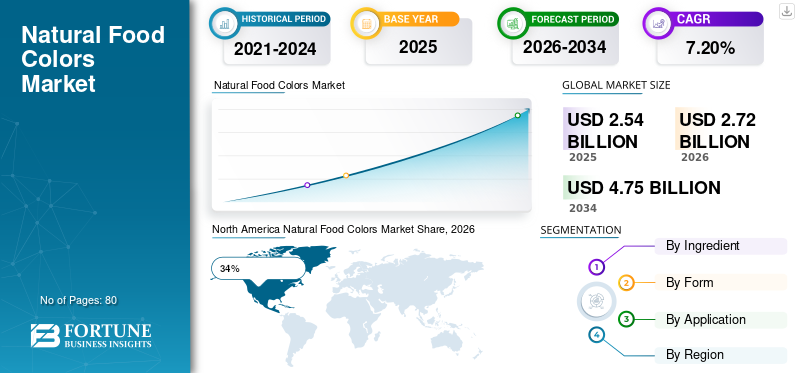
The natural food colors market size was valued at USD 2.33 billion in 2025. The market is projected to grow from USD 2.50 billion in 2026 to USD 4.36 billion by 2034, exhibiting a CAGR of 7.22% during the forecast period.

The natural food colors market is expanding steadily due to growing consumer preference for clean-label ingredients, plant-derived additives, and minimally processed food products. Food manufacturers are increasingly replacing synthetic dyes with natural pigments extracted from fruits, vegetables, algae, flowers, and spices. The demand for beta carotene, anthocyanin, chlorophyll, spirulina extract, turmeric extract, and lycopene has increased across bakery, confectionery, dairy, beverages, and processed food sectors. natural food colors market Analysis indicates that regulatory support for safer ingredients and rising awareness regarding artificial additive side effects are influencing purchasing decisions globally. Natural Food Colors Industry Report findings show strong adoption across premium packaged food brands, functional nutrition categories, and organic food manufacturing operations.
The USA natural food colors market holds approximately 29% market share due to high consumption of organic beverages, naturally flavored snacks, and clean-label confectionery products. More than 72% of American consumers actively check ingredient labels before purchasing processed foods, increasing demand for naturally sourced food pigments. The United States food processing industry continues integrating carotenoid-based and fruit-derived colors in ready-to-drink beverages, dairy desserts, bakery fillings, and plant-based protein products. natural food colors market Research Report data shows strong utilization of turmeric extract, beetroot red, and spirulina blue among beverage manufacturers. Expanding vegan product launches and growing investments in healthy packaged foods continue strengthening the USA natural food colors market Outlook.
Download Free sample to learn more about this report.
Natural Food Colors Market Key Takeaways
 Global Market Size & Forecast
- 2025 Market Size: USD 2.33 Billion
- 2026 Market Size: USD 2.50 Billion
- 2034 Forecast Market Size: USD 4.36 Billion
- CAGR: 7.22% from 2026-2034
 Market Share
- The market in North America dominated with a regional share of 34% in 2025.
- Beta carotene held approximately 34% share of the global market.
- Powder formulations accounted for nearly 43% share of the market.
 Key Regional Highlights
North America
North America led the market with a 34% regional share, supported by growing demand for clean-label food products.
Europe
Europe accounted for 29% of the market, driven by rising adoption of natural and organic ingredients.
Asia-Pacific
Asia-Pacific held 28% share, supported by expanding food and beverage manufacturing.
U.S.
The U.S. remains a major market, supported by strong demand for clean-label and naturally colored food products.
Japan
Japan accounted for 21% of the Asia-Pacific market, supported by demand for premium and functional food products.
Read More

Natural Food Colors Market Latest Trends
The natural food colors market Trends indicate accelerating demand for botanical extracts and fruit-based pigments in packaged foods and beverages. Manufacturers are replacing synthetic additives with turmeric, spirulina, carrot concentrates, safflower, paprika, and red cabbage extracts to align with clean-label product positioning. More than 64% of newly launched confectionery products globally now contain naturally sourced coloring ingredients. Beverage producers are increasingly using water-soluble natural pigments in energy drinks, flavored waters, kombucha, and nutritional beverages.
natural food colors market Growth is also driven by vegan food expansion and rising consumer awareness regarding artificial additives. Plant-based meat manufacturers are incorporating beetroot extracts and paprika oleoresins to improve product appearance and texture appeal. Around 58% of plant-based food launches now contain natural color formulations. Microencapsulation technology is emerging as a major innovation area because it improves heat stability, UV resistance, and shelf-life performance for sensitive pigments.
Download Free sample to learn more about this report.
Natural Food Colors Market Dynamics
DRIVER
Rising Demand for Clean-Label and Plant-Based Food Products.
The natural food colors market Size is increasing significantly due to growing consumer preference for clean-label and naturally sourced food ingredients. More than 69% of global consumers prefer products containing recognizable ingredients without synthetic additives. Food manufacturers are reformulating processed foods, beverages, confectionery, and dairy products using natural pigments to align with evolving regulatory standards and health-conscious purchasing behavior. Plant-based food consumption increased by 41% across urban retail markets during recent years, directly boosting demand for beetroot extract, paprika oleoresin, spirulina, and anthocyanin formulations. natural food colors market Opportunities are expanding in premium beverage and organic snack categories where ingredient transparency strongly influences buying decisions. Regulatory restrictions on synthetic additives across North America and Europe are further accelerating commercial adoption of natural coloring ingredients across large-scale food processing operations.
RESTRAINT
Limited Stability and Higher Production Costs of Natural Pigments.
natural food colors market Forecast assessments indicate that instability under heat, light, and varying pH conditions remains a major limitation for manufacturers. Many naturally sourced pigments lose intensity during high-temperature processing and extended storage cycles. Anthocyanin and chlorophyll-based shades are especially vulnerable to oxidation and color degradation in beverage applications. Production costs for natural color extraction remain significantly higher due to agricultural dependency, seasonal variability, and complex purification requirements. Around 37% of small food manufacturers still rely partially on synthetic additives because of lower operational expenses and longer shelf stability. Supply chain disruptions affecting raw materials such as turmeric, berries, paprika, and algae also create pricing volatility. These operational challenges continue to limit broader penetration among cost-sensitive food processing industries and mass-market packaged food manufacturers.
OPPORTUNITY
Expansion of Natural Pigments In Functional Beverages and Nutritional Foods.
Natural Food Colors Industry Analysis highlights substantial opportunities in functional beverages, nutritional supplements, protein drinks, and fortified snacks. Consumer preference for wellness-oriented products has increased sharply, with nearly 61% of health-focused consumers preferring products containing plant-derived ingredients. Beverage companies are introducing naturally colored sports drinks, vitamin beverages, kombucha products, and probiotic formulations targeting younger demographics. Blue spirulina extracts, purple sweet potato pigments, and fruit-derived anthocyanins are gaining strong commercial adoption due to their visual appeal and antioxidant positioning. natural food colors market Outlook remains favorable as foodservice chains and premium cafés increasingly utilize natural ingredients in desserts, smoothies, and specialty beverages. Technological developments in encapsulation and emulsion stabilization are also creating opportunities for broader application across heat-processed and shelf-stable food products.
CHALLENGE
Raw Material Sourcing Inconsistency and Regulatory Compliance Complexity.
The natural food colors market faces major challenges associated with agricultural dependency and international regulatory differences. Natural pigments derived from fruits, vegetables, flowers, and algae often experience seasonal supply fluctuations caused by climate conditions, crop diseases, and export restrictions. Around 33% of ingredient manufacturers reported procurement disruptions affecting production consistency during recent years. Regulatory approval frameworks also vary significantly between regions, creating formulation and labeling challenges for multinational food companies. Certain pigment extraction methods and solvent-processing standards require separate compliance certifications in North America, Europe, and Asia-Pacific markets. Maintaining uniform color intensity across different production batches remains another technical challenge for manufacturers.
Natural Food Colors Market Segmentation
By Ingredient
Beta carotene accounts for nearly 34% of the natural food colors market Share due to extensive application across dairy products, beverages, margarine, bakery products, and nutritional supplements. This pigment is widely extracted from carrots, algae, and palm sources and is preferred for its orange-yellow color intensity and antioxidant properties. More than 52% of fortified beverage manufacturers utilize beta carotene-based formulations because of their dual functionality as both colorants and nutritional additives. natural food colors market Analysis indicates rising demand from plant-based food manufacturers using beta carotene to enhance appearance in vegan cheese, dairy alternatives, and meat substitutes.
Lycopene holds approximately 21% market share in the natural food colors market and is increasingly utilized across sauces, processed foods, beverages, confectionery, and nutritional supplements. Tomato-derived lycopene is highly preferred due to its bright red coloration and antioxidant characteristics. More than 44% of natural red pigment demand in processed sauces and savory foods is fulfilled by lycopene formulations. Natural Food Colors Industry Report findings reveal increasing investment in microencapsulated lycopene ingredients for enhanced heat stability and extended shelf performance. Beverage manufacturers are also integrating lycopene extracts into wellness drinks and antioxidant-rich product categories.
Anthocyanin represents nearly 26% of natural food colors market Size due to rising demand for purple, blue, and red shades in premium beverages, confectionery, and dairy products. These pigments are commonly extracted from berries, grapes, purple sweet potatoes, and red cabbage. Around 49% of naturally colored fruit beverage launches now contain anthocyanin-based formulations. natural food colors market Trends indicate strong growth in premium bakery and yogurt applications where vibrant fruit-derived shades improve product appeal. Anthocyanin pigments are also gaining traction in organic snack products and functional nutrition categories due to antioxidant positioning.
To know how our report can help streamline your business, Speak to Analyst
By Form
Powder formulations account for nearly 43% of the natural food colors market Share because of their superior storage stability, reduced transportation costs, and longer shelf life. Powdered pigments are extensively used in dry bakery mixes, confectionery products, seasoning blends, powdered beverages, and nutritional supplements. More than 58% of industrial bakery manufacturers prefer powder-based natural colors for easier blending and dosage accuracy. natural food colors market Forecast assessments show increasing use of spray-dried fruit and vegetable concentrates in snack coatings and instant beverage products. Powder formats also support lower moisture exposure and better pigment preservation during long-term storage.
Liquid natural food colors hold approximately 37% market share and are highly preferred in beverage manufacturing, dairy products, syrups, sauces, and liquid nutritional products. Beverage manufacturers increasingly utilize liquid pigments because they offer rapid mixing efficiency and uniform color dispersion. Around 63% of naturally colored beverage launches use liquid-format pigments derived from turmeric, beetroot, spirulina, and fruit concentrates. natural food colors market Opportunities are expanding in flavored waters, energy drinks, smoothies, and alcoholic beverage alternatives. Manufacturers are also developing water-soluble and oil-soluble liquid formulations to improve compatibility across diverse product categories.
Gel and paste formulations represent nearly 20% of the natural food colors market and are widely utilized in bakery decoration, confectionery coatings, icing applications, desserts, and premium processed foods. These formats offer concentrated pigmentation and improved texture consistency for artisan and industrial food applications. More than 46% of commercial bakery decoration manufacturers utilize gel-based natural pigments due to superior application control and vibrant color intensity. natural food colors market Growth in this segment is strongly influenced by rising premium dessert consumption and increasing demand for customized cake decoration products.
Natural Food Colors Market Regional Outlook
North America
North America Natural Food Colors Market Share, 2026 (%)
To get more information on the regional analysis of this market, Download Free sample
North America dominates the natural food colors market with approximately 34% market share due to strong demand from beverage, confectionery, bakery, dairy, and processed food industries. The United States remains the largest contributor because food manufacturers are increasingly replacing artificial dyes with plant-derived ingredients such as spirulina, turmeric, beetroot, and paprika extracts. natural food colors market Analysis indicates that more than 63% of premium beverage launches in North America now feature naturally sourced pigments to attract health-conscious consumers. Major food processing companies continue investing in advanced extraction and stabilization technologies to improve pigment shelf life and thermal resistance. Canada is also experiencing rising demand for organic food products and naturally colored dairy alternatives. Retail expansion of vegan snacks and functional beverages has strengthened market penetration across urban regions. Foodservice chains are incorporating naturally colored sauces, desserts, and drinks to improve clean-label positioning and consumer trust.
Europe
Europe accounts for nearly 29% market share in the natural food colors market because of strict regulations regarding artificial food additives and strong consumer preference for organic food ingredients. Germany, France, the United Kingdom, Italy, and Spain remain major regional consumers of natural pigments used in bakery, confectionery, dairy, and beverage manufacturing. Natural Food Colors Industry Analysis highlights increasing use of anthocyanin, chlorophyll, and beta carotene extracts in premium packaged food products. More than 58% of newly launched organic snacks in Europe contain naturally sourced coloring ingredients. European manufacturers are prioritizing traceability, sustainable farming, and non-GMO ingredient sourcing to strengthen brand value. Plant-based meat and dairy alternatives are also creating substantial demand for paprika and beetroot extracts across the region. Investments in encapsulation technologies and color stabilization systems continue improving commercial viability for sensitive pigments.
Germany Natural Food Colors Market
Germany holds approximately 26% share within the European natural food colors market due to strong demand for organic confectionery, bakery, and dairy products. German food manufacturers are increasingly adopting naturally derived pigments to comply with strict food quality standards and consumer preference for clean-label ingredients. natural food colors market Research Report findings indicate rising use of anthocyanin and beta carotene in flavored yogurt, nutritional beverages, and vegan confectionery applications. More than 52% of premium bakery launches in Germany now contain naturally sourced coloring ingredients. Advanced food processing infrastructure and strong sustainability initiatives continue supporting growth across the country. Demand for paprika extract and spirulina-based formulations is also increasing in functional beverages and plant-based food products. Germany remains a major innovation hub for botanical extraction technologies and stable natural pigment development within Europe.
United Kingdom Natural Food Colors Market
The United Kingdom represents nearly 18% share of the European natural food colors market because of increasing consumer awareness regarding synthetic additive risks and growing demand for organic packaged foods. Retail chains and foodservice brands are actively introducing naturally colored beverages, confectionery products, and ready-to-eat meals. natural food colors market Trends show rising adoption of beetroot, spirulina, and turmeric extracts in vegan snacks and dairy alternatives across the UK. More than 47% of functional beverage launches now emphasize naturally sourced coloring systems as part of clean-label branding strategies. British manufacturers are investing in sustainable ingredient sourcing and advanced formulation technologies to improve product stability. Growing demand for premium desserts, bakery items, and nutritional drinks continues strengthening industrial usage of plant-derived pigments throughout the country.
Asia-Pacific
Asia-Pacific holds approximately 28% market share in the natural food colors market and remains one of the fastest-growing regional industries because of rapid urbanization, expanding processed food production, and increasing health awareness. China, Japan, India, South Korea, and Australia are major contributors to regional demand. natural food colors market Insights reveal strong adoption of fruit-derived and vegetable-based pigments across beverages, instant foods, dairy products, and confectionery applications. More than 51% of premium beverage launches in Asia-Pacific now incorporate botanical color ingredients instead of synthetic dyes. Regional manufacturers are investing heavily in local extraction facilities to improve production capacity and reduce import dependence. The availability of turmeric, paprika, berries, carrots, and algae supports large-scale pigment manufacturing operations across the region. Increasing exports of processed food products from Asia-Pacific are encouraging compliance with international clean-label standards.
Japan Natural Food Colors Market
Japan accounts for approximately 21% share within the Asia-Pacific natural food colors market due to strong demand for premium confectionery, dairy products, and nutritional beverages. Japanese consumers prioritize ingredient transparency, food quality, and visual product presentation, encouraging manufacturers to adopt naturally sourced pigments. natural food colors market Growth in Japan is supported by increasing use of anthocyanin, spirulina, and chlorophyll extracts in desserts, flavored beverages, and convenience foods. More than 44% of newly launched functional beverages in Japan now feature plant-based coloring systems. Advanced food processing technologies and strict quality standards continue supporting innovation in stable and heat-resistant pigment formulations. Demand for naturally colored seasonal confectionery and premium packaged foods is increasing steadily throughout urban retail markets.
China Natural Food Colors Market
China represents nearly 35% share of the Asia-Pacific natural food colors market because of strong processed food production capacity and rapidly expanding beverage manufacturing industries. Domestic ingredient producers are increasing production of paprika extract, lycopene, and beta carotene to meet rising industrial demand. natural food colors market Opportunities are expanding in dairy drinks, confectionery, bakery products, and instant food applications across major Chinese cities. More than 54% of premium beverage brands in China are now promoting naturally sourced ingredients as part of product differentiation strategies. Investments in agricultural cultivation programs and extraction technologies continue strengthening raw material supply stability. Chinese food exporters are also increasing adoption of natural pigments to comply with international food ingredient regulations and clean-label standards.
Rest of World
The Rest of World region accounts for approximately 9% market share in the natural food colors market and includes Latin America, the Middle East, and Africa. Demand for naturally sourced food ingredients is increasing steadily because of expanding packaged food industries and rising urban consumer populations. Brazil and Mexico are major contributors in Latin America due to strong beverage, confectionery, and processed snack production. natural food colors market Forecast data indicates growing use of annatto, turmeric, and paprika extracts across sauces, bakery products, and dairy applications. Middle Eastern food manufacturers are increasingly adopting natural pigments in premium desserts, flavored milk products, and confectionery categories. Africa is also witnessing gradual growth in natural ingredient adoption because of rising investments in food processing infrastructure and retail modernization. International food brands operating across emerging economies are expanding clean-label product portfolios to satisfy changing consumer preferences and strengthen regional market presence.
List of Top Natural Food Colors Market Companies
- BASF
- Archer Daniels Midland Company (ADM)
- San-Ei Gen F.F.I., Inc.
- GNT Group (EXBERRY)
- Chenguang Biotech Group Co., Ltd.
- Oterra A/S
- Allied Biotech Corporation
- Givaudan Sense Colour
- Döhler GmbH
- Sensient Technologies Corporation
Top Two Companies with Highest Market Share
- Sensient Technologies Corporation – 14% market share
- GNT Group (EXBERRY) – 11% market share
Investment Analysis and Opportunities
natural food colors market Investment Analysis indicates rising capital allocation toward botanical extraction technologies, algae cultivation systems, and sustainable ingredient manufacturing facilities. More than 48% of ingredient manufacturers increased investment in clean-label product development during recent years. Companies are expanding production capacity for turmeric, spirulina, paprika, beetroot, and anthocyanin extracts to address growing demand from beverage and processed food manufacturers. natural food colors market Opportunities are especially strong in Asia-Pacific due to expanding food processing infrastructure and increasing export-oriented manufacturing activities.
Private equity firms and strategic investors are supporting acquisitions of specialty pigment producers focused on organic-certified and non-GMO formulations. Investments in encapsulation technology and heat-stable pigment development are increasing significantly due to industrial demand for longer shelf life and improved formulation performance. Beverage companies are also forming long-term partnerships with agricultural producers to secure consistent raw material supply. natural food colors market Outlook remains favorable for manufacturers developing customized color blends, water-soluble formulations, and high-concentration pigment systems targeting premium food and beverage applications.
New Product Development
natural food colors market New Product Development activities are increasingly focused on stability enhancement, organic certification, and expanded shade availability. Manufacturers are introducing advanced spirulina-based blue pigments with improved light resistance and shelf stability for beverage applications. More than 42% of newly introduced natural food coloring solutions now feature non-GMO and allergen-free certifications. Anthocyanin blends derived from purple carrot and berry extracts are gaining popularity across confectionery and dairy product launches.
Companies are also developing oil-dispersible carotenoid formulations designed for plant-based dairy and vegan meat applications. natural food colors market Trends indicate increasing innovation in encapsulation technology to improve thermal resistance during baking and extrusion processing. Several manufacturers have introduced customized color systems targeting premium desserts, sports beverages, and nutritional supplements. Water-soluble turmeric extracts with enhanced brightness retention are becoming widely used in flavored drinks and snack coatings.
Five Recent Developments (2023-2025)
- In 2023, Oterra A/S expanded its natural pigment portfolio with enhanced blue spirulina solutions for beverage manufacturers.
- In 2023, Sensient Technologies Corporation introduced improved heat-stable natural red pigments for confectionery and bakery applications.
- In 2024, GNT Group (EXBERRY) launched new plant-based coloring concentrates derived from fruits and vegetables for clean-label beverages.
- In 2024, Döhler GmbH expanded production capacity for botanical extracts used in dairy and nutritional beverages.
- In 2025, Chenguang Biotech Group Co., Ltd. increased paprika and marigold extraction operations to strengthen export-oriented pigment supply capabilities.
Report Coverage of natural food colors market
The natural food colors market Report provides detailed analysis of industry trends, growth drivers, supply chain dynamics, competitive positioning, and regional consumption patterns across major global markets. The report evaluates demand across beverages, bakery products, confectionery, dairy applications, nutritional supplements, and processed food categories. natural food colors market Research Report findings include segmentation analysis by type, application, and geography with detailed market share evaluation and operational insights.
Request for Customization to gain extensive market insights.
The report also examines clean-label consumption trends, regulatory developments, agricultural sourcing patterns, and innovation activities influencing industrial adoption. natural food colors market Analysis covers production technologies, extraction processes, formulation developments, and stability enhancement strategies implemented by major manufacturers. Detailed company profiling assesses product portfolios, expansion strategies, manufacturing capabilities, and investment activities of leading industry participants. Regional outlook analysis evaluates North America, Europe, Asia-Pacific, and Rest of World markets with emphasis on consumption behavior, food manufacturing infrastructure, and emerging business opportunities across premium and organic food categories.
Frequently Asked Questions
Fortune Business Insights says that the global market value stood at USD 2.33 billion in 2025 and is projected to reach USD 4.36 billion by 2034.
The market is expected to exhibit a CAGR of 7.22% during the forecast period of 2026-2034.
Beta carotene was the leading ingredient segment, accounting for nearly 34% of the market, driven by its extensive use in dairy, beverages, bakery products, and nutritional supplements.
Key players include BASF, Archer Daniels Midland Company (ADM), San-Ei Gen F.F.I., Inc., GNT Group (EXBERRY), Chenguang Biotech Group Co., Ltd., and Oterra A/S.
Major trends include rising demand for botanical and fruit-based pigments and growing adoption of microencapsulation technology to improve pigment stability and shelf life. North America led the market with approximately 34% share.



- 2021-2034
- 2025
- 2021-2024
- 80
-

(Offer valid till 31st Oct 2026)
Get 30-60 hrs Free Customization
Expand Regional and Country Coverage, Segments Analysis, Company Profiles, Competitive Benchmarking, and End-user Insights.
















-
US +1 833 909 2966 ( Toll Free )
-
Get In Touch With Us