North America Home Appliances Market Size, Share & Industry Analysis, By Type (Major Appliances {Refrigeration Equipment, Cooking Appliances, Washing & Drying Equipment, Heating & Cooling Appliances, and Others}, Small Appliances [Coffeemakers, Food Processors, Humidifiers, Microwave Ovens, and Others], and Smart Home Appliances), By Distribution Channel (Supermarkets & Hypermarkets, Specialty Stores, Online/E-commerce, and Others), and Regional Forecast, 2026-2034
 Download Free Sample
(Offer valid till 31st Oct 2026)

North America Home Appliances Market Size
 Listen to Audio Version
The North America Home appliances market size was valued at USD 180.48 billion in 2025 and is estimated to grow to USD 190.03 billion in 2026. The market is projected to reach USD 315.22 billion by 2034 at a CAGR of 6.10% during the forecast period.
The North American home appliances market is shaped by a blend of advanced technology adoption, strong consumer demand for convenience, and growing awareness of energy efficiency. Consumers increasingly favor smart, connected appliances that integrate with digital ecosystems, driving innovation in refrigerators, washing machines, and cooking appliances. Sustainability also plays a central role, with demand for energy-efficient, eco-friendly models rising due to stricter regulatory standards and heightened environmental consciousness.
American Home Shield conducted a study on how Americans are embracing smart home technology surveying 1,006 homeowners and renters across the U.S. in December 2024. The study revealed that a notable 93% of Americans own at least one smart home device while 42% reported that majority of their devices are now smart.
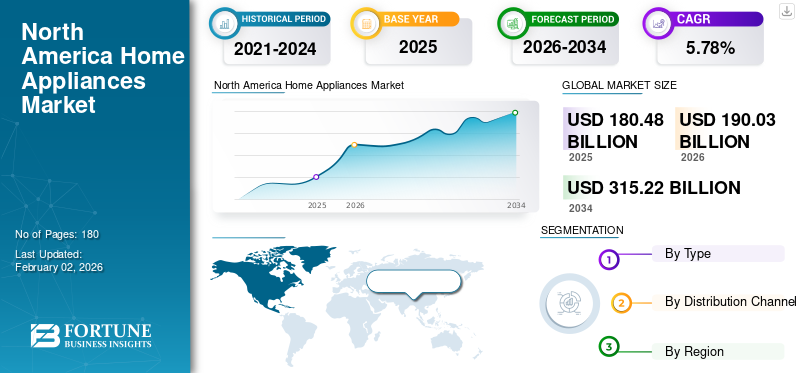
Download Free sample to learn more about this report.
North America Home Appliances Market Trends
Rising Adoption of Smart and Connected Home Appliances
Consumers are increasingly drawn to appliances that can integrate into digital ecosystem allowing remote monitoring, predictive maintenance, and energy optimization. This trend is fueled by lifestyle convenience, growing reliance on IoT (Internet of Things) technologies, and the demand for energy efficiency, driving the North America home appliances market growth.
· A Consumer Technology Association (CTA) survey (2022) found that about 19% of U.S. households own at least one smart appliance, such as a connected fridge, oven, or washer.
Key takeaways
- By type, major appliances accounted for around 63% of the market in 2024.
- On the basis of distribution channel, the online/e-commerce segment is projected to grow at a CAGR of 5.20% in the forecast period.
- The home appliance market in North America was worth USD 171.83 billion in 2024.
- By country, Canada is projected to grow at a CAGR of 6.63% in the forecast period.
North America Home Appliances Market Growth Factors
Strong Emphasis on Energy Efficiency and Sustainability to Boost Market Growth
Rising demand for energy-efficient and environmentally sustainable products is primarily driving the growth of the market. With stricter government regulations, consumer awareness of climate change, and incentives for reducing household energy costs, ENERGY STAR–certified appliances have become a key choice for buyers.
· According to the U.S. Environmental Protection Agency (EPA), Americans purchased more than 300 million ENERGY STAR–certified products in 2022, collectively saving billions in utility costs and cutting greenhouse gas emissions.
This push toward greener living not only reshapes consumer preferences but also compels manufacturers to innovate with eco-friendly technologies, making sustainability one of the most significant growth engines for the region’s appliance industry.
North America Home Appliances Market Restraints
Supply Chain Disruptions and Material Costs Limit Market Growth
Appliances rely heavily on raw material inputs such as steel, aluminum, plastics, and semiconductors, all of which have faced price volatility and shortages in recent years.
· U.S. Bureau of Labor Statistics (BLS) reported that the Producer Price Index (PPI) for household appliances increased by nearly 8% in 2021, reflecting cost pressures passed on to consumers. These fluctuations not only raise retail prices but also create delays in production and delivery, limiting growth momentum in the sector.
North America Home Appliances Market Segmentation Analysis
By Type Analysis
Based on type, the market is divided into major appliances, small appliances, and smart home appliances.
Major appliances such as refrigerators and washing machine account for a larger share of the North America market. These appliances are essential necessities since they assist in day-to-day household chores.
· According to the U.S. Census Bureau’s American Housing Survey, about 99% of U.S. homes have a refrigerator and close to 90% own a washing machine, reflecting their critical role in everyday life.
By Distribution Channel Analysis
Based on distribution channel, the market is segmented into supermarkets & hypermarkets, specialty stores, online/e-commerce, and others.
Specialty stores dominate the North American home appliance distribution landscape since they offer wide product variety, expert guidance, and strong after-sales support, factors that are especially important for expensive purchases such as refrigerators, ovens, or washing machines. Consumers often prefer visiting these outlets to physically compare models, check features, and evaluate energy-efficiency labels before making a decision
By Country Type Analysis
Based on region, the market is segmented into U.S., Canada, and Mexico.
Canada home appliances market is projected to grow at a CAGR of 7.30% over the forecast period. Canada's increasing disposable income, particularly in urban areas, is fueling demand for premium and innovative appliances. Urban consumers favor smart, space-saving appliances tailored for modern living environments. Notably, provinces including Ontario, Quebec, and British Columbia account for over 75% of the Canadian household appliances market, attributing their high income levels and dense urban populations. This concentrated consumer base is driving innovation and premium appliance uptake.
The U.S contributes the largest to North America home appliances market share and is projected to maintain its dominant position over the forecast years.
List of Key Companies in North America Home Appliances Market
Whirlpool Corporation, Samsung Electronics, and LG Electronics are the prominent players in the North America home appliances market. These players are heavily investing in smart, connected, and energy-efficient appliances. Features such as remote monitoring, voice control, and AI-based predictive maintenance are increasingly becoming standard to meet consumer demand for convenience and sustainability.
Other companies such as GE Appliances and Electrolux emphasize eco-friendly models that reduce energy and water consumption, appealing to environmentally conscious consumers.
LIST OF KEY COMPANIES PROFILED:
- Whirlpool Corporation (U.S)
- GE Appliances (U.S.)
- Electrolux Group (U.S.)
- BSH Home Appliances Corporation (U.S.)
- Hamilton Beach Brands (U.S.)
- LG Electronics (U.S.)
- Samsung Electronics (U.S.)
- Panasonic North America (U.S.)
- Miele (U.S.)
- Sub-Zero Group, Inc. (Wolf Appliance) (U.S.)
KEY INDUSTRY DEVELOPMENTS:
- August 2025: GE Appliances, announced to invest more than USD 3 billion in U.S. operations expanding its air conditioning and water heating portfolio. This investment is aimed at increasing production output across all product lines by modernizing its 11 U.S. manufacturing plants with new automation and capital equipment. The first phase of investments will begin at GE Appliances plants in Kentucky, Alabama, Georgia, Tennessee, and South Carolina.
- December 2023: Miele, a manufacturer of premium domestic appliances, announced plans to establish a new production facility in the U.S. This new production facility is focused on producing built-in cooking appliances and Ranges, expanding U.S. footprint of the brand.
REPORT COVERAGE
The North America home appliances market report provides a detailed analysis of the market. It focuses on market dynamics and key industry developments, such as mergers and acquisitions. Additionally, it includes information about the home renovation & remodeling trends, government incentives & regulations, smart technology & IoT integration. Besides this, the report also offers insights into the latest industry trends and the impact of various factors on the demand for home appliances.
·
Request for Customization to gain extensive market insights.
Report Scope & Segmentation
| ATTRIBUTE | DETAILS |
| Study Period | 2021–2034 |
| Estimated Year | 2026 |
| Base Year | 2025 |
| Forecast Period | 2026-2034 |
| Historical Period | 2021–2024 |
| Growth Rate | CAGR of 5.78% from 2026 to 2034 |
| Unit | Value (USD Billion) |
| Segmentation |
By Type
By Distribution Channel
By Country
|
Frequently Asked Questions
Fortune Business Insights says that the U.S. market was worth USD 171.83 billion in 2025.
The market is expected to exhibit a CAGR 5.78% during the forecast period of 2026-2034.
By type, the major appliance segment is set to lead the market.
Whirlpool Corporation, GE Appliances, Electrolux Group, BSH Home Appliances Corporation, and LG Electronics are the leading players in the market.



- 2021-2034
- 2025
- 2021-2024
- 180
-
(Offer valid till 31st Oct 2026)
Get 30-60 hrs Free Customization
Expand Regional and Country Coverage, Segments Analysis, Company Profiles, Competitive Benchmarking, and End-user Insights.



















Related Reports
-
US +1 833 909 2966 ( Toll Free )
-
Get In Touch With Us