Non-steroidal Anti-Inflammatory Drugs (NSAIDs) Market Size, Share & Industry Analysis, By Disease Indication (Arthritis, Migraine, Ophthalmic Diseases, and Others), By Route of Administration (Oral, and Parenteral), By Distribution Channel (Hospital Pharmacy Retail Pharmacy, and Online Pharmacy), and Regional Forecast, 2026-2034
 Download Free Sample
 KEY MARKET INSIGHTS
 Listen to Audio Version
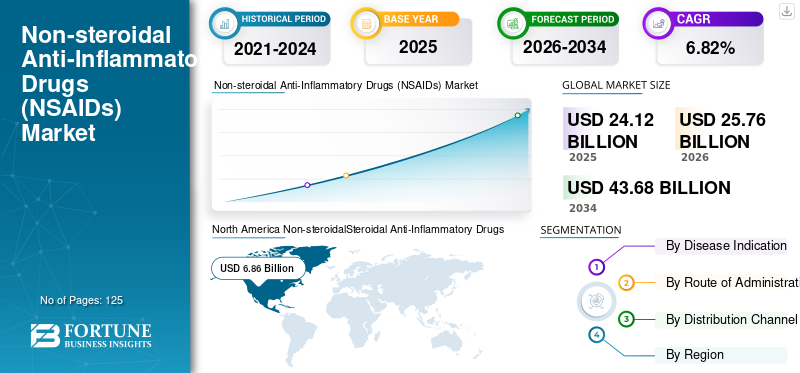
The global non-steroidal anti-inflammatory drugs market size was valued at USD 24.12 billion in 2025. The market is projected to grow from USD 25.76 billion in 2026 to USD 43.68 billion by 2034, exhibiting a CAGR of 6.82% during the forecast period. North America dominated the non-steroidal anti-inflammatory drugs market with a market share of 44.03% in 2025.
Chronic pain causes a major health and economic burden owing to the loss of productivity and treatment cost. Non-steroidal anti-inflammatory drugs are primarily used for the treatment of pain and inflammation. The rising prevalence of rheumatoid arthritis, ankylosing spondylitis, osteoarthritis, migraine, and others is increasing the uptake of these drugs. With the increasing number of prescriptions, these have become the most commonly used drugs across the globe. According to a press release of Endo International plc, about 84 million NSAIDs prescriptions are written annually in the U.S. This is anticipated to augment the market growth. Furthermore, positive recommendations from the Centers for Disease Control and Prevention on the use of non-opioid drugs for the treatment of pain will help the market to flourish. With the launch of new products, the market is expected to grow further. In May 2019, Perrigo Company plc announced the FDA approval for Abbreviated New Drug Application (ANDA) referencing to Voltaren Gel. This is expected to positively impact the NSAIDs market.
Download Free sample to learn more about this report.
Global Non-Steroidal Anti-Inflammatory Drugs (NSAIDs) Market Overview
Market Size & Forecast:
- 2025 Market Size: USD 24.12 billion
- 2026 Market Size: USD 25.76 billion
- 2034 Forecast Market Size: USD 43.68 billion
- CAGR: 6.82% from 2026–2034
Market Share:
- North America dominated the non-steroidal anti-inflammatory drugs market with a 44.03% share in 2025, driven by the high burden of chronic pain conditions, a strong prescription base, and increased adoption of non-opioid pain management strategies.
- By disease indication, the arthritis segment is expected to retain its largest market share owing to the growing prevalence of rheumatoid arthritis and osteoarthritis, rising geriatric population, and widespread use of topical NSAIDs for joint pain.
Key Country Highlights:
- United States: Market growth supported by increasing number of NSAIDs prescriptions, positive regulatory stance on non-opioid therapies, and FDA approvals for new formulations.
- Europe: Strong uptake driven by migraine management initiatives, increased awareness of NSAID therapy, and favorable public reimbursement policies.
- China: Rapid market expansion supported by OTC availability, growing elderly population, and preference for affordable anti-inflammatory drugs.
- Japan: Growth fueled by increased use of topical NSAIDs in ophthalmology and arthritis, alongside ongoing adoption of selective COX-2 inhibitors.
MARKET TRENDS
Download Free sample to learn more about this report.
Research on COX-2 Inhibitors by Major Manufacturers to Boost Growth
- North America witnessed a non-steroidal anti-inflammatory drugs market growth from USD 6.48 Billion in 2018 to USD 6.86 Billion in 2019.
One of the important market trends is the increasing research on selective cyclooxygenase-2 (COX-2) inhibitors. Presently available NSAIDs such as diclofenac and ibuprofen not only inhibit the activity of COX-2, but also of COX-1 resulting in undesirable side effects. Selective COX-2 inhibitors remain a challenging and grey area for the pharmaceutical companies. Currently, Celebrex manufactured by Pfizer is the only COX-2 inhibitor commercially available in the U.S. However, many pharmaceutical giants are now making significant investment to develop new COX-2 inhibitors for the treatment of pain and inflammation. For example, Crystal Genomics is conducting phase 3 clinical trial on CG100649, a dual COX-2 and carbonic anhydrase (CA) inhibitor for the treatment of osteoarthritis.
MARKET DRIVERS
Rising Prevalence of Chronic Pain to Favor Growth
Increasing prevalence of pain and inflammation causing diseases is one of the leading factors driving the non-steroidal anti-inflammatory drugs market growth. Uptake of these drugs is rising gradually for the treatment of acute and chronic pain. Ibuprofen and diclofenac are the commonly prescribed drugs to provide relief form pain. According to the Centers for Disease Control and Prevention, in 2016, over 50 million adults in the U.S. had chronic pain and 19.6 million had high-impact chronic pain. This is expected to fuel the NSAIDs market growth during the forecast period. According to Institute of Medicine Report, chronic pain cost around USD 560 billion every year for medical care, disability services, and loss of productivity in the U.S. Active steps are being taken by the government to reduce this cost burden which is expected to boost the market.
Preference for NSAIDs over Opioids to Foster Market Growth
NSAIDs and opioids are the most commonly prescribed drugs for the treatment of mild to severe pain. However, use of opioids is associated with severe adverse events. Opioids safety thus remains a major concern receiving widespread attention owing to the increasing opioids-relation deaths. This has, in turn, led to an increasing preference for these drugs for the treatment of pain and a declined use of opioids. Furthermore, the American Academy of Family Physicians recommends the use of ibuprofen and naproxen as first line of treatment for mild to moderate pain. Similar positive recommendations are expected to boost the NSAIDs market growth.
MARKET RESTRAINT
Side Effects of NSAIDs are Likely to Hinder the Market Growth
Side effects from the uptake of NSAIDs such as allergic reactions, stomach ulcers, stomach-pain, dizziness, and others are expected to restrain the market growth. Owing to their easy availability and anti-inflammatory action, these drugs are among the most commonly prescribed medications. However, significant rise in NSAIDs-related gastrointestinal complications has been observed across the globe, which is a potential burden on the healthcare system. NSAIDs associated GI bleeding is the most common reason for the majority of emergency hospital admissions. Moreover, its complication is the most common drug side in the U.S. This is expected to negatively impact the non-steroidal anti-inflammatory drugs market revenue.
SEGMENTATION
By Disease Indication Analysis
To know how our report can help streamline your business, Speak to Analyst
Arthritis Segment to Generate the Maximum Revenue
On the basis of disease indication, the market can be segmented into arthritis, migraine, ophthalmic diseases, and others. The arthritis segment is expected to dominate the market throughout the forecast period primarily due to the rising prevalence of rheumatoid arthritis and osteoarthritis. Apart from this, the increasing geriatric population and adoption of topical drugs for arthritis pain are expected to contribute to the expansion of the segment. The migraine segment is anticipated to grow owing to the increasing sales of Advil and the frequent occurrence of migraine. The ophthalmic diseases segment is projected to gain momentum owing to the increasing uptake of these drugs post eye surgery. They are extensively employed to reduce photophobia and pain after photorefractive surgery and reduce inflammation, and cystoid muscular edema post cataract surgery. Thus, the increasing number of eye surgeries is likely to augment the market. The others segment is expected to expand which can be attributable to the rising uptake of over-the-counter NSAIDs for the treatment of acute pain caused due to cramps, bursitis, ankylosing spondylitis, and rising prevalence of atopic dermatitis. In December 2016, Pfizer announced the FDA approval for Eucrisa for the treatment of atopic dermatitis, which, in turn, will expand this segment.
- The arthritis segment is expected to hold a 37.9% share in 2019.
By Route of Administration Analysis
Oral Segment to Exhibit Maximum Growth
On the basis of route of administration, the market is segmented into oral and parenteral. The oral segment generated the maximum revenue in 2019. Factors attributable for the remarkable growth of this segment are availability of more drugs, increasing sales of Celebrex, and rising preference for COX-2 selective NSAIDs. The parenteral segment is likely to propel during the forecast period owing to the use of topical drops for ophthalmic diseases and higher sales of Voltaren gel.
By Distribution Channel Analysis
Hospital Pharmacy Segment to Dominate the Market
In terms of distribution channel, the market is segmented into hospital pharmacy, retail pharmacy, and online pharmacy. The hospital segment accounted for the maximum portion of the market during 2019 owing to the increasing number of prescriptions for NSAIDs and favorable health reimbursement. Rising availability of over-the-counter (OTC) drugs, increasing demand for diclofenac and ibuprofen, and new product launches are projected to boost the retail pharmacy segment. In April 2018, Strides Pharma Inc. received the U.S. FDA approval for Ibuprofen OTC Capsules which is expected to augment the retail pharmacy segment. The online segment is anticipated to grow due to the rising adoption of e-commerce, increasing disposable incomes, and attractive discounts on online sales.
REGIONAL ANALYSIS
North America Non-steroidalSteroidal Anti-Inflammatory Drugs (NSAIDs) Market Size, 2025 (USD Billion)
To get more information on the regional analysis of this market, Download Free sample
The non-steroidal anti-inflammatory drugs market size in North America stood at USD 6.86 billion in 2019. Strategic presence of major manufacturers, rising prevalence of arthritis, and increased research are the factors for the dominant share of North America. According to the Centers for Disease Control and Prevention, 78 million adults in the U.S. are estimated to have doctor-diagnosed arthritis by 2040. This is expected to fuel the market in North America during the forecast period. In Europe, the market for NSAIDs is anticipated to augment owing to the active government support, rising prevalence of migraine, and favorable health reimbursement. The Migraine Trust declared that every day, approximately 3000 migraine attacks occur for each million of the general population. It equates to around 190,000 migraine attacks in the U.K. every year. This is anticipated to foster the market in Europe. Increasing geriatric population, rising adoption of OTC NSAIDs, and less price as compared to biologics are poised to surge the market in Asia Pacific. The market in the Middle East & Africa and Latin America is projected to grow owing to the rising prevalence of inflammatory diseases and increasing health expenditure.
KEY INDUSTRY PLAYERS
GSK and Pfizer to Account for the Leading Position
In terms of non-steroidal anti-inflammatory drugs market revenue, GSK accounted for the maximum portion of the market. Factors attributable for the dominant share of GSK are the merger with Pfizer resulting in inclusion of Advil in GSK’s product portfolio and higher sales of Voltaren Gel. On the other hand, Pfizer stood at the second rank owing to the increasing sales of Celebrex, a diversified product portfolio, and an established distribution channel. Competition in the market is increasing gradually as many new players are striving to enter into the market through new product launches and strategic collaborations.
LIST OF KEY PLAYERS PROFILED:
- GlaxoSmithKline plc
- Pfizer Inc.
- Johnson & Johnson Services, Inc.
- Bayer AG
- AstraZeneca
- Boehringer Ingelheim International GmbH
- Zyla Life Sciences
- Horizon Therapeutics plc
- Others
KEY INDUSTRY DEVELOPMENTS:
- Perrigo Company plc announced the FDA approval for an Abbreviated New Drug Application (ANDA) referencing Voltaren Gel.
- Pfizer announced that Celebrex will be covered under insurance for all adults with rheumatoid arthritis, osteoarthritis, and ankylosing spondylitis. Before this, the insurance benefits were limited to patients ages 60 or above.
- Strides Pharma Inc. received U.S. FDA approval for Ibuprofen OTC Capsules.
- Pfizer announced the FDA approval for Eucrisa for the treatment of atopic dermatitis.
REPORT COVERAGE
The market report on non-steroidal anti-inflammatory drugs offers a detailed analysis of numerous factors affecting the market. These include growth drivers, threats, opportunities, restraints, and key developments. Apart from this, the report further helps in analyzing, segmenting, and defining the market based on different segments such as disease indication, route of administration, and distribution channel. It also provides various key insights such as prevalence of major diseases for key countries, pipeline analysis, new product launches, key mergers& acquisition, joint ventures, and others.
Report Scope & Segmentation
Request for Customization to gain extensive market insights.
|
ATTRIBUTE |
DETAILS |
|
Study Period |
2021-2034 |
|
Base Year |
2025 |
|
Forecast Period |
2026-2034 |
|
Historical Period |
2021-2024 |
|
Unit |
Value (USD Billion) |
|
|
By Disease Indication
|
|
By Route of Administration
|
|
|
By Distribution Channel
|
|
|
By Geography
|
Frequently Asked Questions
Fortune Business Insights says that the non-steroidal anti-inflammatory drugs (NSAIDs) market was valued at USD 25.76 billion in 2026 and is projected to reach USD 43.68 billion by 2034
The market is projected to rise at a CAGR of 6.82% during the forecast period (2026-2034).
The value of the market in North America was USD 6.86 billion in 2025.
Key growth drivers include the rising prevalence of chronic pain and arthritis, a shift away from opioid use due to safety concerns, and increasing recommendations for NSAIDs as first-line pain treatments.
The arthritis segment is the largest contributor to NSAIDs market revenue, due to the growing number of patients with osteoarthritis and rheumatoid arthritis, particularly among the aging population.
North America is expected to hold the highest market share.
GlaxoSmithKline plc and Pfizer Inc. are the top players in the market.
A major trend is the development of selective COX-2 inhibitors, which aim to reduce side effects linked to traditional NSAIDs. Research efforts from companies like Crystal Genomics and Pfizer are driving innovation in this area
Gastrointestinal side effects, allergic reactions, and safety concerns surrounding long-term NSAID use are significant restraints. NSAIDs-related GI bleeding is a common reason for emergency hospital admissions.



- 2021-2034
- 2025
- 2021-2024
- 125
Get 30-60 hrs Free Customization
Expand Regional and Country Coverage, Segments Analysis, Company Profiles, Competitive Benchmarking, and End-user Insights.













.webp)






-
US +1 833 909 2966 ( Toll Free )
-
Get In Touch With Us