Fruit & Vegetable Juice Market Size, Share & Industry Analysis, By Type (Fruit Juice [Orange, Apple, Mango, Pineapple, Berries, and Others], Vegetable Juice [Carrot, Beetroot, Cucumber, and Others], and Fruit & Vegetable Blends), By Nature (Organic and Conventional), By Packaging (PET Bottles, Cans, Tetrapacks/Pouches, and Others), By Distribution Channel (Supermarkets/Hypermarkets, Convenience Stores, Specialty Stores, Online Retail, and Others), and Regional Forecast, 2026-2034
 Download Free Sample
(Offer valid till 15th Oct 2026)

Fruit & Vegetable Juice Market Size and Future Outlook
 Listen to Audio Version
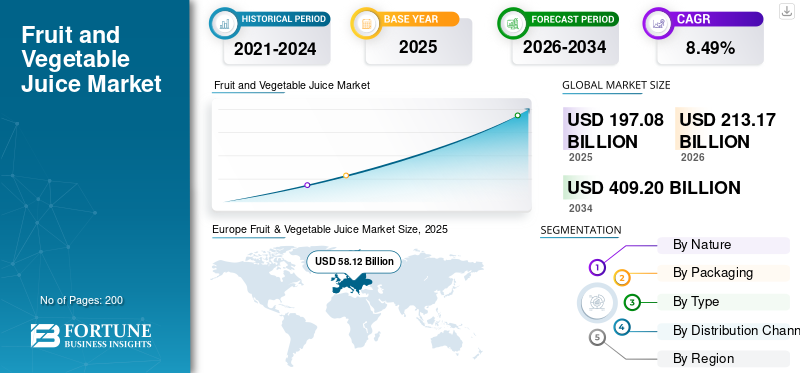
The global fruit & vegetable juice market size was valued at USD 197.08 billion in 2025. The market is projected to grow from USD 213.17 billion in 2026 to USD 409.20 billion by 2034, exhibiting a CAGR of 8.49% during the forecast period. Europe dominated the fruit and vegetable juice market with a market share of 29.49% in 2025.
Fruit and vegetable juices represent a mature yet innovation-driven beverage category positioned between carbonated soft drinks and functional health beverages. Derived from fresh fruit and vegetable concentrates, purees, or direct extraction processes, these beverages are widely consumed for hydration, micronutrient intake, and convenience nutrition. The category includes 100% juices, nectars, juice drinks, cold-pressed variants, and fortified blends enriched with vitamins, minerals, and plant bioactives. Rising health consciousness, sugar-reduction initiatives, demand for natural beverages, and increasing adoption of vegetable-based functional blends drive market growth.
The global market is led by major players, including PepsiCo, Inc., The Coca-Cola Company, Nestlé S.A., Del Monte Foods, Inc., and Ocean Spray Cranberries, Inc. To remain competitive, major companies increasingly rely on product innovation, clean-label formulations, functional beverage expansion, supply chain integration, premiumization, sustainability initiatives, digital distribution, and advanced processing technologies.
Download Free sample to learn more about this report.
Fruit and Vegetable Juice MARKET KEY TAKEAWAYS
 Market Size & Forecast
- 2025 Market Size: USD 197.08 billion
- 2026 Market Size: USD 213.17 billion
- 2034 Forecast Market Size: USD 409.20 billion
- CAGR: 8.49% from 2026–2034
 Market Share
- Europe dominated the fruit and vegetable juice market with a market share of 29.49% in 2025.
- Fruit & vegetable blends is expected to dominates the market with 14.91% in 2025.
- PET bottles segment accounted for the leading share in packaging in 2025.
 Key Regional Highlights
North American
North America was valued at USD 53.45 billion in 2025 and is projected to reach USD 104.37 billion by 2034, growing at a CAGR of 7.75% during the forecast period.
Europe
Europe accounted for USD 58.12 billion in 2025, and has the largest share, and is projected to reach USD 118.97 billion by 2034, registering a CAGR of 8.32% during the forecast period.
Asia Pacific
Asia Pacific was valued at USD 53.73 billion in 2025 and is projected to reach USD 128.37 billion by 2034, growing at the fastest CAGR of 10.18% during the forecast period.
U.S.
The U.S. dominated the region, valued at USD 44.01 billion in 2025
Japan
Growth supported by health-focused beverages and strong demand for packaged fruit and vegetable blends.
Read More

Fruit & Vegetable Juice Market Trends
Rising Consumer Demand for Functional and Vegetable-Based Blends to Shape Industry Trends
Consumers are increasingly shifting toward vegetable-forward juices, cold-pressed juices, and functional blends fortified with vitamin C, probiotics, antioxidants, and immune-support ingredients. Reduced-sugar formulations and no-added-sugar 100% juices are gaining traction amid regulatory pressure on sugary beverages. Growth in wellness culture, on-the-go consumption, and consumer demand for plant-based micronutrient sources are structurally supporting category expansion.
- For instance, in September 2025, Innocent Drinks launched two new smoothies, Green Goodness and Red Goodness, featuring the brand's highest vegetable content to date at over 25%. These fruit-led drinks contain no added sugar and aim to boost daily vegetable intake.
MARKET DYNAMICS
Market Drivers
Download Free sample to learn more about this report.
Expanding Global Fruit & Vegetable Production and Health-Driven Beverage Consumption to Support Market Expansion
The global fruit & vegetable juice market growth has strengthened the supply base for juice processors. Major producing regions such as China, India, Brazil, the U.S., and the European Union ensure year-round raw material sourcing through diversified climatic zones. Rising global awareness regarding vitamin intake, digestive health, and immunity has increased demand for 100% juices and vegetable blends.
- According to the Food and Agriculture Organization (FAO), global production of vegetables (including melons) reached approximately 1.19 billion metric tons in 2023, with vegetable production alone showing a 26% increase since 2010.
Market Restraints
Sugar Content Concerns and Raw Material Price Volatility to Limit Market Stability
Despite being naturally sourced, fruit juices contain intrinsic sugars, leading to regulatory scrutiny under sugar taxation frameworks in Europe and North America. Additionally, climate variability, including droughts in citrus-growing regions and extreme weather in tropical fruit belts, impacts yield and concentrate pricing.
- The World Health Organization (WHO) and FAO recommend limiting free sugar intake to less than 10% of total daily energy (approx. 50g or 12 teaspoons for a 2000-calorie diet) to reduce obesity, dental caries, and noncommunicable diseases.
Market Opportunities
Growth of Cold-Pressed, Organic, and Fortified Juice Variants to Create Premium Revenue Streams
Premiumization trends are reshaping the industry. Organic-certified juices, cold-pressed vegetable blends, and immunity-focused functional beverages command higher retail price points. Demand for sustainable sourcing, recyclable packaging, and clean-label positioning is driving innovation in developed markets.
- For instance, in May 2025, Soluna launched a premium cold-pressed apple juice made exclusively from its signature ANABP 01 apples, known as Bravo apples in Australia. This product uses cold-pressing to retain nutrients and High-Pressure Processing (HPP) for safety, flavor preservation, and a 90-day shelf life without heat or additives.
SEGMENTATION ANALYSIS
By Type
Fruit Juice Segment Dominated Due to Strong Global Citrus and Apple Consumption
Based on type, the market is segmented into fruit juice, vegetable juice, and fruit & vegetable blends.
The fruit juice segment dominated the global market, valued at USD 139.89 billion in 2025, accounting for the largest share due to high consumption of orange, apple, and mango juices across North America, Europe, and Asia Pacific. Orange juice led within the segment at USD 46.84 billion, supported by breakfast consumption patterns and concentrate trade, particularly from Brazil and the U.S., driven by strong demand in Europe and China.
Among all sub-types, beetroot juice is projected to grow at the fastest CAGR of 11.32% (2026–2034), supported by sports nutrition positioning and cardiovascular health awareness.
To know how our report can help streamline your business, Speak to Analyst
By Nature
Conventional Segment Dominated Due to Large-Scale Commercial Production
Based on nature, the market is segmented into organic and conventional.
The conventional segment dominated the global fruit & vegetable juice market share, valued at USD 169.37 billion in 2025, supported by large-scale fruit concentrate processing, established supply chains, and competitive pricing across supermarkets and mass retail. Conventional juices benefit from strong global sourcing networks in Brazil, the U.S., China, and the European Union, ensuring stable raw material availability.
The organic segment was valued at USD 27.71 billion in 2025 and is projected to grow at the fastest CAGR of 9.86% from 2026 to 2034.
By Packaging
PET Bottles Dominated Due to Cost Efficiency and Retail Penetration
By packaging, the market is fragmented into PET bottles, cans, tetrapacks/pouches, and others.
The PET bottles segment led the market, valued at USD 134.08 billion in 2025, driven by strong demand for single-serve and family-pack formats, making it commercially attractive for high-volume fruit juice brands.
Among packaging formats, cans are projected to grow at the fastest CAGR of 10.80% during the forecast period, supported by aluminum recyclability, sustainability perception, and expansion of energy-boost and functional juice beverages.
By Distribution Channel
Supermarkets/Hypermarkets Dominated Due to Strong Shelf Visibility
Based on distribution channel, the market is segmented into supermarkets/hypermarkets, convenience stores, specialty stores, online retail, and others.
The supermarkets/hypermarkets segment dominated the market, valued at USD 84.21 billion in 2025, supported by organized retail expansion, bulk purchasing behavior, and private label penetration. This channel captures routine household consumption and multi-pack purchases.
Online retail was valued at USD 35.70 billion and is projected to grow at the fastest CAGR of 11.28% during the forecast period, supported by subscription beverage models, direct-to-consumer brands, and digital grocery adoption. Increasing urbanization and last-mile delivery infrastructure are structurally strengthening e-commerce penetration.
Fruit & Vegetable Juice Market Regional Outlook
Regionally, the report covers the global market analysis across North America, Europe, Asia Pacific, South America, and the Middle East & Africa.
Europe
Europe Fruit & Vegetable Juice Market Size, 2025 (USD Billion)
To get more information on the regional analysis of this market, Download Free sample
Europe accounted for USD 58.12 billion in 2025, and has the largest share, and is projected to reach USD 118.97 billion by 2034, registering a CAGR of 8.32% during the forecast period. The region benefits from high per capita juice intake, strong sustainability regulations, and expanding organic certifications. Carton packaging remains dominant due to shelf-stable distribution.
Germany Fruit & Vegetable Juice Market
Germany leads Europe with a market size of approximately USD 13.57 billion in 2025, due to high household penetration and strong private-label dominance. Sustainability-driven packaging and organic variants support growth momentum.
U.K. Fruit & Vegetable Juice Market
The U.K. market was valued at approximately USD 8.94 billion in 2025, supported by reduced-sugar reformulation strategies and chilled not-from-concentrate innovation, aligned with regulatory sugar reduction initiatives.
North America
North America was valued at USD 53.45 billion in 2025 and is projected to reach USD 104.37 billion by 2034, growing at a CAGR of 7.75% during the forecast period. The region benefits from established orange and apple juice consumption patterns, strong private label presence, and advanced cold-chain infrastructure. Functional vegetable blends and reduced-sugar formulations are gaining traction across supermarkets and online channels.
U.S. Fruit & Vegetable Juice Market
The U.S. dominated the region, valued at USD 44.01 billion in 2025, supported by large-scale juice processing, concentrate imports (particularly orange juice), and strong retail distribution. Growth remains steady due to premiumization and functional benefits.
Asia Pacific
Asia Pacific was valued at USD 53.73 billion in 2025 and is projected to reach USD 128.37 billion by 2034, growing at the fastest CAGR of 10.18% during the forecast period. Growth is driven by rising disposable incomes, expanding middle-class populations, and increasing fruit production in China and India. Mango, mixed fruit, and vegetable blends are witnessing strong demand.
China Fruit & Vegetable Juice Market
China represents the largest market in the Asia Pacific, valued at approximately USD 19.40 billion in 2025, supported by domestic fruit processing expansion and rising demand for functional beverages.
South America and Middle East & Africa
South America reached USD 17.32 billion in 2025 and is projected to grow to USD 32.90 billion by 2034, registering a CAGR of 7.42% during the forecast period. Brazil’s dominance in global orange juice concentrate exports structurally supports regional processing capacity and revenue generation.
The Middle East & Africa market was valued at USD 14.46 billion in 2025 and is projected to reach USD 24.60 billion by 2034, expanding at a CAGR of 6.10% during the forecast period. Growth is supported by increasing urbanization, retail expansion, and rising import penetration of packaged juice products.
South Africa Fruit & Vegetable Juice Market
South Africa represents the largest market within Sub-Saharan Africa, supported by its well-developed citrus industry and export-oriented processing infrastructure. As part of the Middle East & Africa region, which was valued at USD 4.08 billion in 2025 and is projected to grow at a CAGR of 5.60% during the forecast period.
COMPETITIVE LANDSCAPE
Key Industry Players
Key Players Focus on Vertically Integrated Sourcing and Base Expansion to Maintain a Competitive Advantage
The global fruit & vegetable juices market is highly consolidated at the top tier, with multinational beverage corporations controlling a significant share through vertically integrated sourcing, concentrate procurement contracts, and global distribution networks. Leading companies focus on portfolio diversification across 100% juice, nectars, juice drinks, vegetable blends, and functional variants, allowing them to serve multiple price tiers and consumption occasions.
Leading Players in the Market
|
Rank |
Company Name |
|
1 |
PepsiCo, Inc. |
|
2 |
The Coca-Cola Company |
|
3 |
Nestlé S.A. |
|
4 |
Suntory Beverage & Food Ltd. |
|
5 |
Ocean Spray Cranberries, Inc. |
List of Key Fruit & Vegetable Juice Companies Profiled
- PepsiCo, Inc. (U.S.)
- The Coca-Cola Company (U.S.)
- Nestlé S.A. (Switzerland)
- Suntory Beverage & Food Ltd. (Japan)
- Ocean Spray Cranberries, Inc. (U.S.)
- Del Monte Foods, Inc. (U.S.)
- Eckes-Granini Group GmbH (Germany)
- Britvic plc (U.K.)
- Dabur India Ltd. (India)
- The Kraft Heinz Company (U.S.)
KEY INDUSTRY DEVELOPMENTS
- February 2026: Capri-Sun launched its new Mango & Passion Fruit flavor, targeting U.K. and nationwide retailers with a tropical juice blend. Available in 330ml resealable pouches, it combines mango, passion fruit, orange, and apple for an exotic taste with zero added sugar, no artificial flavors, preservatives, or colors.
- February 2026: Wonder Juice recently launched two new functional cold-pressed juices in its Wonder Green line: Clean Green and Veg8 & Cayenne. These additions target health-conscious consumers seeking detox, hydration, and bold flavors in daily wellness routines.
- August 2025: Tropicana launched its Essentials line in the U.S. to support busy families during the back-to-school season with affordable, nutritious orange juice blends. The line blends orange juice with apple and pear juices, fortified with vitamins C and E, calcium, and vitamin D, and contains no added sugars. Varieties include Orange Blend (no pulp), Orange Blend (some pulp), and Orange Mango Blend (no pulp).
- June 2025: Tropicana introduced 500ml cartons of its top-selling original orange juice in the U.K., available with and without pulp. This marks the first smaller serve format for the range, voted the U.K.'s number one orange juice.
- May 2025: Nomura Dairy Products and Probi launched Japan's first fermented carrot juice fortified with the probiotic strain LP299V. This plant-based beverage under the "My Flora" brand targets health-conscious consumers, especially women aged 30-50, seeking digestive support from carrot juice's natural nutrition combined with the strain's clinically proven gut health benefits.
REPORT COVERAGE
The global fruit & vegetable juice market industry report analyzes the market in depth and highlights crucial aspects such as global market trends, market dynamics, prominent companies, investment in research and development, and end-use. Besides this, the report also provides insights into the global market analysis and highlights significant industry developments.
Request for Customization to gain extensive market insights.
Report Scope & Segmentation
| ATTRIBUTE | DETAILS |
| Study Period | 2021-2034 |
| Base Year | 2025 |
| Estimated Year | 2026 |
| Forecast Period | 2026-2034 |
| Historical Period | 2021-2024 |
| Growth Rate | CAGR of 8.49% from 2026 to 2034 |
| Unit | Value (USD Billion) |
|
Segmentation |
By Nature
|
|
By Type
|
|
|
By Packaging
|
|
|
By Distribution Channel
|
|
|
By Region
|
Frequently Asked Questions
Fortune Business Insights says that the global market was valued at USD 197.08 billion in 2025 and is anticipated to reach USD 409.20 billion by 2034.
At a CAGR of 8.49%, the global market will exhibit steady growth over the forecast period.
By type, the fruit juice segment led the market.
Europe held the largest market share in 2025.
Expanding global fruit & vegetable production and health-driven beverage consumption to support market expansion.
PepsiCo, Inc., The Coca-Cola Company, Nestlé S.A., Del Monte Foods, Inc., and Ocean Spray Cranberries, Inc. are the leading companies in the market.
Rising demand for functional and vegetable-based blends to shape industry trends.



- 2021-2034
- 2025
- 2021-2024
- 200
-
(Offer valid till 15th Oct 2026)
Get 30-60 hrs Free Customization
Expand Regional and Country Coverage, Segments Analysis, Company Profiles, Competitive Benchmarking, and End-user Insights.




















Related Reports
-
US +1 833 909 2966 ( Toll Free )
-
Get In Touch With Us