Oil and Gas Digital Rock Analysis Market Size, Share & Industry Analysis, By Application (Exploration and Production, Research and Development, and Enhanced Oil Recovery (EOR)), By End-User (Oil and Gas Companies and Research Institutes), and Regional Forecast, 2026-2034
 Download Free Sample
(Offer valid till 15th Oct 2026)

Oil and Gas Digital Rock Analysis Market Size and Future Outlook
 Listen to Audio Version
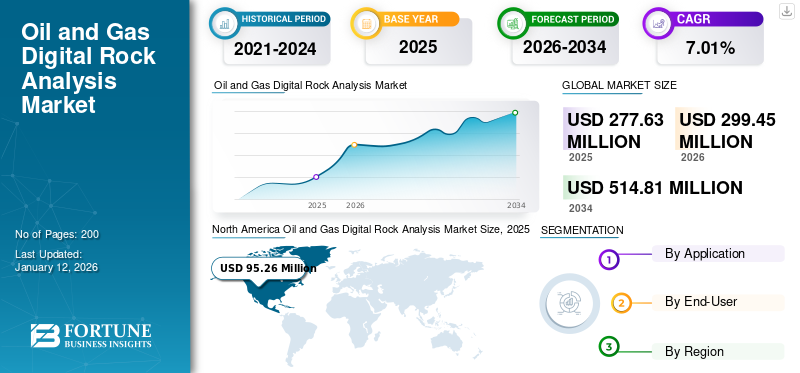
The global oil and gas digital rock analysis market size was valued at USD 277.63 million in 2025. The market is projected to grow from USD 299.45 million in 2026 to USD 513.60 million by 2034, exhibiting a CAGR of 6.98% during the forecast period. North America dominated the oil and gas digital rock analysis market with a market share of 34.31% in 2025.
Digital rock analysis (DRA) in the oil and gas industry is an advanced technique that involves creating high-resolution digital models of reservoir rock samples using imaging technologies such as micro-CT scanning, and then applying computational simulations to evaluate their petrophysical properties. This approach enables the analysis of key parameters such as porosity, permeability, fluid flow behavior, and wettability without relying solely on conventional laboratory core testing. The adoption of digital rock analysis is projected to grow due to its ability to provide faster, more accurate reservoir characterization, enabling optimized hydrocarbon recovery and reduced exploration risks.
The increasing need for accurate and efficient reservoir characterization in the oil and gas industry primarily drives the digital rock analysis market. As conventional hydrocarbon reserves decline, companies are focusing on complex and unconventional reservoirs such as shale and tight formations, where understanding pore structure and fluid behavior is critical. Digital rock analysis enables faster, more precise evaluation than traditional core analysis, reducing time and operational costs. Additionally, the growing adoption of advanced imaging technologies and computational modeling tools is enhancing the accuracy of subsurface data interpretation. Thus, the digital rock analysis market in the oil & gas sector is growing due to the increasing shift toward data-driven decision-making processes, which enable operators to accurately predict reservoir behavior, optimize production strategies, and reduce operational uncertainties.
Halliburton, iRock Technologies, and SLB (Schlumberger) are major vendors in the market due to their strong technological capabilities, extensive industry experience, and integrated service offerings in reservoir characterization. Vendors are actively collaborating and partnering to enhance their technological capabilities and expand their service offerings. Companies such as Halliburton, Schlumberger, and specialized firms such as iRock Technologies are partnering with core laboratories, software providers, and research institutions to integrate digital rock workflows with conventional core analysis.
In October 2023, to accelerate reservoir characterization workflows, Halliburton partnered with Core Laboratories by integrating digital rock analysis with conventional laboratory measurements. Operators will now have access to complete digital rock data in a matter of weeks rather than months, as laboratory testing continues. The new partnership brings Halliburton's pore-scale digital rock analysis expertise together with Core Labs' reservoir characterization capabilities to enable simultaneous digital simulations across different reservoir types and physical experiments.
Download Free sample to learn more about this report.
Oil and Gas Digital Rock Analysis Market Key Takeaways
 Global Market Size & Forecast
- 2025 Market Size: USD 277.63 million
- 2026 Market Size: USD 299.45 million
- 2034 Forecast Market Size: USD 513.60 million
- CAGR: 6.98% from 2026-2034
 Market Share
- North America dominated the oil and gas digital rock analysis market with a 34.31% share in 2025.
- The Exploration & Production segment is expected to account for a 78.96% share in 2026.
- The Oil & Gas Companies segment is projected to hold a 94.45% share in 2026.
 Key Regional Highlights
North America
North America was valued at USD 95.26 million in 2025 and is projected to reach USD 104.72 million in 2026.
Asia Pacific
Asia Pacific accounted for USD 51.54 million in 2025 and is expected to reach USD 55.66 million in 2026.
Europe
Europe was valued at USD 51.89 million in 2025 and is projected to reach USD 55.12 million in 2026.
U.S.
The market was valued at USD 82.75 million in 2025.
Latin America
The market was valued at USD 35.37 million in 2025.
Read More

OIL and GAS DIGITAL ROCK ANALYSIS MARKET TRENDS
Rising Demand for Enhanced Oil Recovery Techniques to Drive Market Growth
The rising demand for enhanced oil recovery EOR techniques is driving the oil and gas digital rock analysis market growth, as operators increasingly focus on extracting maximum value from mature and declining reservoirs. EOR methods such as CO₂ injection, chemical flooding, and thermal recovery require a deep understanding of pore-scale rock properties and fluid interactions to be effective. The digital rock analysis market in oil & gas is growing as exploration and production activities increase, with companies seeking advanced tools to evaluate reservoir properties and enhance resource recovery accurately.
In December 2025, Researchers at NETL, in conjunction with their partners, developed an innovative way to use low-cost surfactants by dissolving them in carbon dioxide (CO₂) to boost oil production from difficult-to-produce, unconventional formations such as shale and tight reservoirs, where hydrocarbons are trapped within complex subsurface rock layers. This approach is further supported by digital rock analysis, which enables detailed pore-scale modeling of fluid-rock interactions, helping to optimize surfactant-CO₂ behavior, improve sweep efficiency, and enhance overall recovery performance in such challenging formations.
MARKET DYNAMICS
MARKET DRIVERS
Increasing Adoption of Digitalization in Oil and Gas Operations to Drive Market Growth
The increasing adoption of digital technologies in oil and gas operations is a key driver of the market. Oil and gas companies are rapidly integrating advanced digital technologies such as artificial intelligence, machine learning, cloud computing, and data analytics to improve efficiency, reduce costs, and enhance decision-making. Digital rock analysis aligns with this shift by enabling virtual simulations of reservoir rock properties, allowing operators to analyze subsurface conditions more quickly and accurately than traditional methods.
In May 2025, SLB introduced Electris, new digital electric completion technologies that enhance productivity, improve reservoir yield, and lower the cost of ownership for production systems. Electris completion technology uses advanced controls to monitor the entire productive wellbore area and provide continuous, real-time production information from the reservoirs. Therefore, operators can proactively manage and adjust their production response to changing conditions, leading to ongoing improvements in overall reservoir management throughout the life of the well. In addition, Electris will also enable access to additional reserves left behind by traditional methods.
Download Free sample to learn more about this report.
MARKET RESTRAINTS
Complexity in Data Interpretation and Model Validation to Restrain Market Growth
The complexity in data interpretation and model validation is a key factor restraining the growth of the market. Digital rock analysis generates large volumes of high-resolution imaging and simulation data that require advanced expertise to interpret accurately. Translating pore-scale insights into reliable reservoir-scale predictions remains challenging, as discrepancies can arise between digital models and actual subsurface conditions. Additionally, validating these models against traditional laboratory results and field data is often time-consuming and technically demanding. This complexity increases reliance on skilled professionals and sophisticated software tools, which limit adoption, particularly among smaller operators, thereby hindering market growth.
MARKET OPPORTUNITIES
Growing Investments in Carbon Capture, Utilization, and Storage (CCUS) Projects to Drive Market Growth
Growing investments in carbon capture, utilization, and storage (CCUS) projects are significantly driving the market. As governments and energy companies intensify efforts to reduce carbon emissions, CCUS has emerged as a critical solution for capturing and storing CO₂ in subsurface geological formations. Digital rock analysis plays a vital role in this process by enabling detailed pore-scale evaluation of reservoir rocks to assess CO₂ storage capacity, seal integrity, and fluid behavior within the formation.
In March 2026, the Indian government has earmarked USD 2.4 billion to accelerate CCUS deployment across sectors such as power, steel, cement, and refineries, highlighting strong policy-driven investment growth. This increasing focus on large-scale carbon storage projects is also driving the adoption of digital rock analysis in the oil and gas sector, as it enables detailed pore-scale evaluation of subsurface formations, helping assess CO₂ storage capacity, ensure reservoir integrity, and optimize long-term storage performance.
MARKET CHALLENGES
High Cost of Advanced Imaging Technologies to Hamper Market Growth
Advanced imaging technologies such as micro-CT scanning, scanning electron microscopy (SEM), and focused ion beam (FIB) imaging require significant capital investment and incur high operating and maintenance costs. They require significant infrastructure and specialized workers to operate. Therefore, smaller and mid-tier oil and gas operators may not be able to easily implement digital rock analysis solutions due to the associated costs. These costs limit the widespread adoption of these technologies and disproportionately affect price-sensitive markets, thereby slowing the overall growth of the digital rock analysis market.
Segmentation Analysis
By Application
Rising Need for Accurate Reservoir Characterization Boosted Exploration and Production Segment Growth
Based on the application, the market is classified into exploration and production, research and development, and enhanced oil recovery (EOR).
The Exploration & Production segment is anticipated to hold a dominant market share of 78.96% in 2026 due to its critical need for accurate reservoir characterization and efficient resource extraction. Digital rock analysis plays a vital role in E&P activities by providing detailed insights into pore structure, fluid flow behavior, and rock properties, which are essential for optimizing drilling strategies and production performance.
The enhanced oil recovery (EOR) segment is the second-largest segment in post-treatment desalination technologies. The enhanced oil recovery (EOR) segment of the market is growing as demand increases to maximize hydrocarbon recovery from mature and declining fields. The enhanced oil recovery (EOR) segment is projected to grow at a CAGR of 6.12% during the forecast period.
By End-User
To know how our report can help streamline your business, Speak to Analyst
Increasing Demand for Improved Recovery Rates and Cost-efficient Subsurface Evaluation Fueled Oil and Gas Companies Segment Growth
By end-user, the market is categorized into oil and gas companies and research institutes.
The Oil & Gas Companies segment is projecteed to dominate the market with a share of 94.45% in 2026. The digital analysis of rocks is gaining popularity among oil/gas businesses as they need accurate data on reservoir characteristics to produce oil/gas more effectively and increase total recovery from each well. By using digital rock analysis, these companies can reduce the risks associated with exploration, improve their drilling and production methods, and ultimately save on expensive laboratory testing by completing digital tests much faster than traditional laboratory tests.
Research institutes are the second-dominating segment in the market. The segment is set to rise at a CAGR of 5.34% over the forecast period. The segment growth is driven by increasing focus on advanced studies in reservoir characterization, pore-scale modeling, and fluid-rock interactions. Research institutions are actively collaborating with industry players to develop innovative imaging techniques, simulation models, and EOR methods, thereby driving technological advancements and expanding the application of digital rock analysis.
Oil and Gas Digital Rock Analysis Market Regional Outlook
By geography, the market is categorized into Europe, North America, Asia Pacific, Latin America, and the Middle East & Africa.
North America
North America Oil and Gas Digital Rock Analysis Market Size, 2025 (USD Million)
To get more information on the regional analysis of this market, Download Free sample
North America holds the dominant oil and gas digital rock analysis market share. North America was valued at roughly USD 95.26 million in 2025 and about USD 104.72 million in 2026. The market in North America is growing due to the region’s strong focus on unconventional resource development, particularly shale oil and gas in the U.S. and Canada. The presence of advanced oilfield service companies, high adoption of digital technologies, and significant investments in enhanced oil recovery (EOR) techniques are driving demand for accurate reservoir characterization.
U.S. Oil and Gas Digital Rock Analysis Market
The U.S. market was valued at around USD 82.75 million in 2025. The market in the U.S. is expanding due to an increased emphasis on the development of unconventional resources such as shale oil and gas within the U.S., as well as the ever-increasing use of modern technologies, such as artificial intelligence, reservoir modeling, and high-resolution imaging, which are increasing the demand for precise subsurface analysis.
Asia Pacific
Asia Pacific accounted for an estimated USD 51.54 million in 2025 and about USD 55.66 million in 2026. The market for oil and gas digital rock analysis in Asia Pacific is rapidly expanding as countries, including China, India, and Australia, increase exploration and production. The energy demand continues to rise globally, and the development of unconventional energy sources, e.g., shale and tight gas, will further drive the need for advanced technologies to characterize reservoirs.
China Oil and Gas Digital Rock Analysis Market
In 2025, the Chinese market was valued at USD 32.09 million. The growth of China's market is based upon its commitment to developing "unconventional" types of resources, i.e., shale gas or tight oil, that require additional techniques to describe the reservoir better (characterize) compared to other types of resources.
Increases in domestic energy demand and efforts to reduce the nation’s reliance on imports have led to greater exploration and production activity in China. These trends will also increase the use of digital rock analysis within China.
In April 2024, a report by the State Council of China noted that China's recently released data showed its technically recoverable oil and gas reserves as follows: total recoverable oil reserves were approximately 3.85 billion tons (up 1% YoY). The increase illustrates the growing significance of advanced technologies such as Digital Rock Analysis for evaluating geological formations, enabling precise reserve estimates and assisting in the development of efficient extraction techniques for complex/unconventional reservoirs.
India Oil and Gas Digital Rock Analysis Market
The India market in 2025 was valued at USD 6.53 million, accounting for roughly 2.35% of the global market. India's market is seeing significant growth as exploration & production increase to reduce reliance on imports and meet rising energy demand. As the development of complex and unconventional reservoirs continues to grow, advanced tools for reservoir characterization are becoming increasingly vital, and digital rock analysis is crucial for this purpose.
Europe
The Europe market in 2025 was valued at USD 51.89 million and is set to reach USD 55.12 million in 2026. Over the last few decades, there has been an increased emphasis on recovering as much product as possible from existing oil and gas fields in Europe, particularly older wells located near the North Sea. Operators have begun to incorporate advanced technologies into their methods for characterizing reservoirs. More specifically, operators are trying to extend the life of older assets by leveraging the improved efficiencies enabled by new technology. Furthermore, stringent regulatory requirements associated with carbon capture, utilization, and storage projects across Europe have increased demand for detailed analysis of subsurface formations. Digital rock analysis will play an essential part in fulfilling this requirement.
U.K. Oil and Gas Digital Rock Analysis Market
The U.K. market in 2025 was valued at USD 4.16 million, representing roughly 1.5% market share of the global market. The presence of leading research institutions and collaborations between academia and industry supports innovation and adoption of oil and gas digital rock analysis technologies in the U.K. market.
Russia Oil and Gas Digital Rock Analysis Market
The Russia market in 2025 was valued at USD 36.13 million, representing roughly 13% of the global market. In Russia's market, growth is driven by its focus on producing difficult-to-extract reserves, such as unconventional and complex formations. Harsh operating conditions in these mature fields necessitate the use of advanced reservoir characterization techniques, leading to greater adoption of digital rock analysis to optimize production and enhance recovery efficiency. Increasingly, companies are seeking to boost domestic energy production in Russia and mitigate operational risks, thereby contributing to market growth.
Latin America and Middle East & Africa
The market in Latin America was valued at USD 35.37 million in 2025. The Latin American digital oil and gas rock analysis market is growing due to increased complexity in resource extraction and efficiency-driven operations. For example, Brazil and Mexico are developing deep-water carbonate reservoirs, which necessitate pore-level analysis for precise evaluation. National oil companies are also facing a growing need for efficiency-driven tools to reduce the time required for laboratory tests and enhance production, while simultaneously seeking methods to optimize costs.
The market in the Middle East & Africa was valued at USD 43.57 million in 2025 and is growing mainly due to the need to optimize resource use and manage resources strategically. The Middle East & Africa region has some of the biggest hydrocarbon reserves globally, with operators looking to maximize recovery from large, mature fields.
Saudi Arabia Oil and Gas Digital Rock Analysis Market
The Saudi Arabian market in 2025 was valued at USD 15.60 million, representing roughly 5.6% of the global market. Saudi Aramco’s investments in digital oilfield initiatives, AI, and advanced subsurface modeling are accelerating the integration of digital rock analysis into reservoir workflows.
COMPETITIVE LANDSCAPE
Key Industry Players
Key Players are Focusing on Advanced Imaging, AI-driven Simulations, and Strategic Collaborations to Maintain Their Dominance
Top companies in the oil and gas digital rock analysis market are working to remain competitive by enhancing their technology and creating new product combinations. They have been investing heavily in high-quality imaging using AI and in cloud-based data solutions to enable faster, more robust pore-scale analyses. In addition, many of these companies are forming partnerships with oil and gas companies, research entities, and core laboratories to collaboratively develop solutions to address their specific challenges in developing various types of reservoirs.
In January 2026, Thermo Fisher Scientific introduced its portable X-ray Fluorescence (XRF) device, offering improved elemental detection for industrial customers who require quick, accurate material verification. The Thermo Scientific Niton XL5e Handheld XRF Analyzer is part of their well-established Niton range. It offers industrial applications across metal recovery, oil & gas sourcing, mining activities, product manufacturing, and scrap metal recovery.
LIST OF KEY OIL AND GAS DIGITAL ROCK ANALYSIS COMPANIES PROFILED
- SLB (U.S.)
- Thermo Fisher Scientific Inc. (U.S.)
- Halliburton (U.S.)
- iRock Technologies (China)
- ESSS (Brazil)
- Petricore (U.S.)
- Dassault Systèmes (France)
- Math2Market GmbH (Germany)
- Synopsys, Inc. (U.S.)
- Baker Hughes (U.S.)
- Core Laboratories (U.S.)
KEY INDUSTRY DEVELOPMENTS
- December 2025: Hunt Oil Company (Hunt) and Baker Hughes Company (Baker Hughes) announced a cooperative framework agreement to evaluate and redevelop aging oil and gas fields worldwide. This collaboration will leverage Hunt's global upstream exploration/development/operations expertise and Baker Hughes' best-in-class technologies, subsurface expertise, and experience delivering solutions for mature assets. The objective is to discover and assess opportunities to extend the productive life of some of the most prolific basins on earth.
- November 2025: Through collaboration with Microsoft and NVIDIA, Synopsys, Inc., revolutionized simulation-based technology to optimize dynamic manufacturing operations in real time. As evidenced by Synopsys' annual revenue from operations, which totaled USD 6.43 billion, and its gross profit margin of 81.13% for the last reporting period, Synopsys continues to solidify its status as an influential software manufacturer in the marketplace. These advanced simulation capabilities are also highly relevant to digital rock analysis, where similar high-performance computing and modeling technologies are used to simulate pore-scale rock properties and fluid behavior, enabling more accurate reservoir characterization and optimization in oil and gas applications.
- May 2025: Core Laboratories partnered with Abdulla Fouad Group to build a new Unconventional Core Analysis Laboratory in Dammam, Saudi Arabia. The laboratory offers a full range of core and fluid analysis services for unconventional reservoirs using state-of-the-art equipment and technology.
- May 2025: With the introduction of SLB's cutting-edge technology, Retina at bit Imaging system provides unparalleled data about rock and geological stratigraphy; it provides superior imaging, consistent with the previous phase and phase-out; it's a revolutionary method to increase drilling productivity and facilitate drilling around the world a method that enhances safety and maximizes the potential for safe formations by identifying stray formations. The system delivers high-resolution data immediately at the point of connection; its accuracy is combined with high-quality images of large-diameter bore holes as they are drilled through the reservoir section.
- August 2024: A partnership program between ESSS Oil and Gas (O&G) and Petrobras was announced as a finalist for a national award from the Brazilian Society of Petroleum Engineers (SBEP). The collaborative effort of ESSS and Petrobras created an innovative machine-learning-based predictive modeling tool for analyzing the geomechanical behavior of subsurface formations using advanced LSTM (Long Short-Term Memory) neural networks. The purpose of this project was to improve the accuracy of predictive models using machine-learning techniques by applying LSTM algorithms to both historical and real-time reservoir data.
REPORT COVERAGE
The global oil and gas digital rock analysis market analysis provides an in-depth study of the market size & forecast across all market segments included in the report. It contains details on the market dynamics and market trends expected to drive the market in the forecast period. It offers information on technological advancements, new product launches, key industry developments, and partnerships, mergers & acquisitions. The market research report also includes a detailed competitive landscape, providing market share and profiles of key players.
Request for Customization to gain extensive market insights.
Report Scope & Segmentation
| ATTRIBUTE | DETAILS |
| Study Period | 2021-2034 |
| Base Year | 2025 |
| Estimated Year | 2026 |
| Forecast Period | 2026-2034 |
| Historical Period | 2021-2024 |
| Growth Rate | CAGR of 6.98% from 2026-2034 |
| Unit | Value (USD Million) |
| Segmentation | By Application, By End-User, and Region |
| By Application |
|
| By End-User |
|
| By Region |
|
Frequently Asked Questions
Fortune Business Insights says that the global market value stood at USD 277.63 million in 2025 and is projected to reach USD 513.60 million by 2034.
The market is expected to exhibit a CAGR of 6.98% during the forecast period (2026-2034).
The exploration and production segment led the market by application.
Increasing adoption of digitalization in oil and gas operations is expected to drive the market growth.
SLB, Halliburton, and Core Laboratories are among the prominent players in the market.
North America dominated the market, with the highest share in 2025.
Growing investments in carbon capture, utilization, and storage (CCUS) projects are expected to drive market growth.



- 2021-2034
- 2025
- 2021-2024
- 200
-
(Offer valid till 15th Oct 2026)
Get 30-60 hrs Free Customization
Expand Regional and Country Coverage, Segments Analysis, Company Profiles, Competitive Benchmarking, and End-user Insights.


















Related Reports
-
US +1 833 909 2966 ( Toll Free )
-
Get In Touch With Us