Organic Yeast Market Size, Share & Industry Analysis, By Product Type (Baker's Yeast, Brewer's Yeast, Nutritional Yeast, and Others), By Species (Saccharomyces cerevisiae, Saccharomyces pastorianus, Kluyveromyces marxianus, and Others), By Application (Food & Beverages, Nutraceuticals, Animal Feed, Pharmaceuticals, and Others), and Regional Forecast, 2026-2034
 Download Free Sample
(Offer valid till 15th Oct 2026)

Organic Yeast Market Size
 Listen to Audio Version
The global organic yeast market size was valued at USD 477.83 million in 2025 and is projected to grow from USD 522.22 million in 2026 to USD 1,075.31 million by 2034, exhibiting a CAGR of 9.45% during the forecast period. Europe dominated the organic yeast market with a market share of 33.12% in 2025.
Organic yeast is a leavening agent processed and cultivated using organic raw materials such as organic grains and molasses, without the use of genetically modified organisms or artificial chemicals. This ingredient is primarily derived from Saccharomyces cerevisiae species and is available in numerous forms (pressed, liquid, and dry). Regarding physical characteristics, organic yeast has a mild, bread-like aroma and is typically light brown. In terms of end-users, it is widely utilized in the health food, pharmaceuticals, and bakery product sectors.
Leading companies in the market include AB Mauri, Lesaffre Group, and Lallemand, Inc. New product launches are a pivotal strategy adopted by key players to improve their positions.
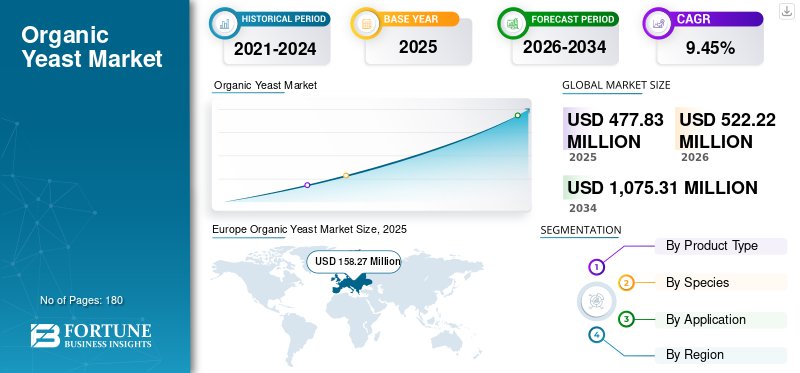
Download Free sample to learn more about this report.
Organic Yeast Market Key Takeaways
 Global Market Size & Forecast
- 2025 Market Size: USD 477.83 million
- 2026 Market Size: USD 522.22 million
- 2034 Forecast Market Size: USD 1,075.31 million
- CAGR: 9.45% from 2026-2034
 Market Share
- Europe dominated the organic yeast market with a 33.12% share in 2025.
- The nutritional yeast segment is projected to grow at the highest CAGR of 11.86% during the forecast period.
- The Kluyveromyces marxianus segment is projected to register the highest CAGR of 14.50% during the forecast period.
 Key Regional Highlights
North America
North America was valued at USD 125.56 million in 2025.
Asia Pacific
Asia Pacific was valued at USD 112.60 million in 2025.
Europe
Europe reached USD 158.27 million in 2025, leading the global market.
U.S.
The market was valued at USD 98.45 million in 2025.
Japan
The market was valued at USD 13.38 million in 2025.
Read More

ORGANIC YEAST MARKET TRENDS
Growing Use of Organic Yeast in Craft Brewing is a Prominent Trend
The utilization of organically produced yeast in craft brewing is an evolving trend, driven by the clean-label movement and the shift toward sustainable brewing practices. Today, the majority of the population is gravitating toward organic craft beers for their unique flavors and premium quality. To produce organic alcoholic beverages, producers widely use yeast to adhere to organic standards. Apart from compliance, it captivates consumers' attention due to transparent sourcing and natural origin. However, it performs similar functions to regular yeast; its production without the use of artificial strains improves its position in artisanal and premium segments.
MARKET DYNAMICS
MARKET DRIVERS
Download Free sample to learn more about this report.
Rising Use of Yeast in Pet Food Formulation Bolsters Industry's Momentum
The growing use of organic yeast in pet food formulation is a major driver propelling market growth. Today, most of the pet owners are treating pets as part of the family and are willing to pay extra for items that provide health advantages and clean-label components, which directly fuels product demand. This ingredient is valued in the pet food sector owing to its natural B vitamins, high protein, and functional compound content. All these nutrients are useful in enhancing the immunity and health of animals. Moreover, it improves the flavor of pet food without using chemicals. Additionally, organic yeast, when added to feed, strengthens the digestion and gut health. Seeing these advantages, pet food producers are reformulating their existing portfolios by focusing on replacing artificial chemicals with natural ingredients.
MARKET RESTRAINTS
Premium Pricing Pressure and Shelf-Life Constraints Impede Market Growth
One of the main obstacles in the global market is high manufacturing costs. Globally, organic yeast production requires controlled fermentation environments and certified organic substrates, all of which substantially boost production prices compared to traditional yeast. Moreover, handling organic certification and maintaining segregated supply chains further increases costs. Such premium pricing is later passed on to customers, making organically produced yeast more costly. As a result, this high cost limits the global organic yeast market growth. Another key challenge in the industry is the limited shelf life. Organic yeast, specifically, minimally processed or fresh forms, has strict storage needs and a shorter shelf life than regular yeast.
MARKET OPPORTUNITIES
Technological Advancements in Yeast Sector Build Numerous Growth Opportunities
The use of modern technologies in the yeast industry opens lucrative growth opportunities. To improve the shelf life of yeast strains, companies are using drying technologies such as fluidized-bed drying and optimized spray drying. Energy-efficient production technologies are also gaining traction in the market as they enhance both environmental performance and cost-efficiency. Moreover, producers aim to adopt automation and digital tools that enable early detection of deviations and real-time tracking. Additionally, substantial advancements in non-GMO techniques help in developing yeast strains with improved flavor profiles, enhanced stress tolerance, and higher fermentation efficiency.
Segmentation Analysis
By Product Type
Baker's Yeast Dominated Market Due to Superior Leavening Efficiency
Based on the product type, the market is segmented into baker's yeast, brewer's yeast, nutritional yeast, and others.
The baker's yeast segment dominated the market in 2025. Compared to brewer's yeast, baker's yeast is capable of producing carbon dioxide more efficiently and quickly, leading to improved dough volume and texture. Moreover, it has a neutral flavor profile, which boosts its acceptance in the food & beverage sector. Additionally, it is economical to produce, unlike brewer's yeast, which needs specialized equipment. As a result, such factors propel the segment's potential.
The nutritional yeast is projected to grow at a high CAGR of 11.86% over the forecast period.
To know how our report can help streamline your business, Speak to Analyst
By Species
Saccharomyces cerevisiae Led Market Due to Strong Commercial Acceptance
Depending on the species, the market is divided into Saccharomyces cerevisiae, Saccharomyces pastorianus, Kluyveromyces marxianus, and others.
In 2025, the Saccharomyces cerevisiae segment led the global market. This species benefits directly from its food-use history and industrial familiarity. Yeast derived from this species is widely used in winemaking, baking, and brewing, driving the segment's growth. Moreover, it has higher process efficiency in conventional systems and is cost-effective. Additionally, lower commercialization and R&D costs further boost growth.
The Kluyveromyces marxianus segment is projected to grow at a high CAGR of 14.50% over the forecast period.
By Application
Food & Beverages Led Market Due to Use of Organic Yeast in Bakery and Brewery
Based on application, the market is distributed into food & beverages, nutraceuticals, animal feed, pharmaceuticals, and others.
Food and beverages led the global market in 2025. Compared to nutraceuticals and animal feed, organic yeast is used in large volumes in the bakery products and alcoholic beverages sectors. Moreover, the multifunctional advantage of a single ingredient and easy integration into production systems fuel its adoption. Additionally, robust alignment with organic food and clean-label trends further drives the segment's momentum.
The nutraceuticals segment is projected to grow at a high CAGR of 12.10% over the forecast period.
Organic Yeast Market Regional Outlook
By geography, the market is categorized into Europe, North America, Asia Pacific, South America, and the Middle East & Africa.
Europe
Europe Organic Yeast Market Size, 2025 (USD Million)
To get more information on the regional analysis of this market, Download Free sample
Europe dominated the organic yeast market share and reached USD 158.27 million in 2025. It is expected to grow at a CAGR of 9.38% in the coming years. The rising organic production and surging inclination toward plant-based products are propelling the region's potential.
Germany Organic Yeast Market
The Germany market in 2025 was valued at around USD 37.25 million, representing roughly 7.80% of the global revenues.
U.K. Organic Yeast Market
The U.K. market was valued at USD 32.95 million in 2025, equivalent to around 6.90% of the global sales.
North America
The North America region was valued at USD 125.56 million in 2025 and secures the second position. The market in North America is expected to grow due to increasing demand for clean-label ingredients and strong regulations by the U.S. Department of Agriculture. Moreover, growing yeast production and increased awareness of its benefits are driving regional growth.
U.S. Organic Yeast Market
Based on North America's strong contribution and the U.S. dominance within the region, the U.S. market was valued at USD 98.45 million in 2025, accounting for roughly 20.60% of global sales.
Asia Pacific
The Asia Pacific region was valued at USD 112.60 million in 2025 and held the third position. The growing emphasis on labelling and marketing of organically produced yeast, and the expanding animal feed sector, are pivotal factors augmenting growth. In the region, India and China were valued at USD 24.17 million and USD 46.42 million, respectively, in 2025.
India Organic Yeast Market
The India market in 2025 was valued at USD 24.17 million, accounting for roughly 5.06% of the global revenues. The rising demand for yeast derivatives and the flourishing pharmaceuticals industry are driving factors in the market.
China Organic Yeast Market
China's market is projected to be one of the largest worldwide, with revenues valued at around USD 46.42 million in 2025, accounting for roughly 9.71% of global sales.
Japan Organic Yeast Market
The Japan market in 2025 was valued at USD 13.38 million, accounting for approximately 2.80% of the global revenues.
South America and Middle East & Africa
The South America and Middle East & Africa regions are expected to witness moderate growth in this market space during the forecast period. The South America market was valued at USD 48.87 million in 2025. The augmented demand for alcoholic drinks and capacity expansion of yeast plants are expected to drive demand. The Middle East and Africa market was valued at USD 32.51 million in 2025.
South Africa Organic Yeast Market
The South African market was valued at USD 14.86 million in 2025, representing roughly 3.11% of global revenues.
COMPETITIVE LANDSCAPE
Key Industry Players
Product Launches Help Companies to Improve Their Profit Generation
The yeast sector is moderately consolidated, characterized by a combination of local specialty producers and prominent yeast producers. Prominent firms such as Lallemand Inc., Lesaffre Group, AB Mauri, and Angel Yeast Co., Ltd., dominate the market owing to their robust organic yeast strains, new product innovations, and strong production facilities. Along with this, the companies should aim for acquisitions and partnerships to strengthen their position in the operating space.
LIST OF KEY ORGANIC YEAST COMPANIES PROFILED
- Lesaffre Group (France)
- AB Mauri (U.K.)
- Lallemand Inc. (Canada)
- Angel Yeast Co., Ltd. (China)
- Kerry Group plc (Ireland)
- Leiber GmbH (Germany)
- Loov Organic, LLC (Estonia)
- DSM-Firmenich (Netherlands)
- Agrano GmbH & Co. KG (Germany)
- Biorigin (Brazil)
KEY INDUSTRY DEVELOPMENTS
- September 2025: Goldie's Superfoods, a U.S.-based nutritional yeast company, announced the launch of its latest non-fortified and organic nutritional yeast flakes, available in 8-ounce pouches.
- January 2023: Lallemand Health Solutions, a Canadian producer of probiotic yeast-based supplements, released its first-ever organic variant of Saccharomyces boulardii probiotic yeast.
- May 2020: Lesaffre, a bread-making solutions firm in France, marketed its Red Star Organic Dry Yeast to French commercial bakers. This ingredient can be used in a variety of flatbreads, muffins, and sweet doughs.
REPORT COVERAGE
The global organic yeast market provides an in-depth study of the market size & forecast by all the market segments included in the market reports. The global market forecast analysis includes details on the market dynamics and global market trends expected to drive the market during the forecast period. The market analysis offers information on the technological advancements, new product launches, key industry developments, and details on partnerships, mergers & acquisitions. The industry forecast also encompasses a detailed competitive landscape with information on the market segmentation, market share, and profiles of key operating players.
Request for Customization to gain extensive market insights.
Report Scope & Segmentation
| ATTRIBUTE | DETAILS |
| Study Period | 2021-2034 |
| Base Year | 2025 |
| Estimated Year | 2026 |
| Forecast Period | 2026-2034 |
| Historical Period | 2021-2024 |
| Growth Rate | CAGR of 9.45% from 2026-2034 |
| Unit | Value (USD Million) |
| Segmentation | By Product Type, Species, Application, Region |
| By Product Type |
|
| By Species |
|
| By Application |
|
| By Region |
|
Frequently Asked Questions
Fortune Business Insights says that the global market value stood at USD 477.83 million in 2025 and is projected to reach USD 1,075.31 million by 2034.
In 2025, the market value in Europe stood at USD 158.27 million.
The market is expected to exhibit a CAGR of 9.45% during the forecast period of 2026-2034.
By product type, the bakers yeast segment led the global market in 2025.
Rising use of yeast in pet food formulation bolsters the industry's momentum.
AB Mauri, Lesaffre Group, and Lallemand, Inc. are the key players in the market.
Europe held the largest market share in 2025.
Growing use of organic yeast in craft brewing is a prominent trend.



- 2021-2034
- 2025
- 2021-2024
- 180
-
(Offer valid till 15th Oct 2026)
Get 30-60 hrs Free Customization
Expand Regional and Country Coverage, Segments Analysis, Company Profiles, Competitive Benchmarking, and End-user Insights.




















Related Reports
-
US +1 833 909 2966 ( Toll Free )
-
Get In Touch With Us