Orthopedic Surgical Robots Market Size, Share & Industry Analysis, By Application (Hip, Knee, Spine), By End-use (Inpatient, Outpatient) and Regional Forecast, 2026-2034
 Download Free Sample
Orthopedic Surgical Robots Market Size & Industry Overview
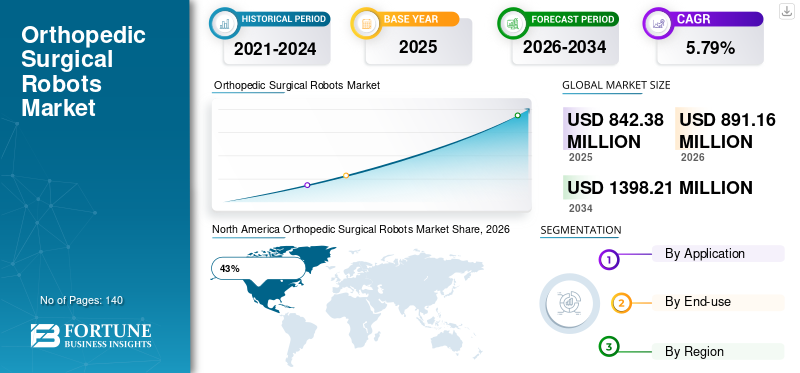
The orthopedic surgical robots market size was valued at USD 842.38 million in 2025. The market is projected to grow from USD 891.16 million in 2026 to USD 1398.21 million by 2034, exhibiting a CAGR of 5.79% during the forecast period.

The orthopedic surgical robots market is experiencing significant transformation due to the increasing adoption of precision-guided surgical systems across orthopedic procedures. Healthcare providers are integrating robotic-assisted technologies to improve implant positioning, surgical consistency, workflow efficiency, and patient outcomes. Orthopedic surgical robots are increasingly utilized in joint replacement and spine surgeries, where precision is critical for long-term clinical success. The market is supported by advancements in artificial intelligence, navigation software, real-time imaging integration, and robotic arm technologies. Growing demand for minimally invasive procedures and enhanced surgical planning capabilities continues to expand the role of orthopedic robotics in modern operating rooms. orthopedic surgical robots market analysis indicates increasing acceptance among hospitals and specialized orthopedic centers.
The United States remains the leading country in the orthopedic surgical robots market due to strong healthcare infrastructure, advanced surgical facilities, and high adoption of robotic-assisted orthopedic procedures. Hospitals across the country increasingly utilize robotic systems for knee replacement, hip replacement, and spine surgeries. The presence of major orthopedic technology developers, widespread surgeon training programs, and favorable adoption of advanced medical technologies support market expansion. The orthopedic surgical robots market Report for the USA highlights rising demand for personalized surgical planning, digital workflow integration, and robotic precision. Large healthcare networks continue investing in robotic platforms to improve procedural outcomes and strengthen competitive positioning within orthopedic care delivery.
Download Free sample to learn more about this report.
Orthopedic Surgical Robots Market Key Takeaways
 Global Market Size & Forecast
- 2025 Market Size: USD 842.38 Million
- 2026 Market Size: USD 891.16 Million
- 2034 Forecast Market Size: USD 1,398.21 Million
- CAGR: 5.79% from 2026-2034
 Market Share
- The market in North America dominated with a revenue share of 43% in 2025.
- Knee procedures dominated by procedure type with a market share of approximately 47%.
- Inpatient facilities dominated by end use with a market share of approximately 72%.
 Key Regional Highlights
North America
North America led the market with a 43% share, supported by advanced healthcare infrastructure and strong adoption of robotic-assisted surgery.
Europe
Europe accounted for 28% of the market, driven by increasing adoption of advanced orthopedic technologies.
Asia-Pacific
Asia-Pacific held a 21% share, supported by expanding healthcare infrastructure and rising demand for orthopedic procedures.
U.S
The U.S. remains a key market, supported by advanced surgical facilities and growing adoption of robotic-assisted orthopedic procedures.
Japan
Japan accounted for approximately 26% of the Asia-Pacific market, supported by advanced healthcare infrastructure and increasing adoption of surgical robotics.
Read More

Orthopedic Surgical Robots Market Latest Trends
One of the most notable orthopedic surgical robots market trends is the integration of artificial intelligence and machine learning algorithms into robotic platforms. These technologies enable surgeons to analyze patient anatomy with greater accuracy, optimize implant placement, and reduce surgical variability. Advanced software solutions are increasingly being integrated with robotic systems to support preoperative planning and intraoperative decision-making.
Download Free sample to learn more about this report.
Another important trend is the expansion of robotic-assisted orthopedic procedures beyond knee and hip replacement surgeries. Manufacturers are developing specialized robotic systems for spine surgery, trauma applications, and complex reconstructive procedures. Cloud-connected surgical platforms, data-driven analytics, and digital orthopedic ecosystems are also becoming prominent features within the Orthopedic Surgical Robots Industry Analysis. Healthcare institutions are focusing on technologies that enhance efficiency, shorten recovery periods, and improve procedural standardization. Furthermore, collaborative robotics and compact robotic designs are helping expand adoption among mid-sized healthcare facilities, creating new orthopedic surgical robots market opportunities.
Orthopedic Surgical Robots Market Dynamics
DRIVER
Increasing Demand for Precision-Based Orthopedic Procedures
The primary driver of the orthopedic surgical robots market growth is the growing demand for highly precise orthopedic surgeries. Robotic-assisted systems help surgeons achieve greater accuracy during implant positioning and bone preparation, reducing the risk of surgical errors. As orthopedic procedures become increasingly complex, healthcare providers seek technologies that enhance procedural consistency and improve long-term patient outcomes.
The rising prevalence of musculoskeletal disorders, sports injuries, degenerative joint diseases, and age-related orthopedic conditions continues to increase procedural volumes worldwide. Robotic systems support individualized treatment planning and facilitate minimally invasive surgical approaches. orthopedic surgical robots market insights indicate that hospitals are increasingly adopting robotic platforms to strengthen surgical capabilities and improve patient satisfaction. Enhanced visualization, real-time navigation, and data-guided surgical execution further contribute to the growing demand for robotic orthopedic solutions.
RESTRAINT
High Acquisition and Implementation Costs
One of the major restraints affecting the orthopedic surgical robots market is the substantial cost associated with purchasing, implementing, and maintaining robotic systems. Advanced orthopedic robots require significant capital investment, making adoption challenging for smaller hospitals and healthcare facilities operating under budget constraints.
Beyond the initial equipment expenditure, institutions must invest in surgeon training, software updates, maintenance services, and operating room modifications. The economic burden can delay purchasing decisions and limit market penetration in cost-sensitive healthcare environments. Additionally, healthcare providers often evaluate return-on-investment metrics before adopting robotic technologies. orthopedic surgical robots market research report findings suggest that cost concerns remain a critical factor influencing procurement decisions, particularly in emerging healthcare markets where healthcare budgets are relatively constrained.
OPPORTUNITY
Expansion of Robotic Applications in Orthopedic Specialties
The expansion of robotic-assisted technologies into additional orthopedic specialties presents a major opportunity for market participants. While knee and hip procedures currently dominate utilization, manufacturers are increasingly developing solutions for spine surgery, trauma reconstruction, shoulder procedures, and complex orthopedic interventions.
Growing acceptance of robotic platforms among surgeons creates opportunities for software innovation, advanced navigation systems, and patient-specific surgical planning tools. Emerging healthcare markets are also investing in advanced surgical infrastructure, creating additional demand for orthopedic robotics. orthopedic surgical robots market forecast assessments indicate that future opportunities will be driven by portable robotic systems, AI-enabled surgical guidance, and integrated digital operating rooms. Companies focusing on broader clinical applications and workflow optimization are expected to gain competitive advantages across global markets.
CHALLENGE
Training Requirements and Workflow Adaptation
A significant challenge within the orthopedic surgical robots market is the need for extensive training and workflow adaptation. Surgeons must become proficient in robotic-assisted procedures, software interfaces, and digital surgical planning systems before achieving optimal outcomes.
The learning curve associated with robotic surgery may initially affect procedural efficiency and operating room scheduling. Healthcare organizations must allocate resources for staff education, certification programs, and technology integration. Resistance to changing established surgical techniques can also slow adoption rates among some healthcare professionals. Orthopedic Surgical Robots Industry Report evaluations indicate that successful implementation requires coordinated efforts involving surgeons, administrators, and technology providers. Maintaining consistent utilization levels and demonstrating measurable clinical benefits remain important challenges for healthcare facilities investing in robotic platforms.
Orthopedic Surgical Robots Market Segmentation
By Procedure Type
Hip applications account for approximately 29% of the orthopedic surgical robots market share. Robotic-assisted hip replacement procedures continue gaining popularity because of the need for accurate implant positioning and improved joint alignment. Surgeons increasingly utilize robotic systems to develop personalized surgical plans based on individual patient anatomy. Advanced robotic technologies provide real-time guidance during bone preparation and implant placement, helping reduce procedural variability. orthopedic surgical robots market analysis indicates that growing demand for hip arthroplasty among aging populations and patients suffering from degenerative joint disorders continues to support segment expansion. Healthcare providers favor robotic assistance because it enhances reproducibility and supports long-term implant performance.
Knee procedures represent approximately 47% of the orthopedic surgical robots market size, making them the largest segment. Robotic-assisted knee replacement surgeries benefit from highly accurate bone resections, alignment optimization, and patient-specific treatment planning. The widespread prevalence of osteoarthritis and knee degeneration continues to increase procedural volumes globally. Healthcare institutions frequently prioritize robotic systems for knee procedures because these surgeries demonstrate measurable improvements in precision and workflow efficiency. orthopedic surgical robots market trends indicate increasing utilization of robotic-assisted partial and total knee arthroplasty. Continuous software advancements and navigation technologies further strengthen segment leadership within the orthopedic robotics industry.
Spine applications account for approximately 24% of the orthopedic surgical robots market share. Robotic-assisted spine surgery is increasingly utilized for pedicle screw placement, spinal stabilization procedures, and complex spinal reconstructions. The need for enhanced precision in anatomically sensitive regions has accelerated adoption among specialized surgical centers. Advanced robotic navigation systems enable surgeons to perform highly accurate spinal interventions while minimizing procedural variability. orthopedic surgical robots market opportunities within spine surgery continue expanding due to rising incidences of spinal disorders and technological advancements in imaging-guided robotics. Healthcare providers increasingly recognize the value of robotic assistance in improving procedural accuracy and supporting minimally invasive spine surgery approaches.
To know how our report can help streamline your business, Speak to Analyst
By End-Use
Inpatient facilities represent approximately 72% of the orthopedic surgical robots market share. Large hospitals and specialized orthopedic centers perform the majority of robotic-assisted procedures due to access to advanced operating rooms, trained personnel, and high procedural volumes. These institutions frequently invest in robotic technologies to strengthen surgical capabilities and attract patients seeking advanced orthopedic care. The inpatient segment benefits from integrated healthcare infrastructure and multidisciplinary clinical teams. orthopedic surgical robots market insights suggest that hospitals continue leading adoption because they possess the resources necessary to support robotic implementation, surgeon training, and long-term utilization strategies. Increasing demand for complex orthopedic procedures further supports segment dominance.
Outpatient facilities account for approximately 28% of the orthopedic surgical robots market share. Ambulatory surgical centers are increasingly incorporating robotic technologies as minimally invasive orthopedic procedures become more common. These facilities focus on efficient workflow management, shorter patient stays, and cost-effective treatment delivery. Advancements in robotic system design and procedural efficiency are making adoption more feasible within outpatient environments. orthopedic surgical robots market growth in this segment is supported by increasing patient preference for same-day surgical procedures and healthcare system efforts to optimize resource utilization. As robotic technologies become more compact and accessible, outpatient adoption is expected to expand further.
Orthopedic Surgical Robots Market Regional Outlook
North America
North America Orthopedic Surgical Robots Market Share, 2026 (%)
To get more information on the regional analysis of this market, Download Free sample
North America holds approximately 43% of the global orthopedic surgical robots market share. The region benefits from advanced healthcare infrastructure, strong technological adoption, and a high concentration of orthopedic specialists. Hospitals across the United States and Canada continue investing in robotic-assisted surgical systems to enhance precision and patient outcomes.
The region demonstrates strong demand for knee replacement, hip replacement, and spine procedures supported by robotic guidance. orthopedic surgical robots market research report assessments indicate that continuous technological innovation, favorable reimbursement environments, and widespread surgeon acceptance contribute to regional leadership. Academic medical centers and integrated healthcare networks actively promote robotic-assisted orthopedic surgery as part of broader digital healthcare initiatives.
Europe
Europe accounts for approximately 28% of the orthopedic surgical robots market share. The region benefits from increasing healthcare modernization, growing orthopedic procedure volumes, and rising interest in precision surgery technologies. Several European countries are expanding robotic surgery programs within public and private healthcare systems.
orthopedic surgical robots market outlook for Europe remains positive due to increasing investments in advanced operating room technologies and clinical research initiatives. Hospitals continue evaluating robotic platforms to improve surgical consistency and support patient-centered orthopedic care. The region remains an important contributor to technological innovation and clinical adoption.
Germany orthopedic surgical robots market
Germany represents approximately 31% of the European orthopedic surgical robots market. The country possesses one of the most advanced healthcare infrastructures in Europe and maintains a strong focus on medical technology innovation. German hospitals actively invest in robotic-assisted orthopedic solutions to improve procedural efficiency and clinical outcomes.
The German Orthopedic Surgical Robots Industry Analysis highlights increasing adoption of robotic systems in joint replacement and spine surgery. Strong surgeon expertise, technological readiness, and hospital modernization programs continue supporting market expansion. Academic hospitals and specialized orthopedic centers play a significant role in advancing robotic-assisted surgical techniques across the country.
United Kingdom orthopedic surgical robots market
The United Kingdom accounts for approximately 22% of the European orthopedic surgical robots market. Growing emphasis on healthcare innovation and surgical efficiency has encouraged the adoption of robotic orthopedic technologies within major healthcare institutions.
orthopedic surgical robots market insights for the United Kingdom indicate increasing deployment of robotic systems in knee and hip replacement programs. Healthcare providers focus on technologies that improve patient outcomes and optimize resource utilization. Continued investments in digital healthcare transformation and surgeon training programs support long-term market development throughout the country.
Asia-Pacific
Asia-Pacific holds approximately 21% of the orthopedic surgical robots market share. Rapid healthcare modernization, expanding hospital infrastructure, and increasing awareness of advanced surgical technologies contribute to regional growth. Countries across the region are investing in robotic-assisted surgical programs to enhance healthcare quality and improve treatment outcomes.
The orthopedic surgical robots market forecast for Asia-Pacific highlights rising demand for minimally invasive procedures and advanced orthopedic care. Growing populations, increasing healthcare expenditures, and expanding access to specialized surgical services continue supporting adoption. Regional manufacturers are also contributing to market development through technology innovation and localization efforts.
Japan orthopedic surgical robots market
Japan accounts for approximately 26% of the Asia-Pacific orthopedic surgical robots market. The country's aging population and high prevalence of orthopedic disorders create substantial demand for advanced surgical interventions. Healthcare providers increasingly adopt robotic technologies to improve procedural precision and support personalized treatment strategies.
orthopedic surgical robots market analysis for Japan demonstrates strong interest in innovative medical technologies and digital healthcare solutions. Hospitals focus on improving surgical quality, reducing complications, and enhancing patient recovery experiences. Continuous technological advancements further strengthen Japan's position within the regional market.
China orthopedic surgical robots market
China represents approximately 38% of the Asia-Pacific orthopedic surgical robots market. Rapid healthcare infrastructure development and increasing investments in advanced medical technologies have accelerated adoption of robotic-assisted orthopedic systems.
The Chinese orthopedic surgical robots market is supported by expanding hospital networks, rising orthopedic procedure volumes, and government initiatives encouraging healthcare modernization. Domestic innovation and increasing availability of robotic solutions continue contributing to market expansion. Large urban hospitals remain key adopters of orthopedic robotics technologies.
Rest of World
The Rest of World region accounts for approximately 8% of the orthopedic surgical robots market share. Adoption is gradually increasing across Latin America, the Middle East, and Africa as healthcare systems modernize and invest in advanced surgical technologies.
orthopedic surgical robots market opportunities within these regions are supported by growing demand for specialized orthopedic services and increasing awareness of robotic-assisted surgery benefits. While adoption rates remain lower than in developed markets, investments in healthcare infrastructure and medical technology procurement continue creating growth potential. Strategic partnerships, training programs, and hospital modernization initiatives are expected to support future market development.
List of Top Orthopedic Surgical Robots Companies
- Medrobotics Corporation
- Medtronic
- Renishaw plc
- Smith and Nephew
- Stryker Corporation
- THINK Surgical, Inc.
- Transenterix (Asensus Surgical, Inc.)
- Zimmer Biomet
- Accuray Incorporated
- Globus Medical
- Auris Health Inc.
- Johnson & Johnson Services Inc.
- Nordson Corporation
- OMNILife science Inc.
- Intuitive Surgical
- Wright Medical Group
Top Two Companies by Market Share
- Stryker Corporation – 24%
- Zimmer Biomet – 19%
Investment Analysis and Opportunities
Investment activity within the orthopedic surgical robots market continues to focus on technological innovation, software development, and expansion of robotic-assisted procedure portfolios. Medical technology companies are allocating substantial resources toward artificial intelligence integration, navigation technologies, and advanced imaging capabilities. Venture capital firms and strategic investors are increasingly interested in robotic surgery platforms due to their long-term growth potential and expanding clinical applications.
orthopedic surgical robots market opportunities are particularly strong in emerging healthcare markets where hospital modernization initiatives are underway. Investments in surgeon training programs, digital surgical ecosystems, and cloud-connected robotic platforms are expected to generate substantial value. Strategic collaborations between hospitals, research institutions, and technology developers are accelerating innovation. Companies that focus on cost-effective robotic solutions, workflow optimization, and expanded clinical indications are positioned to attract investment and strengthen competitive positioning within the global market.
New Product Development
New product development within the orthopedic surgical robots market is centered on improving surgical precision, workflow efficiency, and user experience. Manufacturers are introducing robotic platforms featuring advanced navigation systems, artificial intelligence capabilities, and enhanced imaging integration. These innovations support personalized surgical planning and real-time intraoperative guidance.
Several companies are developing next-generation robotic systems capable of addressing multiple orthopedic specialties through modular platform architectures. orthopedic surgical robots market trends indicate increasing emphasis on compact system designs, cloud-based connectivity, and predictive analytics. Enhanced software capabilities allow surgeons to simulate procedures before entering the operating room, improving preparation and decision-making. Product development efforts are also focused on improving interoperability with hospital information systems and expanding applications across joint replacement, spine surgery, and trauma procedures.
Five Recent Developments (2023-2025)
- Stryker expanded robotic-assisted orthopedic procedure capabilities through software and workflow enhancements.
- Zimmer Biomet introduced upgraded digital planning and navigation functionalities for robotic orthopedic systems.
- Johnson & Johnson strengthened robotic surgery development initiatives targeting orthopedic applications.
- Globus Medical expanded robotic spine surgery offerings with enhanced navigation integration.
- Medtronic advanced robotic-assisted spine surgery technologies focused on precision-guided interventions.
Report Coverage Of Orthopedic Surgical Robots Market
The orthopedic surgical robots market Report provides comprehensive coverage of industry structure, competitive landscape, technology developments, market trends, and strategic growth opportunities. The report evaluates key factors influencing adoption across hospitals, specialty clinics, and ambulatory surgical centers. Detailed segmentation analysis covers procedure categories, end-use environments, and regional markets.
Request for Customization to gain extensive market insights.
The orthopedic surgical robots market research report also examines technological innovations, investment patterns, product development strategies, and emerging business opportunities. Market participants, investors, healthcare providers, and industry stakeholders utilize the report to understand evolving competitive dynamics and future market potential. Coverage includes company profiling, regional assessment, demand analysis, and evaluation of factors influencing technology adoption across global healthcare systems.
Frequently Asked Questions
Fortune Business Insights says that the global market value stood at USD 842.38 million in 2025 and is projected to reach USD 1,398.21 million by 2034.
The market is expected to exhibit a CAGR of 5.79% during the forecast period of 2026-2034.
Knee procedures led the application segment with approximately 47% market share, supported by the widespread prevalence of osteoarthritis and the growing use of robotic-assisted knee replacement.
Key players include Medtronic, Renishaw plc, Smith and Nephew, Stryker Corporation, THINK Surgical, Inc., and Zimmer Biomet.
Major trends include AI and machine learning integration into robotic platforms and expansion into spine, trauma, and other orthopedic procedures. North America led with approximately 43% market share.



- 2021-2034
- 2025
- 2021-2024
- 140
-

(Offer valid till 15th Oct 2026)
Get 30-60 hrs Free Customization
Expand Regional and Country Coverage, Segments Analysis, Company Profiles, Competitive Benchmarking, and End-user Insights.












.webp)






-
US +1 833 909 2966 ( Toll Free )
-
Get In Touch With Us