Oxalic Acid Market Size, Share & Industry Analysis, By Grade (Industrial Grade, Technical Grade, and Others), By Application (Textile Processing, Industrial Cleaning, Metal Surface Treatment, Metals & Mineral Processing, Chemical Intermediates, and Others), and Regional Forecast, 2026-2034
 Download Free Sample
Oxalic Acid Market Overview
 Listen to Audio Version
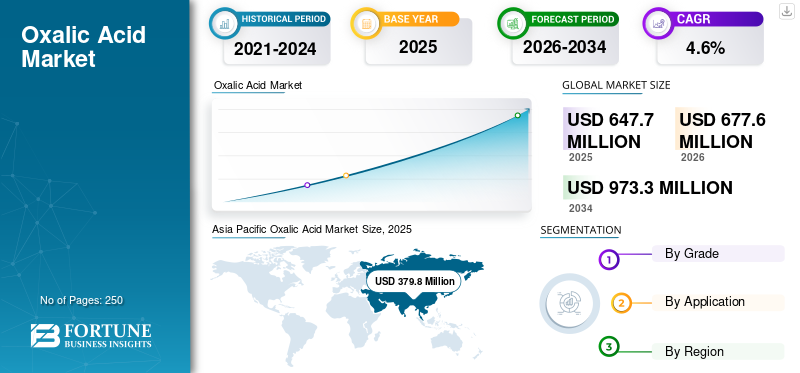
The global oxalic acid market size was valued at USD 647.7 million in 2025. The market is projected to grow from USD 677.6 million in 2026 to USD 973.3 million by 2034, exhibiting a CAGR of 4.6% during the forecast period. Asia Pacific dominated the oxalic acid market with a market share of 58.63% in 2025.
Oxalic acid is a versatile organic acid widely used across industrial cleaning, metal treatment, textile processing, rare earth extraction, pharmaceuticals, textiles and metal processing. It is commonly used as a reducing agent, bleaching agent, chelating agent, and cleaning compound due to its strong acidity and ability to bind with metal ions. The rising demand from metal surface treatment, rust removal agents, textile bleaching, and rare earth element processing is supporting the growth of the global market. In addition, expanding applications in pharmaceutical synthesis, specialty chemicals, and sustainable cleaning formulations are further strengthening product adoption across industrial and commercial end-use sectors. Therefore, market growth is increasingly being driven by steady demand from downstream chemical processing industries, along with rising usage in high-purity applications such as electronics cleaning and rare earth separation.
The global market is shaped by a mix of established Chinese manufacturers and regional suppliers with capabilities in industrial-grade and refined oxalic acid production. Key players include LonG Shine Industry Co., Ltd., Shandong Fengyuan Chemical Co., Ltd., Humate Group, Shandong ACID Technology Co., Ltd., and Oxaquim S.A. These companies continue to compete through production scale, raw material integration, product purity, export reach, and supply reliability.
Download Free sample to learn more about this report.
OXALIC ACID MARKET KEY TAKEAWAYS
 Global Market Size & Forecast
- 2025 Market Size: USD 647.7 Million
- 2026 Market Size: USD 677.6 Million
- 2034 Forecast Market Size: USD 973.3 Million
- CAGR: 4.6% from 2026–2034
 Market Share
- Asia Pacific dominated the oxalic acid market with a market share of 58.63% in 2025.
- The industrial cleaning segment accounted for another major chunk of the market revenue and is anticipated to grow at a CAGR of 4.4% during the forecast period.
- The chemical intermediates segment is anticipated to grow at a CAGR of 4.8% during the forecast period.
 Key Regional Highlights
North America
The market reached USD 87.0 million in 2025 and is expected to grow steadily, supported by demand from industrial cleaning, specialty chemicals, pharmaceuticals, and metal surface treatment applications.
Europe
Europe accounted for USD 109.2 million in 2025, driven by stable demand across specialty chemicals, pharmaceuticals, textile finishing, and industrial cleaning applications.
Asia Pacific
Asia Pacific dominated the global oxalic acid market in 2025, reaching USD 379.8 million.
U.S.
The U.S. oxalic acid market is projected to reach USD 74.2 million in 2026, fueled by industrial cleaning, laboratory chemicals, specialty chemical synthesis, and pharmaceutical applications.
Japan
Japan is expected to witness steady growth during the forecast period, driven by demand for high-purity oxalic acid in specialty chemicals, electronics, metal treatment, and advanced industrial applications.
Read More

OXALIC ACID MARKET TRENDS
Shift Toward High-Purity and Bio-Based Organic Acids to Fuel Product Adoption
The growing preference for cleaner chemicals and high-purity organic acids is accelerating the product adoption across precision-driven applications. Industries such as pharmaceuticals, electronics cleaning, laboratory chemicals, and specialty synthesis require consistent purity, controlled impurities, and reliable performance. This is encouraging producers to improve refining processes and offer application-specific oxalic acid grades. At the same time, sustainability pressure is increasing interest in bio-based oxalic acid production using biomass conversion, carbon dioxide utilization, and electrocatalytic technologies. The increasing preference for grades with better quality consistency, lower impurity levels, and improved suitability for regulated applications is creating positive demand toward product. Therefore, demand is expected to gradually move from bulk industrial-grade oxalic acid toward cleaner, higher-value, and more sustainable product formats.
MARKET DYNAMICS
MARKET DRIVERS
Download Free sample to learn more about this report.
Increasing Use of Oxalic Acid in Metal Cleaning and Mining Drives Market Growth
Oxalic acid’s strong reducing, chelating, and precipitating properties make it highly suitable for metal treatment and critical mineral processing applications. It is widely used in automotive, heavy machinery, construction equipment, aerospace, and industrial engineering sectors for rust removal, mineral deposit cleaning, and surface preparation. Its ability to dissolve oxidation layers without causing excessive corrosion improves metal durability and surface quality. In addition, the rapid expansion of rare earth and critical mineral industries is strengthening demand. The International Energy Agency states that demand for magnet rare earth elements such as neodymium, praseodymium, dysprosium, and terbium has doubled since 2015 and is expected to grow strongly through 2030. As a result, the increasing use of oxalic acid in metal cleaning, metallurgy, and critical mineral processing is set to drive the global oxalic acid market growth during the forecast period.
MARKET RESTRAINTS
Stringent Environmental Regulations May Restrict Market Growth
Stringent environmental regulations and handling risks may restrain market growth. Oxalic acid can be hazardous in concentrated form and requires careful storage, transportation, labeling, and disposal. Its acidic and toxic nature increases compliance requirements for manufacturers and end users, especially across cleaning, textile, metal treatment, and chemical processing applications. Industries must follow workplace safety standards, wastewater treatment norms, and emission-control guidelines, which can increase operating costs. In addition, regulatory pressure on chemical discharge and worker exposure may limit adoption in sensitive applications. Hence, strict environmental, health, and safety requirements are expected to moderately restrict market growth during the forecast period.
MARKET OPPORTUNITIES
Rising Demand for High-Purity Oxalic Acid in Electronics and Specialty Chemicals Opens New Growth Avenues
Rising demand for high-purity oxalic acid across pharmaceuticals, electronics, and specialty chemicals is creating new growth avenues beyond traditional bulk applications. In pharmaceuticals, oxalic acid is used in controlled synthesis, intermediate production, and purification processes where impurity control and consistent quality are important. The expanding pharmaceutical industry is supporting demand for reliable high-purity chemicals. Electronics and semiconductor applications are also strengthening consumption, as precision cleaning, metal ion control, and specialty chemical processing require high-grade materials. Specialty chemical producers are increasingly using oxalic acid in niche formulations, advanced intermediates, and high-value processing applications. Hence, suppliers with strong quality assurance, documentation, regulatory compliance, and application-specific grades are expected to capture higher-value opportunities in the market.
Segmentation Analysis
By Grade
Industrial Grade Segment Dominates Market Owing to Its Extensive Use in Bulk Industrial Cleaning
Based on grade, the market is segmented into industrial grade, technical grade, and others.
Industrial grade segment accounts for the largest share of the global market due to its extensive use across textile processing, industrial cleaning, metal surface treatment, and general chemical processing applications. Its strong reducing, bleaching, and chelating properties make it suitable for rust removal, stain cleaning, textile bleaching, and scale removal. The segment continues to benefit from steady consumption across cost-sensitive and high-volume industrial applications where consistent performance and commercial availability remain key purchasing criteria.
Technical grade segment is expected to witness comparatively faster growth, supported by its use in more controlled applications such as specialty chemicals, pharmaceuticals, laboratory chemicals, electronics cleaning, and refined chemical synthesis. Rising demand for better impurity control, product consistency, and application-specific grades is encouraging manufacturers to strengthen refining and quality assurance capabilities. Therefore, increasing use in higher-value and performance-sensitive applications is expected to steadily expand the technical grade segment at a CAGR of 4.8% over the forecast period.
The others segment includes specialty, customized, and application-specific oxalic acid grades used in niche and higher-value applications. This segment is projected to record the fastest growth, with a CAGR of 5.1% during 2026–2034. Growth is driven by increasing demand for tailored purity profiles, research-grade materials, specialized formulations, and advanced industrial processing requirements. Although it represents a smaller share of the market, the segment benefits from higher value addition and stricter performance specifications.
By Application
Textile Processing Segment Led Market Owing to Its Ability to Remove Iron Stains and Improve Fabric Brightness
Based on application, the market is segmented into textile processing, industrial cleaning, metal surface treatment, metals & mineral processing, chemical intermediates, and others.
To know how our report can help streamline your business, Speak to Analyst
Textile processing segment accounted for the largest global oxalic acid market share in 2025. Oxalic acid is widely used in textile bleaching, stain removal, dyeing support, and fiber cleaning due to its reducing and chelating properties. Its ability to remove iron stains and improve fabric brightness supports continued adoption across textile finishing operations. Although growth remains moderate, the segment continues to hold a leading position due to its established use in large-scale textile manufacturing and processing industries.
The industrial cleaning segment accounted for another major chunk of the market revenue and is anticipated to grow at a CAGR of 4.4% during the forecast period. Increasing use in rust removal, scale cleaning, mineral deposit removal, and surface cleaning applications is supporting the segment growth. Oxalic acid is preferred in industrial cleaning formulations due to its ability to dissolve stains, oxidation layers, and inorganic deposits effectively. It is used across manufacturing facilities, equipment maintenance, construction, and general industrial cleaning operations.
The chemical intermediates segment is anticipated to grow at a CAGR of 4.8% during the forecast period, driven by its use in specialty chemical synthesis, pharmaceutical intermediates, agrochemicals, dyes, and laboratory chemicals. Oxalic acid is used as a reducing agent, reagent, and intermediate in several downstream chemical processes. The segment benefits from rising demand for consistent-quality organic acids in controlled synthesis and high-value chemical manufacturing. Growing specialty chemical production and increasing need for application-specific grades are further supporting adoption.
Oxalic Acid Market Regional Outlook
By geography, the market is segmented into North America, Europe, Asia Pacific, Latin America, and the Middle East & Africa.
Asia Pacific
Asia Pacific Oxalic Acid Market Size, 2025 (USD Million)
To get more information on the regional analysis of this market, Download Free sample
Asia Pacific dominated the global market in 2025, reaching USD 379.8 million, and is expected to remain the leading regional market during the forecast period. The dominance is driven by strong consumption across textile processing, industrial cleaning, metal surface treatment, chemical intermediates, and mineral processing applications. China and India remain major demand centers, supported by their large textile manufacturing base, chemical production ecosystem, metalworking industries, and growing rare earth and specialty chemical processing activities. Expanding industrial output, cost-competitive manufacturing, and rising demand for oxalic acid in both bulk and higher-purity applications continue to strengthen Asia Pacific’s market leadership.
China Oxalic Acid Market
China’s market is set to account for approximately USD 292.5 million in 2026, representing around 43.2% of global demand. The country remains the largest market, supported by its strong production base, large-scale textile processing industry, and extensive use in industrial cleaning, metallurgy, rare earth processing, and chemical intermediates. China’s position as a major producer and exporter of organic acids further supports consistent domestic consumption and global supply participation.
To know how our report can help streamline your business, Speak to Analyst
India Oxalic Acid Market
India’s market is set to reach USD 28.0 million in 2026, accounting for nearly 4.1% of the global market. Demand is supported by expanding textile finishing, leather processing, industrial cleaning, and specialty chemical manufacturing activities. The country’s growing pharmaceutical and agrochemical production base is also increasing the use of oxalic acid in controlled synthesis and intermediate applications.
North America
North America reached USD 87.0 million in 2025 and is projected to grow at a CAGR of 4.1% during 2026–2034. The region represents a mature but steady market, driven by demand from industrial cleaning, metal surface treatment, specialty chemicals, pharmaceuticals, and laboratory applications. Product adoption is supported by the need for reliable cleaning agents, rust removers, and high-purity organic acids in regulated industries. Although regional volume growth is slower compared to Asia Pacific, demand for refined and application-specific grades continues to support value growth.
U.S. Oxalic Acid Market
The U.S. market values at USD 74.2 million in 2026, accounting for around 11.0% of global demand. Consumption is supported by industrial cleaning products, metal treatment chemicals, specialty chemical synthesis, laboratory use, and pharmaceutical-related applications. The country’s strong industrial maintenance sector and demand for high-quality chemical inputs continue to support oxalic acid adoption across both conventional and higher-value applications.
Europe
Europe accounted for USD 109.2 million in 2025, growing at a CAGR of 3.9% over the forecast period. The region has a relatively mature demand base, with consumption linked to specialty chemicals, pharmaceuticals, metal treatment, industrial cleaning, and textile finishing. Strict environmental and workplace safety regulations influence product handling and application practices, but demand remains stable due to oxalic acid’s effectiveness in controlled cleaning, chelation, and synthesis processes. Growth is expected to remain moderate, supported mainly by high-purity grades and value-added chemical applications.
Germany Oxalic Acid Market
Germany’s market is set to reach USD 25.1 million in 2026, representing around 3.7% of global demand. The country’s demand is supported by its strong chemical manufacturing base, metal treatment industry, industrial maintenance activities, and specialty chemical production. Oxalic acid is used in cleaning, surface treatment, and controlled chemical processing applications, where quality consistency and regulatory compliance remain important purchasing factors.
U.K. Oxalic Acid Market
The U.K. market is set to be valued at USD 12.8 million in 2026, accounting for around 1.9% of global demand. Consumption is driven by specialty chemicals, laboratory chemicals, pharmaceuticals, industrial cleaning, and niche textile and surface treatment applications. The market remains comparatively smaller but benefits from demand for controlled-grade oxalic acid across regulated and performance-sensitive end-use industries.
Latin America
Latin America reached USD 42.6 million in 2025 and is expected to expand at a CAGR of 4.6% from 2026 to 2034. Demand is supported by textile processing, industrial cleaning, agriculture-linked chemicals, metal maintenance, and general chemical processing. Brazil remains the largest contributor in the region, while other Latin American markets are gradually adopting oxalic acid in cleaning, surface treatment, and specialty formulation applications. Regional growth is expected to remain steady as industrial activity and downstream chemical consumption improve.
Brazil Oxalic Acid Market
Brazil’s market accounts for approximately USD 12.7 million in 2026, representing nearly 1.9% of global demand. The market is supported by industrial cleaning, metal treatment, textile processing, and chemical intermediate applications. Brazil’s broader manufacturing and agrochemical ecosystem also contributes to oxalic acid consumption, particularly in formulation and processing activities.
Middle East & Africa
The Middle East & Africa market reached USD 29.1 million in 2025, expanding at a CAGR of 4.4% during the forecast period. Demand is primarily supported by industrial cleaning, metal maintenance, water-treatment-related cleaning, construction-linked applications, and selected chemical processing activities. While the region accounts for a smaller share of global demand, gradual industrial diversification, infrastructure development, and rising use of specialty cleaning chemicals are expected to support moderate growth during the forecast period.
South Africa Oxalic Acid Market
South Africa’s market is projected to reach USD 1.94 million in 2026, representing nearly 0.3% of global demand, supported by demand from industrial cleaning, metal treatment, textile processing, leather applications, and chemical intermediates. The country’s established mining, metal finishing, and industrial maintenance sectors are expected to create steady consumption for oxalic acid, particularly in rust removal, surface cleaning, and mineral processing-related applications.
COMPETITIVE LANDSCAPE
Key Industry Players
Key Manufacturers are Increasingly Focusing on Improving Process Efficiency and Serving Higher-Value Applications to Strengthen Market Position
The global oxalic acid market is moderately consolidated, with competition led by Chinese manufacturers and selected regional suppliers. Key companies operating in the market include LonG Shine Industry Co., Ltd., Shandong Fengyuan Chemical Co., Ltd., Humate Group, Shandong ACID Technology Co., Ltd., and Oxaquim S.A. Chinese companies in the market hold a strong position due to cost-competitive production, large-scale capacity, and established export networks. Competition is mainly based on product grade, purity level, price competitiveness, supply reliability, regulatory compliance, and application-specific support. Manufacturers are increasingly focusing on improving process efficiency, strengthening quality consistency, and serving higher-value applications such as specialty chemicals, electronics cleaning, pharmaceuticals, and mineral processing. Hence, suppliers with stable production capabilities and diversified industrial customer bases are expected to maintain stronger market positioning.
LIST OF KEY OXALIC ACID COMPANIES PROFILED IN REPORT
- LonG ShinE Industry Co., Ltd. (China)
- Shandong Fengyuan Chemical Co., Ltd. (China)
- Humate Group (China)
- Shandong Acid Technology Co., Ltd. (China)
- Oxaquim S.A. (Spain)
- Shijiazhuang Taihe Chemical Co., Ltd. (China)
- Indian Oxalate Ltd. (India)
- Punjab Chemicals and Crop Protection Limited (India)
- Mudanjiang Fengda Chemicals Co., Ltd. (China)
- Uranus Chemicals Co., Ltd. (Taiwan)
- Shandong ThFine Chemical Co., Ltd. (China)
- STAROXOCHEM / Star Oxochem Pvt. Ltd. (India)
- Shandong Hualu-Hengsheng Chemical Co., Ltd. (China)
- Radiant Indus Chem Pvt. Ltd. (India)
KEY INDUSTRY DEVELOPMENTS
- December 2025: Oxaquim initiated a USD 23.2 million expansion of its Alcañiz plant, including 40 new jobs and a planned phased production increase. The first phase is expected to enable a 50% production increase by December 2026, with a second phase targeted for completion by the end of 2028.
- October 2025: Oxaquim signed a commercial agreement with a strategic North American company to supply oxalic acid for an expanding production process, strengthening its preferred and critical supplier position for the U.S. market.
- July 2023: Shandong Fengyuan Chemical advanced planning and design for its Huaning Phase 1 project in Yunnan, including 100 kilotons/year oxalic acid and yellow phosphorus tail-gas comprehensive utilization, signaling a capacity-linked expansion in oxalic acid and integrated chemical production.
- May 2022: Oxaquim outlined an investment plan of up to USD 51 million in Teruel, covering expansion of the Alcañiz facility and development of a new oxalic acid plant in Andorra. The project strengthens its role in materials linked to electric mobility, green energy generation, and digital transformation.
REPORT COVERAGE
The global oxalic acid market analysis provides an in-depth study of market size & forecast across all market segments included in the report. It includes details on the market dynamics and market trends expected to drive the market during the forecast period. It offers information on technological advancements, new product launches, key industry developments, and partnerships, mergers & acquisitions. The report also encompasses a detailed competitive landscape, including market share and profiles of key operating players.
Request for Customization to gain extensive market insights.
Report Scope & Segmentation
| ATTRIBUTE | DETAILS |
| Study Period | 2021-2034 |
| Base Year | 2025 |
| Estimated Year | 2026 |
| Forecast Period | 2026-2034 |
| Historical Period | 2021-2024 |
| Growth Rate | CAGR of 4.6% from 2026-2034 |
| Unit | Value (USD Million) and Volume (Kiloton) |
| Segmentation | By Grade, Application, and Region |
| By Grade |
|
| By Application |
|
| By Region |
|
Frequently Asked Questions
Fortune Business Insights says that the global market size was valued at USD 647.7 million in 2025 and is projected to reach USD 973.3 million by 2034.
In 2025, the Asia Pacific’s market value stood at USD 379.8 million.
Recording a CAGR of 4.6%, the market is slated to exhibit steady growth during the forecast period of 2026-2034.
The textile processing application segment led the market in 2025.
The increasing use of oxalic acid in metal cleaning, metallurgy, and critical mineral processing is set to drive the market growth.
LonG Shine Industry Co., Ltd., Shandong Fengyuan Chemical Co., Ltd., Humate Group, Shandong ACID Technology Co., Ltd., and Oxaquim S.A. are the top players in the market.
Asia Pacific held the highest market share in 2025.
Shift toward high-purity and bio-based organic acids to fuel product adoption.



- 2021-2034
- 2025
- 2021-2024
- 250
Get 30-60 hrs Free Customization
Expand Regional and Country Coverage, Segments Analysis, Company Profiles, Competitive Benchmarking, and End-user Insights.


















Related Reports
-
US +1 833 909 2966 ( Toll Free )
-
Get In Touch With Us