Patient Controlled Analgesic Pump Market Size, Share & Industry Analysis, By Type (Electronic, Mechanical), By Application (Diabetes, Oncology, Gastroenterology, Hematology) and Regional Forecast, 2026-2034
 Download Free Sample
Patient Controlled Analgesic Pump Market Overview
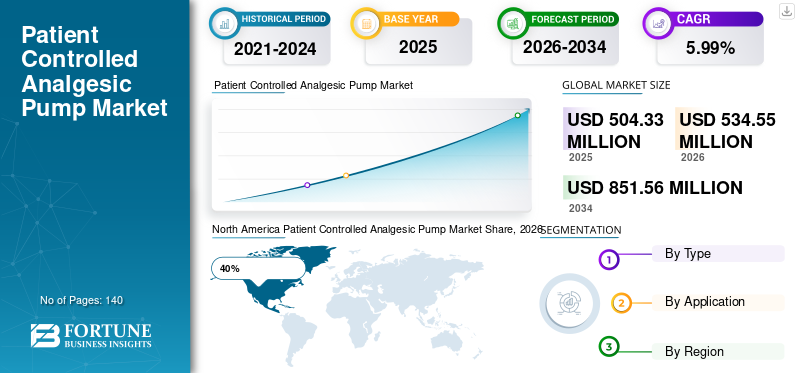
The patient controlled analgesic pump market size was valued at USD 504.33 million in 2025. The market is projected to grow from USD 534.55 million in 2026 to USD 851.56 million by 2034, exhibiting a CAGR of 5.99% during the forecast period. The market in North America dominated with a revenue share of 40% in 2025.

The patient controlled analgesic pump market is expanding steadily due to rising demand for advanced pain management systems across hospitals, surgical centers, and home healthcare settings. Patient controlled analgesic pumps allow patients to self-administer predetermined doses of pain medication, improving comfort, reducing nursing workload, and enhancing postoperative recovery management. Increasing surgical procedures, growing chronic pain prevalence, and rising focus on patient-centric healthcare are driving adoption globally. The patient controlled analgesic pump market Report highlights growing utilization of electronic and programmable infusion technologies in oncology, postoperative care, and palliative treatment applications. Technological advancements in smart infusion monitoring and medication safety systems continue to strengthen patient controlled analgesic pump market Growth worldwide.
The USA patient controlled analgesic pump market is witnessing strong growth because of increasing surgical procedure volumes, rising chronic pain cases, and growing adoption of advanced infusion technologies across healthcare institutions. Hospitals and ambulatory surgical centers in the United States are increasingly utilizing patient controlled analgesic pumps for postoperative pain management and long-term cancer care applications. The patient controlled analgesic pump market Analysis in the USA reflects rising demand for programmable electronic infusion systems integrated with safety monitoring technologies. Healthcare providers are emphasizing opioid management efficiency and patient comfort optimization. Strong healthcare infrastructure and increasing focus on minimally invasive surgeries continue to support the patient controlled analgesic pump market Outlook in the United States.
Download Free sample to learn more about this report.
Particle Size Analysis Market Key Takeaways
 Global Market Size & Forecast
- 2025 Market Size: USD 455.02 Million
- 2026 Market Size: USD 479.96 Million
- 2034 Forecast Market Size: USD 735.56 Million
- CAGR: 5.48% from 2026-2034
 Market Share
- The market in North America dominated with a revenue share of 39% in 2025.
- Laser Diffraction dominated by technology with a market share of approximately 47%.
- Pharmaceuticals dominated by end user with a market share of approximately 62%.
 Key Regional Highlights
North America
North America led the market with a 39% share, supported by advanced pharmaceutical and healthcare research infrastructure.
Europe
Europe accounted for 30% of the market, driven by strong pharmaceutical manufacturing and analytical testing activities.
Asia-Pacific
Asia-Pacific held a 23% share, supported by expanding healthcare, biotechnology, and nanotechnology research.
U.S
The U.S. remains a key market, supported by advanced pharmaceutical research and growing adoption of particle characterization technologies.
Japan
Japan accounted for approximately 25% of the Asia-Pacific market, supported by advanced healthcare infrastructure and growing nanotechnology research.
Read More

Patient Controlled Analgesic Pump Market Latest Trends
The patient controlled analgesic pump market Trends are increasingly shaped by rising adoption of smart infusion systems and wireless pain management technologies. Healthcare facilities are integrating programmable analgesic pumps with digital monitoring systems to improve medication accuracy, reduce dosing errors, and enhance patient safety. Electronic patient controlled analgesic pumps with touchscreen interfaces, automated alerts, and wireless connectivity are becoming increasingly popular across hospitals and specialty care centers. Healthcare providers are also emphasizing integration with electronic medical records and remote patient monitoring systems to improve clinical workflow efficiency.
Download Free sample to learn more about this report.
Another major trend identified in the patient controlled analgesic pump market Research Report is the growing preference for ambulatory and home-based pain management solutions. Portable and lightweight analgesic pumps are gaining popularity because they allow patients to continue pain therapy outside hospital settings while maintaining mobility and treatment flexibility. Manufacturers are introducing compact infusion systems with longer battery life, improved programming capabilities, and enhanced drug delivery precision. The patient controlled analgesic pump market Forecast further highlights increasing investment in opioid-sparing pain management technologies and non-invasive analgesic delivery methods to improve patient outcomes and reduce healthcare complications.
Patient Controlled Analgesic Pump Market Dynamics
DRIVER
Increasing Surgical Procedures and Chronic Pain Management Demand
The increasing number of surgical procedures and growing prevalence of chronic pain conditions are major factors driving patient controlled analgesic pump market Growth. Hospitals and healthcare facilities worldwide are experiencing rising demand for effective postoperative pain management systems due to increasing orthopedic, cardiovascular, gastrointestinal, and oncology-related surgeries. Patient controlled analgesic pumps provide personalized pain control by allowing patients to self-administer medication within predefined safety limits, improving treatment satisfaction and reducing delays in pain relief administration.
The patient controlled analgesic pump market Analysis indicates that healthcare providers are increasingly adopting advanced infusion technologies to improve patient recovery outcomes and reduce nursing intervention requirements. Chronic pain disorders, cancer-related pain, and palliative care needs are significantly contributing to market expansion globally. Healthcare institutions are emphasizing patient-centered treatment approaches and enhanced pain management protocols to improve healthcare quality. Technological advancements in programmable infusion systems and wireless monitoring capabilities are further accelerating adoption across hospitals and ambulatory care settings. Growing aging populations and rising healthcare investments continue to strengthen the Patient Controlled Analgesic Pump Industry Report.
RESTRAINT
Risk of Opioid Misuse and Medication Errors
Risk of opioid misuse and medication errors remains a major restraint affecting the patient controlled analgesic pump market Share. Patient controlled analgesic systems commonly administer opioid medications for postoperative and chronic pain management, creating concerns regarding overdose risks, dependency, and adverse drug reactions. Improper pump programming or incorrect dosage settings may lead to medication administration errors and patient safety complications. Healthcare providers must therefore implement strict monitoring protocols and staff training procedures to minimize operational risks.
The patient controlled analgesic pump market Outlook also highlights regulatory challenges related to controlled substance administration and infusion safety compliance. Hospitals and healthcare institutions are required to maintain rigorous documentation and medication management standards when utilizing analgesic pumps. Additionally, high costs associated with advanced electronic infusion systems and maintenance requirements may limit adoption in smaller healthcare facilities. Concerns regarding cybersecurity vulnerabilities in connected infusion devices and software integration complexities further contribute to operational challenges within the patient controlled analgesic pump market Size.
OPPORTUNITY
Expansion of Home Healthcare and Ambulatory Pain Management
The expansion of home healthcare and ambulatory pain management services presents substantial patient controlled analgesic pump market Opportunities. Healthcare systems worldwide are increasingly shifting toward outpatient treatment models and decentralized care delivery to reduce hospitalization costs and improve patient convenience. Portable patient controlled analgesic pumps allow patients to receive long-term pain therapy in home settings while maintaining mobility and independence. This trend is particularly important for cancer care, postoperative rehabilitation, and chronic pain treatment programs.
The patient controlled analgesic pump market Insights highlight increasing investments in lightweight infusion technologies and wireless monitoring systems optimized for home healthcare environments. Manufacturers are developing user-friendly analgesic pumps with enhanced safety features, remote monitoring capabilities, and simplified programming interfaces. Healthcare providers are also emphasizing opioid-sparing treatment protocols and multimodal pain management strategies. Rising elderly populations, increasing chronic disease prevalence, and growing preference for personalized healthcare continue to create significant growth opportunities within the global Patient Controlled Analgesic Pump Industry Analysis.
CHALLENGE
High Device Costs and Technical Maintenance Requirements
High device costs and technical maintenance requirements remain major challenges within the patient controlled analgesic pump market Forecast. Advanced electronic analgesic pumps equipped with programmable software, wireless connectivity, and smart safety features require significant investment from healthcare institutions. Smaller hospitals and ambulatory care centers may face budget limitations when adopting premium infusion technologies. Ongoing maintenance, calibration, and software update requirements also increase operational expenses for healthcare providers.
The patient controlled analgesic pump market Research Report further highlights technical challenges associated with system interoperability and staff training. Healthcare facilities often use diverse infusion systems and electronic health record platforms requiring integration compatibility. Medical professionals must receive specialized training to ensure safe pump programming and medication administration. Additionally, maintaining battery performance, cybersecurity protection, and device reliability is essential for uninterrupted patient care. Regulatory compliance requirements related to infusion safety standards and medical device approvals further increase operational complexity within the patient controlled analgesic pump market.
Patient Controlled Analgesic Pump Market Segmentation
By Type
Electronic patient controlled analgesic pumps dominate the patient controlled analgesic pump market with approximately 72% market share because they provide advanced programmability, dosage precision, and enhanced patient safety features. Hospitals and specialty care facilities increasingly utilize electronic infusion systems equipped with digital displays, automated alarms, and programmable medication limits to improve postoperative pain management efficiency. These pumps allow healthcare providers to customize treatment settings according to patient needs while minimizing medication administration errors. The patient controlled analgesic pump market Report highlights growing demand for wireless-enabled electronic pumps integrated with remote monitoring and electronic medical record systems. Healthcare institutions are prioritizing smart infusion technologies capable of improving workflow efficiency and reducing nursing workload. Manufacturers are introducing compact electronic pumps with touchscreen interfaces, advanced safety algorithms, and extended battery performance to support ambulatory and home healthcare applications. Rising adoption of digital healthcare infrastructure continues to strengthen the Electronic segment within the overall patient controlled analgesic pump market Growth landscape.
Mechanical patient controlled analgesic pumps account for approximately 28% of the patient controlled analgesic pump market Share because they provide cost-effective and simpler alternatives for pain management applications. These pumps are commonly used in healthcare settings requiring portable, lightweight, and non-electronic infusion systems. Mechanical analgesic pumps operate without complex programming systems, making them suitable for basic postoperative and palliative care procedures. The patient controlled analgesic pump market Trends indicate increasing demand for disposable and elastomeric mechanical pumps within ambulatory care and home healthcare settings. Healthcare providers appreciate their ease of use, portability, and reduced dependency on electronic infrastructure. Manufacturers are improving material durability and infusion flow consistency to enhance treatment reliability. Despite rising adoption of smart electronic systems, mechanical pumps continue to maintain relevance within budget-sensitive healthcare environments globally.
To know how our report can help streamline your business, Speak to Analyst
By Application
Diabetes-related applications contribute approximately 18% to the patient controlled analgesic pump market because diabetic patients often require pain management solutions during surgical procedures, neuropathy treatment, and chronic wound care management. Healthcare providers utilize analgesic pumps to improve patient comfort and medication precision during complex diabetes-related interventions and postoperative recovery programs. The patient controlled analgesic pump market Analysis highlights increasing adoption of portable infusion systems within diabetic patient management programs. Hospitals and specialty clinics are emphasizing personalized pain therapy approaches to improve treatment outcomes and reduce complications associated with chronic disease management. Rising diabetes prevalence and increasing healthcare infrastructure investments continue to support growth within this application segment.
Oncology applications dominate the patient controlled analgesic pump market with approximately 42% market share because cancer-related pain management remains one of the primary clinical uses for analgesic infusion systems. Patient controlled analgesic pumps allow cancer patients to manage pain effectively while maintaining greater treatment flexibility and comfort. Oncology centers and palliative care facilities increasingly utilize programmable infusion systems for long-term pain therapy and supportive care management. The patient controlled analgesic pump market Research Report highlights growing demand for home-based oncology pain management technologies and opioid optimization strategies. Healthcare providers are emphasizing personalized cancer care and improved quality of life through advanced analgesic delivery systems. Increasing global cancer incidence and expansion of palliative care services continue to strengthen the oncology application segment globally.
Gastroenterology applications account for approximately 21% of the patient controlled analgesic pump market Share because analgesic pumps are widely utilized in postoperative gastrointestinal surgery recovery and chronic abdominal pain management. Healthcare providers increasingly utilize infusion technologies to improve pain control during digestive disorder treatment and minimally invasive gastrointestinal procedures. The patient controlled analgesic pump market Forecast indicates rising demand for programmable analgesic systems in bariatric surgery and gastrointestinal oncology care. Hospitals are adopting patient controlled pain management protocols to improve postoperative recovery and reduce hospitalization durations. Increasing gastrointestinal disorder prevalence and surgical procedure volumes continue to support long-term market expansion within this segment.
Hematology applications contribute approximately 19% to the patient controlled analgesic pump market because patients undergoing hematological treatments often require continuous pain management during intensive therapies and bone marrow procedures. Analgesic pumps help improve patient comfort and medication administration precision during complex hematology treatment protocols. The Patient Controlled Analgesic Pump Industry Report highlights increasing utilization of portable infusion systems in oncology-related hematology care and chronic blood disorder treatment programs. Healthcare providers are emphasizing patient-centered supportive care strategies and home-based treatment flexibility. Rising adoption of personalized medicine approaches continues to support growth opportunities within hematology-related analgesic pump applications globally.
Patient Controlled Analgesic Pump Market Regional Outlook
North America
North America Patient Controlled Analgesic Pump Market Share, 2026 (%)
To get more information on the regional analysis of this market, Download Free sample
North America dominates the patient controlled analgesic pump market because of advanced healthcare infrastructure, high surgical procedure volumes, and widespread adoption of smart infusion technologies. Hospitals and specialty care centers across the region extensively utilize patient controlled analgesic pumps for postoperative pain management, oncology care, and chronic disease treatment applications. North America represents approximately 40% of the global market.
The patient controlled analgesic pump market Industry Analysis highlights rising demand for wireless infusion systems, remote monitoring capabilities, and opioid optimization technologies throughout the region. Healthcare providers are emphasizing patient-centered pain management protocols and digital healthcare integration strategies. Increasing elderly populations and expansion of ambulatory surgical procedures continue to support regional market growth.
Europe
Europe remains a significant contributor to the patient controlled analgesic pump market because of increasing healthcare modernization initiatives and growing focus on postoperative recovery management. Hospitals and palliative care facilities across the region are adopting advanced infusion technologies to improve pain management quality and patient safety. Europe contributes approximately 29% of the global market.
The patient controlled analgesic pump market Report highlights increasing investment in electronic analgesic systems and home-based pain management infrastructure throughout European healthcare systems. Healthcare providers are emphasizing medication safety, opioid management efficiency, and digital healthcare integration. Rising chronic disease prevalence and growing cancer care demands continue to strengthen the market across Europe.
Germany patient controlled analgesic pump market
Germany accounts for approximately 34% of the European patient controlled analgesic pump market because of its advanced hospital infrastructure and strong adoption of smart infusion technologies. Hospitals and surgical centers across Germany increasingly utilize electronic analgesic pumps for orthopedic surgeries, oncology treatment, and postoperative pain management applications.
The Germany patient controlled analgesic pump market Outlook highlights growing investment in digital healthcare infrastructure and patient safety technologies. Healthcare providers are emphasizing advanced pain management protocols and wireless infusion monitoring systems to improve clinical outcomes. Germany’s strong medical technology ecosystem and increasing healthcare automation initiatives continue to support market expansion.
United Kingdom patient controlled analgesic pump market
The United Kingdom contributes approximately 22% to the European patient controlled analgesic pump market because healthcare institutions are increasingly prioritizing postoperative recovery optimization and patient-centered pain management strategies. Hospitals and palliative care centers are utilizing programmable infusion systems to improve medication administration efficiency and patient comfort.
The United Kingdom patient controlled analgesic pump market Forecast indicates rising adoption of portable analgesic pumps and remote pain monitoring technologies across healthcare facilities. Healthcare providers are emphasizing opioid stewardship and outpatient care expansion through advanced infusion systems. Increasing healthcare digitization and chronic disease treatment demand continue to strengthen the market landscape within the United Kingdom.
Asia-Pacific
Asia-Pacific is witnessing rapid expansion within the patient controlled analgesic pump market because of rising healthcare infrastructure development, increasing surgical procedures, and growing awareness regarding advanced pain management technologies. Hospitals and specialty clinics across the region are increasingly adopting electronic infusion systems and ambulatory pain management solutions. Asia-Pacific contributes approximately 23% of the global market.
The patient controlled analgesic pump market Trends indicate increasing demand for affordable portable infusion technologies and home-based healthcare systems throughout Asia-Pacific. Government healthcare modernization initiatives and rising healthcare expenditure are supporting regional market development. Growing chronic disease prevalence and expanding medical tourism activities continue to accelerate market growth across the region.
Japan patient controlled analgesic pump market
Japan represents approximately 24% of the Asia-Pacific patient controlled analgesic pump market because of its advanced healthcare system and high elderly population requiring long-term pain management solutions. Hospitals and healthcare facilities increasingly utilize smart infusion systems for oncology care, surgical recovery, and palliative treatment applications.
The Japan patient controlled analgesic pump market Analysis highlights rising adoption of compact electronic infusion pumps and digital healthcare monitoring technologies. Healthcare providers are emphasizing precision medication delivery and patient safety optimization. Japan’s strong medical device innovation ecosystem continues to support growth within the analgesic pump industry.
China patient controlled analgesic pump market
China accounts for approximately 39% of the Asia-Pacific patient controlled analgesic pump market because of rapid healthcare infrastructure expansion and increasing surgical procedure volumes. Hospitals and oncology centers are increasingly adopting programmable infusion technologies to improve postoperative pain management and chronic disease treatment outcomes.
The China patient controlled analgesic pump market Research Report highlights growing domestic manufacturing capabilities and rising investments in smart medical device technologies. Healthcare providers are emphasizing affordable pain management solutions and expansion of home healthcare services. Government healthcare modernization initiatives continue to accelerate patient controlled analgesic pump market Growth across China.
Rest of World
The Rest of World patient controlled analgesic pump market is gradually expanding as healthcare providers across Latin America, the Middle East, and Africa increasingly adopt advanced pain management technologies and ambulatory infusion systems. Hospitals and specialty care facilities are utilizing analgesic pumps to improve postoperative recovery and chronic disease treatment outcomes. Rest of World contributes approximately 8% of the global market.
Healthcare modernization initiatives and increasing awareness regarding patient-centered pain management are supporting demand for programmable infusion systems across emerging economies. Healthcare providers are investing in portable analgesic technologies and home healthcare infrastructure to improve accessibility and treatment flexibility. Rising surgical procedure volumes continue to create additional patient controlled analgesic pump market Opportunities globally.
List of Top Patient Controlled Analgesic Pump Companies
- Baxter
- B. Braun SE
- Smiths Group plc
- Fresenius SE & Co. KGaA
- BD
- ICU Medical, Inc.
Top Two Companies with Highest Market Share
- Baxter – 24%
- B. Braun SE – 19%
Investment Analysis and Opportunities
The patient controlled analgesic pump market Opportunities segment is attracting strong investment from medical device manufacturers, infusion technology providers, and healthcare institutions. Investors are focusing on smart infusion systems, wireless pain monitoring technologies, and home-based healthcare solutions. Growing demand for patient-centered pain management and postoperative recovery optimization is creating significant commercial opportunities across global healthcare markets.
The patient controlled analgesic pump market Insights highlight increasing investment in digital healthcare infrastructure and AI-enabled infusion monitoring systems. Manufacturers are developing portable electronic pumps with enhanced safety algorithms, remote monitoring capabilities, and simplified user interfaces. Strategic collaborations between hospitals and medical device companies are supporting innovation and global market expansion. Rising chronic disease prevalence and increasing ambulatory care adoption continue to strengthen long-term investment potential within the Patient Controlled Analgesic Pump Industry Analysis.
New Product Development
The patient controlled analgesic pump market Trends highlight continuous innovation in programmable infusion technologies and wireless medication delivery systems. Manufacturers are developing lightweight electronic pumps with touchscreen interfaces, automated dosing alerts, and remote patient monitoring integration. Advanced safety algorithms and smart infusion technologies are improving medication accuracy and reducing clinical errors.
Medical device companies are also introducing portable analgesic systems optimized for home healthcare and ambulatory treatment applications. The patient controlled analgesic pump market Research Report highlights increasing innovation in opioid-sparing infusion technologies and non-invasive pain management solutions. Healthcare providers are increasingly adopting compact infusion devices designed to improve patient mobility, comfort, and treatment flexibility.
Five Recent Developments (2023-2025)
- Baxter introduced advanced wireless-enabled electronic analgesic pumps with remote monitoring capabilities in 2024.
- B. Braun SE expanded smart infusion safety technologies targeting postoperative pain management applications in 2023.
- BD launched compact portable patient controlled analgesic pumps optimized for ambulatory healthcare settings in 2025.
- ICU Medical, Inc. introduced programmable infusion systems with enhanced cybersecurity features in 2024.
- Fresenius SE & Co. KGaA developed opioid optimization infusion technologies for oncology and palliative care applications in 2025.
Report Coverage of Patient Controlled Analgesic Pump Market
The patient controlled analgesic pump market Report provides comprehensive analysis of industry trends, technological developments, competitive landscape factors, and healthcare pain management advancements influencing global market expansion. The report evaluates major product categories including electronic infusion pumps, mechanical analgesic systems, and portable home healthcare solutions. It also examines segmentation based on applications, end-use industries, and regional healthcare infrastructure developments.
Request for Customization to gain extensive market insights.
The patient controlled analgesic pump market Research Report further covers investment activities, product innovation trends, regulatory developments, and strategic collaborations among leading industry participants. Company profiling sections analyze manufacturing capabilities, infusion technology expertise, and operational strategies of major market players. Regional analysis highlights healthcare modernization initiatives, chronic disease prevalence, and digital infusion technology adoption trends across North America, Europe, Asia-Pacific, and Rest of World markets.
Frequently Asked Questions
Fortune Business Insights says that the global market value stood at USD 455.02 million in 2025 and is projected to reach USD 735.56 million by 2034.
The market is expected to exhibit a CAGR of 5.48% during the forecast period of 2026-2034.
Laser Diffraction led the technology segment with approximately 47% market share, supported by its fast, accurate, and highly reproducible particle-size measurements across a broad size range.
Key players include Malvern Panalytical Ltd., Horiba Ltd., Agilent Technologies Inc., Microtrac Inc., Beckman Coulter Inc., and Anton Paar GmbH.
Major trends include growing adoption of automated and AI-based particle characterization systems and rising demand for nanoparticle analysis technologies. North America led with approximately 39% market share.



- 2021-2034
- 2025
- 2021-2024
- 140
-

(Offer valid till 15th Oct 2026)
Get 30-60 hrs Free Customization
Expand Regional and Country Coverage, Segments Analysis, Company Profiles, Competitive Benchmarking, and End-user Insights.













.webp)






-
US +1 833 909 2966 ( Toll Free )
-
Get In Touch With Us