Patient Scales Market Size, Share & Industry Analysis, By Type (Mechanical, Electronic), By Product (Floor Scales, Body Fat Scales, Physician Scales), By End Use, and Regional Forecast, 2026-2034
 Download Free Sample
Patient Scales Market Overview
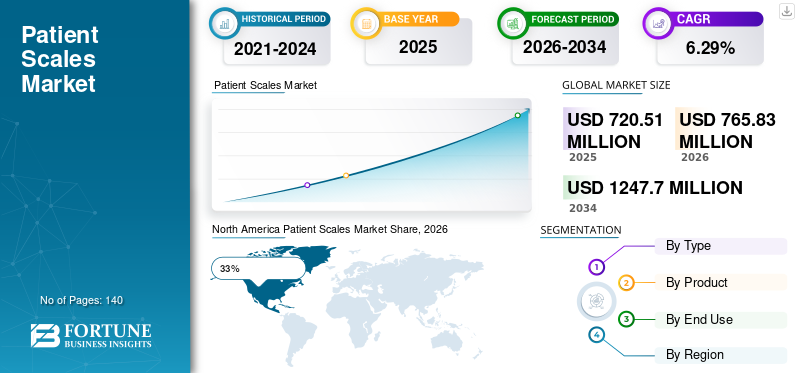
The global patient scales market size was valued at USD 720.51 million in 2025. The market is projected to grow from USD 765.83 million in 2026 to USD 1247.7 million by 2034, exhibiting a CAGR of 6.29% during the forecast period.

The patient scales market is an essential segment of the healthcare equipment industry, supporting accurate body weight measurement across hospitals, clinics, rehabilitation centers, nursing homes, and home healthcare settings. Increasing emphasis on patient monitoring, obesity management, chronic disease treatment, and preventive healthcare is driving demand for advanced weighing solutions. Modern patient scales are equipped with digital displays, wireless connectivity, body composition analysis, and electronic medical record integration capabilities. The patient scales market Report highlights growing adoption of precision measurement technologies that improve clinical decision-making and patient care. Demand is increasing across healthcare facilities seeking reliable and efficient patient assessment tools.
The United States represents a major share of the patient scales market due to its extensive healthcare infrastructure and strong adoption of digital medical devices. Hospitals, outpatient facilities, and physician offices increasingly rely on advanced patient weighing systems for routine health assessments and chronic disease management. Rising prevalence of obesity, diabetes, cardiovascular disorders, and age-related health conditions has increased the importance of accurate patient monitoring. Healthcare providers continue upgrading conventional equipment with connected and electronic scales that improve workflow efficiency and data management. The patient scales market Analysis indicates strong demand for technologically advanced solutions across acute care, long-term care, and home healthcare environments in the United States.
Download Free sample to learn more about this report.
Patient Scales Market Key Takeaways
 Global Market Size & Forecast
- 2025 Market Size: USD 720.51 Billion
- 2026 Market Size: USD 765.83 Billion
- 2034 Forecast Market Size: USD 1,247.70 Billion
- CAGR: 6.29% from 2026–2034
 Market Share
- North America dominated with a revenue share of 33% in 2025.
- Electronic patient scales held the largest type share at approximately 66%.
- Floor scales accounted for the largest product share at approximately 45%.
 Key Regional Highlights
North America
North America led the market with a 33% share in 2025, supported by advanced healthcare infrastructure and growing demand for accurate patient monitoring.
Europe
Europe accounted for approximately 28.6% of the market, driven by established healthcare systems and increasing adoption of digital measurement technologies.
Asia-Pacific
Asia-Pacific held a 24% share, supported by expanding healthcare infrastructure and rising patient monitoring needs.
U.S
The U.S. market is supported by high healthcare spending, advanced clinical infrastructure, and growing adoption of electronic patient scales.
Japan
Japan accounted for 20% of the Asia-Pacific market, supported by advanced healthcare services and increasing demand for precision patient monitoring.
Read More

patient scales market Latest Trends
The patient scales market Trends indicate a significant shift toward electronic and connected weighing systems capable of integrating with healthcare information platforms. Healthcare providers increasingly prefer smart scales that automatically transfer patient data into electronic records, reducing manual documentation errors. Wireless communication technologies and cloud-based monitoring solutions are becoming standard features in modern patient weighing equipment. Body composition analysis capabilities are also gaining popularity as healthcare organizations focus on comprehensive patient assessment beyond simple weight measurement.
Download Free sample to learn more about this report.
Manufacturers are introducing scales with advanced sensors that measure body mass index, hydration levels, muscle mass, and other health indicators. Portable and space-efficient designs are experiencing higher demand due to increasing utilization in outpatient and home healthcare environments. The patient scales market Research Report further highlights rising interest in bariatric scales designed to accommodate growing obesity rates globally. Healthcare facilities are also adopting touchless and antimicrobial scale technologies to support infection control initiatives. Continuous product innovation, increasing healthcare digitization, and growing emphasis on patient-centered care continue to shape the patient scales market Outlook and support long-term industry expansion.
patient scales market Dynamics
DRIVER
Rising Prevalence of Obesity and Chronic Diseases
The increasing prevalence of obesity, diabetes, cardiovascular diseases, and metabolic disorders remains a major growth driver for the patient scales market. Accurate weight measurement plays a critical role in diagnosis, treatment planning, medication dosing, and long-term patient monitoring. Healthcare providers rely on patient scales to track health progress and identify risk factors associated with chronic conditions. Growing public awareness regarding weight management and preventive healthcare has increased utilization of weighing devices across healthcare settings. Hospitals and clinics are investing in advanced measurement technologies that improve accuracy and efficiency. The patient scales market Growth is further supported by aging populations and increasing healthcare utilization worldwide.
RESTRAINT
Price Sensitivity among Smaller Healthcare Facilities
The relatively high cost of technologically advanced patient scales can limit adoption among small clinics, rural healthcare providers, and budget-constrained facilities. Electronic scales equipped with connectivity features and body composition analysis capabilities often require higher initial investments compared to conventional mechanical models. Maintenance, calibration, and software update requirements add to ownership costs. In developing regions, healthcare institutions frequently prioritize essential diagnostic equipment over advanced weighing systems. The Patient Scales Industry Analysis indicates that cost considerations remain an important factor influencing purchasing decisions, particularly in price-sensitive healthcare markets.
OPPORTUNITY
Expansion of Home Healthcare and Remote Patient Monitoring
The rapid growth of home healthcare services presents significant opportunities for the patient scales market. Increasing numbers of patients with chronic diseases are being monitored outside traditional hospital environments. Connected scales enable healthcare providers to track patient weight remotely and support preventive interventions. Growing adoption of telehealth services is encouraging demand for digital patient scales capable of transmitting real-time data. Manufacturers are developing user-friendly products designed specifically for home healthcare applications. The patient scales market Opportunities continue to expand as healthcare systems focus on reducing hospitalization rates and improving long-term patient management through remote monitoring solutions.
CHALLENGE
Ensuring Measurement Accuracy and Regulatory Compliance
Maintaining consistent measurement accuracy remains a major challenge within the patient scales market. Healthcare providers require highly reliable equipment that complies with strict clinical and regulatory standards. Frequent calibration and quality assurance procedures are necessary to ensure precision. Variations in patient weight distribution, environmental conditions, and equipment usage can impact measurement consistency. Manufacturers must continually invest in product testing and compliance certification processes. The patient scales market Insights suggest that balancing innovation with regulatory requirements remains a critical challenge for industry participants seeking to introduce new technologies while maintaining clinical reliability.
patient scales market Segmentation
By Type
Mechanical patient scales account for approximately 34% of the patient scales market. These scales remain widely utilized in healthcare facilities that prioritize durability, simplicity, and low maintenance requirements. Mechanical models do not require electrical power, making them suitable for resource-limited settings and emergency backup applications. Many healthcare institutions continue to rely on these scales for routine weight assessments due to their long operational lifespan. Despite growing competition from electronic alternatives, mechanical scales maintain relevance in developing markets where affordability is a major purchasing consideration.
Electronic patient scales represent approximately 66% of the patient scales market and dominate industry demand. These systems provide enhanced accuracy, digital data recording, connectivity features, and compatibility with healthcare information systems. Electronic scales are increasingly integrated into clinical workflows, improving efficiency and reducing manual documentation errors. Many models offer advanced capabilities such as BMI calculation, body composition analysis, and wireless data transmission. Healthcare providers are actively upgrading legacy weighing equipment to support digital healthcare initiatives. Continuous technological advancements and growing demand for precision monitoring continue to strengthen the position of electronic patient scales within the market.
To know how our report can help streamline your business, Speak to Analyst
By Product
Floor scales account for approximately 45% of the patient scales market and remain the most widely used product category. These scales are commonly installed in hospitals, physician offices, outpatient clinics, and wellness centers. Their versatility, ease of use, and ability to accommodate a broad patient population contribute to strong demand. Modern floor scales increasingly incorporate digital displays and connectivity features to improve workflow efficiency. Healthcare providers rely on these systems for routine patient assessments and chronic disease management. The segment continues to benefit from ongoing technological improvements and expanding healthcare infrastructure.
Body fat scales represent approximately 21% of the patient scales market. These devices provide additional health metrics beyond weight measurement, including body fat percentage, muscle mass, and hydration levels. Growing emphasis on preventive healthcare and obesity management has increased demand for comprehensive body composition assessment tools. Healthcare providers utilize these scales to support nutrition counseling, fitness programs, and chronic disease management initiatives. Advancements in sensor technology continue to improve measurement accuracy and usability. The segment is experiencing increasing adoption across wellness centers and specialized healthcare facilities.
Physician scales account for approximately 34% of the patient scales market. These scales are specifically designed for clinical environments and frequently include integrated height measurement capabilities. Physician offices and primary care clinics rely on these systems for routine patient evaluations and health screenings. Growing patient volumes and increasing focus on preventive healthcare continue to support demand. Manufacturers are introducing advanced physician scales with digital interfaces and electronic record integration features. The segment remains a critical component of healthcare measurement infrastructure worldwide.
By End Use
Hospitals account for approximately 49% of the patient scales market due to high patient volumes and extensive monitoring requirements. Accurate weight measurement is essential for medication dosing, treatment planning, and nutritional assessment. Clinics represent approximately 27% of the patient scales market. Growing demand for routine health assessments, chronic disease management, and preventive care services supports utilization. Other end users, including nursing homes, rehabilitation centers, and home healthcare providers, account for approximately 24% of the patient scales market. Demand is driven by aging populations, long-term care requirements, and increasing adoption of remote patient monitoring solutions.
patient scales market Regional Outlook
North America Patient Scales Market Share, 2026 (%)
To get more information on the regional analysis of this market, Download Free sample
North America
North America accounts for approximately 33% of the global patient scales market. The region maintains a leading position due to its advanced healthcare infrastructure, high adoption of digital medical equipment, and strong demand for accurate patient monitoring solutions. Hospitals, outpatient facilities, physician offices, and long-term care centers are major users of patient weighing systems. Electronic and connected scales are increasingly adopted to improve measurement accuracy, streamline clinical workflows, and support integration with electronic health records. The region also benefits from high healthcare spending and growing demand for obesity management, chronic disease monitoring, and preventive care. Increasing adoption of remote patient monitoring technologies is creating additional opportunities for connected patient scales. Manufacturers are focusing on advanced weighing solutions that offer wireless connectivity, body composition analysis, and enhanced data management capabilities.
Europe
Europe accounts for approximately 28% of the global patient scales market. The region benefits from well-established healthcare systems, increasing emphasis on patient safety, and growing adoption of technologically advanced medical equipment. Hospitals and clinics continue upgrading traditional weighing systems with electronic and connected patient scales to improve clinical efficiency and measurement accuracy. The region’s aging population is also supporting demand for reliable patient monitoring equipment across hospitals, nursing facilities, rehabilitation centers, and home healthcare settings. Growing awareness of obesity management and preventive healthcare further strengthens product adoption. Healthcare providers are increasingly evaluating scales based on connectivity, ease of use, durability, and compatibility with digital healthcare platforms. Sustainability and energy-efficient equipment are also becoming increasingly relevant to procurement decisions across European healthcare facilities.
Germany Patient Scales Market
Germany accounts for approximately 45% of the European patient scales market. The country has a highly developed healthcare infrastructure and a strong network of hospitals, clinics, rehabilitation facilities, and long-term care centers. Healthcare providers place significant emphasis on accurate patient assessment and standardized clinical measurement practices, supporting demand for reliable weighing equipment. Electronic patient scales are increasingly adopted because of their digital functionality, improved accuracy, and ability to support efficient clinical workflows. Germany’s aging population also contributes to demand across hospitals and elderly care facilities. Manufacturers are focusing on advanced solutions featuring connectivity, body composition analysis, and user-friendly interfaces. The country’s strong medical technology sector and emphasis on healthcare quality further support innovation and adoption within the patient scales market.
United Kingdom Patient Scales Market
The United Kingdom accounts for approximately 26% of the European patient scales market. The country’s healthcare system places strong emphasis on accurate patient monitoring, preventive care, and efficient clinical workflows. Hospitals, general practitioner practices, outpatient facilities, and community healthcare providers use patient scales for routine assessments and chronic disease management. Electronic weighing systems with digital displays and data connectivity are gaining adoption as healthcare providers seek to improve documentation and reduce manual errors. The growing prevalence of obesity and age-related conditions continues to support demand for advanced patient weighing solutions. Home healthcare and remote monitoring programs are also creating opportunities for portable and connected patient scales. Manufacturers are increasingly developing products designed to combine accuracy, ease of use, and integration with digital healthcare systems.
Asia-Pacific
Asia-Pacific accounts for approximately 24% of the global patient scales market and represents an important growth region. Expanding healthcare infrastructure, increasing healthcare expenditure, rising awareness of preventive care, and growing patient populations are supporting demand for weighing equipment. Hospitals and clinics across developing economies are increasingly replacing conventional scales with electronic models that provide improved accuracy and digital functionality. The region’s growing burden of obesity, diabetes, cardiovascular diseases, and other chronic conditions is increasing the need for regular weight monitoring. Rapid expansion of home healthcare and telehealth services is also creating demand for portable and connected patient scales. Manufacturers are expanding distribution networks and developing cost-effective products to address diverse healthcare requirements across developed and emerging Asian markets.
Japan Patient Scales Market
Japan accounts for approximately 20% of the Asia-Pacific patient scales market. The country’s aging population and advanced healthcare infrastructure support steady demand for accurate patient weighing equipment. Hospitals, clinics, rehabilitation centers, and elderly care facilities require reliable scales for routine assessments, nutritional monitoring, and chronic disease management. Japanese healthcare providers emphasize precision, durability, and ease of use when selecting medical weighing systems. Electronic patient scales with digital displays and advanced measurement capabilities are gaining adoption across healthcare facilities. Growing home healthcare services are also creating demand for compact and connected weighing solutions that support remote patient monitoring. Japan’s focus on technological innovation and healthcare quality continues to encourage development of advanced patient scales.
China Patient Scales Market
China accounts for approximately 9% of the Asia-Pacific patient scales market. Expanding healthcare infrastructure, increasing hospital capacity, and growing access to medical services are supporting demand for patient weighing equipment. Healthcare providers are increasingly adopting electronic scales to improve measurement accuracy and support modern clinical workflows. Rising awareness of obesity, chronic disease management, and preventive healthcare is further increasing the need for regular patient weight assessment. Large hospitals and urban healthcare centers are major adopters of advanced weighing systems, while developing healthcare facilities continue to create opportunities for cost-effective electronic and mechanical scales. Manufacturers are expanding local distribution and product offerings to address diverse healthcare requirements across the country.
Rest of World
Rest of World accounts for approximately 15% of the global patient scales market and includes Latin America, the Middle East, and Africa. Improving healthcare infrastructure, expanding hospital capacity, and increasing access to medical services are supporting gradual adoption of patient weighing equipment. Hospitals, clinics, rehabilitation centers, and long-term care facilities are increasingly recognizing the importance of accurate weight measurement for patient monitoring and treatment planning. Demand for affordable and durable mechanical scales remains relevant in resource-constrained healthcare environments, while electronic models are gaining adoption as digital healthcare infrastructure improves. Growing awareness of obesity management and chronic disease monitoring is creating additional demand. International suppliers and regional manufacturers are expanding distribution networks to capture opportunities associated with healthcare modernization and increasing demand for reliable patient assessment equipment.
List of Top Patient Scales Companies
- Health O Meter/ Pelstar, LLC
- Algen Scale Corp.
- Detecto Scale Company
- Hillrom (Welch Allyn Inc)
- Natus Medical Inc.
- Tanita
- Seca GmbH and Co.Kg
- Wedderburn Scales
- SR Instruments, Inc.
- Doran Scales Inc
Top Two Patient Scales Companies by Market Share
- Health O Meter/ Pelstar, LLC – 19%
- Seca GmbH and Co.Kg – 16%
patient scales market Investment Analysis and Opportunities
The patient scales market continues attracting investments due to increasing demand for accurate patient monitoring and healthcare digitization. Healthcare providers are allocating capital toward connected weighing solutions capable of integrating with electronic health records and remote monitoring platforms. Growing prevalence of obesity and chronic diseases creates sustained demand for advanced patient assessment technologies. Manufacturers are investing in research and development to improve measurement accuracy, connectivity, and usability. Home healthcare expansion presents significant opportunities for digital patient scales. Emerging healthcare markets offer additional growth potential as healthcare infrastructure improves and adoption of advanced medical devices increases. Strategic partnerships between technology providers and healthcare organizations continue driving innovation and market expansion.
patient scales market New Product Development
Innovation within the patient scales market is focused on connectivity, precision measurement, and enhanced patient monitoring capabilities. Manufacturers are introducing scales with wireless communication features that automatically transfer patient data into healthcare management systems. Advanced body composition analysis capabilities provide additional health insights beyond basic weight measurement. Portable and lightweight designs improve usability across various healthcare settings. New products increasingly incorporate touchless operation and antimicrobial materials to support infection prevention initiatives. Artificial intelligence-enabled analytics are also emerging, helping healthcare providers identify trends and improve patient management. Continuous innovation remains central to strengthening competitive positioning within the market.
patient scales market Five Recent Developments (2023-2025)
- Introduction of wireless patient scales with enhanced electronic health record integration.
- Launch of advanced body composition scales for clinical healthcare applications.
- Expansion of bariatric weighing solutions designed for obesity management programs.
- Development of touchless weighing systems supporting infection control measures.
- Strategic partnerships focused on integrating remote patient monitoring technologies with digital scales.
patient scales market Report Coverage
The patient scales market Report provides comprehensive analysis of market structure, industry trends, growth drivers, restraints, opportunities, and competitive developments. The report evaluates product categories including floor scales, body fat scales, physician scales, mechanical scales, and electronic scales. Detailed segmentation analysis examines adoption patterns across hospitals, clinics, nursing facilities, rehabilitation centers, and home healthcare environments. Regional assessments cover North America, Europe, Asia-Pacific, and Rest of World markets.
Request for Customization to gain extensive market insights.
The Patient Scales Industry Report also analyzes technological innovations, healthcare digitization trends, investment activities, and competitive strategies adopted by major market participants. The study offers valuable patient scales market Insights for manufacturers, distributors, healthcare providers, and investors seeking to understand current market dynamics and future opportunities.
Frequently Asked Questions
According to Fortune Business Insights, the global Patient Scales market was valued at USD 720.51 billion in 2025 and is projected to reach USD 1,247.7 billion by 2034.
The market is expected to grow at a CAGR of 6.29% during the forecast period of 2026–2034.
Electronic patient scales was the leading type segment, accounting for approximately 66% of the market, driven by higher accuracy, digital data recording, connectivity, and integration with healthcare information systems.
Key players include Health O Meter/Pelstar, LLC, Algen Scale Corp., Detecto Scale Company, Hillrom, Natus Medical Inc., and Tanita.
Major trends include the shift toward electronic and connected weighing systems and the growing adoption of body composition analysis, wireless connectivity, and remote monitoring solutions. North America led the market with a 33% share.



- 2021-2034
- 2025
- 2021-2024
- 140
-

(Offer valid till 15th Oct 2026)
Get 30-60 hrs Free Customization
Expand Regional and Country Coverage, Segments Analysis, Company Profiles, Competitive Benchmarking, and End-user Insights.













.webp)






-
US +1 833 909 2966 ( Toll Free )
-
Get In Touch With Us