Pediatric Cardiac Tumor Diagnostic Market Size, Share & Industry Analysis, By Tumor (Primary Cardiac Tumors, Secondary Cardiac Tumors), By Type (Echocardiography, MRI), By End-use, and Regional Forecast, 2026-2034
 Download Free Sample
Pediatric Cardiac Tumor Diagnostic Market Overview
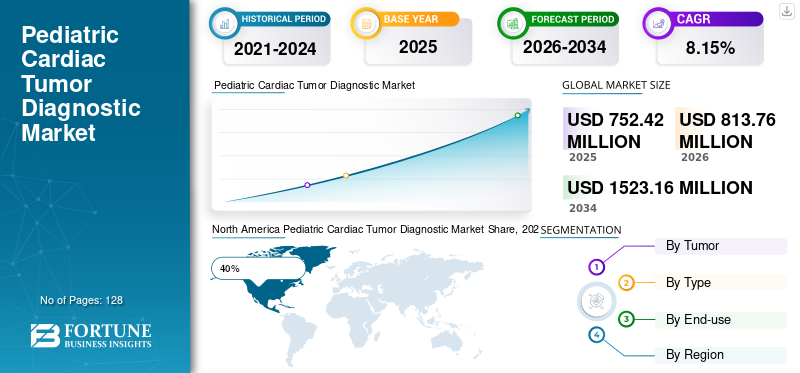
The global pediatric cardiac tumor diagnostic market size was valued at USD 752.42 billion in 2025. The market is projected to grow from USD 813.76 billion in 2026 to USD 1,523.16 billion by 2034, exhibiting a CAGR of 8.15% during the forecast period.

The pediatric cardiac tumor diagnostic market is a specialized segment within pediatric cardiology and diagnostic imaging focused on the identification, characterization, and monitoring of cardiac tumors in infants, children, and adolescents. The market is driven by increasing awareness of congenital cardiac disorders, advancements in non-invasive imaging technologies, and growing adoption of precision diagnostic tools. Echocardiography, magnetic resonance imaging, computed tomography, and molecular diagnostic techniques are becoming essential components of clinical evaluation. The pediatric cardiac tumor diagnostic market report highlights rising demand for early detection solutions that support timely intervention, improve treatment planning, and enhance patient outcomes across specialized pediatric healthcare facilities worldwide.
The United States represents the largest share of the pediatric cardiac tumor diagnostic market, accounting for approximately 38% of global demand. The country benefits from advanced pediatric cardiac care centers, extensive adoption of high-resolution imaging systems, and strong investment in rare disease diagnostics. More than 250 specialized pediatric cardiology programs support diagnostic procedures related to congenital and acquired cardiac abnormalities. Increasing use of MRI and advanced echocardiography technologies is improving detection rates of pediatric cardiac tumors. The pediatric cardiac tumor diagnostic market analysis indicates that growing awareness among clinicians and continuous improvements in pediatric imaging protocols are strengthening market expansion across the United States.
Download Free sample to learn more about this report.
Pediatric Cardiac Tumor Diagnostic Market Key Takeaways
 Global Market Size & Forecast
- 2025 Market Size: USD 752.42 Billion
- 2026 Market Size: USD 813.76 Billion
- 2034 Forecast Market Size: USD 1,523.16 Billion
- CAGR: 8.15% from 2026–2034
 Market Share
- North America dominated with a revenue share of 40% in 2025.
- Primary cardiac tumors held the largest tumor share at approximately 72%.
- Echocardiography accounted for the largest diagnostic modality share at approximately 58%.
 Key Regional Highlights
North America
North America led the market with a 40% share in 2025, supported by advanced pediatric healthcare infrastructure and diagnostic capabilities.
Europe
Europe accounted for 28% of the market, driven by established pediatric cardiac care and access to advanced imaging technologies.
Asia-Pacific
Asia-Pacific held a 24% share, supported by improving healthcare infrastructure and growing access to pediatric diagnostic services.
U.S
The U.S. market is supported by advanced pediatric cardiac centers, specialized imaging systems, and multidisciplinary diagnostic care.
Japan
Japan accounted for 20% of the Asia-Pacific market, supported by advanced healthcare infrastructure and increasing adoption of pediatric cardiac imaging.
Read More

pediatric cardiac tumor diagnostic market Latest Trends
The pediatric cardiac tumor diagnostic market Trends reveal increasing adoption of advanced imaging platforms capable of delivering enhanced visualization of cardiac structures in pediatric patients. Three-dimensional echocardiography is gaining popularity due to its ability to provide detailed anatomical assessments without exposing children to ionizing radiation. Artificial intelligence-assisted image analysis is improving diagnostic accuracy and reducing interpretation times. Healthcare institutions are increasingly integrating multimodality imaging approaches that combine echocardiography, MRI, and CT findings to improve clinical decision-making.
Download Free sample to learn more about this report.
Another notable trend in the Pediatric Cardiac Tumor Diagnostic Industry Report is the expansion of genetic and molecular testing to identify hereditary conditions associated with cardiac tumors. Pediatric hospitals are investing in dedicated cardiovascular imaging departments equipped with high-resolution diagnostic systems optimized for children. Telemedicine-enabled image sharing is facilitating consultations between regional healthcare providers and specialized pediatric cardiac centers. The pediatric cardiac tumor diagnostic market outlook also highlights increasing emphasis on early diagnosis, longitudinal monitoring, and personalized treatment planning. These developments are contributing to improved diagnostic efficiency and supporting broader adoption of advanced pediatric cardiac imaging technologies worldwide.
pediatric cardiac tumor diagnostic market Dynamics
DRIVER
Increasing Prevalence of Congenital Cardiac Abnormalities and Rare Pediatric Tumors
The primary growth driver for the pediatric cardiac tumor diagnostic market is the increasing recognition and diagnosis of congenital heart disorders and pediatric cardiac tumors. Improved neonatal screening programs and advancements in pediatric cardiology have significantly enhanced early detection capabilities. Healthcare providers are increasingly utilizing advanced imaging technologies to identify cardiac masses before complications arise. Early diagnosis allows physicians to implement appropriate monitoring and treatment strategies, reducing risks associated with tumor progression. The pediatric cardiac tumor diagnostic market growth is also supported by rising awareness among parents and healthcare professionals regarding the importance of specialized cardiac assessments. Expanding pediatric healthcare infrastructure and increasing availability of sophisticated imaging systems continue to drive market demand.
RESTRAINT
Limited Availability of Specialized Pediatric Cardiac Imaging Centers
A major restraint affecting the pediatric cardiac tumor diagnostic market is the limited availability of highly specialized pediatric cardiac imaging facilities. Accurate diagnosis of pediatric cardiac tumors often requires advanced imaging equipment and experienced pediatric cardiologists, which are concentrated in major healthcare centers. Smaller hospitals frequently lack the expertise and infrastructure needed to perform complex diagnostic evaluations. High equipment acquisition costs and specialized training requirements further restrict adoption. The pediatric cardiac tumor diagnostic market research report identifies accessibility challenges as a significant factor limiting widespread diagnostic utilization, particularly in developing healthcare systems where specialized pediatric services remain limited.
OPPORTUNITY
Expansion of Artificial Intelligence and Precision Diagnostics
Artificial intelligence presents substantial opportunities for the pediatric cardiac tumor diagnostic market. AI-powered image analysis tools can improve detection rates, enhance diagnostic consistency, and reduce interpretation variability among clinicians. Precision diagnostics incorporating imaging data, genetic information, and clinical biomarkers are creating new possibilities for personalized patient management. Healthcare providers increasingly seek integrated diagnostic solutions that streamline workflows and support evidence-based treatment planning. The pediatric cardiac tumor diagnostic market opportunities are expanding as manufacturers develop advanced software platforms designed specifically for pediatric cardiovascular applications. Growing investment in digital healthcare technologies is expected to accelerate innovation across the diagnostic ecosystem.
CHALLENGE
Complexity of Diagnosing Rare Pediatric Cardiac Tumors
Diagnosing pediatric cardiac tumors remains challenging due to their rarity and diverse clinical presentations. Many tumors present with non-specific symptoms, making early identification difficult. Differentiating between benign and malignant lesions often requires multiple diagnostic modalities and extensive clinical expertise. Variability in tumor location, size, and growth patterns further complicates assessment. The pediatric cardiac tumor diagnostic market insights indicate that limited clinical experience with rare pediatric cardiac tumors can lead to diagnostic delays. Continuous education, advanced imaging capabilities, and multidisciplinary collaboration remain essential for overcoming these challenges and improving patient outcomes.
pediatric cardiac tumor diagnostic market Segmentation
By Tumor
Primary cardiac tumors account for approximately 72% of the pediatric cardiac tumor diagnostic market share. These tumors originate within the heart and include conditions such as rhabdomyomas, fibromas, and myxomas. Rhabdomyomas are among the most commonly diagnosed pediatric cardiac tumors and are frequently associated with genetic disorders. Diagnostic evaluation relies heavily on echocardiography and MRI to assess tumor characteristics and monitor progression. Increasing awareness regarding congenital cardiac abnormalities is supporting demand for early diagnostic intervention. Healthcare providers continue to expand utilization of advanced imaging technologies to improve detection accuracy.
Secondary cardiac tumors represent approximately 28% of the pediatric cardiac tumor diagnostic market share. These tumors originate outside the heart and spread to cardiac tissues through metastatic processes. Although less common than primary tumors, secondary tumors require comprehensive diagnostic evaluation to determine disease extent and treatment planning requirements. Advanced MRI and multimodal imaging approaches are frequently used to assess cardiac involvement. Increasing availability of sophisticated imaging systems is improving diagnostic capabilities. Healthcare providers are emphasizing multidisciplinary care models that integrate oncology and cardiology expertise.
To know how our report can help streamline your business, Speak to Analyst
By Type
Echocardiography accounts for approximately 58% of the pediatric cardiac tumor diagnostic market share and remains the primary diagnostic modality. The technique provides real-time visualization of cardiac anatomy and tumor characteristics without exposing patients to radiation. Pediatric cardiologists rely extensively on echocardiography for initial diagnosis, follow-up monitoring, and treatment planning. Technological improvements such as three-dimensional imaging and enhanced Doppler capabilities have significantly improved diagnostic accuracy. The modality's accessibility, safety profile, and cost-effectiveness contribute to its dominant market position. Increasing adoption across pediatric hospitals continues to support segment growth.
MRI represents approximately 42% of the pediatric cardiac tumor diagnostic market share. The modality offers superior soft tissue characterization and detailed anatomical assessment, making it particularly valuable for complex cases. MRI enables clinicians to evaluate tumor composition, location, and relationship to surrounding structures. Advanced cardiac MRI protocols are increasingly utilized in specialized pediatric centers. Growing investments in high-field imaging systems and artificial intelligence-assisted analysis are improving diagnostic precision. The Pediatric Cardiac Tumor Diagnostic Industry Analysis highlights MRI as a rapidly advancing segment with significant potential for future expansion.
By End-use
End-use applications are dominated by pediatric hospitals, specialty cardiac centers, and academic research institutions. Pediatric hospitals account for approximately 61% of end-use demand due to their comprehensive diagnostic capabilities and access to multidisciplinary expertise. Specialty cardiac centers contribute 27% through focused cardiovascular care services and advanced imaging infrastructure. Research institutions hold 12% share by supporting clinical studies, innovation, and development of emerging diagnostic technologies. These end-use categories collectively represent 100% of the pediatric cardiac tumor diagnostic market share and play essential roles in advancing pediatric cardiac healthcare.
pediatric cardiac tumor diagnostic market Regional outlook
North America Pediatric Cardiac Tumor Diagnostic Market Share, 2026 (%)
To get more information on the regional analysis of this market, Download Free sample
North America
North America accounts for 40% of the pediatric cardiac tumor diagnostic market and maintains its leadership position due to advanced pediatric healthcare infrastructure and widespread availability of specialized cardiac diagnostic services. The region has a strong concentration of children's hospitals equipped with sophisticated echocardiography and cardiac MRI systems. Growing awareness regarding congenital cardiac abnormalities and rare pediatric tumors continues to increase diagnostic volumes. Healthcare providers are emphasizing early detection and accurate characterization of cardiac masses to improve treatment outcomes. Significant investments in artificial intelligence-assisted imaging and digital healthcare solutions are supporting diagnostic efficiency. Research institutions actively contribute to innovation in pediatric cardiovascular diagnostics. Strong reimbursement frameworks and access to specialized expertise further strengthen the market. Continuous technological advancements and increasing demand for precision medicine are expected to sustain regional growth.
Europe
Europe holds 28% of the pediatric cardiac tumor diagnostic market and remains a major center for pediatric cardiovascular diagnostics. The region benefits from well-established healthcare systems, increasing investment in advanced imaging technologies, and strong clinical research activities. Hospitals are increasingly adopting high-resolution echocardiography and cardiac MRI to improve diagnostic accuracy for rare cardiac tumors. Growing awareness among healthcare professionals regarding early diagnosis supports market expansion. Collaborative initiatives between academic institutions and healthcare providers contribute to innovation in diagnostic methodologies. Demand for non-invasive imaging techniques continues to rise due to their safety and effectiveness in pediatric patients. Ongoing modernization of healthcare facilities is enhancing access to specialized cardiac care. The region remains an important contributor to technological development and clinical excellence in pediatric diagnostics.
Germany pediatric cardiac tumor diagnostic market
Germany represents 35% of the global pediatric cardiac tumor diagnostic market and is one of the strongest national markets within Europe. The country is recognized for its advanced medical infrastructure and specialized pediatric cardiac care centers. Healthcare institutions are increasingly investing in state-of-the-art imaging technologies to improve diagnostic precision and patient management. Echocardiography and MRI remain the most widely utilized tools for identifying and monitoring pediatric cardiac tumors. Strong research activities support the development of innovative diagnostic approaches and treatment planning strategies. Germany also benefits from a highly skilled healthcare workforce and advanced hospital networks. Growing focus on rare disease diagnosis and precision medicine further strengthens market demand. Continuous technological upgrades contribute to sustained market growth across the country.
United Kingdom pediatric cardiac tumor diagnostic market
The United Kingdom accounts for 25% of the global pediatric cardiac tumor diagnostic market and continues to expand its diagnostic capabilities through investments in pediatric healthcare services. Specialized children's hospitals are adopting advanced imaging systems to improve detection and evaluation of cardiac tumors. Growing emphasis on early diagnosis and multidisciplinary patient care is driving demand for innovative diagnostic technologies. Healthcare providers are increasingly utilizing MRI and advanced echocardiography for comprehensive cardiac assessments. Research collaborations between healthcare institutions and academic organizations support continuous innovation. Improvements in healthcare infrastructure are enhancing access to specialized pediatric cardiac services. Rising awareness of congenital heart conditions is contributing to increased diagnostic activity. The country remains an important market for pediatric cardiovascular diagnostic advancement.
Asia-Pacific
Asia-Pacific accounts for 24% of the pediatric cardiac tumor diagnostic market and is emerging as the fastest-growing regional segment. Rapid healthcare infrastructure development and increasing investment in pediatric specialty care are major growth drivers. Countries across the region are expanding access to advanced diagnostic imaging technologies to improve detection of rare cardiac disorders. Growing awareness regarding congenital heart diseases is encouraging earlier diagnosis and intervention. Large patient populations and rising healthcare expenditure create significant opportunities for market expansion. Governments are supporting healthcare modernization initiatives focused on improving pediatric outcomes. Healthcare providers are increasingly adopting sophisticated echocardiography and MRI systems. International collaborations and physician training programs further strengthen diagnostic capabilities. The region continues to attract investments in advanced pediatric healthcare services.
Japan pediatric cardiac tumor diagnostic market
Japan holds 20% of the global pediatric cardiac tumor diagnostic market and is recognized for its advanced healthcare technology and strong emphasis on diagnostic excellence. Pediatric hospitals across the country utilize sophisticated imaging systems to support accurate diagnosis of cardiac abnormalities in children. The adoption of advanced MRI and echocardiography technologies continues to improve diagnostic precision. Strong investment in medical research contributes to ongoing innovation in pediatric cardiovascular care. Healthcare providers prioritize early detection and comprehensive evaluation of rare cardiac tumors. The country benefits from highly trained specialists and well-developed healthcare infrastructure. Increasing focus on personalized medicine further supports market development. Japan remains a key market for advanced pediatric diagnostic technologies.
China pediatric cardiac tumor diagnostic market
China accounts for 20% of the global pediatric cardiac tumor diagnostic market and is experiencing rapid expansion due to healthcare modernization and increasing investments in pediatric medicine. Major hospitals are enhancing their diagnostic capabilities through deployment of advanced imaging technologies and specialized cardiac programs. Rising awareness regarding congenital heart disorders is driving demand for comprehensive diagnostic evaluations. Government initiatives aimed at improving healthcare accessibility support market growth. Healthcare providers are focusing on early detection and improved patient outcomes through advanced diagnostic tools. Expansion of pediatric specialty centers is increasing access to high-quality cardiac care. Technological advancements in imaging equipment continue to strengthen the market. China remains one of the most promising regions for future growth and innovation.
Rest of World
The Rest of World region represents 8% of the pediatric cardiac tumor diagnostic market and includes Latin America, the Middle East, and Africa. Healthcare systems across these regions are increasingly investing in pediatric specialty services and diagnostic infrastructure. Growing awareness of rare pediatric cardiac conditions is encouraging demand for advanced imaging technologies. Hospitals are gradually expanding access to echocardiography and cardiac MRI services to improve diagnostic capabilities. Government healthcare initiatives and international collaborations support infrastructure development and physician training. Improvements in healthcare accessibility are contributing to higher diagnostic rates. Urban medical centers are leading adoption of modern imaging equipment. Rising focus on early diagnosis and treatment planning is supporting market development. The region offers significant long-term opportunities as healthcare systems continue to evolve.
List of Top Pediatric Cardiac Tumor Diagnostic Companies
- GE HealthCare
- Siemens Healthineers AG
- Koninklijke Philips N.V.
- CANON MEDICAL SYSTEMS CORPORATION
- Boston Scientific Corporation
- Lantheus
- Bio-Rad Laboratories, Inc.
- Abbott
- F. Hoffmann-La Roche Ltd
- Medtronic
Top Two Companies with Highest Market share
- GE HealthCare – 18%
- Siemens Healthineers AG – 16%
Investment Analysis and opportunities
The pediatric cardiac tumor diagnostic market is attracting increasing investment due to growing demand for specialized pediatric cardiovascular diagnostics. Healthcare institutions are allocating resources toward advanced imaging systems, digital health platforms, and artificial intelligence applications designed to improve diagnostic precision. Investments in pediatric cardiac research programs are contributing to enhanced understanding of rare tumor conditions and supporting innovation in diagnostic methodologies.
Significant opportunities exist within emerging healthcare markets where access to specialized pediatric diagnostic services continues to expand. Manufacturers are focusing on development of child-friendly imaging solutions that improve patient comfort and diagnostic efficiency. Strategic collaborations between healthcare providers, academic institutions, and technology companies are accelerating innovation. The pediatric cardiac tumor diagnostic market opportunities also include expansion of telemedicine-enabled diagnostic consultation networks and cloud-based imaging platforms. Increasing demand for precision medicine approaches and personalized treatment planning continues to create favorable investment conditions across the market.
New Product Development
Innovation remains a defining characteristic of the pediatric cardiac tumor diagnostic market. Manufacturers are introducing advanced ultrasound systems with enhanced three-dimensional imaging capabilities designed specifically for pediatric applications. Artificial intelligence-powered image interpretation tools are improving diagnostic consistency and reducing analysis times. New MRI technologies provide improved tissue characterization while reducing scan durations for young patients.
Developers are also focusing on portable imaging solutions that enhance accessibility in regional healthcare settings. Cloud-integrated diagnostic platforms enable efficient collaboration among specialists and support remote consultation services. Advanced software applications facilitate comprehensive visualization of cardiac anatomy and tumor structures. Molecular diagnostic innovations are expanding understanding of genetic factors associated with pediatric cardiac tumors. These developments continue to strengthen the pediatric cardiac tumor diagnostic market growth by improving diagnostic accuracy, workflow efficiency, and patient-centered care.
Five Recent Developments (2023-2025)
- Introduction of AI-assisted pediatric echocardiography platforms for enhanced tumor detection accuracy.
- Launch of advanced cardiac MRI systems with improved imaging speed and pediatric-specific protocols.
- Expansion of cloud-based cardiovascular imaging platforms supporting remote specialist consultations.
- Development of high-resolution three-dimensional ultrasound technologies for pediatric cardiac assessments.
- Strategic collaborations between diagnostic technology providers and pediatric healthcare institutions to improve rare disease detection.
Report Coverage
The pediatric cardiac tumor diagnostic market report provides detailed evaluation of market structure, growth drivers, restraints, opportunities, and competitive developments. The report analyzes diagnostic technologies, tumor classifications, end-use applications, and regional performance across key healthcare markets. Comprehensive segmentation analysis examines Primary Cardiac Tumors, Secondary Cardiac Tumors, Echocardiography, MRI, and End-use categories.
Request for Customization to gain extensive market insights.
The pediatric cardiac tumor diagnostic market research report further assesses technological advancements, healthcare infrastructure developments, and emerging diagnostic trends influencing market expansion. Regional analysis covers North America, Europe, Asia-Pacific, and Rest of World while highlighting country-level opportunities. Competitive landscape evaluation includes major industry participants, product innovation strategies, and market positioning. The report also explores investment patterns, research initiatives, and evolving clinical practices shaping the Pediatric Cardiac Tumor Diagnostic Industry Analysis. Special emphasis is placed on diagnostic accuracy, pediatric imaging advancements, artificial intelligence integration, and future opportunities within specialized cardiovascular healthcare.
Frequently Asked Questions
According to Fortune Business Insights, the global Pediatric Cardiac Tumor Diagnostic market was valued at USD 752.42 billion in 2025 and is projected to reach USD 1,523.16 billion by 2034.
The market is expected to grow at a CAGR of 8.15% during the forecast period of 2026–2034.
Echocardiography was the leading type segment, accounting for approximately 58% of the market, owing to its real-time visualization, radiation-free diagnosis, accessibility, and cost-effectiveness.
Key players include GE HealthCare, Siemens Healthineers AG, Koninklijke Philips N.V., CANON MEDICAL SYSTEMS CORPORATION, Boston Scientific Corporation, and Lantheus.
Major trends include the growing adoption of 3D echocardiography and AI-assisted image analysis, along with increasing integration of multimodality imaging such as echocardiography, MRI, and CT. North America led the market with a 40% share.



- 2021-2034
- 2025
- 2021-2024
- 128
-

(Offer valid till 15th Oct 2026)
Get 30-60 hrs Free Customization
Expand Regional and Country Coverage, Segments Analysis, Company Profiles, Competitive Benchmarking, and End-user Insights.













.webp)






-
US +1 833 909 2966 ( Toll Free )
-
Get In Touch With Us