Pelvic Organ Prolapse (POP) Market Size, Share & Industry Analysis, By Product Type (Synthetic Mesh Implants, Biological Grafts, Suture Kits, Pessaries, and Others), By Treatment Type (Surgical Treatment {Sacrocolpopexy, Sacrohysteropexy, and Others}, and Non-Surgical Treatment {Pessary Management, Pelvic Floor Physical Therapy, and Others}), By Prolapse Type (Anterior Compartment Prolapse, Posterior Compartment Prolapse, and Others), By End-user (Hospitals, Specialty Clinics, and Others), and Regional Forecast, 2026-2034
 Download Free Sample
Pelvic Organ Prolapse (POP) Market Size and Future Outlook
 Listen to Audio Version
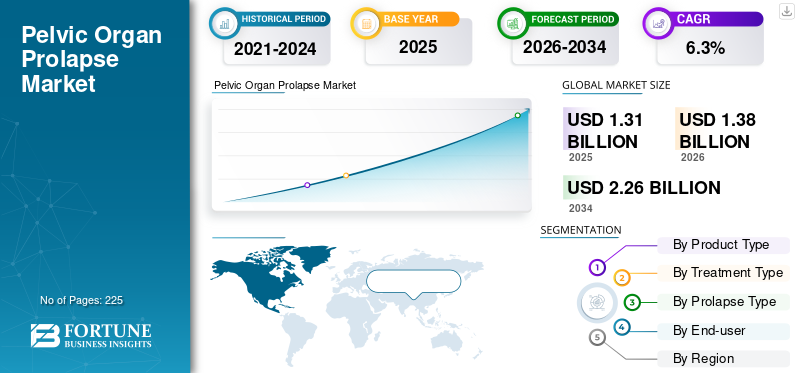
The global pelvic organ prolapse market size was valued at USD 1.31 billion in 2025. The market is projected to grow from USD 1.38 billion in 2026 to USD 2.26 billion by 2034, exhibiting a CAGR of 6.3% during the forecast period. North America dominated the global pelvic organ prolapse market with a market share of 34.35% in 2025.
Pelvic organ prolapse (POP) occurs when the muscles and tissues that support the pelvic organs become weak, causing organs such as the bladder, uterus, or rectum to shift from their normal position. This condition is seen mostly in women after childbirth, menopause, or post- pelvic surgeries. The POP market growth is attributed to rising preference for the treatment as they are safer and more personalized. In addition, rising age, higher rates of obesity, and better screening in hospitals are also increasing the number of women diagnosed with pelvic floor disorders. Further, companies are improving device design to reduce complications and shorten recovery time, which is expected to have a positive impact on the market.
Furthermore, the market is dominated by major players, including Boston Scientific Corporation, Coloplast A/S, Johnson & Johnson Services Inc., CooperSurgical Inc., BD, and others. These players are involved in innovations and strategic initiatives to expand their market reach.
Download Free sample to learn more about this report.
Pelvic Organ Prolapse Market Takeaways
 Global Market Size & Forecast
- 2025 Market Size: USD 1.31 billion
- 2026 Market Size: USD 1.38 billion
- 2034 Forecast Market Size: USD 2.26 billion
- CAGR: 6.3% from 2026–2034
 Market Share
- North America dominated the pelvic organ prolapse market with a 34.35% share in 2025.
- The surgical treatment segment is projected to hold the largest market share of 59.8% in 2026.
- The anterior compartment prolapse segment is expected to account for 48.7% of the market in 2026.
 Key Regional Highlights
North America
North America maintained its leading position, reaching USD 0.45 billion in 2025 and continuing to dominate the global market.
Europe
Europe is projected to grow at a 5.4% CAGR, reaching USD 0.37 billion by 2026.
Asia Pacific
Asia Pacific is expected to reach USD 0.36 billion in 2026, securing the third-largest regional market.
U.S.
The U.S. pelvic organ prolapse market is estimated to reach USD 0.41 billion by 2026.
Japan
Japan is anticipated to witness steady market growth, supported by increasing awareness, an aging female population, and advances in minimally invasive pelvic floor treatments.
Read More

MARKET DYNAMICS
MARKET DRIVERS:
Rising Burden of Pelvic Floor Disorders in Aging Women to Boost Market Growth
The growing number of women living with pelvic floor disorders as they age is one of the prominent market drivers. Moreover, another factors such as childbirth, menopause, obesity, hysterectomy, and chronic coughing or heavy work are also responsible for pelvic floor conditions. In addition, better screening technologies, along with the availability of advanced systems, are also estimated to have a positive impact on the market. As life expectancy increases and more women live longer with chronic conditions, the overall pool of patients needing evaluation and treatment for POP continues to grow, which supports steady demand for both conservative and surgical management options.
- According to data published by the Royal College of Obstetricians and Gynecologists in February 2023, an estimated 60% of women in the U.K. show at least one symptom of pelvic floor disorders.
MARKET RESTRAINTS:
Cautious Adoption of Implant-Based POP Repair Techniques to Deter Market Growth
A major restraint for the pelvic organ prolapse market is the cautious approach toward implant-based repair techniques, including transvaginal meshes and synthetic support materials. Surgeons and hospitals are highly selective about when these products are used, prioritizing procedures with well-established safety profiles and predictable long-term performance. This careful decision-making often shifts preference toward native tissue repair, biologic grafts, and non-implant alternatives, especially for patients in earlier stages of prolapse. The higher level of clinical scrutiny, combined with the need for strong evidence, specialized training, and clear postoperative guidance, slows the adoption of newer implantable devices.
MARKET OPPORTUNITIES:
Growing Demand for Minimally Invasive and Organ-Preserving Solutions to Provide Lucrative Growth Opportunities
Rising demand for minimally invasive, organ-preserving, and patient-friendly treatments is estimated to offer a substantial opportunity for global pelvic organ prolapse (POP) market growth. Many women want symptom relief without major open surgery or a long recovery time. This creates room for laparoscopic and robotic procedures, improved vaginal repair techniques, and better-designed pessaries that are easier to fit and more comfortable for long-term use. There is also interest in devices and techniques that support the pelvic floor while preserving sexual function and overall quality of life.
- For instance, in May 2025, Mediplus announced the expansion of its POPY pelvic organ prolapse pessary range with five new sizes, aimed at providing more precise, non-surgical support options for women with POP and improving comfort and fit in conservative, organ-preserving management.
MARKET CHALLENGES:
Underdiagnosis, Stigma, and Limited Access to Specialists Pose Challenge for Market Growth
A major challenge for the POP market is that many women still do not seek help or receive a proper diagnosis. Cultural stigma, embarrassment, and the belief that pelvic problems are a normal part of aging or childbirth often stop them from discussing symptoms with doctors. In many regions, there is also a shortage of urogynecologists and trained pelvic floor surgeons, which limits access to advanced care. As a result, a large share of women either live with untreated prolapse or only receive basic support rather than structured treatment.
PELVIC ORGAN PROLAPSE (POP) MARKET TRENDS:
Increasing Focus on Patient-Centered Pelvic Floor Care is One of Key Market Trends
Rising preference for more holistic, patient-centered pelvic floor care is one of the important trends observed in the market. Instead of treating prolapse as a stand-alone structural problem, many clinics now combine physical therapy, lifestyle changes, continence management, and psychological support with surgical and device-based options. In addition, pelvic floor physiotherapy, guided exercises, and education programs are becoming more common, especially for early-stage prolapse or for women who are not ready for surgery. Furthermore, digital tools and pelvic health apps are also being launched, enabling better pelvic floor management.
- For instance, in June 2024, Hinge Health launched a nationally accessible Women’s Pelvic Health Program that combines virtual visits with pelvic floor physical therapists and customized exercise plans.
Download Free sample to learn more about this report.
Segmentation Analysis
By Product Type
Rising Adoption of Reconstructive Surgical Procedures to Boost Synthetic Mesh Implant Segment Growth
Based on the product type segmentation, the market is classified into synthetic mesh implants, biological grafts, suture kits, pessaries, and others.
Request for Customization to gain extensive market insights.
The synthetic mesh implants segment accounted for the largest global pelvic organ prolapse (POP) market share in 2025. The segment growth is majorly attributed to its significant adoption in reconstructive procedures that aim to provide durable support for weakened pelvic tissues. In addition, continual design improvements, such as lighter-weight materials and optimized pore structure, are also estimated to offer lucrative opportunities for segment growth.
- For instance, in July 2021, BioAesthetics Corp. received a grant of USD 256,000 for the development of a new product for treating pelvic organ prolapse (POP).
Additionally, the pessaries segment is expected to grow at a CAGR of 6.9% during the forecast period.
By Treatment Type
Rapid Improvements in Surgical Treatments to Accelerate Segment Growth
Based on treatment type, the market is segmented into surgical treatment and non-surgical treatment.
By treatment type, the surgical treatment segment accounted for the largest share in 2025. The segment growth is majorly attributed to rapid improvements in minimally invasive sacrocolpopexy, sacrospinous fixation, and pectopexy. Moreover, developments in hybrid techniques that support better patient recovery are also projected to boost segment growth. Also, the segment is set to hold 59.8% share in 2026.
In addition, the non-surgical treatment segment is projected to grow at a CAGR of 5.2% during the forecast period.
By Prolapse Type
Considerable Prevalence of Conditions Associated with Anterior Compartment Prolapse to Drive Segment Growth
Based on prolapse type, the market is segmented into anterior compartment prolapse, posterior compartment prolapse, and others.
In 2025, the global market was dominated by anterior compartment prolapse in terms of prolapse type. Anterior compartment prolapse, typically involving descent of the bladder into the vaginal wall (cystocele), represents one of the most common forms of pelvic organ prolapse and therefore accounts for a large share of clinical workload and device use. Furthermore, the segment is set to hold 48.7% share in 2026.
In addition, the posterior compartment prolapse segment is projected to grow at a CAGR of 6.7% during the forecast period.
By End-user
Availability of Advanced Infrastructure in Hospital Drive Segment Growth
Based on end-user, the market is segmented into hospitals, specialty clinics, and others.
In 2025, the global market was dominated by hospitals in terms of end-user. Hospitals lead the pelvic organ prolapse (POP) market because most surgical implants take place in these settings. In addition, these facilities are equipped with advanced instruments, which enable streamlining of the surgical procedure. Furthermore, the segment is set to hold 58.8% share in 2026.
In addition, the specialty clinics segment is projected to grow at a CAGR of 6.9% during the forecast period.
Pelvic Organ Prolapse (POP) Market Regional Outlook
By geography, the market is categorized into North America, Europe, Asia Pacific, Latin America, and Middle East & Africa.
NORTH AMERICA
North America held the dominant share in 2024, valuing at USD 0.43 billion, and also maintained the leading share in 2025, with USD 0.45 billion. The growth is attributed to the rising prevalence of pelvic floor conditions amongst women and the introduction of advanced technologies. In 2026, the U.S. market is estimated to reach USD 0.41 billion.
- For instance, in May 2024, Reia, LLC received FDA approval for its collapsible vaginal pessary. The product is designed for non-surgical management of pelvic organ prolapse.
EUROPE and ASIA PACIFIC
Other regions, such as Europe and the Asia Pacific, are projected to experience notable growth during the forecast period. Europe is projected to record a growth rate of 5.4% and reach a valuation of USD 0.37 billion by 2026. This growth is attributed to the presence of major players in countries like Germany, the U.K., and France. Due to these factors, the U.K. is expected to record a valuation of USD 0.06 billion, Germany USD 0.08 billion, and France USD 0.05 billion in 2026. After Europe, the market in Asia Pacific is estimated to reach USD 0.36 billion in 2026 and secure the position of the third-largest region in the market. In the region, India and China are both estimated to reach USD 0.08 billion and USD 0.12 billion, respectively, in 2026.
LATIN AMERICA and MIDDLE EAST & AFRICA
Over the forecast period, the Latin America and Middle East & Africa regions are expected to showcase moderate growth in the market. The Latin America market in 2026 is set to reach a valuation of USD 0.08 billion. The growth is attributed to increasing awareness of surgical care in the region. In the Middle East & Africa, the GCC is set to reach a value of USD 0.03 billion by 2026.
COMPETITIVE LANDSCAPE
Key Industry Players:
Focus on Product Launches and Approval to Strengthen Position of Key Players
In 2025, major players such as Boston Scientific Corporation, Coloplast A/S, Johnson & Johnson Services Inc., CooperSurgical Inc., and BD accounted for the largest global pelvic organ prolapse (POP) market share. The share is attributed to the focus of these players on innovations and other strategic initiatives, including partnerships, acquisitions, and collaborations.
Other prominent companies, such as Caldera Medical, MedGyn Products, Integra LifeSciences, and Symmetry Surgical, are focused on increasing product supply to emerging countries, which is expected to help them gain a significant market share.
LIST OF KEY PELVIC ORGAN PROLAPSE (POP) MARKET COMPANIES PROFILED:
- Boston Scientific Corporation (U.S.)
- Coloplast A/S (Denmark)
- Johnson & Johnson Services Inc. (U.S.)
- CooperSurgical Inc. (U.S.)
- BD (U.S.)
- Caldera Medical (U.S.)
- MedGyn Products (U.S.)
- Integra LifeSciences (U.S.)
- Symmetry Surgical (U.S.)
- KARL STORZ (Germany)
- B. Braun Melsungen AG (Germany)
KEY INDUSTRY DEVELOPMENTS:
- June 2025: Escala Medical raised USD 4.5 million for the commercialization of its FDA-approved Mendit device.
- May 2025: Mediplus announced the expansion of its POPY silicone pessary range for pelvic organ prolapse.
- September 2024: ConTIPI Medical entered a strategic collaboration with EVERSANA to advance the market launch of ProVate, a vaginal ring pessary.
- May 2023: pfm medical AG announced an investment in Lyra Medical Ltd. to support the commercialization of its self-retaining support (SRS) implant.
- February 2022: Medtronic received FDA approval for its InterStim X sacral neuromodulation system, expanding neuromodulation options for pelvic floor-related bladder and bowel dysfunction and supporting broader adoption of implantable pelvic floor therapies.
REPORT COVERAGE
The global pelvic organ prolapse (POP) market encompasses a detailed analysis of the market, including all segments. It encompasses market dynamics, including market drivers, trends, opportunities, challenges, and restraints. The report also provides key insights, including new product launches and significant industry developments, such as partnerships, mergers, and acquisitions. Additionally, the report provides a detailed profile of key players operating in the market, along with an analysis of their market share.
Request for Customization to gain extensive market insights.
Report Scope & Segmentation
| ATTRIBUTE | DETAILS |
| Study Period | 2021-2034 |
| Base Year | 2025 |
| Forecast Period | 2026-2034 |
| Historical Period | 2021-2024 |
| Growth Rate | CAGR of 6.3% from 2026-2034 |
| Unit | Value (USD Billion) |
| Segmentation | By Product Type, Treatment Type, Prolapse Type, Application, End-user, and Region |
| By Product Type |
|
| By Treatment Type |
|
| By Prolapse Type |
|
| By End-user |
|
| By Region |
|
Frequently Asked Questions
Fortune Business Insights says that the global market value stood at USD 1.31 billion in 2025 and is projected to reach USD 2.26 billion by 2034.
In 2025, the market value stood at USD 0.45 billion.
The market is expected to exhibit a CAGR of 6.3% during the forecast period of 2026-2034.
The synthetic mesh implants segment led the market by product type.
The key factors driving the market are the increasing number of implantations and technological advancements.
Boston Scientific Corporation, Coloplast A/S, Johnson & Johnson Services Inc., CooperSurgical Inc., and BD are some of the prominent players in the market.
North America dominated the market in 2025.



- 2021-2034
- 2025
- 2021-2024
- 225
Get 30-60 hrs Free Customization
Expand Regional and Country Coverage, Segments Analysis, Company Profiles, Competitive Benchmarking, and End-user Insights.













.webp)






Related Reports
-
US +1 833 909 2966 ( Toll Free )
-
Get In Touch With Us