 Download Free Sample



Get a Quote
Receive a tailored pricing based on your needs.
- Choose license type
- Multiple user options
- Custom scope & coverage
- Fast turnaround
"Designing Growth Strategies is in our DNA"
 Listen to Audio Version
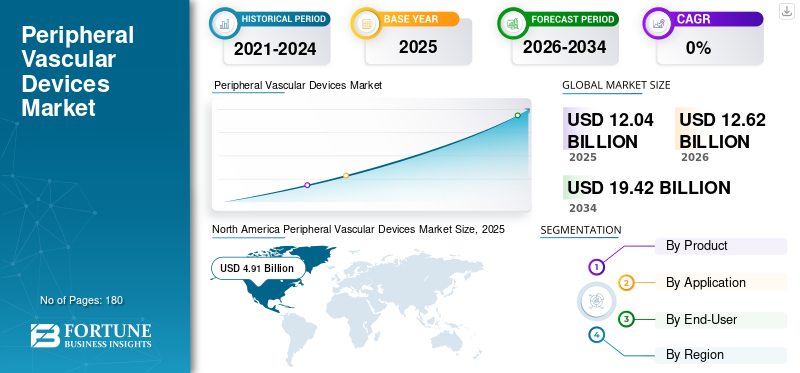
The global peripheral vascular devices market size was valued at USD 12.04 billion in 2025 and is projected to grow from USD 12.62 billion in 2026 to USD 19.42 billion by 2034, exhibiting a CAGR of 5.5% during the forecast period. North America dominated the global peripheral vascular devices market with a market share of 40.78% in 2025.
Peripheral vascular devices are tools used to open or restore blood flow in vessels outside the heart, especially in the legs and arms. In addition, they are also used when blood vessels get narrowed or blocked, which can cause pain while walking, slow wound healing, or in severe cases, risk of limb loss.
The market growth is attributed to rising prevalence of cardiac conditions and lifestyle related diseases that is leading to blood-circulation issues. Moreover, hospitals also prefer treatments that reduce recovery time, hence minimally invasive procedures are becoming more common. In addition, technological advancements is also projected to leverage market growth.
Furthermore, many key industry players, such as Abbott, Medtronic, Boston Scientific Corporation, Terumo Corporation, and BD operating in the market, are focusing on developing various innovative technologies to offer better products with improved accuracy and efficiency.
Download Free sample to learn more about this report.
 Market Size & Forecast
 Market Share
 Key Regional Highlights
North America
North America maintained its market leadership, with the market valued at USD 4.91 billion in 2026.
Asia Pacific
Europe is projected to reach USD 3.41 billion by 2026, supported by a 5.0% growth rate.
Asia Pacific
Asia Pacific is estimated to attain a market value of USD 2.87 billion in 2026, making it the third-largest regional market.
U.S.
U.S. The market is estimated at USD 4.39 billion in 2026, accounting for roughly 34.8% of global sales.
Japan
Japan The market is estimated at USD 0.50 billion in 2026, representing approximately 3.9% of global revenues.
Read More

Expanding Range of Applications for Peripheral Vascular Devices is an Emerging Market Trend
The market is currently witnessing increase in applications of peripheral vascular devices, which is one of the important trend observed in the market. Hospitals are seeing more patients with severe leg circulation problems, especially those linked to diabetes. This is pushing companies to develop devices specifically designed for smaller, harder-to-treat vessels. In addition, as more BTK-focused products receive approvals, hospitals gain confidence to treat complex cases earlier and more effectively.
Download Free sample to learn more about this report.
Increasing Burden of Periphery Artery Disease to Accelerate Market Growth
An increasing burden of periphery artery disease is prominently driving the peripheral vascular devices market growth. In addition, certain factors such as lifestyle change, occurrence of blood-circulation conditions are boosting market growth. As hospitals see more PAD cases, they adopt newer tools that can improve outcomes and reduce repeat procedures. This demand results in companies looking for new product clearances and expansions.
Need for Safety and Considerable Scrutiny is Expected to Hamper Market Growth
Peripheral vascular devices face strong scrutiny as they are used in critical blood vessels, and hospitals want clear proof of safety and benefit before switching products. This slows adoption, increases clinical study requirements and can delay launches across countries. In practice, even when devices are already used, the industry keeps responding to safety monitoring and updates from regulators.
Rising Emphasis on Minimally Invasive Surgery is Projected to Offer Lucrative Market Growth Opportunities
The market is witnessing growing priority for minimally invasive surgeries to reduce patient recovery time, procedure-related complications and length of stay. In addition, compared to open surgery, minimally invasive treatments are preferred by both clinicians and patients, which supports higher procedure volumes and repeat use of peripheral vascular devices. As hospitals expand cath labs and endovascular suites, demand for a broader range of peripheral devices continues to rise.
Pricing Pressure is Likely to Pose a Critical Challenge to Market Growth
The market is witnessing strong pricing pressure, especially in hospitals that buy through tenders or group purchasing systems, posing a critical challenge for market growth. Moreover, when hospitals evaluate multiple similar devices, price becomes a key deciding factor, which can limit margins for manufacturers and reduce the willingness to invest heavily in sales support. This also creates longer negotiation cycles and forces companies to offer discounts, bundled pricing, or extended service terms to win contracts.
Superior Treatment by Peripheral Stents for Lower Leg Complications to Drive Segment Growth
Based on the product, the market is divided into vascular access & entry devices, vascular navigation & delivery devices, intravascular diagnostic & imaging devices, thrombus & embolus management devices, peripheral stents and others.
The peripheral stent segment is anticipated to account for the largest peripheral vascular devices market share. Majority of the healthcare institutions prefer peripheral stents due to its superior treatment outcomes. In addition, these are also used across a wide range of patient severity, so volumes remain steady. Moreover, increasing number of product launches coupled with technological advancements is also projected to leverage segment growth during the forecast period.
The thrombus & embolus management devices segment is anticipated to rise with a CAGR of 6.6% over the forecast period.
To know how our report can help streamline your business, Speak to Analyst
Substantial Prevalence of Peripheral Arterial Disorders to Accelerate Segment Growth
Based on application, the market is segmented into peripheral arterial disorders, aneurysmal disease, venous diseases and others.
In 2025, the peripheral arterial disorders segment dominated the global market. The segment growth is attributed to substantial prevalence of peripheral artery disease across the globe and adoption of peripheral devices for its treatment due to superior treatment outcomes. In addition, rising investments by companies as well as government authorities to contain cardiac conditions is also estimated to have a positive impact on the segment growth.
The venous diseases segment is anticipated to rise with a CAGR of 6.1% over the forecast period.
Higher Volume of Peripheral and Cardiac Surgeries in Hospitals to Boost Segment Growth
Based on end-user, the market is segmented into hospitals, specialty clinics and others.
In 2025, hospitals segment held highest market share. Hospitals segment leads as most peripheral vascular procedures require imaging support, specialist teams and post-procedure monitoring, especially for complex PAD and urgent cases. Hospitals also handle referrals and advanced care, so they drive higher device volumes compared to smaller centers. In addition, many new technologies are first adopted in hospital settings before wider spread. Furthermore, the segment is set to hold 61.8% share in 2026.
In addition, specialty clinics segment is projected to grow at a CAGR of 5.8% during the study period.
By geography, the market is categorized into Europe, North America, Asia Pacific, Latin America, and the Middle East & Africa.
North America Peripheral Vascular Devices Market Size, 2025 (USD Billion)
To get more information on the regional analysis of this market, Download Free sample
North America held the dominant share in 2024, valuing at USD 4.70 billion, and maintained the leading share in 2025, with USD 4.91 billion. The market in North America is expected to increase due to higher emphasis on minimally invasive surgeries, rising incidence of diabetes, and development in bio-absorbable stents.
Based on North America’s strong contribution, the U.S. market can be analytically approximated at around USD 4.39 billion in 2026, accounting for roughly 34.8% of global sales.
Europe is projected to record a growth rate of 5.0% in the coming years, which is the second highest among all regions, and reach a valuation of USD 3.41 billion by 2026. The region is estimated to witness considerable market growth due to rising investments for new product development, and growing incidence of venous disease.
The U.K. market in 2026 is estimated at around USD 0.55 billion, representing roughly 4.4% of global revenues.
Germany’s market is projected to reach approximately USD 0.77 billion in 2026, equivalent to around 6.1% of global sales.
Asia Pacific is estimated to reach USD 2.87 billion in 2026 and secure the position of the third-largest region in the market. Improving healthcare infrastructure coupled with favorable reimbursement policies are estimated to accelerate regional growth.
The Japan’s market in 2026 is estimated at around USD 0.50 billion, accounting for roughly 3.9% of global revenues.
China’s market is projected to be one of the largest worldwide, with 2026 revenues estimated at around USD 0.95 billion, representing roughly 7.6% of global sales.
The India’s market in 2026 is estimated at around USD 0.64 billion, accounting for roughly 6.7% of global revenues.
The Latin America and Middle East & Africa regions are expected to witness moderate growth during the forecast period. The Latin America market is set to reach a valuation of USD 0.80 billion in 2026. In the Middle East & Africa, the GCC is set to reach a value of USD 0.15 billion in 2026.
The South Africa market is projected to reach around USD 0.55 billion in 2026, representing roughly 0.48% of global revenues.
Increasing Investments by Key Players in Technology Upgradation to Boost Market Progress
The global peripheral vascular devices market holds a semi-consolidated market structure, constituting prominent players such as Abbott, Medtronic, Boston Scientific Corporation, Terumo Corporation, and BD. The significant market share of these companies is due to numerous strategic activities, including massive investments and product approvals.
Other notable players in the market are Cook Medical, Cardinal Health, Teleflex Incorporated, Merit Medical Systems, and Getinge. These companies are expected to prioritize collaborations to increase share during the forecast period.
Request for Customization to gain extensive market insights.
|
ATTRIBUTE |
DETAILS |
|
Study Period |
2021-2034 |
|
Base Year |
2025 |
|
Estimated Year |
2026 |
|
Forecast Period |
2026-2034 |
|
Historical Period |
2021-2024 |
|
Growth Rate |
CAGR of 5.5% from 2026-2034 |
|
Unit |
Value (USD Billion) |
|
Segmentation |
By Product, Application, End-User, and Region |
|
By Product |
|
|
By Application |
|
|
By End-User |
|
|
By Region |
|
According to Fortune Business Insights, the global market value stood at USD 12.04 billion in 2025 and is projected to reach USD 19.42 billion by 2034.
In 2025, the market value stood at USD 4.91 billion.
The market is expected to exhibit a CAGR of 5.5% during the forecast period of 2026-2034.
By product, the peripheral stent segment is expected to lead the market.
Rising emphasis on minimally invasive surgical procedures coupled with rising prevalence of peripheral artery diseases are driving market expansion.
Abbott, Medtronic, Boston Scientific Corporation, Terumo Corporation, and BD are the major players in the global market.
North America dominated the market in 2025.

Get 30-60 hrs Free Customization
Expand Regional and Country Coverage, Segments Analysis, Company Profiles, Competitive Benchmarking, and End-user Insights.













.webp)






Get In Touch With Us
US +1 833 909 2966 ( Toll Free )
Receive a tailored pricing based on your needs.
Discuss your questions with our industry experts.
Have questions? Get quick answers before you purchase.

