Personalized Nutrition Market Size, Share & Industry Analysis, By Form (Tablets, Capsules, Powder, Liquid, and Others), By Application (Standard Supplements and Disease-Based Supplements), By Product Type (Active Measurement and Standard Measurement), By End-User (Adults, Pregnant Women, and Geriatrics), By Distribution Channel (Direct-to-Consumers, Wellness & Fitness Centers, Hospitals, and Others), and Regional Forecast, 2026-2034
 Download Free Sample
(Offer valid till 15th Oct 2026)

Personalized Nutrition Market Size and Industry Overview
 Listen to Audio Version
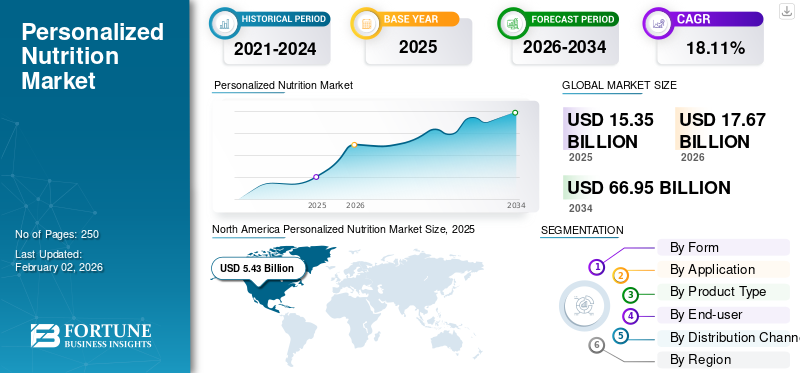
The global personalized nutrition market size was valued at USD 15.35 billion in 2025. The market is projected to grow from USD 17.67 billion in 2026 to USD 66.95 billion by 2034, exhibiting a CAGR of 18.11% during the forecast period. North America dominated the personalized nutrition market with a market share of 35.36% in 2025.
Moreover, the U.S. personalized nutrition market is projected to reach USD 13.24 billion by 2032, as consumers seek customized dietary solutions.
Personalized nutrition is an emerging concept or approach to tailor or customize nutrition supplements for individuals using their genetics, lifestyle patterns, and lab-test data. The emerging technological advancements in the supplement industry are significantly contributing to the rapid shift in the global landscape. Growing disposable income, increased spending on health & wellness products, and increasing disease-specific supplement product awareness, is likely to push the product popularity to the next level. The growth in the number of new entrants to the industry, paired with new product launches and merger & acquisition activities, will propel the global market growth during the forecast period.
Amidst the fear of coronavirus spread, the immune system supporting dietary supplement product demand has exhibited a sudden surge globally. In spite of economic hardships, consumers positively reacted to purchasing dietary supplement products such as immunity boosters and multivitamins. The change in the purchasing pattern of supplements among consumers significantly affected the demand for tailored nutrition products. This shifting consumer supplement purchasing behavior positively impacted companies' sales. As a result, key players experienced double-digit sales, particularly from the supplements segment.
Download Free sample to learn more about this report.
Personalized Nutrition Market KEY TAKEAWAYS
 Market Size & Forecast
- 2025 Market Size: USD 15.35 Billion
- 2026 Market Size: USD 17.67 Billion
- 2034 Forecast Market Size: USD 66.95 Billion
- CAGR: 18.11% from 2026-2034
 Market Share
- North America holds 35.36% market share.
- Capsules hold 44.65% market share.
- Standard supplements hold 80.08% market share.
 Key Regional Highlights
North America
North America holds 35.36% market share, supported by leading market players.
Europe
Europe holds 28.40% market share, driven by increasing health consciousness.
Asia Pacific
Asia Pacific holds 25.64% market share and is expected to record the highest growth rate.
U.S.
The U.S. market is projected to reach USD 5.17 billion by 2026.
Japan
Japan's market is projected to reach USD 1.24 billion by 2026.
Read More

Personalized Nutrition Market Trends
Emerging Joint Ventures and Partnerships to Drive Growth in Upcoming Years
Nutrition plays a key role in obtaining overall well-being by maintaining both physical and mental health. Since consumers are becoming more aware of health and diet, the concept of personal nutrition has been emerging worldwide. The tailored diet and nutritional solutions help to meet the user’s nutrient requirements effectively while supporting the immune system, enhancing energy levels, managing chronic conditions, and reducing the risk of diet-related diseases. To tailor user-specific nutrition and diet, industry players have opted for various advanced technologies, such as DNA testing, blood tests, and questionnaires related to user’s lifestyles. These technologies assist industry players in developing and delivering personalized nutrition supplement products.
Industry players are adopting various strategies to strengthen their presence in the market and stay ahead of the competitive curve. Partnerships and merger & acquisition activities assist players in developing innovative products to serve their consumers. For instance, in January 2022, Bioniq, a London-based startup specialized in developing personalized nutrition solutions, acquired a university spin-off company, LOEWI. This acquisition accelerates its presence in the European market.
Download Free sample to learn more about this report.
Personalized Nutrition Market Growth Factors
Rising New Entrants Coupled with Increasing Venture Investment to Fuel Market Growth
Since product demand is surging globally, numerous players are entering the industry with innovative product ideas. For instance, in July 2022, Made4 Vitamins, an emerging U.K.-based dietary supplement products manufacturing company, entered the subscription-based personalized vitamin supplements space. The company strives to deliver uniquely blended vitamin pouches to its consumers. Furthermore, established players are planning to enter new market spaces, especially emerging nations such as India, Korea, and China, to expand their clientele base. This factor is additionally supporting the industry expansion in the upcoming years.
Additionally, newly entered emerging players are seeking financial assistance to enhance their business operations, such as R&D activities, new product launches, and marketing. For instance, in May 2023, VitaminLab, a British company specialized in personalized vitamin supplements, raised an undisclosed amount in its Series A financing. The increasing financial assistance and fundraising are likely to contribute further to the global personalized nutrition market growth.
Industry Beneficial Programs by Governments to Push Industry to New Heights
Favorable government policies are an important factor in surging tailored supplement demand. Since nutritional deficiency among individuals is increasing, especially in developing countries, government organizations have initiated various programs to improve awareness of nutritional foods and supplement benefits.
Furthermore, the government is also incorporating various industry-beneficial programs and financial aids to strengthen new entrants in the industry. In July 2021, the Ministry of Food & Drug Safety, South Korea, initiated the Sandbox project to promote and open new stores in the country. Numerous supplement companies, such as Pulmuone Health & Living, Herbalife Korea, Amway Korea and Cosmax NBT, are involved in this project. This project would allow these companies to open certain shops and 152 stores are anticipated to open under this project in the upcoming years. Under this project, Cosmax NBT opened its 5th customized nutrition store in October 2021. Thus, the government’s supportive programs and policies will propel the industry in upcoming years.
RESTRAINING FACTORS
Volatile Regulatory Landscape and Technological Complexity to Impede Market Growth
Customized nutrition solutions are in a developing stage. Thus, it is currently considered unregulated across the world. Over the past decade, a number of studies have investigated the benefits and challenges of the concept. Manufacturers gather individuals' personal information, such as genotype information and lifestyle and dietary requirements, using advanced technologies such as artificial intelligence and data analytics. The sharing of personal data may affect users' privacy. Thus, regulators consider this concept to be part of the regulatory aspects of data protection. For instance, in Europe, the personalized nutrition services provider must follow the EU standard’s guidelines prescribed under Art. 4.1 GDPR. These complex yet volatile policies, paired with poor standardized regulatory frameworks, are likely to impede industry growth.
Furthermore, to offer effective services, companies need to adopt advanced technologies such as DNA tests, AI tools, and data analytics. These technology-driven tools are complex and need specialized resources to handle them. It may increase companies' operation costs and may adversely influence their revenue growth.
Personalized Nutrition Market Segmentation Analysis
By Form Analysis
Capsules Hold Leading Market Position with its High Affordability & Flexibility
Based on form, the market is divided into tablets, capsules, powder, liquid, and others. The other segment contains gummies and soft-gels.
Capsule forms of supplements are associated with several beneficial factors, such as high affordability, convenient packaging, and more accessibility across the various sales channels. They can be packed in small packets, which will help users to intake their daily dosage of supplements during their busy scheduled lifestyle and travels. These factors significantly influence product sales globally. Thus, the segment is projected to hold the largest personalized nutrition market with a share of 44.65% in 2026.
Tablets are another prominent form traditionally available across retail shelves. The segment is predicted to show considerable growth during the forecast period owing to various factors. The longer shelf life, high convenience factor, and capacity to reduce the bad taste of complex ingredients augment the tablet demand.
The powder segment is projected to grow at the highest CAGR during the forecast period. The increasing popularity of fitness and bodybuilding among youths drives the demand for personalized protein supplements. Traditionally, protein supplements are formulated in powder form and designed to be easily mixed with water or liquid. Furthermore, manufacturers are combining the blend of vitamins, minerals, and herbs with these powder supplements. Thus, the powder form of supplements offers more flexibility to users while providing a higher volume of active ingredients and supplements.
To know how our report can help streamline your business, Speak to Analyst
By Application Analysis
Increasing Concern for Overall Well-being to Drive Standard Supplements Demand
Based on application, the market is classified into standard supplements and disease-based supplements.
The standard supplements segment is projected to holds the largest share of the global market with 80.08% in 2026. Increasing consumer health awareness and concern for achieving overall well-being is primarily driving the demand for standard supplement products. These supplements contain holistic nutrition that help to fulfill multiple requirements, including immunity boosting, enhancing physical endurance, and better mental health. The various benefits associated with the standard supplement drive the prominence of the segment and it is anticipated to grow at a promising CAGR during the forecast period.
The disease-based supplements segment is projected to grow at the highest CAGR over the forecast period. The changing consumers’ lifestyles, such as unhealthy diets, hectic work schedules, and physical inactivity, are increasing the prevalence of lifestyle-related problems. Furthermore, an unbalanced and stressful career has increased mental illness among the users. Thus, consumers' shift toward preventive health conditions and the importance of disease-specific solutions are the major factors driving segment growth.
By Product Type Analysis
Influence of Digitally Driven Solutions is Likely to Drive Demand for Active Measurement
By product type, the market is classified into active measurement and standard measurement.
The active measurement segment is anticipated to accounted for the largest market with a share of 78.49% in 2026, owing to the rising influence of digitalized customized supplement solutions. The digitalized solutions assist key players in offering individualized nutrition solutions and DNA-based diet plans to their clients by using genomic kits, applications, and various tests. Compared to standard measurement, the accuracy and effectiveness of active measurement are high. This factor will positively drive the traction toward the particular product type and propel the segment's growth with the highest rate during the forecast period.
The standard measurement segment contributes a considerable share to the industry. The availability of products at retail channels with a lesser price range has positively impacted the segment’s growth globally. As a result, the segment is projected to grow at a promising CAGR over the forecast period.
By End-User Analysis
Adults Segment to Lead Owing to Increasing Health Concerns
Based on end-user, the market is classified into adults, pregnant women, and geriatrics.
The adults segment expected to hold the largest share of the global marketwith a share of 57.67% in 2026. The increasing overall health and wellness concerns among millennials and Gen-Z consumers drive the demand for personalized nutrition supplements. Nowadays, a larger number of young consumers are strongly attracted to fitness, athletics, and adventurous activities. To achieve stamina, physical endurance, protein supplements, and achieve their physical goal, they are searching for more customized and effective supplement solutions. As a result, the demand for tailored nutritional supplement products will gain a rapid surge from adults at the global level.
The pregnant women segment is projected to grow at a substantial CAGR over the forecast period. Increasing vitamin and mineral deficiency among pregnant women, especially in developing countries such as India, China, Japan, and Brazil, is primarily contributing to the growth of product demand. According to WHO, approximately 23.4% of pregnant women in Japan have gestational anemia, which is caused by the deficiency of iron and vitamins A and B. Growing awareness of nutrients importance during the pregnancy period is likely to propel the product demand among pregnant women.
By Distribution Channel Analysis
High Exposure for Personalization from Direct-to-Consumer Channels Primarily Influences its Prominence
By distribution channel, the market is classified into direct-to-consumers, wellness & fitness centers, hospitals, and others.
The direct-to-consumer segment accounted for the largest market share in 2023 owing to the rising companies' involvement in offering customized services through their websites. Leading players such as Amway and Herbalife Nutrition are following the D2C channels, as the method is more effective in understanding individuals' requirements and developing customized products according to their needs. Furthermore, tech-driven companies such as DNAfit, Nutrigenomix, and Zoe Nutrition Private Limited are collecting their consumers' data through their several kits and apps. It will further help them to develop a tailored nutritional supplement more accurately and effectively. Therefore, flexibility, traceability, ease of tracking, and effectiveness are likely to drive the product sales from the D2C segment.
Wellness & fitness centers are playing a key role in promoting customized supplement products in the market. As youngsters are more concerned about their fitness and bodybuilding, fitness trainers and wellness service providers are recommending purchasing particular supplements based on their client's goals. Therefore, the increasing influence of fitness centers among youths is strongly driving the segment’s growth. The segment is anticipated to grow at the highest CAGR over the analysis period.
REGIONAL INSIGHTS
Geographically, the market has been studied across North America, Europe, Asia Pacific, South America, and the Middle East & Africa.
North America
North America Personalized Nutrition Market Size, 2025 (USD Billion)
To get more information on the regional analysis of this market, Download Free sample
North America dominates the global market by holding the largest market share. North America accounted for USD 5.43 billion in 2025, representing 35.36% of the global market share, and is projected to reach USD 6.22 billion in 2026. There are various players, such as Amway, Herbalife Nutrition, and Viome Life Science, in the market. These players are spending an adequate budget on promotional and marketing activities, which is likely to drive the product demand across the U.S., Canada, and Mexico. Furthermore, new entrants in the industry are raising financial assistance from several investors. This is anticipated to support them in researching, developing, and launching novel products to the retail shelves. This factor will further boost the industry’s growth in North America during the forecast period. The U.S. market is projected to reach USD 5.17 billion by 2026.
Europe
To know how our report can help streamline your business, Speak to Analyst
Europe is another emerging market for customized nutrition products. The increasing consumers’ concern for health and well-being is primarily driving the demand for the product. The Europe market was valued at USD 4.36 billion in 2025, capturing 28.40% of global revenue, and is estimated to reach USD 5.01 billion in 2026. Furthermore, emerging digital influence and advancements in technologies are likely to drive product demand across Germany, France, Italy, and the U.K. Additionally, international customized nutritional product manufacturers are collaborating with retailers such as Target and Tesco to expand their geographical presence. It will additionally drive the surge in product demand. The UK market is projected to reach USD 1.05 billion by 2026, while the Germany market is projected to reach USD 0.75 billion by 2026.
Asia Pacific
Asia Pacific is projected to expand at the highest growth rate during the forecast period. Increasing international players' focus on entering the Asian market, paired with rising new start-ups, is significantly impacting the surge of product demand. In 2025, Asia Pacific held 25.64% of the global market, reaching a valuation of USD 3.94 billion, and is projected to grow to USD 4.58 billion in 2026. The increasing health consciousness among users is motivating them to adopt health-enhancing customized supplement products. As a result, the market is becoming more attractive to product manufacturers, especially in Japan, China, and India. In 2020, an Indian Nutraceutical start-up Bookhahaathi, launched AI-based tailored nutritional supplement services in the country. The Japan market is projected to reach USD 1.24 billion by 2026, the China market is projected to reach USD 1.74 billion by 2026, and the India market is projected to reach USD 0.5 billion by 2026.
South America
South America is anticipated to exhibit a promising growth rate during the forecast period with rising new product launches, a growing middle-class population, and increasing adoption of healthier lifestyles among youths. Brazil and Argentina are adopting nutritional supplements to support their physical and athletic activities. It additionally drives tailored supplement products, especially protein supplements in the region.
Middle East & Africa
The Middle East & Africa market is relatively small and will witness steady growth in the upcoming years. Middle East & Africa contributed approximately USD 0.33 billion to the global market in 2025, accounting for 2.16% share, and is expected to reach USD 0.37 billion in 2026. Increasing government focus on enhancing the awareness of health supplements among individuals to support the product demand across the region. Furthermore, key companies' marketing strategies and geographical expansion activities further contribute to the surging demand for personalized nutrition supplements across the region.
Latin America
The Latin America region captured 8.44% of the global market in 2025, generating USD 1.3 billion in revenue, and is projected to reach USD 1.5 billion in 2026.
KEY INDUSTRY PLAYERS
Incorporating Merger & Acquisition Activities to Expand Geographical Presence and Retail Capabilities
The global personalized market is highly fragmented with the presence of numerous medium-scale and large-scale industry players. Along with these established international players, various regional companies are significantly contributing to the industry. The increasing number of new enterprises in the sector led to intense competition across retail shelves worldwide.
This has created a strong barrier for international players such as DSM SE, Nestle Health Science, and Amway to enter new markets. In October 2022, Hologram Sciences, a consumer-facing customized nutrition company backed by Royal DSM, signed a strategic partnership agreement with Maeil Health Nutrition, a nutritional supplement manufacturing company. The move aimed to expand the company’s geographical presence and strengthen its product portfolio of personalized dietary solutions in the Korean market.
List of Top Personalized Nutrition Companies:
- Amway (U.S.)
- Herbalife International of America, Inc. (U.S.)
- DSM SE (Netherlands)
- Metagenics (U.S.)
- Nestle Health Science (Switzerland)
- Viome Life Sciences, Inc. (U.S.)
- Bayer AG (Germany)
- Harbin Pharmaceutical Group Co., Ltd (GNC Holdings Inc.,) (U.S.)
- DNAFit (U.K.)
- Zoe Nutrition Private Limited (India)
KEY INDUSTRY DEVELOPMENTS:
- April 2024: Vitamyna, one of the emerging lifestyle brands, launched its innovative personalized pack builder feature to address the increasing need for customized nutrition and wellness products. The company allows consumers to create custom daily vitamin packs according to their requirements through its website and delivers the order to their doorstep.
- December 2023: Monolabs, a South Korean gaming company, entered the personalized nutrition sector by launching “I AM” services in China via WeChat. The company has nearly 30 SKUs, with a nutrition range including vitamins and minerals, to cater to consumers' preferences such as weight management and eye health.
- October 2023: AHARA, one of the emerging players specializing in developing tailored nutrition, launched its free version of the customized nutrition plan to be accessible to everyone. This plan offers services including Personalized Health Assessments, Nutritional Guidance, Lifestyle Recommendations, and Progress Tracking.
- April 2023: Gainful, an American customized nutrition brand, strategically entered a partnership agreement with Target, an American retail company, to sell its customized nutrition products across 1800 Target’s retail stores.
- April 2021: Royal DSM-firmenich, a global company in nutrition and health products, announced the launch of a Hologram Science to provide more holistic solutions for consumers to achieve better health. The Hologram Science has been launched with a USD 100 million investment to offer solutions combining health diagnostics, digital coaching, and personalized nutrition.
REPORT COVERAGE
The report includes quantitative and qualitative insights into the market. This market intelligence report also offers a detailed regional and global industry analysis of the market size, statistics, regional & global market share, and growth rate for all possible segments. In addition, the report provides various key insights on the market, an overview of related markets, the competitive landscape, recent industry developments such as mergers & acquisitions, the regulatory scenario in critical countries, and key industry trends.
Request for Customization to gain extensive market insights.
Report Scope & Segmentation
|
ATTRIBUTE |
DETAILS |
|
Study Period |
2021-2034 |
|
Base Year |
2025 |
|
Estimated Year |
2026 |
|
Forecast Period |
2026-2034 |
|
Historical Period |
2021-2024 |
|
Growth Rate |
CAGR of 18.11% from 2026 to 2034 |
|
Unit |
Value (USD Billion) |
|
Segmentation |
By Form
By Application
By Product Type
By End-User
By Distribution Channel
By Region
|
Frequently Asked Questions
Fortune Business Insights says that the market size was USD 15.35 billion in 2025.
Rising at a CAGR of 18.11%, the market will exhibit promising growth over the forecast period (2026-2034).
Based on form, the capsules segment is the leading segment in the global market.
The increasing number of new entrants and growing investments in new ventures are set to propel the market.
Amway, Herbalife International of America, Inc., DSM SE, and Nestle Health Science are the leading players in the market.
North America dominated the global personalized nutrition market share.
The active measurement type segment holds the major share of the market.
Increasing joint ventures and partnerships among industry players is a key trend in the market.



- 2021-2034
- 2025
- 2021-2024
- 250
-
(Offer valid till 15th Oct 2026)
Get 30-60 hrs Free Customization
Expand Regional and Country Coverage, Segments Analysis, Company Profiles, Competitive Benchmarking, and End-user Insights.




















Related Reports
-
US +1 833 909 2966 ( Toll Free )
-
Get In Touch With Us