Pharmaceutical Blockchain Market Size, Share & Industry Analysis, By Product (Blockchain Platforms, Pharma Blockchain Applications, Integration & Data Products, & Services), By Network Type (Private, Consortium / Industry Network, Public Blockchain, & Hybrid), By Application (Supply Chain Traceability & Compliance, Anti-counterfeit & Product Authentication, Quality, Manufacturing & GxP Evidence, & Others), By Deployment (Cloud-based, On-premise, & Hybrid), By End User (Pharma & Biopharma Manufacturers, CMOs/CDMOs, Healthcare Providers & Health Systems, & Others), & Regional Forecast, 2026-2034
 Download Free Sample
Pharmaceutical Blockchain Market Size and Future Outlook
 Listen to Audio Version
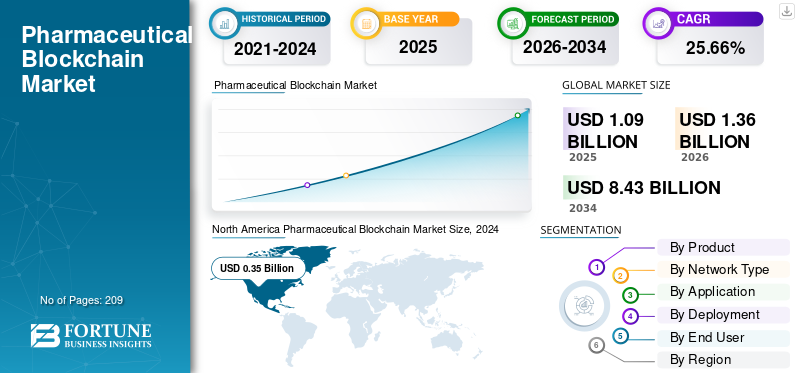
The global pharmaceutical blockchain market size was valued at USD 1.09 billion in 2025. The market is projected to grow from USD 1.36 billion in 2026 to USD 8.43 billion by 2034, exhibiting a CAGR of 25.66% during the forecast period. North America dominated the pharmaceutical blockchain market with a market share of 40.37% in 2025.
The global market is poised to grow significantly over the forecast period driven by pharmaceutical companies’ growing focus on data privacy and data security. Pharmaceutical blockchains are a digital ledger that is tamper-evident, enabling multiple pharma stakeholders such as manufacturers, CMOs, and regulators to track, verify, and secure the entire lifecycle of drugs, from manufacturing to patient, ensuring authenticity and safety. Pharmaceutical workflows are audit-heavy, with strict regulations that push companies toward interoperable and electronic traceability. Blockchains in the pharmaceutical industry can securely record data in real time and protect it from future tampering. To meet these demands, key companies are integrating blockchain solutions into their workflows to streamline business operations.
- In October 2025, the PharmaLedger Association (PLA) expanded its digital trust solutions with the launch of astralabel, a SaaS platform open to members and non-members.
Moreover, major players in the clinical NLP platforms industry, such as IBM, Blockchain Industry Group (BIG), Guardtime, and BurstIQ, are driving market growth by investing heavily in technological advancements and strategic collaborations.
Download Free sample to learn more about this report.
Pharmaceutical Blockchain Market KEY TAKEAWAYS
 Global Market Size & Forecast
- 2025 Market Size: USD 1.09 billion
- 2026 Market Size: USD 1.36 billion
- 2034 Forecast Market Size: USD 8.43 billion
- CAGR: 25.66% from 2026–2034
 Market Share
- North America dominated the pharmaceutical blockchain market with a 40.37% share in 2025.
- The services segment is projected to grow at a CAGR of 26.14% during the forecast period.
- The hybrid segment is anticipated to grow at a CAGR of 26.35% over the forecast period.
 Key Regional Highlights
Asia Pacific
Asia Pacific is projected to reach USD 0.34 billion in 2026, driven by growing pharmaceutical manufacturing.
North America
North America reached USD 0.44 billion in 2025, supported by rising healthcare digitalization.
Europe
Europe is projected to reach USD 0.35 billion in 2026, fueled by increasing digital healthcare investments.
U.S.
The market is estimated at USD 0.51 billion in 2026, driven by demand for blockchain-based pharmaceutical solutions.
Japan
Japan is estimated to reach approximately USD 0.06 billion in 2026, supported by growing digital technology adoption.
Read More

PHARMACEUTICAL BLOCKCHAIN MARKET TRENDS
Shift Toward Production Deployments Driven by Regulatory Deadlines is a Prominent Trend Observed
Regulatory deadlines are pushing pharmaceutical blockchain from small pilots into full-scale use in routine occurrences. Stringent regulations and compliance guidelines, such as DSCSA, govern the market. Companies can no longer rely on limited testing as interoperability challenges or gaps in partner verification may disrupt product movement and increase compliance risk. As a result, pharma and supply chain partners are prioritizing production-ready blockchain networks that can support real transaction volumes, standardized data exchange, and audit-ready records across many trading partners. Emphasizing these advantages, the market is witnessing strategic collaborations that are supporting overall global pharmaceutical blockchain market growth.
For instance, in July 2025, LedgerDomain partnered with Legisym, a key provider of regulatory compliance credentialing services, to integrate the company’s License Verify service into LedgerDomain’s Drug Supply Chain Security Act (DSCSA) compliance platform. This integration streamlined verification of trading partners’ state and federal licenses, enabling pharmaceutical manufacturers, distributors, and dispensers to meet DSCSA requirements with ease.
MARKET DYNAMICS
MARKET DRIVERS
Increased Adoption of Blockchain for End-to-End Drug Traceability and Anti‑Counterfeiting to Drive Market Growth
One of the key factors driving the global pharmaceutical blockchain market is the rising adoption of blockchain technology for end-to-end drug traceability and anti-counterfeiting. Pharma companies need more centralized systems to ensure the authenticity of products as they move from the manufacturer through distributors and subsequently to the patients. Counterfeits and diversion create patient-safety issues and compliance exposure. Many traditional traceability systems are fragmented and poorly connected across partners which slows down the verification process, making investigations a cumbersome process. Blockchain supports this shift by providing supply-chain partners with a shared record of key events, improving authenticity checks, speeding up recalls, and strengthening auditability.
For instance, in November 2025, Medical Value Chain (MVC) initiated strategic engagement with the Ethiopian Pharmaceutical Supply Service (EPSS), the government agency responsible for the procurement, storage, and distribution of pharmaceuticals, medical equipment, and laboratory reagents to public health facilities nationwide. The development aims to curb pharmaceutical counterfeits.
Download Free sample to learn more about this report.
MARKET RESTRAINTS
Integration Complexities with Pharmaceutical Blockchains to Delay Adoption, Limiting Market Growth
Integration complexity is a significant factor hindering the growth of the pharmaceutical blockchain market. Pharmaceutical manufacturers run supply-chain and quality operations on legacy systems such as ERP, WMS, serialization platforms, and partner portals. To make blockchain beneficial, these existing systems are required to establish connectivity and exchange data in a consistent way. Additionally, blockchain networks only deliver full value when a large number of trading partners participate. Thus, slow partner onboarding and uneven technical readiness can delay adoption. As a result, some companies limit projects to small scopes or postpone deployments, which slows adoption and reduces short-term market growth.
For instance, in January 2026, Emerald Insight published an article titled ‘Pharmaceutical supply chain blockchain adoption barriers and drivers in developing countries: a DEMATEL approach’ that reported technological factors, such as interoperability in blockchain models, were the main obstacles for integration of these solutions into workflows.
MARKET OPPORTUNITIES
Integration of Blockchain with IoT, RFID, and Serialization Platforms to Offer Significant Growth Opportunities
Integration of blockchain with IoT, RFID, and serialization platforms is a strong growth opportunity as it transforms traceability from a post-event record to immediate, comprehensive visibility. Serialization creates a unique ID, RFID/IoT captures movement and condition data faster with fewer manual scans. Blockchain adds a shared, tamper-evident layer so that multiple supply-chain partners can trust the same events and resolve exceptions rapidly. Collectively, this helps pharma companies improve anti-counterfeiting, recall speed, inventory accuracy, and compliance reporting, while also enabling new value-added services such as automated replenishment, faster investigations, and proof-of-handling across the chain. Emphasizing growth potential, numerous key companies are launching new products with innovative features and AI integration to meet global demand for technical NLP platforms.
For instance, in February 2026, Wellgistics Health, Inc., patented its AI-enabled blockchain-smart contract platform, PharmacyChain, into its pharmacy dispensing optimization artificial intelligence platform, EinsteinRx.
MARKET CHALLENGES
High Initial Implementation Costs and Integration Complexity to Pose Critical Challenges in Market Growth
Significant initial implementation costs and integration complexity poses a major challenge to the market growth. Pharmaceutical companies are required to connect the blockchain network to existing ERP systems, serialization repositories, and EPCIS event systems, and align on data standards and governance across trading partners. This often leads to complex integration work and long partner onboarding cycles. These factors result in increased upfront cost and delayed ROI.
- For instance, according to a blog post published by qodequay technologies in September 2025, average cost estimates for pilot blockchain solutions ranged from USD 70,000 to USD 150,000.
Segmentation Analysis
By Product
Faster Result Owing to Prebuilt Workflows Propels Pharma Blockchain Application
Based on product, the market is classified into blockchain platforms, pharma blockchain applications, integration & data products, and services. Among these, the pharma blockchain applications accounted for a significant pharmaceutical blockchain market share in 2025. The segment's dominance is attributed to its ability to provide buyers with ready-to-deploy solutions that address issues related to traceability, verification, and chargebacks for pharmaceutical entities. These applications include pre-built workflows, dashboards, and rules, enabling teams to move faster. As a result, investment in these applications is easier to defend than platform purchases alone. Furthermore, strategic collaborations among key companies using these blockchain-integrated applications support market growth.
- For instance, in October 2025, Wellgistics Health entered into a smart contract services agreement with DataVault AI to develop a patented pharmacychain(TM) manufacturer-to-patient blockchain-enabled tracking & dispensing platform for the prescription drug market.
The services segment is expected to grow at a CAGR of 26.14% over the forecast period.
To know how our report can help streamline your business, Speak to Analyst
By Network Type
Consortium / Industry Network’s Efficient Interoperability Due to Multi-Company Design Makes it a Preferred Network Type
Based on network type, the market is segmented into private, consortium/industry network, public blockchain, and hybrid.
In 2025, the consortium/industry network dominated the market. The consortium networks support multi-company pharma supply chains by design. A consortium-based model distributes cost and governance responsibilities among multiple across many participants and improves adoption. This structure also improves interoperability because the network is built to work across multiple solution providers rather than a single vendor. In regulated environments, these industry networks help align stakeholders more quickly by offering common rules and shared onboarding. Underscoring these advantages, key companies are starting to participate in strategic partnerships.
- For instance, in January 2025, the Open Credentialing Initiative (OCI), the leading driver of trusted digital interactions within the U.S. pharmaceutical supply chain, started its credential ecosystem encompassing over 10,000 pharmacy locations across the United States, ranging from retail to specialty and inpatient pharmacies, clinics, and hospital systems.
The hybrid segment is projected to grow at a CAGR of 26.35% over the coming years.
By Application
Supply Chain Traceability & Compliance is the Leading Application Due to its Robust Traceability Systems
By application, the market is sub-segmented into supply chain traceability & compliance, anti-counterfeit & product authentication, quality, manufacturing & GxP evidence, clinical trials & R&D integrity, contracts, rebates, chargebacks & commercial ops, cold chain monitoring attestations, and others.
The supply chain traceability & compliance dominated the market in 2025 as traceability is a high-priority application of these blockchain solutions. Regulators expect detailed documentation of drugs from sourcing, operations, and transit to verify their legitimacy. Blockchain-based approaches help create an audit-friendly history, which reduces disputes during investigations, recalls, and verifications.
Companies also use traceability systems to reduce exposure to counterfeit products and lower the operational costs of responding to compliance checks.
- For instance, in February 2025, Medical Value Chain (MVC) conducted a series of comprehensive training sessions for government officials, manufacturers, importers, distributors, and dispensers in Bahrain. These sessions aimed to enhance understanding and use of the upgraded NHRA-MVC Traceability Hub, ensuring compliance with Bahrain’s Legislative Decree No. 41 of 2017, which mandates a Track and Trace System for pharmaceuticals.
The contracts, rebates, chargebacks & commercial ops are projected to grow at a CAGR of 31.70% during the forecast period market.
By Deployment
Cloud Deployment Leads as it Enables Access to the System through Various Time Zones
Based on deployment, the market is segmented into cloud-based, on-premises, and hybrid. Cloud-based deployment accounts for the largest share. Blockchain programs require many parties to access the same system across locations and time zones. This can be easily achieved using cloud deployment. Cloud makes onboarding faster, updates easier, and scaling affordable. Additionally, it also supports real-time sharing of credentials, events, and verification responses. Buyers also opt for cloud because they can start small and expand usage without large upfront infrastructure investments.
Emphasizing these advantages, key companies are increasingly adopting cloud-based deployments for pharmaceutical blockchain.
- For instance, in July 2023, NABP collaborated with IBM to build a new digital platform, Pulse by NABP, intended to bring visibility to the drug supply chain management and help protect patients from counterfeit drugs.
In addition, the hybrid segment is projected to grow at a CAGR of 24.08% during the study period.
By End User
Pharma & Biopharma Manufacturers are Leading End Users Owing to their Large Volume of Patient Data
Based on end user, the market is segmented into pharma & biopharma manufacturers, CMOS/CDMOs, healthcare providers & health systems, supply chain intermediaries, and others.
Pharma & biopharma manufacturers dominate the global market as they are the primary point of product identity, producing metrics such as serialization, batch creation, and other factors. Inconsistencies in manufacturer data result in slower and expensive verification processes in every downstream. They are also at a higher risk to the brand due to counterfeits. These factors encourage pharma and biopharma manufacturers to invest in systems that protect and improve data integrity. To cater to these entities, various key players are focusing on strategic partnerships to improve supply chain management.
- For instance, in November 2023, numerous pharmaceutical giants participated in a collaborative event at Cencora’s headquarters (formerly AmerisourceBergen). This collaborative gathering aimed to pave the way for a healthcare supply chain characterized by efficiency, transparency, and innovation. Such developments drive the segment's growth.
In addition, the CMOs/CDMOs segment is projected to grow at a CAGR of 27.88% during the study period.
Pharmaceutical Blockchain Market Regional Outlook
By geography, the market is categorized into Europe, North America, Asia Pacific, Latin America, and the Middle East & Africa.
North America
North America Pharmaceutical Blockchain Market Size, 2024 (USD Billion)
To get more information on the regional analysis of this market, Download Free sample
North America held the dominant share in 2024, valued at USD 0.35 billion, and maintained its leading position in 2025, with a value of USD 0.44 billion. The market in North America is growing rapidly because healthcare systems face high drug shortages, need transparency in operations, and are digitalizing records. These factors result in a growing demand for blockchain solutions among pharmaceutical manufacturers. The region also benefits from a large vendor ecosystem, faster commercialization, rising IT budgets, and cloud partnerships, all of which support market growth.
U.S. Pharmaceutical Blockchain Market
Given North America’s substantial contribution and the U.S. dominance in the region, the U.S. market can be estimated at around USD 0.51 billion in 2026, accounting for roughly 37.74% of the global market.
Europe
Europe is anticipated to grow at a CAGR of 24.25% over the coming years, the second-highest among all regions, and projected to reach USD 0.35 billion in 2026. The region is expected to experience robust growth due to faster digitization of regulated product data, stringent regulations such as GDPR that protect data, and rising investment.
U.K. Pharmaceutical Blockchain Market
The U.K. market is estimated to reach around USD 0.07 billion in 2026 representing roughly 5.22% of the global market.
Germany Pharmaceutical Blockchain Market
Germany is projected to reach approximately USD 0.08 billion in 2026, equivalent to around 6.15% of the global market.
Asia Pacific
Asia Pacific is estimated to reach USD 0.34 billion in 2026 and secure third position in the market. As Asian pharmaceutical manufacturing and exports grow, companies are also facing stronger expectations to document product provenance and handling, which further accelerates blockchain adoption.
Japan Pharmaceutical Blockchain Market
Japan is estimated to be around USD 0.6 billion in 2026, accounting for approximately 4.56% of the global market.
China Pharmaceutical Blockchain Market
The Chinese market is projected to be one of the largest worldwide, with 2026 revenues estimated at around USD 0.11 billion, representing roughly 7.83% of the global market.
India Pharmaceutical Blockchain Market
The market in India is estimated to reach at around USD 0.05 billion in 2026, accounting for roughly 3.33% of global revenue.
Latin America and the Middle East & Africa
The Latin America and the Middle East & Africa regions are expected to experience moderate growth during the forecast period. The Latin American market is set to reach USD 0.07 billion in 2026. The region is experiencing market growth driven by increased investment and government initiatives. In the Middle East & Africa, the GCC is set to reach USD 0.02 billion in 2026.
South Africa Pharmaceutical Blockchain Market
The South African market is projected to reach approximately USD 0.01 billion in 2026, accounting for roughly 0.40% of the global revenue.
COMPETITIVE LANDSCAPE
Key Industry Players
Focus on New Product Launches by Key Players to Propel Market Progress
The global pharmaceutical blockchain market has a consolidated structure, with companies such as Guardtime, BurstIQ, Oracle, and Systech holding a significant share. Strategic partnerships, technological advancements, and increased investments in the sector drive these companies' market share gains. Other notable players include PharmaLedger Association, PharmaTrail AG, and IBM. These companies are expected to prioritize technological advancements, strategic collaborations, and new product launches to strengthen their position during the forecast.
- For instance, in March 2019, FlowMetric Life Sciences, Inc., a global provider of specialty flow cytometry services and personalized medicine testing products, partnered with BurstIQ, a leader in the healthcare blockchain data sector.
LIST OF KEY PHARMACEUTICAL BLOCKCHAIN COMPANIES PROFILED:
- Guardtime (Switzerland)
- BurstIQ (U.S.)
- Oracle (U.S.)
- Systech (U.S.)
- PharmaLedger Association (Switzerland)
- PharmaTrail AG (Switzerland)
- IBM (U.S.)
- Blockchain Industry Group (BIG) (U.S.)
KEY INDUSTRY DEVELOPMENTS
- December 2025: Antares Vision partnered with Spherity as a reseller of Spherity’s ATP credentials. The development reflects strong industry momentum and the need for a seamless, scalable DSCSA compliance solution that ensures interoperability across the pharmaceutical supply chain.
- August 2024: The MediLedger network partnered with Prisma Health, South Carolina's leading health organization. The development enabled the company to revolutionize contract management and ensure accurate pricing across its extensive network.
- April 2022: AmerisourceBergen (AB) announced a partnership with Chronicled to leverage a new blockchain-powered solution designed to enhance pharmaceutical chargeback accuracy and significantly reduce chargeback rejections.
- October 2021: Chronicled Inc., custodian of the Mediledger Network, partnered with Horizon Therapeutics to improve customer management and identity alignment through blockchain.
- January 2020: The Ministry of Health and Prevention, MoHAP, in collaboration with the Ministry of Presidential Affairs, Dubai Healthcare City, and other relevant health authorities, launched the first advanced digital platform to store the data for health, pharmaceutical government and private facilities, health practitioners, and drug information as well.
REPORT COVERAGE
The global pharmaceutical blockchain market analysis includes a comprehensive study of the market size & forecast across all market segments covered in the report. It includes details on the market dynamics and trends expected to drive the market over the forecast period. It provides information on key aspects, including technological advancements, the regulatory environment, and product launches. Additionally, it details partnerships, mergers & acquisitions, and key healthcare industry developments. The global market research report also provides a detailed competitive landscape, including market share and profiles of key operating players.
Request for Customization to gain extensive market insights.
Report Scope & Segmentation
|
ATTRIBUTE |
DETAILS |
|
Study Period |
2021-2034 |
|
Base Year |
2025 |
|
Forecast Period |
2026-2034 |
|
Historical Period |
2021-2024 |
|
Growth Rate |
CAGR of 25.66% from 2026 to 2034 |
|
Unit |
Value (USD Billion) |
|
Segmentation |
By Product, Network Type, Application, Deployment, End User, and Region |
|
By Product |
|
|
By Network Type |
|
|
By Application |
|
|
By Deployment |
|
|
By End User |
|
|
By Region |
North America (By Product, Network Type, Application, Deployment, End User, and Country)
Europe (By Product, Network Type, Application, Deployment, End User, and Country/Sub-region)
Asia Pacific (By Product, Network Type, Application, Deployment, End User, and Country/Sub-region)
Latin America (By Product, Network Type, Application, Deployment, End User, and Country/Sub-region)
Middle East & Africa (By Product, Network Type, Application, Deployment, End User, and Country/Sub-region)
|
Frequently Asked Questions
According to Fortune Business Insights, the global market value stood at USD 1.09 billion in 2025 and is projected to reach USD 8.43 billion by 2034.
In 2025, the market value of North America stood at USD 0.44 billion.
The market is expected to grow at a CAGR of 25.66% over the forecast period of 2026-2034.
By product, the pharma blockchain applications segment is expected to lead the market.
Increased adoption of blockchain for end-to-end drug traceability and anti‑counterfeiting to drive market growth.
BurstIQ, Microsoft, Oracle, IBM, and PharmaTrail AG are the major players in the global market.
North America held the largest market share in 2025.



- 2021-2034
- 2025
- 2021-2024
- 209
Get 30-60 hrs Free Customization
Expand Regional and Country Coverage, Segments Analysis, Company Profiles, Competitive Benchmarking, and End-user Insights.













.webp)






Related Reports
-
US +1 833 909 2966 ( Toll Free )
-
Get In Touch With Us