Pharmaceutical Glass Packaging Market Size, Share & Industry Analysis, By Product (Vials & Ampoules, Bottles, Cartridges, and Syringes), By Drug Type (Generic, Branded, and Biologic), and Regional Forecast, 2026-2034
 Download Free Sample
Pharmaceutical Glass Packaging Market Size & Share
 Listen to Audio Version
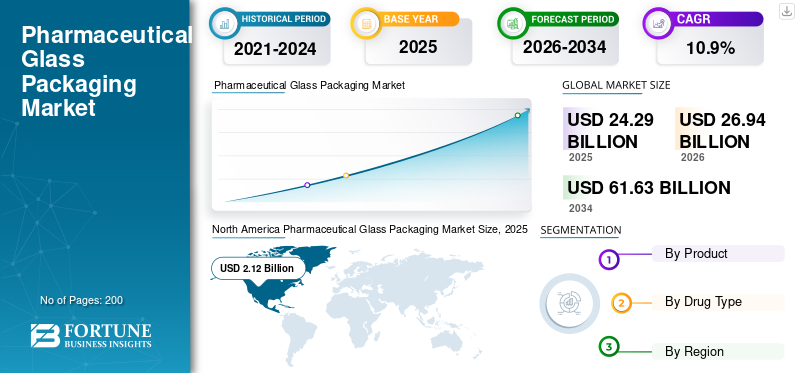
The global pharmaceutical glass packaging market size was valued at USD 24.29 billion in 2025. The market is projected to grow from USD 26.94 billion in 2026 to USD 61.63 billion by 2034, exhibiting a CAGR of 10.90% during the forecast period. North America dominated the pharmaceutical glass packaging market with a market share of 33.6% in 2025.
The pharmaceutical industry is rising at an exceptional rate. The need for packaging in this industry is mainly reliant on increasing both communicable and non-communicable diseases and their treatments around the world. Pharmaceutical glass packaging products are highly regulated as they need to guarantee the protection of medicines from physical damage, biological contamination, and external influences that might lead to contamination. This glass packaging aids in increasing the shelf life of the product and is also used for promotions. An increasing demand for pharmaceutical drugs and medicines, combined with technological advancements in the pharmaceutical industry, would directly lead to the growth of this market.
Download Free sample to learn more about this report.
PHARMACEUTICAL GLASS PACKAGING MARKET KEY TAKEAWAYS
 Market Size & Forecast
- 2025 Market Size: USD 24.29 billion
- 2026 Market Size: USD 26.94 billion
- 2034 Forecast Market Size: USD 61.63 billion
- CAGR: 10.90% from 2026–2034
 Market Share
- North America dominated the market with a 33.6% share in 2025.
- The bottles segment held the largest market share in 2025.
- The generic drug type segment is the fastest-growing segment in the market.
 Key Regional Highlights
North America
North America led the market due to its expanding pharmaceutical industry and rising healthcare spending.
Europe
Europe remained the second-largest market, supported by Germany, the U.K., and Italy.
Asia Pacific
Asia Pacific is witnessing strong growth driven by investments in pharmaceutical manufacturing.
U.S.
The country is the major contributor to North America's pharmaceutical glass packaging market.
Japan
Growing pharmaceutical investments are supporting market expansion in the country.
Read More

LATEST TRENDS
Adoption of New Glass Types to Minimize Product Contamination will Offer Growth Opportunities
The development of new glass types will lead to high demand for pharmaceutical glass packaging. A different type of network former is being used in the manufacturing of these glasses in order to eliminate the need for boron. When used in conventional glasses, boron volatilizes during the manufacturing of vials, thereby creating different chemistry in the drug contacting region of the packaging, which can lead to glass flake formation. The newly developed glass does not contain boron, resulting in chemically durable and uniform glass chemistry. The boron-free glass is introduced by Corning Inc. under the brand name Valor. Furthermore, glass packaging manufacturers are using permanent engraving to minimize the counterfeiting of the “year of manufacture,” which is anticipated to fuel the demand. North America witnessed a growth from USD 2.02 Billion in 2018 to USD 2.12 Billion in 2019.
DRIVING FACTORS
Growth of Pharmaceutical Industry around the Globe to Drive the Demand
The pharmaceutical industry is growing at a rapid pace, mainly in developing countries such as China, India, and Brazil, as well as in developed countries such as the U.S., U.K., and Germany. Factors such as an exponential growth of population, rising awareness of health, and increasing spending on public healthcare systems are projected to surge the demand for glass packaging in the pharmaceutical industry. Additionally, increasing innovations in technologies and the implementation of advanced manufacturing processes are expected to surge glass consumption in the pharmaceutical industry. Favorable properties of glass such as high recyclability, transparency, and chemical inertness are set to surge the product demand in the forthcoming years. Glass packaging is impermeable to moisture and air and can be easily sterilized, thereby supporting the growth of the market.
Download Free sample to learn more about this report.
RESTRAINING FACTORS
Increasing Adoption of Alternative Packaging Materials to Restrict Growth
Glass packaging is increasingly being substituted by plastic in the pharmaceutical industry. Plastics offer properties such as flexibility, easy molding, cost-effectiveness, impact resistance, and other protective properties. The bottles and cartridges made from plastics are low cost, lightweight, and easy to transport in comparison with the ones made from glass. The use of plastics for pharmaceutical packaging negates the chances of accidental breakage owing to the high impact resistance of plastic. Additionally, the high flexibility of plastics minimizes the need for tertiary packaging of the pharmaceutical product, thereby reducing the manufacturing and transportation cost. The above-mentioned factors are restraining the pharmaceutical glass packaging market growth.
SEGMENTATION
By Product Analysis
To know how our report can help streamline your business, Speak to Analyst
Bottles Segment to Account for the Major Share during the Forecast Period
Based on the product, the market is categorized into vials & ampoules, bottles, cartridges, and syringes. Among these, the bottles segment is the largest and is anticipated to remain at the forefront during the forecast period. The growth of this segment is attributed to its chemical inertness, rigidity, and superior protective qualities. Additionally, bottles have gained preference in the packaging of solid as well as liquid pharmaceutical preparations such as tablets, capsules, syrups, and ophthalmic products. The increasing demand for bottles in the pharmaceutical industry is expected to drive market growth.
- The cartridges segment is expected to hold a 11% share in 2019.
The vials & ampoules segment is anticipated to exhibit rapid growth during the review period. Glass vials prevent atmospheric gases such as carbon dioxide and oxygen from damaging the product contained. Additionally, these vials are inert to the majority of chemicals and hence, prevent the product from undergoing oxidation or hydrolysis. Furthermore, they are easy to clean and are resistant to particulates, further leading to the growth of the segment.
The syringes segment is estimated to have a high growth rate in the forecast period owing to the rising need for immediate treatment with the increasing prevalence of cardiovascular diseases. The surging demand for self-administered and multi-dose injectables will lead to the growth of the cartridges segment during the forthcoming years.
By Drug Type Analysis
Generic Segment to be the Fastest-growing Drug Type in the Market
Based on the drug type, the market is classified into generic, branded, and biologic. Generic is the fastest-growing drug type in the market. Generic drugs are low-cost in comparison with branded drug products with similar compositions. Initiatives by the government for promoting the use of generic drugs is surging its demand. Furthermore, patent expiration of branded drugs, along with the rising demand from developing countries, is responsible for the growth of the generic segment, therefore strengthening the pharmaceutical glass packaging market.
The high effectiveness of biological drugs for the treatment of chronic and autoimmune diseases is expected to drive the growth of the biological segment.
REGIONAL INSIGHTS
North America Pharmaceutical Glass Packaging Market Size, 2025 (USD Billion)
To get more information on the regional analysis of this market, Download Free sample
The global pharmaceutical glass packaging market size in North America stood at USD 2.12 billion in 2019, accounting for the largest share in the market. The U.S. is the major contributor to this region. The growth of the market in the region is owed to the rapid expansion of the pharmaceutical industry. Also, the increasing spending on healthcare and the growing prevalence of infectious diseases is driving the key market in this region.
Europe is the second-largest region in the market, in which Germany, the U.K., and Italy have a substantial influence on growth. This is attributed to the implementation of new guidelines by governments to control the transmission of infectious diseases, including COVID-19. In the Asia Pacific, China, Japan, and India are the leading countries contributing to the growth of the market. Increasing investments in the pharmaceutical industry and the expansion of pharmaceutical manufacturing companies in these countries are estimated to offer multiple growth opportunities to the market in this region.
Factors such as a rise in the geriatric population and government benefits such as favorable tariff protection are anticipated to surge the market growth in Latin America. The increasing expansion of pharmaceutical manufacturing capabilities and a rise in healthcare awareness will lead to the growth of the market in the Middle East & Africa.
KEY INDUSTRY PLAYERS
Key Players Focus on Using Organic and Inorganic Growth Strategies to Maintain Their Positions in the Market
At present, the competitive landscape of this market depicts a fragmented scenario with the top 10 companies accounting for major shares in the market. Key players in the market have invested a considerable amount of resources in the research and development of several packaging products and technologies to produce them. Gerresheimer AG offers diversified product portfolios with varying sizes of bottles and ampoules. SCHOTT, on the other hand, has invested in safe & novel technology development and superior operational efficiency for pharmaceutical glass packaging applications.
LIST OF KEY COMPANIES PROFILED:
- Corning Inc. (New York, U.S.)
- Nipro Corporation (Osaka, Japan)
- SCHOTT (Mainz, Germany)
- Gerresheimer AG (Dusseldorf, Germany)
- SGD S.A. (France)
- Stölzle-Oberglas GmbH (Köflach, Austria)
- Bormioli Pharma (Philadelphia, U.S.)
- West Pharmaceutical Services, Inc. (Pennsylvania, U.S.)
- Shandong Medicinal Glass Co., Ltd. (China)
- Beatson Clark (U.K.)
- Şişecam Group (Tuzla, Turkey)
- Others
KEY INDUSTRY DEVELOPMENTS:
- In May 2021, Nipro Corporation’s pharmaceutical manufacturing subsidiary Nipro Pharma Corporation entered into a Contract Manufacturing Agreement with AstraZeneca for the fill and finish process of COVID-19 vaccine, Vaxzevria. More than 90 million doses, of the vaccine, will be manufactured domestically in Japan.
- In March 2021, Stoelzle Glass Group acquired Anchor Hocking Glass Company’s Monaca, Pennsylvania glass factory. Anchor Hocking Glass Company is a subsidiary of The Oneida Group. With the new acquisition, the company opens its seventh glass plant in the United States and first outside Europe.
- In December 2020, SCHOTT commenced production at its new pharmaceutical tubing factory in China. The new plant manufactures FIOLAX® borosilicate glass tubing – the base material for packagings such as ampoules, vials, syringes, and cartridges. SCHOTT invested USD 73.1 million in the new plant as part of a USD 1 billion investment in its global pharmaceutical business.
REPORT COVERAGE
The pharmaceutical glass packaging market research report provides a detailed analysis of the market. It focuses on key aspects such as leading companies, product types, materials used in packaging, sterilization methods adopted, and leading applications of the product. Besides this, it offers insights into the market trends and highlights key industry developments. In addition to the aforementioned factors, the report encompasses several factors that have contributed to the growth of the market over recent years.
Report Scope & Segmentation
Request for Customization to gain extensive market insights.
|
ATTRIBUTES |
DETAILS |
|
Study Period |
2021-2034 |
|
Base Year |
2025 |
|
Forecast Period |
2026-2034 |
|
Historical Period |
2021-2024 |
|
Unit |
Value (USD Billion) |
|
Segmentation
|
By Product
|
|
By Drug Type
|
|
|
By Geography
|
Frequently Asked Questions
According to Fortune Business Insights, the global pharmaceutical glass packaging market size was valued at USD 26.94 billion in 2026 and is projected to reach USD 61.63 billion by 2034, exhibiting a CAGR of 10.9% during the forecast period.
The primary drivers include the expanding pharmaceutical industry, rising prevalence of communicable and non-communicable diseases, and increasing demand for safe, sterile, and chemically inert packaging. Additionally, glass packaging ability to protect medicines from contamination and extend shelf life is accelerating market growth.
Registering a CAGR of 10.9%, the market will exhibit significant growth in the forecast period (2026-2034).
North America held the largest share in 2019, accounting for USD 2.12 billion or 33.6% of the global market. The growth is attributed to advanced healthcare infrastructure, high pharmaceutical spending, and strong demand for high-quality packaging in the U.S. and Canada.
A key trend is the adoption of boron-free glass types, like Corning Valor® Glass, which offers improved chemical durability and eliminates drug-contact issues caused by boron. There is also a growing use of engraving technologies to reduce counterfeiting.
The main product types include vials & ampoules, bottles, cartridges, and syringes. Among them, bottles hold the largest market share due to their versatility, chemical inertness, and ability to store both solid and liquid drugs.
The generic drug segment is the fastest-growing due to lower costs, government initiatives promoting generics, and expiring patents of branded drugs, especially in emerging economies such as India and Brazil.
Major companies include Corning Inc., Nipro Corporation, SCHOTT, Gerresheimer AG, SGD S.A., Stölzle-Oberglas GmbH, and Bormioli Pharma. These players focus on product innovation, strategic acquisitions, and expansion of manufacturing capabilities to strengthen their market position.



- 2021-2034
- 2025
- 2021-2024
- 200
Get 30-60 hrs Free Customization
Expand Regional and Country Coverage, Segments Analysis, Company Profiles, Competitive Benchmarking, and End-user Insights.


















Related Reports
-
US +1 833 909 2966 ( Toll Free )
-
Get In Touch With Us