Phytogenic Feed Additives Market Size, Share & Industry Analysis, By Animal (Poultry, Swine, Ruminants), By Application (Antimicrobial Effect, Digestion Enhancement), By Distribution Channel, and Regional Forecast, 2026-2034
 Download Free Sample
Phytogenic Feed Additives Market Size & Overview
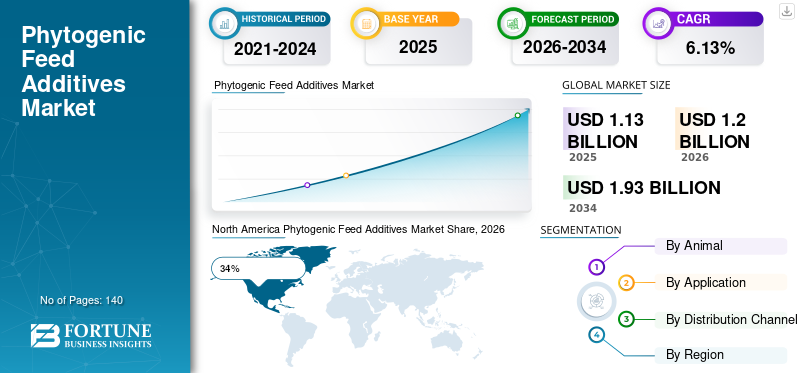
The global phytogenic feed additives market size was valued at USD 1.13 billion in 2025. The market is projected to grow from USD 1.2 billion in 2026 to USD 1.93 billion by 2034, exhibiting a CAGR of 6.13% during the forecast period.

The phytogenic feed additives market is gaining strong momentum due to increasing demand for natural animal nutrition products and growing restrictions on antibiotic-based feed additives. phytogenic feed additives market analysis indicates that livestock producers are increasingly adopting plant-based feed ingredients to improve digestion, immunity, and feed efficiency in poultry, swine, and ruminants. Essential oils, herbs, spices, and botanical extracts are widely utilized to enhance animal performance and support sustainable livestock farming practices. The phytogenic feed additives industry report highlights growing interest in residue-free meat production and clean-label animal nutrition solutions. Rising awareness regarding animal gut health and productivity is further supporting the phytogenic feed additives market growth globally.
The USA phytogenic feed additives market is witnessing substantial expansion due to rising demand for antibiotic-free meat and increasing focus on livestock productivity. Feed manufacturers and commercial livestock farms are integrating phytogenic additives into animal feed formulations to improve feed conversion ratios and digestive performance. phytogenic feed additives market trends in the United States indicate strong adoption of botanical extracts and essential oils in poultry and swine feed applications. Regulatory emphasis on reducing antibiotic usage in animal farming is further strengthening demand for plant-based feed additives. The USA contributes approximately 36% of the North American phytogenic feed additives market share due to advanced livestock farming infrastructure and growing demand for natural feed solutions.
Download Free sample to learn more about this report.
Phytogenic Feed Additives Market Key Takeaways
 Global Market Size & Forecast
- 2025 Market Size: USD 1.13 Billion
- 2026 Market Size: USD 1.20 Billion
- 2034 Forecast Market Size: USD 1.93 Billion
- CAGR: 6.13% from 2026-2034
 Market Share
- North America dominated with a revenue share of 34% in 2025.
- Poultry accounted for approximately 48% of the market share.
- Antimicrobial Effect held approximately 57% of the market share.
 Key Regional Highlights
North America
North America led the market with a 34% share, supported by advanced livestock production and demand for natural feed additives.
Europe
Europe accounted for 30% of the market, driven by increasing adoption of antibiotic-free animal nutrition solutions.
Asia-Pacific
Asia-Pacific held a 28% share, supported by expanding poultry and livestock production.
U.S.
The U.S. market is supported by growing demand for antibiotic-free meat and increasing adoption of phytogenic feed solutions.
Japan
Japan accounted for 11% of the Asia-Pacific market, supported by growing interest in natural and sustainable animal nutrition.
Read More

phytogenic feed additives market Latest Trends
The phytogenic feed additives market is evolving rapidly with increasing adoption of natural feed enhancement technologies and sustainable livestock production practices. One of the major phytogenic feed additives market trends is the growing use of essential oils, flavonoids, and herbal extracts to improve animal gut health and feed efficiency. Livestock producers are increasingly replacing synthetic growth promoters with plant-derived feed ingredients to meet rising consumer demand for antibiotic-free meat and dairy products.
Download Free sample to learn more about this report.
Another important phytogenic feed additives market Insight involves the development of precision feed formulations tailored to species-specific nutritional requirements. Feed manufacturers are investing in advanced encapsulation technologies and standardized botanical blends to improve ingredient stability and nutrient absorption. phytogenic feed additives market research report findings also indicate rising demand for multifunctional feed additives capable of delivering antimicrobial, antioxidant, and digestion-enhancing benefits simultaneously. Integration of sustainable feed production practices and expansion of organic livestock farming continue to support long-term market expansion. Increasing investments in animal nutrition research and advanced feed processing technologies are strengthening the global phytogenic feed additives market outlook.
phytogenic feed additives market Dynamics
DRIVER
Growing Demand for Antibiotic-Free Animal Feed Solutions.
The phytogenic feed additives market growth is primarily driven by increasing global demand for antibiotic-free livestock production and sustainable animal nutrition practices. Governments and regulatory authorities across multiple regions are implementing stricter regulations on antibiotic usage in animal feed due to concerns regarding antimicrobial resistance and food safety. phytogenic feed additives market analysis indicates that feed manufacturers and livestock producers are increasingly shifting toward plant-based additives capable of improving digestive health, immunity, and animal productivity without leaving harmful residues in meat or dairy products.
Consumer preference for natural and clean-label food products is also accelerating adoption of phytogenic feed ingredients in commercial livestock farming. Poultry and swine producers are utilizing herbal extracts, essential oils, and spice blends to improve feed efficiency and support animal health management. phytogenic feed additives market forecast studies indicate growing integration of botanical additives into precision nutrition programs and sustainable livestock production systems. Rising investments in animal nutrition research and expansion of industrial feed manufacturing infrastructure continue to strengthen market demand worldwide.
RESTRAINT
Variability in Raw Material Quality and Product Standardization.
The phytogenic feed additives market faces significant restraints associated with inconsistent raw material quality and lack of standardized botanical formulations. Plant-derived feed additives are influenced by factors such as climate conditions, cultivation practices, harvesting methods, and extraction processes, leading to variability in active ingredient concentration and performance. phytogenic feed additives market research report findings indicate that inconsistent product quality can create challenges for feed manufacturers seeking predictable animal performance outcomes.
Another important restraint involves the relatively higher cost of phytogenic additives compared to conventional synthetic feed ingredients. Small-scale livestock producers and cost-sensitive farming operations may hesitate to adopt premium botanical feed products due to budget limitations. phytogenic feed additives market Insights further reveal technical challenges related to ingredient stability, shelf life, and compatibility with large-scale feed processing systems. Limited awareness regarding optimal dosage levels and application techniques in emerging livestock markets also restricts broader market penetration.
OPPORTUNITY
Expansion of Organic Livestock Farming and Sustainable Animal Nutrition.
Rapid expansion of organic livestock farming and sustainable animal production practices presents significant phytogenic feed additives market opportunities globally. Consumers are increasingly demanding residue-free meat, poultry, eggs, and dairy products produced using natural feed ingredients and environmentally responsible farming methods. phytogenic feed additives market trends indicate rising adoption of herbal extracts and essential oils in organic poultry, swine, and ruminant feed formulations.
Feed manufacturers are investing heavily in research and development activities focused on multifunctional botanical additives capable of improving immunity, digestion, and animal productivity simultaneously. opportunities are also increasing through integration of phytogenic additives into aquaculture and specialty livestock nutrition programs. phytogenic feed additives market outlook studies highlight strong growth potential in emerging economies where industrial livestock production and commercial feed manufacturing are expanding rapidly. Increasing collaboration between feed companies, botanical ingredient suppliers, and livestock producers continues to create favorable conditions for long-term market expansion.
CHALLENGE
Maintaining Efficacy Consistency across Livestock Species and Production Systems.
One of the major challenges within the phytogenic feed additives market is maintaining consistent efficacy across different livestock species, feed compositions, and farming environments. Botanical feed additives may produce variable results depending on animal genetics, feed quality, climate conditions, and farm management practices. phytogenic feed additives market analysis indicates that achieving standardized performance outcomes remains a significant challenge for feed manufacturers and livestock operators.
Another major challenge involves ensuring long-term supply chain stability for botanical raw materials used in phytogenic additive production. Seasonal crop fluctuations, agricultural disruptions, and geopolitical factors can affect availability and pricing of herbs, spices, and essential oils. phytogenic feed additives market Insights further reveal challenges associated with regulatory approvals, product labeling requirements, and scientific validation of health claims. Manufacturers must continuously invest in clinical research, ingredient traceability, and quality assurance systems to maintain market competitiveness and customer confidence.
phytogenic feed additives market Segmentation
By Animal
The poultry segment accounts for approximately 48% of the phytogenic feed additives market share due to extensive global poultry production and increasing demand for antibiotic-free chicken products. Poultry feed manufacturers are increasingly incorporating phytogenic ingredients such as oregano oil, garlic extract, turmeric, and cinnamon into broiler and layer feed formulations. phytogenic feed additives market analysis indicates that botanical additives help improve feed conversion efficiency, digestive performance, and immune function in poultry production systems. Commercial poultry farms are adopting phytogenic feed technologies to reduce disease risks and improve overall flock productivity. Rising consumer demand for natural poultry meat and eggs is accelerating adoption of plant-derived feed additives in intensive farming operations.
The swine segment represents approximately 31% of the phytogenic feed additives market share due to growing focus on gut health management and feed efficiency improvement in pig farming operations. Swine producers are increasingly using phytogenic additives to support intestinal health, reduce pathogenic bacterial growth, and enhance nutrient utilization. phytogenic feed additives market research report findings indicate rising adoption of essential oils, pepper extracts, and herbal compounds in starter and grower pig feed formulations. Livestock producers are emphasizing antibiotic-free pork production to meet evolving consumer preferences and food safety regulations. Phytogenic additives are widely utilized to reduce digestive disorders and improve weight gain performance in commercial swine farming systems.
Ruminants account for approximately 21% of the phytogenic feed additives market share due to increasing use of botanical additives in dairy and beef cattle nutrition programs. Livestock producers are integrating phytogenic compounds into ruminant feed formulations to improve rumen fermentation efficiency, feed digestibility, and milk production performance. phytogenic feed additives market analysis indicates growing demand for natural feed solutions capable of reducing methane emissions and supporting sustainable cattle farming. Essential oils, tannins, and saponins are widely used in ruminant nutrition to improve metabolic efficiency and reduce digestive disorders. Dairy farms are increasingly utilizing phytogenic additives to enhance milk quality and animal immunity.
To know how our report can help streamline your business, Speak to Analyst
By Application
The antimicrobial effect segment holds approximately 57% of the phytogenic feed additives market share due to increasing demand for natural alternatives to antibiotic growth promoters in livestock production. Botanical extracts, essential oils, and spice compounds are widely used to inhibit harmful bacteria and support animal gut health. phytogenic feed additives market analysis indicates strong adoption of oregano oil, thyme oil, garlic extract, and cinnamon compounds for antimicrobial applications in poultry and swine feed. Feed manufacturers are increasingly focusing on multifunctional phytogenic products capable of delivering antimicrobial and immune-enhancing benefits simultaneously. The growing regulatory focus on antimicrobial resistance and antibiotic reduction policies is accelerating adoption of plant-based antimicrobial feed solutions. phytogenic feed additives market trends further highlight increasing research activities focused on synergistic botanical formulations and targeted pathogen control strategies.
The digestion enhancement segment accounts for approximately 43% of the phytogenic feed additives market share due to rising demand for feed efficiency optimization and improved nutrient absorption in livestock farming. Phytogenic additives are increasingly utilized to stimulate digestive enzyme activity, improve gut microbiota balance, and enhance feed utilization efficiency. phytogenic feed additives market research report findings indicate strong demand for herbal extracts and essential oils capable of improving digestive performance in poultry, swine, and ruminant production systems. Livestock producers are integrating botanical digestion enhancers into feed formulations to reduce feed wastage and improve animal productivity. Growing emphasis on precision animal nutrition and sustainable farming practices is accelerating adoption of plant-derived digestive support additives.
By Distribution Channel
The direct sales channel dominates the phytogenic feed additives market with approximately 61% market share due to strong demand from large commercial livestock farms, industrial feed manufacturers, and integrated poultry producers. Major feed additive companies prefer direct engagement with customers to provide customized botanical feed formulations, technical support, and long-term procurement agreements. phytogenic feed additives market analysis indicates that direct procurement enables feed manufacturers to maintain product consistency, ingredient traceability, and quality assurance standards across large-scale livestock operations.
Direct sales channels are widely utilized for essential oils, herbal extracts, and advanced phytogenic blends designed for poultry, swine, and ruminant feed applications. Increasing industrialization of livestock farming and growing emphasis on precision nutrition technologies continue to strengthen the importance of direct supplier relationships across the global market. The distributors and dealers segment accounts for approximately 39% of the phytogenic feed additives market share and remains highly important for expanding market penetration in regional and emerging agricultural economies.
phytogenic feed additives market Regional outlook
North America
North America Phytogenic Feed Additives Market Share, 2026 (%)
To get more information on the regional analysis of this market, Download Free sample
North America accounts for approximately 34% of the global phytogenic feed additives market share due to strong demand for antibiotic-free animal nutrition products and advanced livestock farming infrastructure. Poultry and swine producers across the region are increasingly adopting botanical feed additives to improve productivity and comply with stricter food safety regulations. phytogenic feed additives market analysis indicates rising use of essential oils, herbal extracts, and spice compounds in commercial feed manufacturing.
The region benefits from strong presence of advanced feed technology companies and increasing investment in sustainable livestock farming practices. Consumer demand for natural meat and dairy products is encouraging livestock producers to adopt clean-label feed solutions. phytogenic feed additives market trends also highlight expansion of precision feeding technologies and advanced feed processing systems across North America. Increasing focus on animal welfare and residue-free food production continues to strengthen regional market growth.
Europe
Europe represents approximately 30% of the global phytogenic feed additives market share due to strict regulations on antibiotic feed additives and growing focus on sustainable livestock production. European livestock producers are increasingly integrating plant-based feed ingredients into poultry, swine, and cattle nutrition programs to improve digestive health and feed efficiency. phytogenic feed additives market research report findings indicate strong demand for natural feed enhancement solutions throughout the region.
The European market is supported by advanced animal nutrition research, strong feed manufacturing capabilities, and increasing organic livestock farming activities. Feed manufacturers are focusing on innovative botanical formulations capable of improving immunity and reducing pathogenic bacterial growth. phytogenic feed additives market outlook studies also highlight increasing adoption of encapsulated phytogenic compounds and customized feed blends in commercial livestock operations. Expansion of sustainable farming practices continues to support long-term market demand across Europe.
Germany Phytogenic Feed Additives Market
Germany contributes approximately 29% of the European phytogenic feed additives market share due to its strong livestock farming industry and advanced animal nutrition sector. German feed manufacturers are actively investing in botanical feed technologies designed to improve livestock productivity and support antibiotic-free animal farming. phytogenic feed additives market analysis indicates rising adoption of herbal extracts, essential oils, and spice blends in poultry and swine feed applications across Germany.
The country’s strong regulatory framework supporting sustainable agriculture and clean-label food production is encouraging livestock producers to adopt phytogenic additives. German companies are also investing heavily in feed research and precision animal nutrition technologies. phytogenic feed additives market trends highlight increasing focus on feed efficiency optimization, methane reduction strategies, and environmentally sustainable livestock production systems. Growing consumer preference for naturally produced meat and dairy products continues to strengthen demand within the German market.
United Kingdom Phytogenic Feed Additives Market
The United Kingdom accounts for approximately 22% of the European phytogenic feed additives market share due to increasing emphasis on sustainable livestock farming and natural feed solutions. Poultry and dairy producers across the UK are incorporating phytogenic additives into feed formulations to improve animal health and production efficiency. phytogenic feed additives market Insights indicate growing demand for herbal feed ingredients capable of supporting antibiotic-free farming systems.
Feed manufacturers in the United Kingdom are expanding investments in botanical extraction technologies and precision nutrition programs tailored to livestock species-specific requirements. Rising consumer awareness regarding food safety and sustainable farming practices is accelerating adoption of natural feed additives. phytogenic feed additives market forecast studies also indicate increasing demand for multifunctional phytogenic blends offering antimicrobial and digestion-enhancing benefits. Expansion of premium livestock production systems continues to support market growth across the UK.
Asia-Pacific
Asia-Pacific holds approximately 28% of the global phytogenic feed additives market share due to rapid expansion of industrial livestock farming and increasing demand for animal protein products. Poultry and swine producers across the region are increasingly adopting phytogenic feed additives to improve productivity and reduce dependency on antibiotic growth promoters. phytogenic feed additives market analysis indicates strong growth potential across China, India, Japan, and Southeast Asian livestock industries.
Rising investments in commercial feed manufacturing infrastructure and modern farming technologies are accelerating regional market expansion. Governments and agricultural organizations are promoting sustainable livestock production practices and improved feed efficiency strategies. phytogenic feed additives market trends also highlight increasing adoption of essential oils and herbal compounds in aquaculture feed applications throughout Asia-Pacific. Expansion of urban populations and rising meat consumption continue to support long-term market demand across the region.
Japan Phytogenic Feed Additives Market
Japan represents approximately 11% of the Asia-Pacific phytogenic feed additives market share due to strong focus on animal nutrition quality and advanced livestock management practices. Japanese livestock producers are increasingly utilizing phytogenic additives to improve feed efficiency, animal immunity, and meat quality. phytogenic feed additives market research report findings indicate growing demand for premium feed ingredients and precision animal nutrition technologies across Japan.
Feed manufacturers in Japan are investing in innovative encapsulation technologies and highly standardized botanical formulations to ensure consistent livestock performance. Consumer preference for safe, natural, and high-quality meat products is driving adoption of plant-derived feed additives. phytogenic feed additives market opportunities are further expanding through integration of sustainable farming initiatives and advanced feed optimization systems. Rising focus on antibiotic-free livestock production continues to strengthen market growth in Japan.
China Phytogenic Feed Additives Market
China accounts for approximately 6% of the Asia-Pacific phytogenic feed additives market share due to its massive livestock farming sector and expanding commercial feed manufacturing industry. Poultry and swine producers across China are increasingly adopting botanical feed additives to improve productivity and support disease management strategies. phytogenic feed additives market analysis indicates strong demand for essential oils, herbal extracts, and natural growth-promoting feed ingredients.
Government initiatives promoting sustainable livestock production and reduced antibiotic usage are accelerating market development across China. Domestic feed companies are investing heavily in advanced botanical extraction technologies and precision feed formulation systems. phytogenic feed additives market trends also highlight rising adoption of natural feed additives in aquaculture and dairy farming applications. Expansion of industrial livestock production and increasing consumer demand for safe animal protein products continue to support strong market growth throughout China.
Rest of World
The Rest of World region accounts for approximately 8% of the global phytogenic feed additives market share due to growing modernization of livestock farming systems and increasing awareness regarding natural animal nutrition solutions. Countries across Latin America, the Middle East, and Africa are gradually adopting phytogenic additives in poultry, cattle, and aquaculture feed formulations to improve productivity and animal health.
phytogenic feed additives market Insights indicate rising demand for sustainable livestock production technologies and feed efficiency optimization strategies across developing agricultural economies. International feed manufacturers are expanding regional partnerships and distribution networks to strengthen market penetration. Growing investments in commercial farming infrastructure and increasing demand for high-quality meat and dairy products continue to support long-term market opportunities across the Rest of World region.
List of Top phytogenic feed additives Companies
- Cargill, Inc.
- ADM
- Alltech, Inc.
- Kemin Industries, Inc.
- DSM-Firmenich
- Evonik Industries AG
- Nutreco (Selko)
- Adisseo
- DuPont (IFF)
- Natural Remedies
- Nuevo
Top Two Companies by Market share
- Cargill, Inc. – 17% market share
- ADM – 14% market share
Investment analysis and opportunities
The phytogenic feed additives market is attracting substantial investments due to increasing demand for natural livestock nutrition products and sustainable farming technologies. Feed manufacturers, agricultural investors, and livestock producers are investing heavily in botanical extraction facilities, precision feed formulation systems, and advanced encapsulation technologies. Rising consumer preference for antibiotic-free meat and dairy products is creating favorable investment opportunities across the global animal nutrition sector.
phytogenic feed additives market opportunities are also expanding through integration of herbal compounds into aquaculture feed, pet nutrition, and specialty livestock applications. Companies are focusing on research and development activities aimed at improving feed conversion efficiency, animal immunity, and digestive health through multifunctional phytogenic products. Expansion of organic farming and sustainable livestock production systems continues to strengthen long-term investment potential. Increasing collaboration between feed companies, agricultural research institutions, and livestock producers is accelerating innovation and commercialization of advanced botanical feed technologies worldwide.
New Product Development
Innovation within the phytogenic feed additives market is accelerating as manufacturers focus on advanced botanical extraction technologies and multifunctional feed enhancement solutions. Companies are developing highly concentrated essential oil blends, encapsulated herbal additives, and customized feed formulations tailored to livestock species-specific nutritional requirements. phytogenic feed additives market trends indicate rising demand for standardized botanical products capable of delivering consistent antimicrobial and digestion-enhancing benefits.
Manufacturers are also introducing precision phytogenic solutions designed for poultry, swine, dairy cattle, and aquaculture feed applications. Advanced microencapsulation technologies are improving ingredient stability, controlled release performance, and nutrient absorption efficiency. phytogenic feed additives market Insights reveal increasing investment in synergistic plant compound combinations and natural antioxidant formulations. Feed companies are additionally focusing on environmentally sustainable production methods and traceable ingredient sourcing systems to strengthen product quality and regulatory compliance across global livestock markets.
Five Recent Developments (2023-2025)
- Cargill, Inc. expanded botanical feed additive production capacity for poultry and swine nutrition applications in 2024.
- DSM-Firmenich introduced advanced phytogenic feed blends targeting gut health improvement in 2025.
- Kemin Industries, Inc. launched encapsulated essential oil feed additives for commercial livestock operations in 2023.
- ADM strengthened investment in precision animal nutrition technologies and natural feed ingredient research in 2024.
- Nutreco (Selko) expanded sustainable livestock feed programs integrating phytogenic solutions in 2025.
report Coverage
The phytogenic feed additives market report provides comprehensive analysis of industry trends, livestock nutrition technologies, competitive landscape, and market expansion factors influencing global demand for botanical feed additives. The report evaluates major growth drivers including increasing demand for antibiotic-free feed solutions, sustainable livestock production practices, and rising consumer preference for clean-label meat and dairy products. Market restraints associated with raw material variability, regulatory challenges, and formulation standardization are also examined in detail.
Request for Customization to gain extensive market insights.
phytogenic feed additives market analysis within the report covers segmentation by livestock type, application, and regional demand trends. Detailed insights regarding poultry, swine, ruminants, antimicrobial applications, and digestion enhancement technologies are included. The report further examines investment activities, technological innovations, strategic partnerships, and product development initiatives among leading feed manufacturers and animal nutrition companies. Regional analysis spans North America, Europe, Asia-Pacific, and Rest of World markets with country-level evaluation for Germany, the United Kingdom, Japan, and China.
Frequently Asked Questions
Fortune Business Insights says that the global market value stood at USD 1.13 billion in 2025 and is projected to reach USD 1.93 billion by 2034.
The market is expected to exhibit a CAGR of 6.13% during the forecast period of 2026-2034.
Poultry was the leading animal segment, accounting for approximately 48% of the market share, driven by extensive poultry production and rising demand for antibiotic-free products.
Key players include Cargill, Inc., ADM, Alltech, Inc., Kemin Industries, Inc., DSM-Firmenich, and Evonik Industries AG.
Major trends include increasing adoption of essential oils and botanical extracts for gut health and feed efficiency, along with growing demand for sustainable and antibiotic-free animal nutrition solutions. North America held the largest regional share at 34%.



- 2021-2034
- 2025
- 2021-2024
- 140
-

(Offer valid till 30th Sep 2026)
Get 30-60 hrs Free Customization
Expand Regional and Country Coverage, Segments Analysis, Company Profiles, Competitive Benchmarking, and End-user Insights.














-
US +1 833 909 2966 ( Toll Free )
-
Get In Touch With Us