Plastic Welding Equipment Market Size, Share & Industry Analysis, By Type (Automatic, Semi-automatic, and Manual), By Technology (Ultrasonic Welding, Vibration Welding, Laser Welding, Infrared Welding, Spin Welding, Hot Plate Welding, and Others), By Application (Automotive, Electronics & Electrical, Packaging, Medical Devices, Consumer Goods, and Others), and Regional Forecast, 2026-2034
 Download Free Sample
Plastic Welding Equipment Market Future Outllok
 Listen to Audio Version
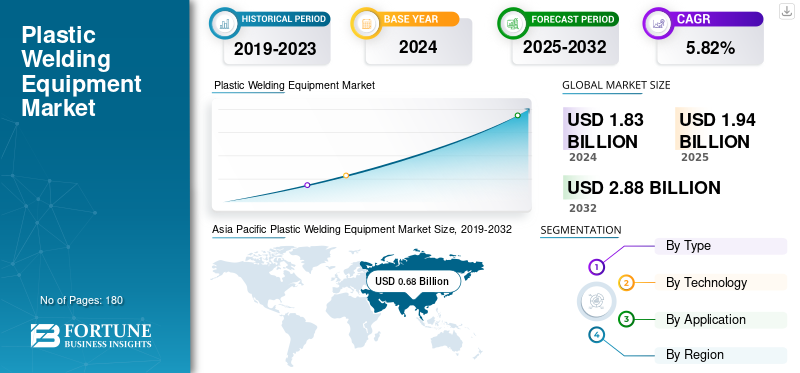
The global plastic welding equipment market size was valued at USD 1.94 billion in 2025. The market is projected to grow from USD 2.06 billion in 2026 to USD 3.21 billion by 2034, exhibiting a CAGR of 5.70% during the forecast period. Asia Pacific dominated the plastic welding equipment market with a market share of 37.40% in 2025.
Plastic welding equipment are tools and machines that use heat and pressure to chemically join compatible thermoplastic materials, thus resulting in a strong, permanent molecular bond. Such equipment encompasses machines such as hot air welders, ultrasonic welders, and hot plate welders, which heat the plastic to a pliable state before, subsequently welding the pieces and finally cooling them to complete the weld.
The market has become increasingly prosperous over the last few years as a result of the demand for the lighter and more efficient materials coming from the sectors of automotive, electronics, and packaging. The need for precise, automated joining technologies is another major factor behind this market growth. Pivotal factors are the expansion of the automotive industry, notably with the upsurge of electric vehicles (EVs) and the rising adoption of advanced welding technologies such as ultrasonic and laser welding.
The top firms in the industry are Leister AG, Dukane Corp., Emerson Electric Co., Miller Weldmaster, and BAK Technology AG.
Download Free sample to learn more about this report.
PLASTIC WELDING EQUIPMENT MARKET KEY TAKEAWAYS
 Global Market Size & Forecast
- 2025 Market Size: USD 1.94 billion
- 2026 Market Size: USD 2.06 billion
- 2034 Forecast Market Size: USD 3.21 billion
- CAGR: 5.70% from 2026–2034
 Market Share
- Asia Pacific dominated the plastic welding equipment market with a market share of 37.40% in 2025.
- The automatic segment held the largest revenue share of USD 1.07 billion in the overall global market in the year 2026.
- The ultrasonic welding segment is expected to account for 39.32% of the market in 2026.
 Key Regional Highlights
North America
North America accounted for 27.30% of the global market in 2025.
Europe
Europe held 24.70% market share in 2025.
Asia Pacific
Asia Pacific dominated the market with 37.40% share in 2025.
U.S.
The U.S. market is projected to reach USD 0.40 billion by 2026.
Japan
Japan market is projected to reach USD 0.07 billion by 2026.
Read More

MARKET DYNAMICS
Market Drivers
Rising Demand for Lightweight and Sustainable Manufacturing Solutions Drives Market Growth
The increase in the application of lightweight plastic parts in the automotive and aerospace industries is contributing greatly to the need to have advanced plastic welding technologies. As an example, the U.S. Department of Transportation estimates that plastic components will be used in vehicles 40% more by 2030, with greater attention to the necessity of effective joining techniques. Also, the sustainability policies such as the EU Green Deal and Japan’s Green Growth Strategy are promoting energy-efficient and recyclable manufacturing techniques, and manufacturers are forced to use ultrasonic and laser welding machines that produce least waste and use less energy.
Market Restraints
High Capital Costs and Skill Gaps Hinder Market Growth
The adoption of modern plastic welding systems is restrained by high initial costs of installation and a lack of skilled personnel. Sophisticated equipment such as laser and vibration welding machines may cost more than USD 100,000 per unit, which is expensive for small and medium enterprises. Furthermore, the International Labour Organization (ILO) reports that there is a growing shortage of skilled workers in advanced manufacturing making it difficult to properly use and maintain these machineries.
Market Opportunities
Increasing Industrialization and Automation in Developing Economies to Open Up Growth Opportunities
The emerging economies are experiencing a high rate of industrialization and automation, which results in increased demand for plastic welding equipment. For example, the India’s “Make in India” initiative and China’s “Made in China 2025” policy is speeding up the process of manufacturing modernization, which has increased the need to use automated welding equipment in the automotive, electronics, and packaging industry segments. Moreover, online retail sales in the Asia Pacific region and the online retail sector in general are projected to boom to over USD 3 trillion by 2027, as stated by UNCTAD. This is bound to further boost the use of precision welding equipment in packaging and other logistics applications.
PLASTIC WELDING EQUIPMENT MARKET TRENDS
Rising Automation and Precision in Plastic Welding Emerges as a Major Market Trend
Automated and high-precision welding systems are become the focus of the market as Industry 4.0 is adopted, and the population demands products of consistent quality. Robotic ultrasonic and laser welding devices are being integrated into companies to facilitate speed and precision. For example, ABB and FANUC have increased robotic welding plants in Asia and Europe, while Deloitte (2024) noted that more than 60% of manufacturers intend to boost automation investment by 2026 to enhance operational effectiveness.
Download Free sample to learn more about this report.
SEGMENTATION ANALYSIS
By Type
Growing Adoption of Industry 4.0 Technologies Drives the Growth of Automatic Segment
Based on the type, the market is segmented into automatic, semi-automatic, and manual.
The automatic segment held the largest revenue share of USD 1.07 billion in the overall global market in the year 2026. The segment is expected to lead the market, contributing 59.71% globally in 2026. The segment’s growth is attributable to the expanding automation of manufacturing lines across automotive, electronics, and packaging industries, where consistent weld quality and production efficiency are crucial. These systems reduce human error, improve process repeatability, and enable high-speed operations that meet modern throughput demands. The growth is also backed by growing adoption of Industry 4.0 technologies.
By Technology
Ultrasonic Welding Segment Leads Market Owing to Its Proven Reliability and Speed Across High-Volume Applications
Based on technology, the market is divided into ultrasonic welding, vibration welding, laser welding, infrared welding, spin welding, hot plate welding, and others.
The ultrasonic welding segment is expected to account for 39.32% of the market in 2026. The ultrasonic welding segment leads with a market share of USD 0.71 billion. The segment’s growth is attributable to its proven reliability and speed across high-volume applications including automotive assemblies, consumer electronics and medical device components. It also offers benefits such as low cycle times, minimal part fixturing, and compatibility with a wide range of thermoplastics which is of great use to manufacturers seeking consistent joint strength and high-throughput production.
Laser welding has the highest CAGR of 7.1% in the global market. The growth is due to rising demand for precision, cosmetic-quality joins and non-contact processing in medical devices, micro-electronics and advanced automotive. The improvements in laser sources and beam delivery systems, greater integration with robotics and vision systems, and declining equipment costs are speeding up the adoption in areas, particularly where tight tolerances, clean welds and minimal thermal distortion are crucial.
To know how our report can help streamline your business, Speak to Analyst
By Application
Demand for Welded Plastic Components Augments the Automotive Segment Growth
Based on the application, the market is divided into automotive, electronics & electrical, packaging, medical devices, consumer goods, and others.
In 2026, the automotive segment is projected to lead the market with a 37.11% share. The automotive segment was the major contributor to the plastic welding equipment market share with USD 0.68 billion in 2026. The segment’s growth is attributable to the large and sustained demand for welded plastic components such as dashboards, bumpers, lighting housings, air-intake parts and battery-system enclosures in EVs, where durability, dimensional accuracy and repeatable cycle times are essential. High production volumes and increasing use of engineered thermoplastics push OEMs and Tier-1s to standardize on automated welding solutions and validated process regimes, creating a large installed base and steady replacement/upgrade cycles.
Electronics & electrical accounts for the highest CAGR of 6.6% in the global market. The segment’s growth is a result of rapid product miniaturization, increased use of plastic enclosures and connectors, and strict aesthetic and functional requirements for consumer electronics, telecoms and industrial electronics. Manufacturers are inclined toward technologies which deliver them the required precision, minimal heat-affected zones and faster cycle times, and along with this, they are also increasingly taking steps toward automation, cleanroom-compatible systems and inline quality inspection.
PLASTIC WELDING EQUIPMENT MARKET REGIONAL OUTLOOK
Geographically the market is segmented into North America, Europe, Asia Pacific, South America and Middle East & Africa.
North America
Asia Pacific Plastic Welding Equipment Market Size, 2021-2034 (USD Billion)
To get more information on the regional analysis of this market, Download Free sample
North America contributed 27.30% to the global market in 2025, with a valuation of USD 0.53 Billion, and is projected to reach USD 0.56 Billion in 2026. The region’s growth is attributable to the incorporation of advanced technologies such as ultrasonic and laser welding, a shift toward lightweight plastics, and automation across automotive, packaging, and electronics industries.
The U.S. market is projected to reach USD 0.4 billion by 2026. This growth is due to strong demand from the automotive, aerospace, and electronics sectors, increasing production of electric vehicles, and the adoption of advanced technologies such as ultrasonic and laser welding.
Europe
Europe accounted for USD 0.48 Billion in 2025, representing 24.70% of the global market share, and is projected to reach USD 0.51 Billion in 2026. The expansion is due to stringent environmental regulations, the drive toward sustainability, and high demand from the automotive and electronics industries.
The U.K., Germany and Italy are some of the leading contributors to the growth in the market. The UK market is projected to reach USD 0.1 billion by 2026, and the Germany market is projected to reach USD 0.16 billion by 2026.
Asia Pacific
The Asia Pacific market was valued at USD 0.72 Billion in 2025, capturing 37.40% of global revenue, and is estimated to reach USD 0.77 Billion in 2026. This development is associated with the robust manufacturing ecosystem that the region has to offer in the automotive, electronics, and medical devices industries, as well as large-scale production capacity from countries such as China, Japan, South Korea, and India. The demand for high-precision, automated plastic welding systems is sustained by rapid industrialization, growing inclination toward automation, and government-imposed initiatives to encourage advanced manufacturing. All of this, paired with the need for high volume production, evolving EV and electronics industries, and to remain updated with technologies makes the Asia Pacific the largest growing regional marketplace.
The Japan market is projected to reach USD 0.07 billion by 2026, the China market is projected to reach USD 0.34 billion by 2026, and the India market is projected to reach USD 0.12 billion by 2026.
South America and Middle East & Africa
The markets of South America and Middle East & Africa are growing with an expected share of USD 0.11 billion and USD 0.09 billion respectively in 2025 due to industrial expansion in sectors such as automotive, packaging, and construction.
GCC countries are predicted to have a market share of USD 0.04 billion by 2025.
Latin America
In 2025, the Latin America market stood at USD 0.11 Billion, representing 5.80% of global demand, and is projected to grow to USD 0.12 Billion in 2026.
COMPETITIVE LANDSCAPE
Key Industry Players
Top Firms Leverage their Strong Distribution Networks to Lead in the Industry
The top firms in the industry are Leister AG, Dukane Corp., Emerson Electric Co., Miller Weldmaster, and BAK Technology AG. These firms employ several strategies to stay competitive. A primary strategy is utilizing cutting-edge technologies such as AI and automation to enhance precision, efficiency, and real-time monitoring. Companies also invest heavily in research and development to create energy-efficient and eco-friendly products. Additionally, many focus on expanding their product portfolios, using strong distribution networks, and implementing customer-centric models to capture market share.
LIST OF KEY PLASTIC WELDING EQUIPMENT COMPANIES PROFILED
- Leister AG (Switzerland)
- Dukane Corp. (U.S.)
- Emerson Electric Co. (U.S.)
- Miller Weldmaster (U.S.)
- BAK Technology AG (Switzerland)
- Herrmann Ultraschall (Germany)
- LPKF Laser & Electronics (Germany)
- MUNSCH Kunststoff-Schweißtechnik GmbH (Germany)
- Johnson Plastosonic (P) Ltd (India)
- Bortte (China)
- KING ULTRASONIC CO., LTD (Taiwan)
- Seelye Acquisitions, Inc. (U.S.)
KEY INDUSTRY DEVELOPMENTS
- June 2025- LPKF Laser and Electronics announced the launch of TherMoPro, an advanced thermographic analysis system. TherMoPro has the capability to transform thermal data into actionable insights for laser plastic welding applications.
- January 2025- ProWeld Tools Inc., Escondido, Calif., announced the launch of the MavWeld brand of welding tools and equipment. MavWeld will operate both as an OEM of welding tooling and as an online reseller of welding tools and machines.
- May 2025- Polyvance, a top provider of automotive plastic repair solutions headquartered in Rainsville, Alabama, announced a new partnership with Titanium Equipment, Canada-based firm. This partnership combines Polyvance’s advanced plastic welding technologies with Titanium Equipment's extensive network and expertise in the Canadian automotive and industrial equipment market.
- November 2024- C-Hawk Technology, a global leader in the manufacturing of components, assemblies and processes for the semiconductor and healthcare industries, announced its new patent-pending Roberto™ platform, an integrated robotics system that automates plastic welding and sets new benchmarks for quality, precision, scalability and safety in manufacturing for plastic welded assemblies and subassemblies.
- October 2024- Polyvance has announced the launch of its newest nitrogen plastic welder, the Nitro-Fuzer Touch. The Nitro-Fuzer Touch features a large touchscreen that simplifies welding with easy control functions, including temperature and gas flow.
- April 2023- Vonco Products LLC, an industry-leading risk-free plastic products and packaging manufacturer, announced the acquisition of Genesis Plastics Welding, marking the company’s third acquisition in as many years.
REPORT COVERAGE
The global report provides a detailed analysis of the market and focuses on key aspects such as prominent companies, deployment modes, types, and end users of the product. Besides this, it offers insights into the plastic welding equipment market trends and highlights key industry developments and market share analysis for key companies. In addition to the aforementioned factors, the report encompasses several factors that have contributed to the growth of the market over recent years.
Request for Customization to gain extensive market insights.
Report Scope & Segmentation
| ATTRIBUTE | DETAILS |
| Study Period | 2021-2034 |
| Base Year | 2025 |
| Estimated Year | 2026 |
| Forecast Period | 2026-2034 |
| Growth Rate | CAGR of 5.70% from 2026-2034 |
| Historical Period | 2021-2024 |
| Unit | Value (USD Billion) |
| Segmentation |
By Type
By Technology
By Application
By Region
|
Frequently Asked Questions
Fortune Business Insights says that the global market stood at USD 1.94 billion in 2025 and is projected to reach USD 3.21 billion by 2034.
The market is expected to exhibit steady growth at a CAGR of 5.70% during the forecast period.
Rising focus on circular economy is speeding up the market growth.
Leister AG, Dukane Corp., Emerson Electric Co., Miller Weldmaster, and BAK Technology AG. are some of the top players in the market.
The Asia Pacific region held the largest market share.
Asia Pacific dominated the plastic welding equipment market with a market share of 37.40% in 2025.



- 2021-2034
- 2025
- 2021-2024
- 180
Get 30-60 hrs Free Customization
Expand Regional and Country Coverage, Segments Analysis, Company Profiles, Competitive Benchmarking, and End-user Insights.














-
US +1 833 909 2966 ( Toll Free )
-
Get In Touch With Us