Polybutadiene Rubber Market Size, Share & Industry Analysis, By Application (Tire, Non-tire Automotive, Industrial Rubber Goods, Footwear, and Others), and Regional Forecast, 2026-2034
 Download Free Sample
KEY MARKET INSIGHTS
 Listen to Audio Version
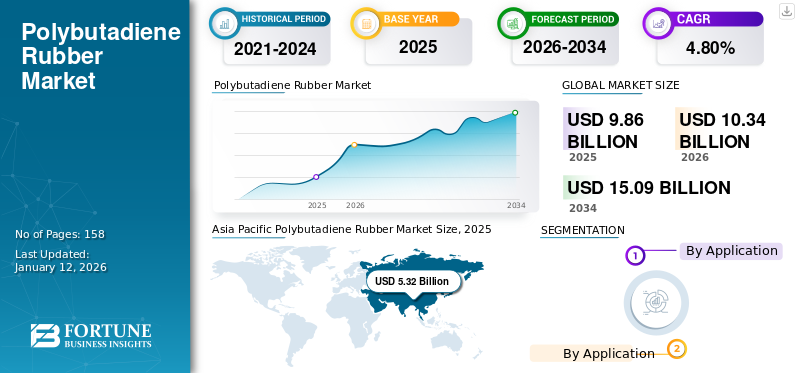
The global polybutadiene rubber market size was valued at USD 9.86 billion in 2025 and is projected to grow from USD 10.34 billion in 2026 to USD 15.09 billion by 2034, exhibiting a CAGR of 4.8% during the forecast period. Asia Pacific dominated the polybutadiene rubber market with a market share of 54% in 2025.
Polybutadiene rubber (PBR), also known as butadiene rubber (BR), is a synthetic rubber produced through the polymerization of 1,3-butadiene, a monomer derived from petroleum. It belongs to the class of elastomers and is characterized by high resilience, excellent abrasion resistance, low glass transition temperature, and high elasticity, allowing it to return to its original shape after deformation.
The increased demand for tires in the automotive sector is expected to drive the growth of the polybutadiene rubber market. The product demand is favored for its superior properties, such as excellent abrasion resistance, low rolling resistance, and high resilience, which enhance tire performance and durability.
Major companies operating in the market include ARLANXEO, Indian Oil Corporation Ltd, Reliance Industries Limited, ENEOS Materials Corporation, Goodyear Tire and Rubber Company, and SIBUR International GmbH.
Download Free sample to learn more about this report.
Polybutadiene Rubber Market Key Takeaways
 Market Size & Forecast
- 2025 Market Size: USD 9.86 billion
- 2026 Market Size: USD 10.34 billion
- 2034 Forecast Market Size: USD 15.09 billion
- CAGR: 4.8% from 2026–2034
 Market Share
- Asia Pacific dominated the polybutadiene rubber market with a 54.00% share in 2025.
- The tire segment accounted for the largest market share in 2025.
- Non-tire automotive applications are witnessing steady growth, driven by demand for durable rubber components.
 Key Regional Highlights
Asia Pacific
Asia Pacific reached USD 5.32 billion in 2025 and is projected to grow to USD 5.62 billion in 2026.
North America
North America accounted for USD 1.64 billion in 2025 and is projected to reach USD 1.70 billion in 2026.
Europe
Europe generated USD 2.40 billion in 2025 and is expected to reach USD 2.49 billion in 2026.
U.S.
Strong automotive manufacturing continues to support demand for high-performance polybutadiene rubber.
Japan
Automotive production and tire manufacturing sustain steady demand for polybutadiene rubber.
Read More

MARKET DYNAMICS
POLYBUTADIENE RUBBER MARKET TRENDS
Shift Toward Eco-Friendly Materials to Propel Product Demand
The rising trend towards the adoption of sustainable and eco-friendly materials is significantly influencing the polybutadiene rubber market growth. Manufacturers are increasingly exploring bio-based polybutadiene and recycling options to comply with environmental regulations and address shifting consumer preferences. Growing public awareness and preference for eco-friendly products are compelling manufacturers to innovate and incorporate sustainable practices into their production processes. As a result, the demand for eco-conscious polybutadiene rubber products is on the rise.
MARKET DRIVERS
Growing Adoption of Polybutadiene Rubber in Construction & Infrastructure Sectors to Drive Market Growth
The polybutadiene rubber adoption in the construction and infrastructure sectors is on the rise, driven by its exceptional properties and rising demand for durable materials across various applications. The product is known for its flexibility, resilience, and resistance to weathering, making it an ideal choice for construction applications. These properties allow PBR to perform well in challenging environments, ensuring longevity and reliability in construction components.
The rising number of infrastructure projects, such as road construction and the expansion of transportation networks, is significantly boosting the adoption of polybutadiene rubber. Its use in conveyor systems and other structural materials is becoming increasingly common as global infrastructure development accelerates.
- The National Action Plans on Business and Human Rights Association indicates that the global construction industry is expected to increase by USD 4.5 trillion, reaching a total of USD 15.2 trillion in the coming years, with the U.S., India, China, and Indonesia accounting for 58.3% of this projected growth. Emphasizing sustainable and ethical construction practices, through the use of innovative products and solutions is essential for meeting Sustainable Development Goals (SDGs) 9 and 11, which target resilient infrastructure, inclusive industrialization, and the development of sustainable cities and communities.
MARKET RESTRAINTS
Health Concerns Regarding Exposure to Polybutadiene May Restrain Market Growth
The market faces potential restraints due to health concerns associated with exposure to this synthetic rubber. Exposure to polybutadiene can lead to various health issues. At high levels, it may cause irritation to the eyes, nasal passages, throat, and lungs. In more severe cases, individuals may experience neurological symptoms such as blurred vision, fatigue, headache, and vertigo. These potential health risks are raising concerns among workers in manufacturing and processing environments, potentially leading to stricter regulations.
MARKET OPPORTUNITIES
Increasing Use in Consumer Products to Create Growth Opportunities
The growing adoption of polybutadiene rubber in consumer products presents significant opportunities for market expansion. The butadiene rubber is increasingly being utilized in a variety of consumer products due to its excellent properties, such as high resilience, abrasion resistance, and low rolling resistance. These characteristics make it ideal for applications in footwear, sports equipment, and various industrial rubber products. For instance, its absorption capabilities enhance the performance of items such as golf balls and athletic shoes, making them more appealing to consumers.
MARKET CHALLENGES
Stringent Environmental Regulations to Challenge Market Growth
Increasingly stringent environmental regulations are compelling manufacturers to invest in compliance measures. These regulations often mandate the adoption of cleaner production technologies and strict control of emissions in the manufacturing of butadiene rubber. This can lead to increased operational costs and may deter new entrants into the market, thereby slowing growth. Such factor reduces the polybutadiene rubber market share.
Concerns regarding the environmental impact of polybutadiene production are becoming more pronounced. The production process can generate hazardous waste and emissions, prompting regulatory bodies to impose stricter guidelines. This affects existing manufacturers and creates barriers for potential new players in the market.
TRADE PROTECTIONISM
Trade protectionism often takes the form of tariffs and import restrictions on foreign-produced products. These measures can increase the cost of imported materials, making domestic products more competitive. While this can benefit local manufacturers, it may also lead to higher prices for consumers and reduced availability of certain grades of polybutadiene rubber.
Download Free sample to learn more about this report.
Segmentation Analysis
By Application
Tire Segment Leads the Market due to Soaring Demand for High-Quality Tires
Based on application, the market is classified into tire, non-tire automotive, industrial rubber goods, footwear, and others.
The tire segment dominates the market, accounting for a leading share of the market. PBR is favored in tire production due to its excellent abrasion resistance, low rolling resistance, and high resilience, properties that enhance tire performance and durability. This segment is expected to maintain its lead in the market as global automotive production and demand for tires grow.
The product is also utilized in various non-tire automotive applications, such as seals, gaskets, and other rubber parts that require flexibility and long-term durability. The increasing focus on automotive innovation and the demand for high-performance materials in vehicles are driving growth in the segment.
PBR finds application in the footwear industry, particularly in the production of soles and components that benefit from its flexibility and comfort. The growing trend toward high-performance athletic footwear is likely to drive further growth in this segment.
Polybutadiene Rubber Market Regional Outlook
By geography, the market is categorized into North America, Europe, Asia Pacific, Latin America, and Middle East & Africa.
Asia Pacific
Asia Pacific Polybutadiene Rubber Market Size, 2025 (USD Billion)
To get more information on the regional analysis of this market, Download Free sample
The Asia Pacific market was valued at USD 5.32 billion in 2025, capturing 54.00% of global revenue, and is estimated to reach USD 5.62 billion in 2026, driven by a robust industrial and automotive manufacturing base in countries such as China, India, and Japan. Rapid urbanization and increasing demand for automotive tires are key factors contributing to the region’s dominance. The market is expected to continue expanding, supported by rising production capacities and investments in infrastructure.
North America
North America contributed 17.00% to the global market in 2025, with a valuation of USD 1.64 billion, and is projected to reach USD 1.7 billion in 2026. In North America, particularly the U.S., features a strong automotive industry that fuels the demand for high-performance tires and industrial rubber goods. However, polybutadiene rubber market growth in the regional market may face challenges from stringent environmental regulations and competition from alternative materials.
Europe
Europe accounted for USD 2.4 billion in 2025, representing 24.00% of the global market share, and is projected to reach USD 2.49 billion in 2026. Europe is experiencing positive growth in the market, with a strong focus on innovation and sustainability. The automotive sector, along with various industrial applications, plays a crucial role in driving demand. European manufacturers are increasingly adopting eco-friendly practices, which may influence the types of polybutadiene rubber products developed and marketed.
Middle East & Africa
The market in Middle East & Africa reached USD 0.37 billion in 2025, representing 4.00% of total market revenue, and is projected to reach USD 0.39 billion in 2026. The Middle East and Africa region is witnessing gradual growth in the market, primarily due to increasing industrial activities and infrastructure development. However, the market is still in its nascent stages compared to other regions and faces challenges such as economic and logistical challenges.
Latin America
In 2025, the Latin America market stood at USD 0.13 billion, representing 1.00% of global demand, and is projected to grow to USD 0.14 billion in 2026. Latin America’s PBR market is growing, though at a slower pace compared to other regions. The demand is primarily driven by the automotive and industrial sectors. Economic fluctuations and political instability in some countries may pose challenges to market growth in this region.
COMPETITIVE LANDSCAPE
Key Industry Players
Key Companies Capacity Expansion to Strengthen their Positions in the Market
The polybutadiene rubber market is highly competitive, with major players focusing on capacity expansion, sustainability initiatives, and mergers & acquisitions to strengthen their market presence. Key global companies include Indian Synthetic Rubber Private Limited, Apcotex Industries Limited, Reliance Industries Limited, Sinopec, and Goodyear Tire and Rubber Company. While global leaders dominate in developed markets, regional players are expanding aggressively in emerging economies, intensifying competition and reshaping the industry landscape.
LIST OF KEY POLYBUTADIENE RUBBER COMPANIES PROFILED
- ARLANXEO (Netherlands)
- Indian Oil Corporation Ltd (India)
- Reliance Industries Limited (India)
- ENEOS Materials Corporation (Japan)
- Goodyear Tire and Rubber Company (U.S.)
- SIBUR International GmbH (Austria)
- LANXESS (Germany)
- KURARAY CO., LTD. (Japan)
- JSR Corporation (Japan)
- Kumho Petrochemical (South Korea)
KEY INDUSTRY DEVELOPMENTS
- February 2023: Arlanxeo announced the launch of a polybutadiene rubber production facility with a capacity of 65 ktpa in southern Brazil. Located within the Triunfo petrochemical complex in Rio Grande do Sul, this new plant emphasizes the company's commitment to enhancing its presence in Latin America.
- March 2022: Indian Oil Corporation Limited planned to build a 60 ktpa polybutadiene rubber (PBR) facility at the current naphtha cracker complex located in Panipat. The project involves an investment of INR 14.6 billion (USD 169 million). It plans to obtain the necessary feedstock, butadiene, from the 138 ktpa butadiene extraction unit (BDEU) already operating within the Panipat complex.
- February 2019: SIBUR initiated an investment project focused on improving the efficiency of polybutadiene rubber (Nd-BR) production at its Voronezh plant (Voronezhsintezkauchuk). The goal of the project is to implement a comprehensive upgrade that enhances the operational efficiency of the current facility and guarantees the consistent production of high-quality products. This initiative will allow SIBUR to manufacture superior products while increasing operational efficiency.
REPORT COVERAGE
The global polybutadiene rubber market analysis provides market size and forecasts for all segments included in the report. It includes details on the market dynamics and emerging market trends. It offers information on key regions, key industry developments, new product launches, details on partnerships, and mergers & acquisitions. The report covers a detailed competitive landscape with information on the market share and profiles of key players.
Request for Customization to gain extensive market insights.
Report Scope & Segmentation
|
ATTRIBUTE |
DETAILS |
|
Study Period |
2021-2034 |
|
Base Year |
2025 |
|
Estimated Year |
2026 |
|
Forecast Period |
2026-2034 |
|
Historical Period |
2021-2024 |
|
Growth Rate |
CAGR of 4.8% from 2026-2034 |
|
Unit |
Value (USD Billion) Volume (Kiloton) |
|
Segmentation |
By Application
|
|
By Region
|
Frequently Asked Questions
Fortune Business Insights says that the global market value stood at USD 10.34 billion in 2026 and is projected to reach USD 15.09 billion by 2034.
In 2025, the market value stood at USD 9.86 billion.
The market is expected to exhibit a CAGR of 4.8% during the forecast period.
By type, the tire segment led the market.
Rapid automotive industry development is a key factor driving the market.
ARLANXEO, Indian Oil Corporation Ltd, Reliance Industries Limited, ENEOS Materials Corporation, Goodyear Tire and Rubber Company, and SIBUR International GmbH are some of the leading players in the market.
Asia Pacific dominated the market in 2025.
Increasing construction activities and rapid infrastructure development are some of the major factors that are expected to favor product adoption.



- 2021-2034
- 2025
- 2021-2024
- 158
Get 30-60 hrs Free Customization
Expand Regional and Country Coverage, Segments Analysis, Company Profiles, Competitive Benchmarking, and End-user Insights.


















Related Reports
-
US +1 833 909 2966 ( Toll Free )
-
Get In Touch With Us