Polytetramethylene Ether Glycol Market Size, Share & Industry Analysis, By Molecular Weight Grades (Low Molecular Weight PTMEG (≤1000), Medium Molecular Weight PTMEG (1000–2000), and High Molecular Weight PTMEG (>2000)), By Application (Spandex, Thermoplastic Urethane Elastomers, Co-polyester Ether Elastomers, and Others), By End-Use Industry (Coatings, Construction, Textiles, Automotive, and Others), and Regional Forecast, 2026-2034
 Download Free Sample
Polytetramethylene Ether Glycol Market Size and Future Outlook
 Listen to Audio Version
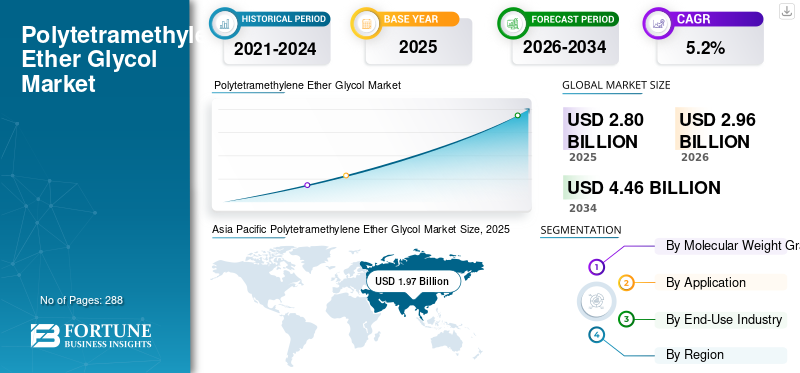
The polytetramethylene ether glycol market size was valued at USD 2.80 billion in 2025 and is projected to grow from USD 2.96 billion in 2026 to USD 4.46 billion by 2034, exhibiting a CAGR of 5.2% during the forecast period. Asia Pacific dominated the polytetramethylene ether glycol market with a market share of 70.36% in 2025.
Polytetramethylene ether glycol (PTMEG) is an important specialty chemical used in the production of spandex fibers, thermoplastic polyurethanes, polyurethane elastomers, and other elastic materials. Its demand is closely tied to textiles, sportswear, footwear, automotive parts, industrial hoses, films, and performance products that require flexibility, strength, durability, and comfort. The market benefits from steady use of stretch fabrics and high-performance polymers, especially in apparel, mobility, and industrial applications. Globally, growth is supported by rising demand for lightweight, durable, and flexible materials across premium consumer and technical end-use segments. Demand remains more value-driven than large-volume commodity growth.
The market is dominated by a small group of integrated chemical producers with large-scale manufacturing assets and established process technologies. Major players such as BASF, Mitsubishi Chemical, Dairen Chemical Corporation (DCC), Hyosung, and China Petrochemical Corporation, and regional producers, focus on stable PTMEG supply, product quality, feedstock integration, and long-term customer relationships. As a result, the market remains moderately consolidated, supported by steady demand, high entry barriers, and controlled capacity.
Download Free sample to learn more about this report.
Polytetramethylene Ether Glycol Market KEY TAKEAWAYS
 Global Market Size & Forecast
- 2025 Market Size: USD 2.80 billion
- 2026 Market Size: USD 2.96 billion
- 2034 Forecast Market Size: USD 4.46 billion
- CAGR: 5.2% during 2026–2034
 Market Share
- Asia Pacific dominated the global market with a 70.36% share in 2025.
- Medium-Molecular-Weight PTMEG (≤1000) accounted for a major market share in 2025.
- Spandex Accounted for a major application share in 2025.
 Key Regional Highlights
Asia Pacific
Dominated the market with a valuation of USD 1.97 billion in 2025 and is expected to reach USD 2.09 billion in 2026.
North America
Reached USD 0.24 billion in 2025, supported by established demand for spandex.
Europe
Reached USD 0.36 billion in 2025, with demand supported by technical textiles, automotive, footwear.
U.S.
The market reached USD 0.21 billion in 2025, representing approximately 87.3% of North American revenues.
Japan
The market is supported by Japan's established textile, automotive, footwear.
Read More

POLYTETRAMETHYLENE ETHER GLYCOL MARKET TRENDS
Growing Use of PTMEG in High-Performance Elastomers Is Shaping the Market
A key trend in the PTMEG market is its increasing use in high-performance elastomers and specialty polyurethane materials. PTMEG is widely used in spandex fibers, thermoplastic polyurethanes, polyurethane elastomers, coatings, sealants, and copolyester elastomers due to its flexibility, strength, abrasion resistance, and durability. As industries such as textiles, footwear, automotive, and industrial manufacturing require materials with better comfort and longer service life, producers are focusing on the development of consistent and application-specific PTMEG grades tailored to end-user requirements.
- According to the Press Information Bureau, India aims to take its technical textiles market to USD 40 billion by 2025–26, supporting demand for high-performance textile materials and PTMEG-based applications.
MARKET DYNAMICS
MARKET DRIVERS
Download Free sample to learn more about this report.
Rising Demand for Spandex/Elastane Fibers Driving the Growth of the PTMEG Market
The growing use of spandex and elastane fibers across apparel, sportswear, activewear, innerwear, medical textiles, and industrial applications mainly drives polytetramethylene ether glycol demand. These fibers are widely preferred for their high stretchability, flexibility, comfort, and durability, making them an important component in both everyday apparel and high-performance-based textile products. The rising adoption of stretch fabrics in fitness wear, compression garments, footwear, and technical textiles is creating steady demand for PTMEG, as higher spandex production directly increases the consumption of PTMEG-based raw materials.
- According to the Press Information Bureau (PIB), India’s textile and apparel production reached USD 175.7 billion, supporting demand for spandex fibers and PTMEG-based materials.
MARKET RESTRAINTS
Volatility in Raw Material Prices Restraining the Growth of the PTMEG Market
The polytetramethylene ether glycol market growth is restrained by price volatility in key raw materials, especially tetrahydrofuran and 1,4-butanediol, which are closely linked to petrochemical feedstock costs. Fluctuations in crude oil, natural gas, refinery operations, transportation costs, and raw material availability can increase PTMEG production costs. Since PTMEG is mainly used in spandex, thermoplastic polyurethanes, and polyurethane elastomers, higher raw material prices can raise downstream manufacturing costs and reduce purchasing flexibility among end users. This creates margin pressure across the value chain and makes the market vulnerable to feedstock price instability.
MARKET OPPORTUNITIES
Development of Bio-Based and Sustainable PTMEG Creating Opportunities for Market Growth
The polytetramethylene ether glycol market is expected to benefit from the growing shift toward bio-based and sustainable polymer raw materials. Rising environmental concerns, stricter sustainability regulations, and increasing demand for low-carbon materials are encouraging manufacturers to develop PTMEG derived from renewable feedstocks, such as bio-based butanediol and sustainable tetrahydrofuran. These alternatives can help reduce dependence on petroleum-based raw materials while supporting the sustainability goals of spandex, TPU, footwear, automotive, and polyurethane manufacturers. As global brands focus on the circular economy, lower carbon footprint, and greener material sourcing, bio-based PTMEG creates new growth opportunities across the value chain.
- According to the U.S. Department of Agriculture, the use of biobased products displaced 10.7 million barrels of oil equivalents in 2021, supporting the shift toward renewable raw materials such as bio-based PTMEG.
MARKET CHALLENGES
Strong Dependence on Spandex Creates Supply-Demand Challenges
Polytetramethylene ether glycol producers face a key challenge due to the market’s strong dependence on spandex and elastic fiber production. Since PTMEG is widely used in spandex manufacturing, any slowdown in textile demand, apparel production, or stretch fabric consumption can directly affect PTMEG demand. At the same time, capacity expansions can create pressure if downstream demand does not grow at the same pace. As a result, effective supply planning, inventory management, and long-term customer relationships are important to maintaining market stability and supporting sustained growth within the PTMEG industry.
Segmentation Analysis
By Molecular Weight Grades
Medium Molecular Weight PTMEG (≤1000) Led Due to Its Broad Use in Spandex and Polyurethane Applications
Based on molecular weight grades, the market is segmented into low molecular weight PTMEG (≤1000), medium molecular weight PTMEG (1000–2000), and high molecular weight PTMEG (>2000).
The medium-molecular-weight PTMEG (≤1000) segment accounted for a major polytetramethylene ether glycol market share in 2025. Medium molecular weight grades are widely used in spandex fibers, thermoplastic polyurethanes, and polyurethane elastomers as they offer a balanced combination of flexibility, strength, elasticity, and processability. These properties make them suitable for stretch fabrics, footwear, automotive components, films, hoses, and other performance materials. As demand for elastic, durable, and lightweight materials continues to grow, medium molecular weight PTMEG remains the most preferred grade across major downstream industries.
The high molecular weight PTMEG (>2000) segment is expected to grow at a CAGR of 5.5% over the forecast period. Demand for High-molecular-weight PTMEG is mainly driven by premium elastomer and high-performance polyurethane applications that require superior elastic recovery, softness, dynamic mechanical performance, low-temperature flexibility, and durability. These grades are preferred in advanced TPU, cast polyurethane elastomers, engineered components, wheels, industrial belts, automotive hoses, gaskets, and high-performance footwear or sports goods. Growth in this segment is also supported by the increasing use of durable elastomeric materials in automotive, industrial, consumer goods, and specialty engineering applications.
By Application
Spandex Segment Dominated Due to Rising Demand for Stretchable and Lightweight Fabrics
Based on application, the market is segmented into spandex, thermoplastic urethane elastomers, co-polyester ether elastomers, and others.
The spandex segment accounted for a major share of the market in 2025. Spandex drives PTMEG consumption, as it is a key raw material that provides elasticity, flexibility, softness, and durability in stretch fibers. These fibers are widely used in sportswear, activewear, innerwear, compression garments, swimwear, medical textiles, and performance apparel. As demand for comfortable, stretchable, and lightweight fabrics continues to rise, spandex remains the most important application area for PTMEG, creating steady downstream demand across the textile and apparel industries.
To know how our report can help streamline your business, Speak to Analyst
The thermoplastic urethane elastomers segment is expected to grow at a CAGR of 5.0% over the forecast period. This segment represents a major non-spandex application for PTMEG. Demand is driven by the increasing use of flexible, abrasion-resistant, durable, and high-performance TPU materials in footwear, automotive parts, cables, films, hoses, consumer goods, electronics accessories, industrial components, and sports equipment. PTMEG-based TPU offers strong hydrolytic stability, elastic recovery, mechanical strength, and low-temperature performance, making it preferred in demanding applications where conventional polyols may not meet performance requirements.
By End-Use Industry
Growing Demand for Spandex and Stretch Fabrics Boosted Textiles Segment Growth
By end-use industry, the market is segmented into coatings, construction, textiles, automotive, and others.
The textiles segment accounted for the largest share in 2025. Textiles are the leading industry for PTMEG, as the material is widely used in the production of spandex fibers, which are essential for stretchable, comfortable, and durable fabrics. These fibers are used across sportswear, activewear, innerwear, swimwear, compression garments, and performance apparel. As consumer preference for flexible, lightweight clothing increases, textile manufacturers continue to use spandex-blended fabrics. This creates a strong downstream demand base for PTMEG and reinforces textiles as the most important end-use segment.
The automotive segment is expected to grow at a CAGR of 4.8% over the forecast period. Demand is driven by the growing use of high-performance elastomers, TPU, hoses, seals, gaskets, interior components, cable sheathing, films, and vibration-resistant parts. PTMEG-based elastomers are valued for their flexibility, abrasion resistance, hydrolytic stability, durability, and performance across a range of temperatures. The segment benefits from vehicle lightweighting, higher polymer content per vehicle, demand for durable interiors and under-the-hood elastomeric components, and the growth of electric vehicles, which require flexible cables, protective films, and engineered polymer systems.
The construction segment is driven by the use of PTMEG-based polyurethane systems in sealants, waterproofing materials, coatings, membranes, adhesives, flooring systems, and flexible elastomeric components. These applications benefit from PTMEG’s contributions to flexibility, durability, weather resistance, and resistance to hydrolysis and mechanical stress. Growth is supported by infrastructure development, repair and renovation activities, industrial flooring, demand for waterproofing, and the growing use of high-performance polyurethane sealants in building applications.
Polytetramethylene Ether Glycol Market Regional Outlook
By geography, the market is categorized into North America, Europe, Asia Pacific, South America, and the Middle East & Africa.
Asia Pacific
Asia Pacific Polytetramethylene Ether Glycol Market Size, 2025 (USD Billion)
To get more information on the regional analysis of this market, Download Free sample
Asia Pacific held the dominant position in 2025, valued at USD 1.97 billion, and is expected to retain its leading position in 2026, reaching USD 2.09 billion. The region’s leadership is driven by its strong textile and spandex manufacturing base, large-scale footwear production, and growing use of performance polyurethane materials. Robust demand from stretch fabrics, sportswear, activewear, automotive components, industrial elastomers, and thermoplastic polyurethanes supports sustained PTMEG consumption, particularly in high-volume textile and performance material applications.
China Polytetramethylene Ether Glycol Market
Based on Asia Pacific’s strong contribution and China’s large-scale textile and chemical manufacturing footprint, the China market reached USD 1.59 billion in 2025, accounting for approximately 80.7% of regional revenues. Demand is supported by strong spandex production, expanding use of stretch fabrics, footwear manufacturing, and growing consumption of thermoplastic polyurethanes and polyurethane elastomers across textile, automotive, and industrial applications in key end-use sectors.
India Polytetramethylene Ether Glycol Market
The Indian market stood at around USD 0.11 billion in 2025. Growth is supported by rising spandex consumption, expanding textile and apparel production, stronger demand for stretch fabrics, and increasing use of PTMEG-based polyurethane materials in footwear, automotive, and industrial applications across downstream sectors.
North America
North America remains a significant regional market, reaching USD 0.24 billion in 2025. Demand is supported by established consumption of spandex, thermoplastic polyurethanes, polyurethane elastomers, and performance materials across textiles, footwear, automotive, and industrial applications. The region benefits from advanced downstream processing, premium apparel demand, and the use of technical materials. At the same time, overall growth remains moderate due to mature manufacturing and stable replacement-led demand patterns across key end users.
U.S. Polytetramethylene Ether Glycol Market
The U.S. market reached USD 0.21 billion in 2025, representing approximately 87.3% of regional revenues. Demand is supported by spandex fibers, thermoplastic polyurethanes, polyurethane elastomers, and performance materials used in textiles, footwear, automotive components, and industrial products, where flexibility, durability, comfort, and abrasion resistance remain important functional requirements across advanced end-use applications.
Europe
Europe is expected to record modest growth over the forecast period. The market reached USD 0.36 billion in 2025. The established use of spandex fibers, thermoplastic polyurethanes, polyurethane elastomers, and specialty performance materials supports product demand. Strong demand from technical textiles, automotive, footwear, and industrial manufacturing supports consumption, while growth remains moderate due to mature end-use industries, high production costs, strict sustainability requirements, and cautious regional capacity investments.
Germany Polytetramethylene Ether Glycol Market
Germany’s market reached approximately USD 0.12 billion in 2025, equivalent to around 32.8% of regional revenues. Demand is supported by automotive manufacturing, technical textiles, footwear materials, and PTMEG-based thermoplastic polyurethanes and polyurethane elastomers used in high-performance applications.
U.K. Polytetramethylene Ether Glycol Market
The U.K. market stood at USD 0.05 billion in 2025, accounting for roughly 12.9% of regional revenues. Consumption is concentrated in technical textiles, performance apparel, footwear materials, and selected applications of PTMEG-based thermoplastic polyurethane and polyurethane elastomers.
South America and the Middle East & Africa
South America and the Middle East & Africa are expected to witness moderate growth during the forecast period. The South American market reached USD 0.09 billion in 2025, supported by rising textile consumption, footwear production, and the gradual use of PTMEG-based thermoplastic polyurethanes and elastomers in industrial applications. In the Middle East & Africa, demand is supported by growing textile imports, expanding apparel consumption, developing industrial activity, and the gradual expansion of downstream polymer processing capacity. The MEA market reached USD 0.15 billion in 2025, with growth remaining steady, although smaller than major producing regions due to limited local production capacity.
Saudi Arabia Polytetramethylene Ether Glycol Market
The Saudi Arabia market accounted for around USD 0.06 billion in 2025, representing approximately 38.5% of regional revenues. Demand is supported by apparel consumption, textile imports, industrial polymer applications, and the country’s role as a regional hub for chemical and polymer distribution.
COMPETITIVE LANDSCAPE
Key Industry Players
Leading Players Focus on Optimizing Existing Production Assets to Reinforce Their Market Position
The polytetramethylene ether glycol market is relatively consolidated and capital-intensive, as complex production technologies, high investment requirements, feedstock integration needs, and strict quality standards create significant barriers to entry. These factors limit easy participation and concentrate supply among a small group of global chemical producers with integrated operations and established process expertise.
Leading players such as BASF, Mitsubishi Chemical, Dairen Chemical Corporation (DCC), Hyosung Chemical, and China Petrochemical Corporation focus primarily on optimizing existing production assets and strengthening feedstock integration rather than pursuing aggressive capacity expansion. Recent industry developments highlight a strategic emphasis on stable supply, cost competitiveness, product quality, and gradual adoption of sustainable raw material practices to support long-term market growth and competitive positioning.
LIST OF KEY POLYTETRAMETHYLENE ETHER GLYCOL COMPANIES PROFILED
- BASF (Germany)
- LyondellBasell Industries Holdings B.V. (U.S.)
- Mitsubishi Chemical Group Corporation (Japan)
- HYOSUNG (Vietnam)
- Xinjiang Blue Ridge Tunhe Sci.&Tech. Co., Ltd. (China)
- China Petrochemical Corporation (China)
- Haizo Chemical (China)
- Dairen Chemical Corporation (DCC) (Taiwan)
- GO YEN CHEMICAL INDUSTRIAL CO LTD (Taiwan)
- Hangzhou Sanlong New Material Co., Ltd. (China)
KEY INDUSTRY DEVELOPMENTS
- November 2025: BASF announced the consolidation of its Asian PolyTHF business into its Caojing site in China and the discontinuation of PolyTHF production at its Ulsan site in South Korea. The move reflects efforts to optimize its production network and improve competitiveness in the PTMEG value chain.
- May 2024: Dairen Chemical Corporation joined The LYCRA Company and Qore in the development of renewable LYCRA fiber, signing a letter of intent to convert QIRA into low-impact PTMEG for bio-derived LYCRA fiber. The initiative highlights DCC’s strategic focus on sustainable PTMEG applications within the textile value chain.
- April 2024: Hyosung TNC received investment approval for its USD 1 billion Bio-BDO project in Vietnam. The Bio-BDO produced under the project would be used as a raw material for PTMG manufactured at the company’s Dong Nai factory, supporting upstream integration and the development of sustainable PTMG value-chains.
- October 2023: Mitsubishi Chemical Group strengthened its BioPTMG business by optimizing product composition and allocating product tanks at its Yokkaichi Plant, with plans to increase BioPTMG capacity to 3,000 tons/year, signaling capacity expansion for plant-derived PTMG.
- April 2022: Xinjiang Blue Ridge Tunhe Energy Co., Ltd. commenced its Phase II 46,000-ton/year PTMEG project alongside its Phase III 104,000-ton/year BDO project, signaling PTMEG capacity expansion and stronger upstream integration to support the company’s polyurethane, spandex, and elastomer value chain.
REPORT COVERAGE
The global polytetramethylene ether glycol market analysis provides an in-depth study of the market size & forecast by all the market segments included in the report. It includes details on market dynamics and trends expected to drive the market during the forecast period. It offers information on technological advancements, new product launches, key industry developments, and partnerships, mergers & acquisitions. The research report also includes a detailed competitive landscape, including market share and profiles of key players.
Request for Customization to gain extensive market insights.
Report Scope & Segmentation
| ATTRIBUTE | DETAILS |
| Study Period | 2021-2034 |
| Base Year | 2025 |
| Estimated Year | 2026 |
| Forecast Period | 2026-2034 |
| Historical Period | 2021-2024 |
| Growth Rate | CAGR of 5.2% from 2026 to 2034 |
| Unit | Value (USD Billion) Volume (Kiloton) |
| Segmentation | By Molecular Weight Grades, Application, End-Use Industry, and Region |
| By Molecular Weight Grades |
|
| By Application |
|
| By End-Use Industry |
|
| By Geography |
|
Frequently Asked Questions
Fortune Business Insights says that the global market size was valued at USD 2.80 billion in 2025 and is projected to reach USD 4.46 billion by 2034.
Recording a CAGR of 5.2%, the market is slated to exhibit steady growth during the forecast period.
As per the end-use industry, the textiles segment led the market in 2025.
Asia Pacific held the highest market share in 2025.
The growing demand for spandex/elastane fibers is a key factor driving market growth.



- 2021-2034
- 2025
- 2021-2024
- 288
Get 30-60 hrs Free Customization
Expand Regional and Country Coverage, Segments Analysis, Company Profiles, Competitive Benchmarking, and End-user Insights.


















Related Reports
-
US +1 833 909 2966 ( Toll Free )
-
Get In Touch With Us