Post-Treatment Desalination Technologies Market Size, Share & Industry Analysis, By Chemical (Limestone (CaC03), Lime (Ca(0H)2), C02, Sodium Hydroxide, and Others) By End-User (Municipal, Industrial, and Power Generation), By Technology Type (Remineralization Systems, pH Adjustment Systems, Disinfection Systems, Corrosion Control Systems, and Others) Regional Forecast, 2026-2034
 Download Free Sample
Post-Treatment Desalination Technologies Market Size and Future Outlook
 Listen to Audio Version
The global post-treatment desalination technologies market size was valued at USD 3.18 billion in 2025. The market is projected to grow from USD 3.44 billion in 2026 to USD 5.66 billion by 2034, exhibiting a CAGR of 6.43% during the forecast period. Middle East & Africa dominated the post-treatment desalination technologies market with a market share of 47.16% in 2025.
The market refers to the global industry comprising technologies, systems, and services applied after the primary desalination process (such as reverse osmosis or thermal desalination) to condition, stabilize, and enhance the quality of desalinated water so that it meets regulatory standards and is suitable for municipal, industrial, and commercial end use. These technologies include remineralization, pH and alkalinity adjustment, disinfection, stabilization, and blending processes that address the inherent limitations of desalinated water, which is typically low in essential minerals, chemically unstable, and potentially corrosive to infrastructure. The market is expected to grow during the forecast period, driven by the increasing use of fossil-fuel-based desalination systems and the widespread adoption of thermal desalination processes such as Multi-Effect Distillation (MED) and Multi-Stage Flash (MSF), which are often powered by fossil fuels.
In MED, seawater is heated and passed through multiple stages (or “effects”), where it evaporates and condenses repeatedly under reduced pressure. Each stage uses the heat from the previous one, making the process highly energy-efficient. The market is also growing despite high operating costs as these processes are essential to ensure the final water quality meets regulatory and usability standards.
The market is primarily driven by the rapid increase in global water scarcity and the subsequent expansion of desalination capacity, particularly in water-stressed regions such as the Middle East, Asia Pacific, and parts of Africa. As desalinated water produced through processes such as reverse osmosis is inherently low in minerals, chemically unstable, and potentially corrosive, the need for post-treatment solutions such as remineralization, pH adjustment, and disinfection becomes essential, making these technologies a mandatory component of desalination infrastructure. The market is growing for clean water production, driven by increasing demand for safe, potable water across residential, industrial, and municipal sectors.
Recent developments in the desalination sector highlight increasing involvement of major vendors in advancing post-treatment desalination technologies, driven by the need for higher water quality and regulatory compliance. Leading companies such as Veolia, SUEZ, Xylem, DuPont, and IDE Technologies are actively investing in innovative post-treatment solutions, including advanced remineralization systems, energy-efficient disinfection technologies (UV and ozone), and automated chemical dosing systems.
In February 2026, a 30-year concession agreement was signed by a consortium headed by the French engineering companies Meridiam and Suez, together with Vinci Construction of France and Orascom Construction of Egypt, to design, finance, construct, run, maintain, and ultimately transfer the project to the government. The EUR 4 billion (about USD 6 billion) project pledges to produce 300 million cubic meters of desalinated water each year, enough to meet 40% of Jordan's drinking water demand.
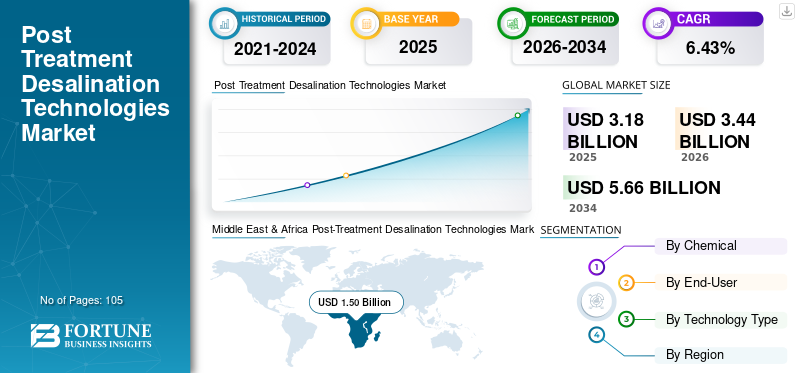
Download Free sample to learn more about this report.
Post Treatment Desalination Technologies Market Key Takeaways
 Global Market Size & Forecast
- 2025 Market Size: USD 3.18 billion
- 2026 Market Size: USD 3.44 billion
- 2034 Forecast Market Size: USD 5.66 billion
- CAGR: 6.43% from 2026–2034
 Market Share
- Middle East & Africa dominated the market with a 47.16% share in 2025.
- The Limestone (CaCO₃) segment led the market with a 38.28% share in 2025.
- The Municipal segment accounted for the largest market share of 67.38% in 2025.
 Key Regional Highlights
Asia Pacific
Asia Pacific recorded USD 0.69 billion in 2025 and is expected to grow to USD 0.75 billion in 2026.
North America
North America reached USD 0.37 billion in 2025 and is projected to grow to USD 0.40 billion in 2026.
Europe
Europe generated USD 0.47 billion in 2025 and is projected to reach USD 0.50 billion in 2026.
U.S.
U.S. market reached USD 0.31 billion in 2025.
Japan
Growing investments in desalination infrastructure and advanced water treatment technologies are expected to support market growth.
Read More

POST-TREATMENT DESALINATION TECHNOLOGIES MARKET TRENDS
Adoption of Smart and Digital Monitoring Systems is Driving Market Growth
The adoption of smart, digital monitoring systems is driving the growth of the market by significantly enhancing the efficiency, reliability, and cost-effectiveness of water treatment processes. Post-treatment involves precise control of parameters such as pH, mineral dosing, disinfection levels, and corrosion potential, which traditionally required manual monitoring and frequent adjustments. With the integration of IoT-enabled sensors, real-time analytics, and automated control systems, operators can continuously monitor water quality and instantly adjust chemical dosing and treatment conditions, ensuring optimal performance and regulatory compliance.
- In September 2024, Siemens, TAQA, and SUEZ signed a Memorandum of Understanding to collaborate on the Mohamed bin Zayed Water Initiative, a global competition to develop cutting-edge desalination technologies that provide water sustainably and affordably in developing nations. The goal of the five-year Mohamed bin Zayed Water Initiative is to revolutionize desalination techniques, materials, and systems and to encourage widespread desalination that advances socioeconomic equality and environmental preservation. The course will involve building a pilot desalination unit and then an industrial demonstration model.
MARKET DYNAMICS
MARKET DRIVERS
Rising Global Water Scarcity to Drive Market Growth
Rising global water scarcity is a major driver of the post-treatment desalination technologies market growth, as declining freshwater availability due to climate change, population growth, and over-extraction of natural water resources is forcing countries to rely on desalination as a sustainable water supply solution increasingly. Regions such as the Middle East, India, North Africa, and parts of Australia are experiencing severe water stress, prompting large-scale investments in desalination infrastructure.
- In May 2024, through its subsidiary SIDEM, Veolia, the global leader in water technology, will develop and provide essential technology for the Hassyan seawater desalination facility in Dubai, UAE. The facility will be the second-largest desalination plant in the world, utilizing reverse osmosis (RO) technology, and the largest desalination plant to run on solar power. It was commissioned by the Dubai Electricity and Water Authority (DEWA) and ACWA Power. This major undertaking underscores Veolia's dedication, as reaffirmed in its new GreenUp strategic plan, to delivering environmentally friendly, low-carbon, and energy-efficient solutions while conserving water resources amid increasing global water scarcity and climate change.
Download Free sample to learn more about this report.
MARKET RESTRAINTS
High Operational and Chemical Costs to Restrain Market Growth
Since post-treatment desalination systems depend heavily on ongoing use of chemicals such as lime, carbon dioxide, chlorine, and other conditioning agents to maintain the correct pH balance and disinfect desalinated water, the high operational and chemical costs are expected to limit market growth. In contrast to capital expenditures, these are recurring expenses that contribute to a considerable increase in the overall cost of water treatment over time. Furthermore, operations costs are increased by the energy required for dosing systems, monitoring devices, and control activities in post-treatment procedures.
MARKET OPPORTUNITIES
Growing Urbanization and Industrial Demand to Drive Market Growth
The market for post-treatment desalination technologies is primarily driven by rising urbanization and industrial demand, which immediately increases the need for safe, usable, high-quality water after desalination. Cities are experiencing increased stress on their freshwater supplies due to urban population growth. Municipal water needs are increasingly met by desalination facilities, especially in areas with limited water supplies. The growing need to reduce operational costs and environmental impacts while meeting water quality criteria is driving the popularity of energy-efficient post-treatment desalination techniques.
- In November 2025, Norwegian subsea desalination business Flocean announced that it had increased its total Series A funding to USD 22.5 million (NOK 228 million). Additionally, Flocean disclosed that it had reached an agreement with the Alver Municipality of Norway to investigate the possibility of supplying its water to the Municipality's industrial and household clients, and to evaluate its compatibility with the Municipality's current water infrastructure.
MARKET CHALLENGES
Chemical Handling and Environmental Concerns to Hamper Market Growth
Chemical handling and environmental concerns are expected to hamper the growth of the market due to the heavy reliance on chemical additives and the associated risks. Post-treatment processes commonly use chemicals such as chlorine, lime, carbon dioxide, and corrosion inhibitors to stabilize and disinfect desalinated water. However, improper storage, handling, or dosing of these chemicals can pose safety hazards to workers and lead to environmental contamination. Additionally, the discharge of chemically treated water or residual by-products negatively impacts marine ecosystems and surrounding environments, prompting stricter regulatory scrutiny.
Segmentation Analysis
By Chemical
Limestone (CaCO₃) Segment Growing due to Efficient Role in Remineralizing Desalinated Water
Based on the chemical, the market is classified into limestone (CaCO3), Lime (Ca (OH) 2), CO2, sodium hydroxide, and others.
The limestone (CaC03) segment dominates the growing market, with the largest post-treatment desalination technologies market share of 38.28% in 2025. Due to its cost-effectiveness, efficiency, and widespread use in remineralization procedures, limestone (CaCO₃) is the most prevalent material in the market. Limestone is commonly used to remineralize desalinated water as it is naturally deficient in vital minerals, which can cause corrosion in pipelines and infrastructure.
The lime (Ca(OH)₂) segment is the fastest-growing sector in the market due to its high reactivity, operational efficiency, and ability to satisfy demanding water quality criteria. Lime is a good fit for today's desalination facilities, which require strict, regulated water chemistry, as it quickly adjusts pH. Particularly in large-scale industrial and municipal applications, lime reacts faster than limestone, enabling operators to achieve the desired alkalinity and calcium levels more effectively. The lime (Ca(OH)2 market segment is projected to grow at a CAGR of 8.41% during the forecast period.
By End-User
Need to Ensure Safe Drinking Standards for Desalinated Water Drive Municipal Segment Growth
By end-user, the market is categorized into municipal, industrial, and power generation.
The municipal segment dominates the market and recorded a 67.38% share in 2025. Due to the rising need for clean drinking water driven by rapid urbanization, population growth, and an increasing reliance on desalination as a primary water source, the municipal component of post-treatment desalination technologies is expanding. Effective post-treatment methods, such as remineralization and disinfection, are necessary for municipal utilities to ensure that desalinated water complies with regulatory requirements and is safe for public consumption, thereby promoting the acceptance of these technologies.
The industrial segment is the fastest-growing in the market. The segment is growing with a CAGR of 8.09%. Due to rising demand for process-specific, high-purity water in industries such as power generation, oil & gas, chemicals, and manufacturing, the industrial sector is the fastest-growing market. The adoption of sophisticated, specialized post-treatment solutions is driven by the need for precisely treated desalinated water in these industries to prevent corrosion, scaling, and equipment failures.
By Technology Type
To know how our report can help streamline your business, Speak to Analyst
Remineralization Systems Segment Growing due to Essential Role in Restoring Mineral Balance
By technology type, the global market is segmented into remineralization systems, pH adjustment systems, disinfection systems, corrosion control systems, and others.
Remineralization systems dominate the market, accounting for 38.47% of the market share in 2025. As desalinated water lacks vital minerals and is extremely corrosive, remineralization is a crucial process in the industry to restore calcium, alkalinity, and pH balance for safe distribution and infrastructure protection, thus making it the most important segment.
The pH adjustment systems segment is the second-dominating segment in the market as maintaining optimal pH is essential to ensure water stability, prevent pipeline corrosion, and meet regulatory drinking water standards, making it a critical step alongside remineralization in desalinated water treatment. The pH adjustment systems segment is expected to grow at a CAGR of 6.29% during the forecast period.
Post-Treatment Desalination Technologies Market Regional Outlook
By region, the market is categorized into Europe, North America, Asia Pacific, Latin America, and the Middle East & Africa.
Middle East & Africa
Middle East & Africa Post-Treatment Desalination Technologies Market Size, 2025 (USD Billion)
To get more information on the regional analysis of this market, Download Free sample
The Middle East & Africa approximately valued at around USD 1.50 billion in 2025. Due to severe water shortages and a strong reliance on desalination as the main source of freshwater, the Middle East & Africa have the largest market share. Nations with extensive desalination facilities include Saudi Arabia, Israel, and the UAE, where post-treatment procedures are necessary to ensure that the water is safe for drinking and distribution. Furthermore, the widespread use of post-treatment technologies in the area is accelerated by significant government expenditure, rising urban populations, and a high demand for industrial water.
Saudi Arabia Post-Treatment Desalination Technologies Market
The Saudi Arabia market in 2025 was valued at around USD 0.64 billion, representing roughly 20% of the global market. Due to Saudi Arabia's severe water shortage and reliance on desalination as its main source of fresh water, the market for post-treatment desalination technology in the country is expanding.
Asia Pacific
Asia Pacific accounted for an estimated USD 0.69 billion in 2025 and about USD 0.75 billion in 2026. The market for desalination technologies for post-treatment in the Asia Pacific is expanding due to rapid urbanization, water scarcity, and growing industrial demand in nations such as China, India, and Australia. To address freshwater shortages, governments are making significant investments in desalination facilities, which in turn increase demand for sophisticated post-treatment technologies to ensure water quality, safety, and regulatory compliance.
China Post-Treatment Desalination Technologies Market
In 2025, the China market is estimated to reach USD 0.24 billion. Water shortages are a major issue in China, especially in the northern parts of the nation, where freshwater resources are insufficient to meet demand. The government is making greater investments in desalination facilities to remedy this imbalance. But desalinated water must be treated appropriately before use or distribution, which is driving high demand for technologies such as remineralization and pH adjustment systems. China’s extensive coastal development, including industrial zones and urban clusters, is increasing reliance on seawater desalination. These coastal desalination plants require efficient post-treatment systems to make water suitable for both municipal and industrial applications, supporting market growth.
- In May 2025, one of China's largest industrial seawater desalination plants was commissioned at Wanhua Chemical's Penglai Industrial Park. Its purpose is to address local water scarcity by providing significant quantities of freshwater for industrial applications.
India Post-Treatment Desalination Technologies Market
The India market size in 2025 was valued at around USD 0.13 billion, accounting for roughly 4% of the global market. India's industry is expanding due to growing water scarcity, rapid urbanization, and rising industrial demand. Desalination is becoming increasingly popular in coastal cities such as Mumbai and Chennai to meet drinking water needs, driving demand for post-treatment systems to ensure water quality and safety.
North America
North America was valued at roughly USD 0.37 billion in 2025 and about USD 0.40 billion in 2026. Due to growing water stress in areas such as California and the southwestern U.S., as well as expanding investments in desalination and water reuse programs, the market in North America is growing. Furthermore, the implementation of complex post-treatment technologies to ensure compliance, prevent corrosion, and ensure safe distribution is being driven by strict water-quality legislation and the demand for high-purity water across sectors such as power generation, pharmaceuticals, and manufacturing.
U.S. Post-Treatment Desalination Technologies Market
The U.S. market was valued at around USD 0.31 billion in 2025. Increasing water shortages in drought-prone areas such as California, Texas, and the southwestern states are driving greater reliance on desalination as a substitute water supply, which is fueling the expansion of the U.S. market. Since desalinated water lacks crucial minerals and must be stabilized before use, there is an increasing need for post-treatment methods such as remineralization, pH adjustment, and disinfection.
Europe
The European market was valued at USD 0.47 billion, and also led in 2026, with USD 0.50 billion. The market for desalination technologies in Europe after treatment is expanding due to increased water scarcity in Southern European nations such as Spain, Italy, and Greece, along with growing investments in sustainable water management strategies. The region's emphasis on environmental regulations and high standards for drinking water quality is driving the adoption of sophisticated post-treatment systems to ensure that desalinated water meets stringent regulatory requirements.
U.K. Post-Treatment Desalination Technologies Market
The U.K. market in 2025 was valued at around USD 0.024 billion. Rising concerns over water security, population growth, and recurring droughts, especially in southeast England, are driving the expansion of the U.K.'s post-treatment desalination technology industry. The U.K. is diversifying its water supply by investing in desalination and water reuse initiatives, which require post-treatment techniques to ensure desalinated water meets stringent drinking water quality criteria.
Germany Post-Treatment Desalination Technologies Market
The German market in 2025 was valued at around USD 0.04 billion. Due to a greater emphasis on water reuse, industrial water efficiency, and strict environmental standards, the market in Germany is expanding. The high-quality treated water that Germany's robust industrial foundation, including the chemical, energy, and manufacturing industries, requires is a major driver of the need for sophisticated post-treatment systems.
Latin America
Latin America accounted for an estimated USD 0.14 billion in 2025. The market in this region is expanding due to rising water scarcity, particularly in countries such as Chile, Peru, and Brazil, where freshwater supplies are under strain from mining operations and urbanization.
Chile Post-Treatment Desalination Technologies Market
The Chile market in 2025 was valued at around USD 0.06 billion, representing roughly 40.13% of the global market. With a significant mining sector, especially in dry areas such as northern Chile, the market in Chile is expanding. Desalinated seawater, which requires sophisticated post-treatment to manage water chemistry and prevent corrosion and scaling in machinery, is becoming increasingly prevalent in mining operations.
COMPETITIVE LANDSCAPE
Key Industry Players
Key Market Players Investing in R&D to Develop Efficient, Sustainable, and Low-chemical Solutions
To ensure that desalinated water meets required quality standards, vendors in the post-treatment desalination technology industry are focusing on developing sophisticated, effective, and integrated water treatment solutions. They are investing in technologies such as pH regulation, real-time water quality monitoring, disinfection, and remineralization systems to increase operational efficiency and reliability. Furthermore, corporations are expanding their global footprint through alliances, acquisitions, and project partnerships, particularly in areas with scarce water resources.
- In January 2026, scientists at King Abdullah University of Science and Technology (KAUST) created a novel desalination membrane that enhances the conversion of seawater and concentrated brines into freshwater. The study presents a scalable polymer membrane that operates at room temperature and pressure, achieving excellent salt rejection with a considerably lower energy requirement than traditional methods. The technology is now being tested at a pilot scale at KAUST, bringing it one step closer to practical application.
LIST OF KEY POST-TREATMENT DESALINATION TECHNOLOGIES COMPANIES PROFILED
- Veolia Water Technologies (France)
- Suez Group (France)
- Xylem, Inc. (France)
- DuPont Water Solutions (U.S.)
- IDE Technologies (Israel)
- ACWA (Saudi Arabia)
- ACCIONA (Spain)
- Metito (UAE)
- Toray Industries, Inc. (Japan)
- Kurita Water Industries (Japan)
KEY INDUSTRY DEVELOPMENTS
- January 2026: ACCIONA announced that it had created a predictive AI platform to forecast changes in parameters that measure the quality of water delivered from its desalination facilities. These parameters include turbidity, salinity spikes, and external events affecting quality. An example of such a system can be found at the Tampa Bay desalination plant in Florida, USA.
- January 2026: IDE Technologies signed a contract with the State Industries Promotion Corporation of Tamil Nadu (SIPCOT) to design, construct, and operate a new seawater RO (Reverse Osmosis) desalination facility in Mullakadu, Tuticorin. This plant will produce 60 million liters of clean filtered seawater per day to help mitigate the existing water shortage in the surrounding region. During the operational phase, customized adjustments to water quality will be made after desalination.
- October 2025: Toray Industries Inc. announced its new TLF-400ULD series of reverse osmosis (RO) membranes. This new membrane was developed collaboratively between the Toray Membrane (Foshan) operation and the Advanced Materials Research Laboratories of Toray International (China). Compared to the previous generation of RO membranes, the new membrane offers twice the chemical resistance, uses approximately 10% less energy than traditional RO elements, improves resistance to fouling, and extends overall membrane life. Therefore, this membrane will be used for both wastewater reuse and desalination of adjacent water sources; however, its primary end use is to produce stable, high-quality permeate.
- February 2025: A company known as Metito Utilities has made arrangements with three companies, namely Cassa Depositi e Prestiti from Italy, SACE, and ACEA S.p.A., all of whom have agreed to work together to improve the quality of water by developing new ways to provide clean and safe drinking water as well as improving the delivery of water services throughout Africa and the Middle East through the use of advanced technologies.
- February 2025: Kurita American (a subsidiary of the Japanese Kurita Water Industry Company) completed a merger with Avista Technology. As part of this transaction, Kurita acquired Avista's expertise and intellectual property in membrane treatment technologies, including support for Reverse Osmosis (RO), Ultrafiltration (UF), and Microfiltration (MF). This acquisition becomes effective on April 1st, 2025. It is intended to provide Kurita the opportunity to increase its portfolio of membrane-related technologies, which are critical to desalination and post-processing water purification systems.
REPORT COVERAGE
The global post-treatment desalination technologies market analysis provides an in-depth study of the market size & forecast across all market segments included in the report. It contains details on the market dynamics and market trends expected to drive the market in the forecast period. It offers information on technological advancements, new product launches, key industry developments, and partnerships, mergers & acquisitions. The market research report also includes a detailed competitive landscape, providing market share and profiles of key players.
Request for Customization to gain extensive market insights.
Report Scope & Segmentation
| ATTRIBUTE | DETAILS |
| Study Period | 2021-2034 |
| Base Year | 2025 |
| Estimated Year | 2026 |
| Forecast Period | 2026-2034 |
| Historical Period | 2021-2024 |
| Growth Rate | CAGR of 6.43% from 2026-2034 |
| Unit | Value (USD Billion) |
| Segmentation | By Chemical, End-User, Technology Type, and Region |
| By Chemical |
|
| By End-User |
|
| By Technology Type |
|
| By Region |
|
Frequently Asked Questions
Fortune Business Insights says that the global market value stood at USD 3.18 billion in 2025 and is projected to reach USD 5.66 billion by 2034.
The market is expected to exhibit a CAGR of 6.43% during the forecast period.
The remineralization systems segment led the market by technology type.
The rising global water scarcity to drive the market growth.
Xylem, Inc., DuPont Water Solutions, and IDE Technologies are the prominent players in the market.
Middle East & Africa dominated the market with the highest share in 2025.
The growing urbanization and industrial demand to drive the market growth.



- 2021-2034
- 2025
- 2021-2024
- 105
Get 30-60 hrs Free Customization
Expand Regional and Country Coverage, Segments Analysis, Company Profiles, Competitive Benchmarking, and End-user Insights.



















Related Reports
-
US +1 833 909 2966 ( Toll Free )
-
Get In Touch With Us