Potassium Permanganate Market Size, Share & Industry Analysis, By Application (Potable Water Treatment, Wastewater Treatment, Oilfield Water Treatment, Air & Gas Treatment, and Others), and Regional Forecast, 2026-2034
 Download Free Sample
POTASSIUM PERMANGANATE MARKET SIZE AND FUTURE OUTLOOK
 Listen to Audio Version
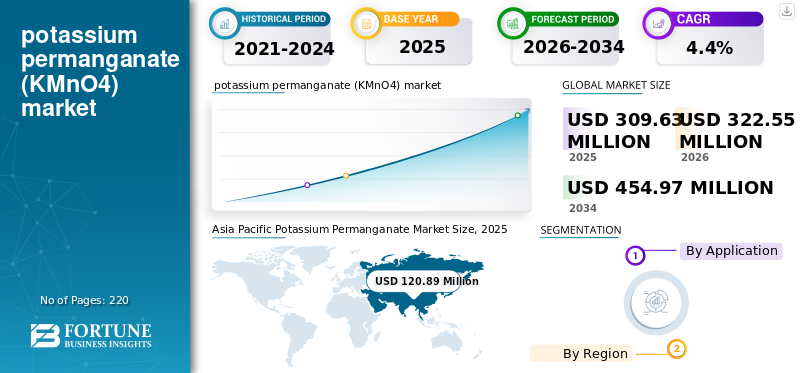
The global potassium permanganate market size was valued at USD 309.63 million in 2025 and is projected to grow from USD 322.55 million in 2026 to USD 454.97 million by 2034, exhibiting a CAGR of 4.4% during the forecast period. Asia Pacific dominated the potassium permanganate market with a market share of 39.04% in 2025.
Potassium permanganate (KMnO₄) is a strong inorganic oxidizing agent supplied as dark purple crystals or granules and widely used across potable water treatment, wastewater treatment, industrial process oxidation, odor control, remediation, and select oilfield applications. Its commercial relevance comes from its ability to oxidize iron, manganese, sulfides, and other contaminants, thereby improving treatment efficiency and downstream water quality. The major demand driver is the continued expansion and tightening of global water and wastewater treatment requirements, particularly where utilities and industries need reliable oxidation chemistry to meet regulatory standards, improve process performance, and manage rising contamination loads. Chongqing Changyuan Group, Carus Group, GFS Chemicals, Nippon Chemical Industrial, and Universal Chemicals & Industries are the key players operating in the market.
Download Free sample to learn more about this report.
POTASSIUM PERMANGANATE MARKET Key Takeaways
 Global Market Size & Forecast
- 2025 Market Size: USD 309.63 million
- 2026 Market Size: USD 322.55 million
- 2034 Forecast Market Size: USD 454.97 million
- CAGR: 4.4% from 2026–2034
 Market Share
- Asia Pacific dominated the potassium permanganate market with a market share of 39.04% in 2025.
- The potable water treatment segment reached a share of 35.1% in 2025.
- The wastewater treatment segment is projected to grow at a CAGR of 4.6% over 2026 to 2034.
 Key Regional Highlights
Asia Pacific
The dominant demand driver is potable water treatment solutions, supported by rising demand for safe drinking water and expanding wastewater treatment infrastructure.
North America
Portable water treatment solutions are the primary demand driver, supported by the need for reliable water quality and regulatory compliance.
Europe
Market demand is driven by wastewater treatment, supported by the region’s strong regulatory focus on pollution reduction, discharge quality, and safe treatment performance.
U.S.
The U.S. market recorded revenues of around USD 58.75 million in 2025, representing roughly 19.0% of global sales.
Japan
Japan’s market reached approximately USD 12.33 million in 2025, equivalent to around 4.0% of global sales.
Read More

POTASSIUM PERMANGANATE MARKET TRENDS
Rising Water Security Pressures Drive the Shift Toward Mission-Critical Treatment Applications
A major global trend in the industry is the shift from broad commodity-style usage toward more targeted, performance-critical applications, especially in potable water, wastewater, remediation, and industrial process treatment. Buyers increasingly value potassium permanganate not simply as an oxidant, but as a dependable treatment chemical for difficult contaminants such as iron, manganese, sulfides, taste-and-odor compounds, and certain organic pollutants. This is pushing suppliers to emphasize application support, dosing precision, purity consistency, and regulatory compliance. As a result, the market is becoming more solution-oriented, with demand concentrating in essential treatment environments where operational reliability and contaminant-control performance matter more than lowest upfront price.
MARKET DYNAMICS
MARKET DRIVERS
Download Free sample to learn more about this report.
Tightening Water Quality Standards Drive Stronger Structural Demand Support
The primary global driver for potassium permanganate market growth is the continuing need for stronger water and wastewater treatment performance under tightening environmental and public-health expectations. Municipalities, utilities, and industrial operators face growing pressure to remove contaminants more effectively, improve odor and color control, and protect downstream treatment systems. Potassium-permanganate benefits as it is a proven strong oxidizing agent with established use in contaminant conversion and process conditioning. Its demand is further supported where aging infrastructure, industrial discharge complexity, and growing scrutiny of water safety increase the need for robust treatment chemistries. In this context, demand is driven less by discretionary spending and more by compliance, continuity, and treatment effectiveness.
MARKET RESTRAINTS
Competition from Alternative Oxidants on Cost and Flexibility Limits Adoption
A major restraint in the industry is competition from alternative oxidation and treatment chemistries that may offer lower cost, easier logistics, or better fit for certain systems. Depending on the application, users may choose chlorine-based oxidants, hydrogen peroxide, ozone, or other specialty chemicals instead of potassium permanganate. This limits market expansion, particularly in price-sensitive or technically flexible installations. In addition, the chemical agent requires disciplined dosing and handling, which can discourage smaller users or less sophisticated operators. As buyers increasingly evaluate total treatment economics, the chemical may lose share where its performance advantages are not sufficiently differentiated from substitute chemistries.
MARKET OPPORTUNITIES
Remediation and Advanced Treatment Needs Expansion Drives New Value Pools
A major opportunity for the industry lies in expanding use cases linked to environmental remediation, industrial water reuse, advanced contaminant control, and specialized treatment needs in emerging markets. As groundwater cleanup, industrial sustainability programs, and non-traditional water treatment applications grow, potassium permanganate can benefit from its strong oxidation capability and established engineering familiarity. There is also opportunity to deepen value through higher-service business models such as application consulting, dosing optimization, custom formulations, and integrated treatment packages. In developing regions, rising investment in municipal water and wastewater systems can create additional headroom. The industry’s opportunity is not only volume growth, but also value capture through more specialized and solution-led positioning.
MARKET CHALLENGES
Persistent Supply Concentration and Hazard Handling Pressures Make Industry Stability Harder to Maintain
A major challenge in the global market is maintaining reliable, cost-effective supply in a market shaped by concentrated production, hazardous-material handling requirements, and variable downstream demand conditions. As potassium permanganate is a strong oxidizer, storage, transport, packaging, and workplace safety standards are more demanding than for many conventional treatment chemicals. This increases operational complexity across the value chain. At the same time, a relatively concentrated supplier base can amplify disruption risk from outages, logistics bottlenecks, or regulatory changes. The challenge for the industry is therefore twofold, ensuring secure supply continuity while also controlling cost, compliance burden, and service quality in a market where reliability is often as important as price.
SEGMENTATION ANALYSIS
By Application
To know how our report can help streamline your business, Speak to Analyst
Intensifying Drinking Water Quality Pressures Drive Market Demand in Potable Water Treatment
Based on the application, the market is segmented into potable water treatment, wastewater treatment, oilfield water treatment, air & gas treatment, and others.
The potable water treatment segment is anticipated to hold the dominant potassium permanganate market share during the forecast period. Further, the segment reached a share of 35.1% in 2025. The key factor driving the product demand in potable water treatment is the increasing need to remove iron, manganese, sulfides, and taste-and-odor-causing impurities more effectively while protecting downstream treatment performance. Utilities prefer proven oxidation chemistries that can improve water clarity, reduce aesthetic complaints, and support regulatory compliance without requiring complete process redesign. The product gains demand as it helps convert difficult dissolved contaminants into removable forms. Further, making it especially valuable in water systems facing rising raw-water quality variability and growing pressure to deliver safe, consistent drinking water.
The main factor driving potassium permanganate demand in wastewater treatment is the growing requirement for stronger contaminant control and odor management in municipal and industrial effluent streams. Treatment operators increasingly need reliable oxidants that can address reduced compounds, improve process efficiency, and support discharge compliance in more complex wastewater conditions. The product benefits as it offers a targeted oxidation solution for troublesome contaminants while helping stabilize downstream treatment steps. As wastewater systems face stricter environmental scrutiny and higher treatment-performance expectations, demand rises for oxidation chemistries that improve operational reliability and compliance outcomes. Further, the wastewater treatment segment is projected to grow at a CAGR of 4.6% over 2026 to 2034.
POTASSIUM PERMANGANATE MARKET REGIONAL OUTLOOK
By region, the market is segmented into North America, Europe, Asia Pacific, Latin America, and the Middle East & Africa.
Asia Pacific
Asia Pacific Potassium Permanganate Market Size, 2025 (USD Million)
To get more information on the regional analysis of this market, Download Free sample
In the Asia Pacific region, the dominant demand driver for the industry is potable water treatment solutions. The region features a large population exposure, uneven access to safe-water, and rising expectations for treated drinking clean water, making oxidation chemistry especially valuable for removing iron, manganese, sulfides, and odor-causing contaminants. This creates both current volume demand and future runway. Wastewater treatment is the strongest supporting application as treatment infrastructure still needs major expansion, while oilfield water treatment solutions also adds momentum in energy-intensive economies. Still, the primary regional growth driver is the need to improve drinking-water quality at scale across both developing and industrializing markets.
Japan Potassium Permanganate Market
Japan’s market value reached approximately USD 12.33 million in 2025, equivalent to around 4.0% of global sales.
China Potassium Permanganate Market
China’s market was analytically approximated at around USD 37.96 million in 2025, accounting for roughly 12.3% of global sales.
India Potassium Permanganate Market
India’s market size reached approximately USD 23.76 million in 2025, equivalent to around 7.7% of global sales.
North America
In North America, portable water treatment solutions are the primary demand driver for the industry. The chemical’s strongest regional role is in oxidizing iron, manganese, sulfides, and taste-and-odor precursors so utilities can protect downstream filtration and deliver stable water quality. This remains the core demand engine as the market is mature, compliance-led, and operationally reliability focused. Wastewater treatment provides a secondary pull where odor control and oxidation performance matter, while air & gas treatment and oilfield water treatment remain more specialized. Overall, water-treatment reliability, rather than broad industrial expansion, is expected to drive market growth.
U.S. Potassium Permanganate Market
The U.S.’s market is projected to be one of the largest worldwide, with 2025 revenues recorded at around USD 58.75 million, representing roughly 19.0% of global sales.
Europe
Europe market demand is driven by wastewater treatment, supported by the region’s strong regulatory focus on pollution reduction, discharge quality, and safe treatment performance. This application is especially important as Europe is a mature market where demand growth comes less from new basic access and more from tighter treatment standards, better contaminant control, and process optimization. Potable water treatment remains an important supporting segment, but its growth is more incremental as access is already highly developed in most countries. Air & gas treatment contributes selectively in industrial settings, though it is not the primary market driver.
U.K. Potassium Permanganate Market
U.K.’s market reached approximately USD 4.53 million in 2025, equivalent to around 1.5% of global sales.
Germany Potassium Permanganate Market
Germany’s market reached approximately USD 14.93 million in 2025, equivalent to around 4.8% of global sales.
Latin America
In Latin America, the main driver for market demand is potable water treatment, as many countries continue to expand and upgrade municipal systems to improve drinking-water quality and service reliability. KMnO₄ benefits where utilities must manage iron, manganese, sulfides, and aesthetic water-quality issues without overhauling existing treatment trains. Wastewater treatment is the key supporting application and could become increasingly important over time as environmental compliance strengthens and more treatment capacity is added. Oilfield water treatment supports demand in selected markets, but regionally it is still secondary to the broader need for better municipal water infrastructure.
Brazil Potassium Permanganate Market
Brazil’s market reached approximately USD 8.99 million in 2025, equivalent to around 2.9% of global sales.
Middle East & Africa
In the Middle East & Africa, the current driver is potable water treatment, as water stress, source-quality variability, and the need for dependable treatment chemistry make oxidation performance critical. It is well positioned where utilities must manage difficult dissolved contaminants and protect downstream treatment efficiency. At the same time, oilfield water treatment is the most important supporting application and, in some subregions, can become a major future demand driver as hydrocarbon activity creates ongoing need for produced-water conditioning and contaminant control. Wastewater treatment also adds medium-term upside as treatment coverage and reuse requirements expand.
Saudi Arabia Potassium Permanganate Market
Saudi Arabia’s market reached approximately USD 8.77 million in 2025, equivalent to around 2.8% of global sales.
COMPETITIVE LANDSCAPE
Key Industry Players
Global Supply Concentration Among Few Producers Drives Reliability and Compliance-Led Competition
The global potassium permanganate industry has a relatively concentrated competitive landscape shaped by a small number of established producers, strong water-treatment exposure, and high importance of product consistency, regulatory compliance, and distribution reliability. Competition is driven less by branding and more by manufacturing scale, oxidation performance, technical support, and the ability to serve essential-use markets such as potable water and wastewater treatment. The market is also influenced by regional supply concentration, with China and India playing major export roles. Key producers commonly referenced in the market include Chongqing Changyuan Group, Carus Group, GFS Chemicals, Nippon Chemical Industrial, and Universal Chemicals & Industries.
LIST OF KEY POTASSIUM PERMANGANATE COMPANIES PROFILED
- Carus Group Inc. (U.S.)
- Nippon Chemical Industrial Co., Ltd. (Japan)
- Chongqing Changyuan Group Limited (China)
- GFS Chemicals (U.S.)
- Guangdong Hangxin Technology Co., Ltd. (China)
- Universal Chemicals & Industries Pvt. Ltd. (India)
- ORGANIC INDUSTRIES PVT LTD. (India)
- Libox Chem (India) Pvt. Ltd. (India)
- Magnesia Chemicals LLP (India)
REPORT COVERAGE
The global potassium permanganate market report provides a detailed analysis of the market. It focuses on key aspects such as profiles of leading companies, product types, and leading applications of the product. Besides this, it offers insights into the analysis of key market trends and highlights key industry developments. In addition to the aforementioned factors, it encompasses several other factors that have contributed to the growth of the market over recent years.
Request for Customization to gain extensive market insights.
Report Scope & Segmentation
| ATTRIBUTE | DETAILS |
| Study Period | 2021-2034 |
| Base Year | 2025 |
| Estimated Year | 2026 |
| Forecast Period | 2026-2034 |
| Historical Period | 2021-2024 |
| Unit | Volume (Kiloton); Value (USD Million) |
| Growth Rate | CAGR of 4.4% during 2026-2034 |
| Segmentation | By Application, and By Region |
| By Application |
|
| By Region |
|
Frequently Asked Questions
Fortune Business Insights says that the global market size was USD 309.63 million in 2025 and is projected to record a valuation of USD 454.97 million by 2034.
In 2025, the market value stood at USD 120.89 million.
Registering a CAGR of 4.4%, the market will exhibit steady growth during the forecast period.
The potable water treatment application is expected to lead this market during the forecast period.
The global push for clean water infrastructure to sustain and drive market growth.
Chongqing Changyuan Group, Carus Group, GFS Chemicals, Nippon Chemical Industrial, and Universal Chemicals & Industries are the major players operating in the market.
Asia Pacific dominated the market in terms of share in 2025.
The global tightening of water quality standards to drive wider adoption.



- 2021-2034
- 2025
- 2021-2024
- 220
Get 30-60 hrs Free Customization
Expand Regional and Country Coverage, Segments Analysis, Company Profiles, Competitive Benchmarking, and End-user Insights.


















Related Reports
-
US +1 833 909 2966 ( Toll Free )
-
Get In Touch With Us