Ultra Wideband Market Size, Share & Industry Analysis, By Component (Hardware, Software, and Services), By Positioning System (Indoor Positioning, Outdoor Positioning, and Hybrid Positioning), By Range (Short Range, Medium Range, and Long Range) By Application (Real-Time Location Systems, Asset Tracking, Indoor Navigation, Secure Digital Access, Communication, and Others), By Industry (Consumer Electronics, Automotive, Healthcare, Manufacturing, Retail, and Others), and Regional Forecast, 2026 – 2034
 Download Free Sample
Ultra Wideband Market Overview
 Listen to Audio Version
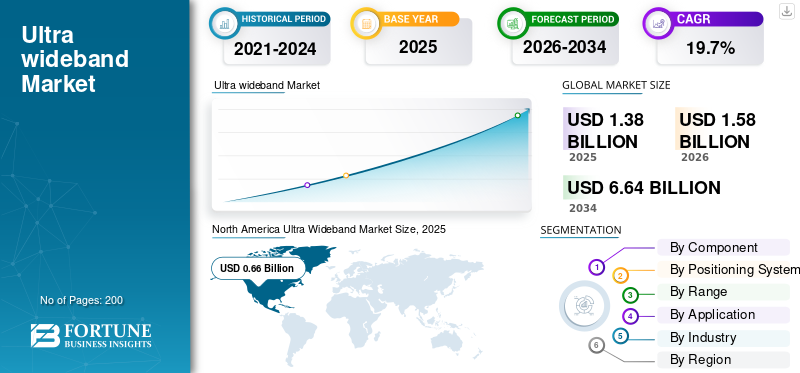
The global ultra wideband market size was valued at USD 1.38 billion in 2025 and is projected to grow from USD 1.58 billion in 2026 to USD 6.64 billion by 2034, exhibiting a CAGR of 19.7% during the forecast period. North America dominated the ultra wideband market with a market share of 47.83% in 2025.
The ultra wideband market comprises hardware, software, and ecosystem-level solutions that enable high-precision positioning, secure proximity detection, and real-time location intelligence across consumer electronics, automotive systems, and industrial environments. These solutions are built around ultra wideband (UWB) chipsets, RF transceivers, antenna modules, positioning engines, and software platforms that together deliver centimeter-level accuracy for use cases such as digital car keys, indoor navigation, asset tracking, spatial awareness, and smart device interaction. By enabling precise short-range communication in GPS-denied environments, UWB supports a wide range of applications in smart factories, healthcare facilities, retail spaces, connected homes, and next-generation vehicles, where real-time visibility and secure access are critical.
The market is gaining strong momentum as industries shift toward Industry 4.0, connected mobility, and spatial computing ecosystems, where traditional technologies such as BLE and Wi-Fi are insufficient for high-accuracy positioning needs. Growing deployment of digital vehicle access systems, Real-Time Locating System (RTLS) platforms in industrial automation, and ecosystem-wide integration of UWB in smartphones and IoT devices are accelerating product adoption. Increasing demand for secure, low-latency, and interference-resistant positioning is also driving UWB integration into multi-protocol environments alongside BLE, NFC, and Wi-Fi, enabling seamless connectivity across devices and platforms. As a result, UWB is transitioning from a niche technology to a foundational layer for next-generation location-aware systems.
Key players such as Samsung, NXP Semiconductors, Qualcomm, and Zebra Technologies are driving UWB adoption across consumer, automotive, and industrial applications. Samsung and Qualcomm are expanding UWB use in smartphones and spatial awareness ecosystems, while NXP focuses on automotive digital keys and in-cabin sensing. Zebra Technologies is enabling industrial RTLS for asset tracking and automation, and Broadcom supports connectivity integration across devices. Together, these companies are accelerating the commercialization of UWB across multiple end-use industries.
Download Free sample to learn more about this report.
ultra wideband market KEY TAKEAWAYS
 Global Market Size & Forecast
- 2025 Market Size: USD 1.38 Billion
- 2026 Market Size: USD 1.58 Billion
- 2034 Forecast Market Size: USD 6.64 Billion
- CAGR: 19.7% from 2026-2034
 Market Share
- North America dominated the market with a revenue share of 47.83% in 2025.
- Consumer electronics held a 33.3% market share in 2025.
- Hardware held a 71.8% market share in 2025.
 Key Regional Highlights
North America
North America dominated the market with revenue of USD 0.66 billion in 2025.
Europe
Europe reached USD 0.16 billion in 2025 and is projected to grow at a CAGR of 18.0%.
Asia Pacific
Asia Pacific reached USD 0.49 billion in 2025 and is projected to grow at the highest CAGR of 21.1%.
U.S.
The market was valued at around USD 0.50 billion in 2025, accounting for roughly 36.2% of global sales.
Japan
The market was valued at around USD 0.08 billion in 2025, accounting for roughly 5.8% of global revenues.
Read More

ultra wideband market TRENDS
Rising Adoption of Industry 4.0 and Smart Manufacturing to Boost Market Expansion
UWB-based RTLS is increasingly becoming a core enabler of Industry 4.0-driven smart factories, warehouses, and healthcare systems, where centimeter-level positioning improves automation, workflow visibility, and asset utilization. In modern manufacturing environments, UWB RTLS is being deployed to create real-time digital maps of production lines, enabling instant tracking of tools, materials, and workers to reduce bottlenecks and improve operational efficiency. Recent industrial deployments highlight that UWB systems are now being integrated with digital twin platforms and Manufacturing Execution Systems (MES), allowing enterprises to simulate and optimize factory operations using live location data rather than static inputs.
A notable industry implementation in smart factories shows UWB RTLS being used for production line monitoring and smart logistics optimization, where tagged assets move across workstations and managers receive real-time alerts on delays or inefficiencies, significantly improving throughput and reducing idle time. For instance,
- According to industry reports, warehouse deployments combining UWB with RFID have demonstrated measurable gains in operational efficiency, including up to ~40% improvement in logistics processes through optimized routing and real-time asset visibility.
These developments indicate a clear shift in which RTLS is no longer limited to tracking alone but is evolving into a decision-making layer for industrial automation, predictive maintenance, and smart supply chain orchestration, positioning UWB as a foundational technology for next-generation industrial ecosystems.
MARKET DYNAMICS
MARKET DRIVERS
Download Free sample to learn more about this report.
Rapid Expansion of Industry 4.0 and Digital Twin Technologies Drives UWB Demand
The rapid expansion of Industry 4.0 ecosystems, smart factories, robotics, and digital twin technologies is significantly increasing the need for real-time, high-precision location intelligence in industrial environments. As manufacturing operations become increasingly automated and data-driven, enterprises are prioritizing continuous visibility of assets, tools, and personnel to optimize production flow and reduce operational inefficiencies. In this context, UWB-based RTLS is emerging as a critical enabling layer due to its centimeter-level accuracy and reliability in complex indoor environments where GPS, BLE, and RFID are less precise or inconsistent.
A recent industrial implementation highlights this shift, where UWB RTLS deployments in smart factory environments have been used to enable real-time tracking of tools, materials, and work-in-progress assets, directly supporting digital twin systems and production optimization workflows. For example, industrial deployments discussed in Automation World (2026) show UWB-based systems being used in factories such as TRUMPF’s manufacturing facilities to improve on-time delivery performance and reduce production inefficiencies through continuous location visibility of shop-floor assets, demonstrating measurable operational improvements from RTLS integration.
Additionally, academic and industrial studies on Industry 4.0 RTLS implementations confirm that UWB enables dynamic mapping of factory environments and real-time monitoring of production flows, which significantly enhances decision-making in manufacturing execution systems and supports predictive maintenance and digital twin-based optimization models. This growing convergence of UWB RTLS with MES platforms, industrial IoT, and simulation-based manufacturing systems is positioning it as a foundational technology for next-generation smart manufacturing ecosystems.
|
Rank |
Market Drivers |
Overall Impact Rank |
CAGR Contribution (2026-2034) |
Impact 2026-2028 |
Impact 2029-2031 |
Impact 2032-2034 |
|
1 |
Growing adoption of Industry 4.0 and smart manufacturing |
High |
+6.0% |
High |
High |
High |
|
2 |
Growing deployment of Industrial RTLS for real-time asset and workforce tracking |
High |
+5.1% |
High |
High |
High |
|
3 |
Expansion of automotive digital key systems and connected vehicle ecosystems |
High |
+4.6% |
High |
High |
High |
|
4 |
Rising integration of UWB in consumer electronics for spatial awareness and ecosystem connectivity |
High |
+3.9% |
Medium |
High |
High |
|
5 |
Expansion of smart infrastructure, IoT ecosystems, and smart building automation |
Medium |
+2.5% |
Medium |
Medium |
High |
|
6 |
Others (smart home adoption, retail automation, niche enterprise positioning use cases, etc.) |
Low |
+1.1% |
Low |
Low |
Medium |
|
Total Positive Growth Contribution |
+23.2% |
MARKET RESTRAINTS
Strong Competition from Established Positioning Technologies Limits UWB Adoption
A key restraint in the ultra wideband market growth is the strong dominance of established positioning technologies such as BLE, Wi-Fi RTT, RFID, and GPS, which already operate at massive global scale and limit UWB penetration. For instance,
- According to Bluetooth, Bluetooth-enabled devices exceed 5 billion shipments annually, reflecting BLE’s deep integration across smartphones, wearables, and IoT ecosystems, making it the default choice for short-range connectivity and proximity tracking.
In comparison, UWB adoption remains limited to select premium applications such as automotive digital keys and high-precision indoor positioning, where costs and infrastructure requirements are higher.
This imbalance is further reinforced by ecosystem design. For instance, Apple’s AirTag tracking system relies primarily on Bluetooth Low Energy for wide-area detection, using UWB only for close-range precision finding, showing that BLE remains the foundational layer in mainstream tracking ecosystems. As a result, despite UWB offering superior centimeter-level accuracy, incumbent technologies such as BLE and GPS continue to dominate due to their ubiquity, lower cost, and mature infrastructure.
|
Rank |
Market Restraint |
Overall Impact Rank |
Negative CAGR Contribution (2026-2034) |
Impact 2026-2028 |
Impact 2029-2031 |
Impact 2032-2034 |
|
1 |
Strong competition from established positioning technologies |
High |
-1.6% |
High |
High |
Medium |
|
2 |
High deployment cost and infrastructure complexity of UWB systems |
High |
-1.1% |
High |
Medium |
Medium |
|
3 |
Interoperability limitations and fragmented ecosystem integration across regions |
Medium |
-0.6% |
Medium |
Medium |
Low |
|
4 |
Others (legacy system dependence, slow enterprise migration, integration challenges, etc.) |
Low |
-0.2% |
Low |
Low |
Low |
|
Total Negative Growth Impact |
-3.5% |
MARKET OPPORTUNITIES
Rapid Expansion of UWB-enabled Automotive Digital Key Creates New Growth Opportunities
UWB is emerging as a key enabling technology for next-generation automotive digital key systems, allowing secure, hands-free vehicle access with centimeter-level precision and strong protection against anti-relay attack. Major automakers such as BMW, Hyundai, Mercedes-Benz, and Audi are actively integrating UWB into Digital Key 3.0 ecosystems under the Car Connectivity Consortium (CCC) framework, where it works alongside Bluetooth Low Energy and NFC to enable seamless passive entry and start functions. The Car Connectivity Consortium (CCC) has standardized UWB as part of its certified digital key architecture to ensure interoperability across smartphone and vehicle ecosystems, accelerating industry-wide adoption of secure mobile-based vehicle access systems.
In addition, industry collaboration between the Car Connectivity Consortium and the FiRa Consortium is actively strengthening UWB standardization for automotive uses by focusing on secure distance measurement and cross-device compatibility, which is expected to further expand deployment across premium and mid-range vehicles. As software-defined vehicles gain momentum and digital key adoption increases across connected car platforms, UWB is increasingly positioned as a foundational layer for secure access, in-cabin personalization, and vehicle-sharing use cases.
Segmentation Analysis
By Industry
Consumer Electronics Segment Dominated the Industry Due to Widespread Integration into Mass-market Devices and Strong Existing Device Ecosystem
Based on industry, the market is segmented into consumer electronics, automotive, healthcare, manufacturing, retail, and others.
Consumer electronics held the major share of the market, registering a 33.3% share in 2025. The segment’s dominance is driven by the rapid and scalable deployment of UWB through mass-market devices such as smartphones, wearables, and smart accessories. Unlike other applications that require new infrastructure, UWB adoption in consumer electronics is fueled by a well-established device ecosystem. Leading OEMs such as Apple and Samsung have embedded UWB into high-volume products to support use cases such as precision finding, spatial awareness, and seamless device connectivity, allowing the technology to reach a large global user base.
The automotive segment is expected to witness the highest CAGR of 24.7% during the forecast period.
To know how our report can help streamline your business, Speak to Analyst
By Component
Hardware Segment Dominated Due to its Broad Adoption Across Smartphones and RTLS Systems
Based on component, the market is segmented into hardware, software, and services.
Hardware dominated the market, registering a share of 71.8% in 2025. The segment’s dominance is attributed to the hardware-centric nature of UWB deployment, as every application requires embedded components such as UWB ICs, antennas, modules, and anchors to enable precise positioning and communication. Across applications including automotive digital keys, smartphones, and RTLS systems, hardware serves as the mandatory layer of deployment. In contrast, software and services are largely dependent on the installed base of UWB-enabled devices, making their adoption dependent on the expansion of hardware deployment.
The software segment is expected to witness the highest CAGR of 23.0% during the forecast period.
By Positioning System
Indoor Positioning Segment Dominated Owing to Strong High Precision Performance in GPS-Denied Environments
Based on positioning system, the market is categorized into indoor positioning, outdoor positioning, and hybrid positioning.
Indoor positioning held the majority market share in 2025, holding a 61.9% share as UWB delivers its core value proposition in GPS-denied environments, where centimeter-level accuracy is required for asset tracking, navigation, and automation inside factories, hospitals, and warehouses. Most high-volume UWB deployments, such as RTLS in Industry 4.0 facilities, smart logistics hubs, and indoor navigation in retail and healthcare, are inherently indoor use cases, driving large-scale hardware installation.
The hybrid positioning segment is expected to witness the highest CAGR of 25.3% during the forecast period.
By Range
Medium Range Segment Held the Largest Share Due to Robust Demand from Major UWB Uses
Based on range, the market is categorized into short range, medium range, and long range.
Medium range dominated the market, accounting for a 46.5% share in 2025, as it is required for most real-world UWB deployments such as RTLS, automotive digital keys, and industrial tracking. In these applications, devices typically operate within a few meters to tens of meters, where UWB maintains high positioning accuracy without the power and infrastructure costs associated with long-range systems.
The long range segment is expected to witness the highest CAGR of 24.1% during the forecast period.
By Application
Real-Time Location Systems (RTLS) Segment Led the Market Due to Large-Scale Enterprise Deployment
Based on application, the market is categorized into real-time location systems, asset tracking, indoor navigation, secure digital access, communication, and others.
Real-time location systems held the major share of the market, holding a 27.7% share in 2025, as it represents the core and highest-value use case of UWB technology, where its centimeter-level accuracy is fully utilized for continuous tracking of assets, personnel, and equipment in complex environments such as manufacturing, logistics, and healthcare. Unlike applications such as communication or general indoor navigation, RTLS deployments are large-scale, infrastructure-heavy, and enterprise-wide, requiring dense UWB anchor installations and long-term system integration, which significantly increases revenue contribution.
The secure digital access segment is expected to witness the highest CAGR of 25.6% during the forecast period.
ultra wideband market Regional Outlook
By region, the market is categorized into North America, South America, Europe, the Middle East & Africa, and Asia Pacific.
North America
North America Ultra Wideband Market Size, 2025 (USD Billion)
To get more information on the regional analysis of this market, Download Free sample
The market in North America was valued at USD 0.66 billion in 2025. The region holds the majority of the ultra wideband market share due to its early technology commercialization, strong semiconductor ecosystem, and rapid adoption across automotive, consumer electronics, and industrial RTLS applications. The region is home to major UWB ecosystem leaders such as Apple, Qualcomm, and Qorvo, which have accelerated large-scale integration of UWB into smartphones, connected devices, and automotive platforms.
- For instance, according to the World Bank, the U.S. leads global digital transformation in manufacturing, with the country accounting for ~32% of global manufacturing value. This strong manufacturing base supports the widespread deployment of smart factory and RTLS solutions, where UWB technology is widely used for real-time tracking and automation.
This combination of high-tech leadership and industrial digitization continues to reinforce North America’s dominant position in the UWB market.
U.S. Ultra Wideband Market
Given North America’s strong contribution and the U.S. dominance in the region, the U.S. market was valued at around USD 0.50 billion in 2025, accounting for roughly 36.2% of global sales.
Europe
Europe reached USD 0.16 billion in 2025 and is projected to grow at a CAGR of 18.0% over the forecast period. The growth is due to strong adoption of industrial automation, strict regulatory focus on security and privacy, and rapid deployment of Industry 4.0 frameworks across manufacturing hubs such as Germany, France, and the Nordics. The region has a well-established automotive ecosystem where UWB is increasingly integrated into digital car keys, in-cabin sensing, and connected vehicle platforms, supported by OEM innovation and standardization efforts.
Additionally, the region is witnessing growing deployment of UWB-based RTLS solutions in healthcare, logistics, and smart infrastructure projects, driven by the need for high-precision indoor tracking and operational efficiency.
U.K. Ultra Wideband Market
The U.K. market in 2025 was valued at around USD 0.02 billion, representing roughly 1.4% of global revenues.
Germany Ultra Wideband Market
Germany’s market reached approximately USD 0.01 billion in 2025, equivalent to around 0.7% of global sales.
Asia Pacific
Asia Pacific region reached USD 0.49 billion in 2025 and is expected to grow at the highest CAGR of 21.1% during the forecast period. The growth is due to its position as the global manufacturing hub for smartphones, wearables, automotive electronics, and IoT modules, where UWB integration scales directly with device production volumes rather than standalone infrastructure deployment. Countries such as China, South Korea, and Japan are rapidly embedding UWB into next-generation consumer devices and connected vehicle platforms, creating a cascading effect across OEM supply chains. The region is undergoing fast expansion of smart logistics networks and industrial automation clusters, particularly in China and Southeast Asia, where RTLS adoption is accelerating to improve warehouse efficiency and production traceability.
Japan Ultra Wideband Market
The Japan market was valued at around USD 0.08 billion in 2025, accounting for roughly 5.8% of global revenues.
China Ultra Wideband Market
China’s market is projected to be one of the largest worldwide, with 2025 revenues standing at around USD 0.17 billion, representing roughly 10.1% of global sales.
India Ultra Wideband Market
The Indian market reached around USD 0.06 billion in 2025, accounting for roughly 4.3% of global sales.
South America and Middle East & Africa
The Middle East & Africa are expected to grow at the second-highest CAGR of 20.1% during the forecast period. The growth is due to rapid investments in smart city programs, high-value infrastructure projects, and digital transformation initiatives led by governments and sovereign wealth funds, particularly in the GCC region. Countries such as the UAE and Saudi Arabia are deploying UWB-enabled systems in smart buildings, airports, logistics hubs, and urban mobility projects, where high-precision indoor positioning is critical for asset tracking and operational efficiency.
South America is expected to grow at a slow and steady CAGR of 16.8% during the forecast period. The growth is due to its gradual pace of digital infrastructure modernization and limited large-scale deployment of advanced positioning systems compared to North America, Europe, and the Asia Pacific. While industries such as retail, logistics, and manufacturing are beginning to adopt automation technologies, investments in RTLS, smart factories, and connected ecosystems remain concentrated in a few urban and industrial hubs.
GCC Ultra Wideband Market
The GCC market reached around USD 0.02 billion in 2025, representing roughly 1.4% of global revenues.
COMPETITIVE LANDSCAPE
Key Industry Players
Key Players Focus on Innovation to Gain Competitive Edge
Key players in the ultra wideband market are driving innovation to support the growing demand for high-precision positioning, secure connectivity, and real-time location intelligence across automotive, consumer electronics, and industrial applications. Leading companies are focusing on the development of UWB chipsets, RF modules, positioning platforms, and integrated SoC solutions that enable centimeter-level accuracy for use cases such as digital car keys, indoor navigation, asset tracking, and smart device interaction. Vendors are also strengthening their portfolios around RTLS platforms, spatial awareness systems, automotive-grade UWB solutions, and IoT-enabled connectivity ecosystems to support large-scale deployment in smart factories, healthcare facilities, logistics networks, and connected vehicles.
LIST OF KEY ULTRA WIDEBAND COMPANIES PROFILED
- Apple Inc. (U.S.)
- Samsung (South Korea)
- NXP Semiconductors (Netherlands)
- Qorvo (U.S.)
- Qualcomm (U.S.)
- Texas Instruments (U.S.)
- Zebra Technologies (U.S.)
- HID Global (U.S.)
- Infineon Technologies (Germany)
- Trimble Inc. (U.S.)
- Sewio Networks (Czechia)
- Ubisense (U.K.)
- Humatics (U.S.)
KEY INDUSTRY DEVELOPMENTS
- June 2026: AntennaWare partnered with Icoteq to integrate its BodyWave Ultra-Wideband (UWB) antenna into the TagRanger wildlife tracking platform. The solution combines LoRaWAN for long-range communication with UWB for centimeter-level localization, improving the accuracy and reliability of tracking animals in challenging environments. The technology enhances signal performance under on-body and non-line-of-sight conditions, supporting conservation efforts through more precise and infrastructure-free wildlife monitoring.
- May 2026: Qorvo introduced a scalable Ultra-Wideband (UWB) Real-Time Location System (RTLS) solution that integrates UWB technology directly into enterprise Wi-Fi access points, eliminating the need for dedicated RTLS infrastructure. Supporting FiRa and Omlox standards, the solution enables accurate, interoperable indoor positioning for applications in healthcare, logistics, mining, and automotive manufacturing while reducing deployment cost and complexity.
- March 2026: Ceva, Inc. launched its next-generation Ceva-Waves UWB IP, the industry's first solution compliant with the IEEE 802.15.4ab standard. The new UWB IP delivers up to 30× longer ranging and 4× higher data rates while maintaining ultra-low power consumption, enabling advanced applications such as secure access, precise positioning, radar sensing, and industrial IoT.
- October 2025: Infineon Technologies opened its first dedicated Ultra-Wideband (UWB) Application Lab in Graz in collaboration with Silicon Austria Labs to accelerate UWB innovation for automotive, industrial, IoT, and consumer applications. The lab would support advanced testing for precise localization, secure communication, and sensing using state-of-the-art equipment.
- February 2025: FiRa Consortium announced expansion of its certification program to accelerate interoperable UWB deployments across consumer devices and automotive systems. The update focuses on improving cross-device compatibility and secure ranging performance. This is helping standardize UWB adoption across fragmented ecosystems.
- February 2025: Qualcomm strengthened its Snapdragon UWB platform, enabling improved spatial computing, secure access, and device-to-device proximity services. The enhancement supports broader Android OEM integration of UWB features. This is increasing competition with Apple’s UWB ecosystem in consumer devices.
REPORT COVERAGE
The ultra wideband report provides a comprehensive analysis of the industry, focusing on key market players and the overall competitive landscape. It offers valuable insights into current market trends, technological advancements, and significant industry developments. The report further examines key growth drivers, restraints, opportunities, and challenges influencing market expansion.
Request for Customization to gain extensive market insights.
Report Scope & Segmentation
| ATTRIBUTE | DETAILS |
| Study Period | 2021-2034 |
| Base Year | 2025 |
| Estimated Year | 2026 |
| Forecast Period | 2026-2034 |
| Historical Period | 2021-2024 |
| Growth Rate | CAGR of 19.7% from 2026 to 2034 |
| Unit | Value (USD Billion) |
| Segmentation | By Component, Positioning System, Range, Application, Industry, and Region |
| By Component |
|
| By Positioning System |
|
| By Range |
|
| By Application |
|
| By Industry |
|
| By Region |
|
Frequently Asked Questions
According to Fortune Business Insights, the global market value stood at USD 1.38 billion in 2025 and is projected to reach USD 6.64 billion by 2034
In 2025, the market value stood at USD 0.66 billion.
The market is expected to grow at a CAGR of 19.7% over the forecast period.
By industry, the consumer electronics segment led the market.
Growing adoption of Industry 4.0 and smart manufacturing are the key factors driving the market.
Samsung, NXP Semiconductors, Qualcomm, and Zebra Technologies are the major players in the global market.
North America dominates the market.



- 2021-2034
- 2025
- 2021-2024
- 200
Get 30-60 hrs Free Customization
Expand Regional and Country Coverage, Segments Analysis, Company Profiles, Competitive Benchmarking, and End-user Insights.




















Related Reports
-
US +1 833 909 2966 ( Toll Free )
-
Get In Touch With Us