Propanol Market Size, Share & Industry Analysis, By Type (n-Propanol and Isopropyl Alcohol), By Application (Paints, Coatings & Inks, Pharmaceutical & Healthcare, Personal Care & Home Care, Industrial & Chemical Manufacturing, Electronics & Specialty Cleaning, and Others), and Regional Forecast, 2025-2032
 Download Free Sample
Propanol Market Size and Future Outlook
 Listen to Audio Version
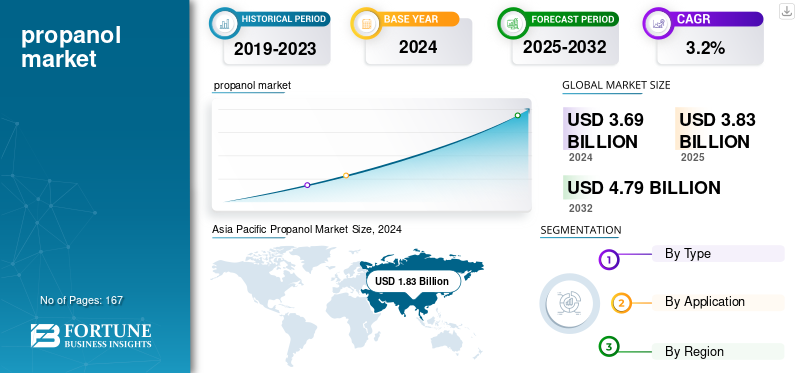
The global propanol market size was valued at USD 3.69 billion in 2024. The market is projected to grow from USD 3.83 billion in 2025 to USD 4.79 billion by 2032, exhibiting a CAGR of 3.2% during the forecast period. Asia Pacific dominated the global propanol market with a market share of 49.59% in 2024.
Propanol refers to a group of three-carbon alcohols (C₃H₈O) that exist mainly as two structural isomers — n-propanol (1-propanol) and isopropanol (2-propanol or isopropyl alcohol). Both are clear, colorless, volatile liquids with characteristic alcoholic odors and are miscible with water and most organic solvents. The expanding demand for solvents across various end-use industries is driving the market.
The market encompasses several major players, with BASF, Sasol Chemicals, Luxi Chemical Group, Mitsui Chemicals, and ExxonMobil being other key players at the forefront. A broad portfolio, innovative product launches, and strong geographic presence expansion have supported the dominance of these companies in the global market.
Download Free sample to learn more about this report.
Propanol Market Key Takeaways
 Market Size & Forecast
- 2024 Market Size: USD 3.69 billion
- 2025 Market Size: USD 3.83 billion
- 2032 Forecast Market Size: USD 4.79 billion
- CAGR: 3.2% from 2025–2032
 Market Share
- Asia Pacific dominated the global propanol market with a market share of 49.59% in 2024.
- The Isopropyl Alcohol segment held the largest propanol market share
- pharmaceuticals and healthcare segment hold major share expected for 24.24% in 2024.
 Key Regional Highlights
Asia Pacific
Reached USD 1.80 billion in 2023 and USD 1.83 billion in 2024, driven by industrialization and manufacturing growth.
North America
Projected to reach USD 0.67 billion by 2025, supported by pharmaceutical and personal care demand.
Europe
Projected to reach USD 0.70 billion by 2025, driven by paints & coatings and pharmaceutical industries.
U.S.
Projected to reach USD 0.61 billion by 2025, fueled by pharmaceutical and industrial solvent demand.
China
Projected to reach USD 0.98 billion by 2025, supported by strong manufacturing activity and expanding end-use industries.
Read More

MARKET DYNAMICS
MARKET DRIVERS:
Growing Demand for Paints & Coatings Reinforces Global Market Expansion
Propanol is primarily used as a versatile solvent in various products, including paints, coatings, printing inks, adhesives, and cleaning agents. Its chemical properties make it valuable in industries that are growing with construction and manufacturing—especially in the Asia Pacific region, where industrial activity is strong. It dissolves resins, pigments, and other ingredients easily and evaporates at a steady rate, leaving smooth, clean finishes. This makes them ideal for many uses:
- In coatings, propanol helps control thickness and drying speed, improving the finish and preventing surface defects.
- In printing inks, it dries quickly and gives sharp print quality, which is important for packaging materials.
- In adhesives, it enhances stickiness and bonding by facilitating the glue's even spread on surfaces.
- In cleaning products, it quickly removes grease and dirt, dries without residue, and is ideal for surface preparation and equipment cleaning.
Isopropanol evaporates faster and is more effective at dissolving certain plastics and resins, making it commonly used in printing, electronics cleaning, and the formulation of fast-drying coatings. N-Propanol, which evaporates slightly slower, helps coatings flow more smoothly in humid conditions and is also used to produce propyl acetate, another useful solvent. Manufacturers often blend propanol with other solvents to fine-tune drying speed, reduce strong odors, and meet environmental standards. Growing regulations against harmful aromatic solvents have also prompted industries to use safer oxygenated solvents.
Propanol demand closely follows trends in construction and manufacturing. When construction increases, so does the use of paints and coatings for buildings, steel structures, and floors. Every stage—from primer to final finish—needs solvents such as propanol. Similarly, printing ink demand grows with the rise of packaging in e-commerce and fast-moving consumer goods (FMCG). Adhesives are also used more as building and packaging activities expand, especially for laminated panels, flooring, and flexible packaging.
Pharmaceutical Expansion and Generic Growth Fuel Demand for Propanol
Propanol, especially isopropyl alcohol, is closely linked to pharmaceutical manufacturing and hygiene. In plants, it is used as a disinfectant, solvent, and cleaning agent for equipment and surfaces, as well as in some dosage forms.
- The World Health Organization’s hand-hygiene guidance explicitly recommends alcohol-based handrubs formulated with isopropyl alcohol (approximately 75% v/v) or ethanol for routine hand antisepsis in clinical settings, underscoring the central role of IPA in healthcare hygiene and, by extension, in pharmaceutical facilities that follow GMP-aligned sanitation standards.
Two structural trends in 2024 amplified the demand for propanol. First, generic medicines dominate prescription volumes, keeping manufacturing lines for mature molecules highly utilized.
- The U.S. FDA notes that about 91% of all prescriptions in the U.S. are filled with generics—illustrating the size of the generic base and the continuous need for solvents and sanitizers across high-throughput facilities.
Second, export-oriented production hubs expanded output. India, ranked third globally by volume, reported pharmaceutical exports of USD 27.85 billion in FY 2023–24, a new high that reflects sustained manufacturing activity across APIs and formulations. These operations consume IPA and, to a lesser extent, n-propanol for process solvents, line cleaning, and hygiene compliance.
Beyond these anchor markets, broader pharmaceutical consumption across OECD economies continued to rise post-pandemic, supporting steady utilization of solvent and hygiene inputs within supply chains. The OECD’s 2023 indicators show ongoing increases in medicine use, consistent with aging populations and the treatment needs for chronic diseases, which keep formulation and filling operations busy and solvent demand resilient.
MARKET RESTRAINTS:
Feedstock And Energy Price Volatility to Limit Market Growth
Propanol production is tightly linked to petrochemical feedstocks (e.g., propylene or ethylene routes) and therefore exposed to oil & gas price swings. Volatile feedstock and energy costs compress margins for producers, making long-term contracts harder to price for downstream customers. This encourages end-users to optimize away from single-solvent dependence, again moderating demand growth.
Commercial propanol is primarily produced from petrochemical intermediates, such as propylene (via hydration/oxidation routes) or related oxo-alcohol pathways. These intermediates, in turn, come from crude-oil- or natural-gas–based streams (naphtha crackers, refinery propylene, etc.). When crude or gas prices spike or collapse, the cost of these intermediates can change sharply in a short period. Producers then face squeezed and highly unstable margins, especially if they are locked into medium-term supply contracts with downstream customers. This is expected to hinder the propanol market growth over the projected period.
MARKET OPPORTUNITIES:
Growing Hygiene Standards Create Growth Avenues
Propanol still has a strong upside, especially where hygiene, high-performance waterborne systems, and sustainability intersect.
The most promising opportunity lies in the long-term demand for hygiene and healthcare products. The World Health Organization formally recommends two alcohol-based handrub formulations, one with 75% v/v isopropanol and another with 60% v/v n-propanol as the reference standard for surgical hand antisepsis. During the COVID-19 pandemic, IPA prices in the U.S. and Europe reached record highs as demand for hand sanitizer and disinfectant outstripped supply, underscoring the central role IPA has come to play in infection control. Even as the pandemic spike normalizes, higher baseline use of alcohol-based handrubs in hospitals, public spaces, and households structurally supports demand.
MARKET CHALLENGES:
Substitution Pressure from Alternatives to Hamper Market Growth
Competition from lower-VOC and non-flammable alternatives is intensifying. The rapid growth of water-borne coatings (already the dominant technology in decorative paints in regions such as Europe) and the increased demand for glycol ethers, acetates, and water-rich cleaning systems structurally limit how much propanol can grow as a classic solvent. Once customers reformulate away from high-solvent systems, they rarely return, so every successful substitution is typically permanent. A concrete indicator of substitution is the shift in the automotive refinish market. European Commission data, cited in sectoral analyses, show that the share of water-based coatings in the auto refinish market in Europe rose from approximately 8% in 2007 to around 20% in 2020 – a traditionally solvent-heavy segment. This growth comes largely at the expense of solvent-borne systems, where propanol and similar alcohols are used as key solvents.
- In Europe, solvent-related non-methane VOC emissions have decreased by ~49% between 1990 and 2018, and by 27% since 2005, according to data compiled for the EMEP/EEA Guidebook using estimates from the European Solvent Industry Group (ESIG).
PROPANOL MARKET TRENDS:
Decarbonization And Rise Of Bio / CO₂-Based Propanol is a Significant Market Trend
Decarbonisation and the rise of bio- or CO₂-based propanol are among the most significant structural trends in the market, creating a new “green solvent” niche with premium growth.
On the technology side, LanzaTech Global is a flagship example. In October 2024, it was awarded USD 3 million by the U.S. Department of Energy’s Office of Fossil Energy and Carbon Management for the Project ADAPT (Accelerating Decarbonization via Advanced Production Technologies) initiative. The project specifically targets the conversion of waste CO₂ into sustainable IPA, building on LanzaTech’s existing pilot-scale work using CO₂ as a feedstock to make IPA. This indicates that carbon-reuse routes to propanol are transitioning from the lab to DOE-backed demonstrations, with explicit decarbonization goals.
Download Free sample to learn more about this report.
Segmentation Analysis
By Type
Isopropyl Alcohol Dominated Market Due to Growing Demand from End-use Industries
Based on type, the market is segmented into n-Propanol and Isopropyl Alcohol.
The Isopropyl Alcohol segment held the largest propanol market share due to its wider and more mature usage across key end-use industries. It is a primary solvent and disinfectant in pharmaceuticals, personal care, and medical hygiene (sanitizers, wipes, hospital disinfectants), where demand remains structurally high. It is also extensively used in electronics cleaning, inks, coatings, and industrial degreasing due to its fast evaporation and good solvency.
N-Propanol serves as an intermediate for propyl acetate and other derivatives used in specialty formulations. Its growth is supported by expanding manufacturing and construction activity.
By Application
Paints, Coatings & Inks Segment to Dominate Due to Higher Adoption
Based on application, the market is classified into paints, coatings & inks, pharmaceuticals and healthcare, personal care and home care, industrial and chemical manufacturing, electronics and specialty cleaning, and others.
The paints, coatings & inks segment is expected to dominate consumption, as these applications primarily use propanol as a solvent and co-solvent in large volumes. It improves flow, leveling, drying time, and adhesion in architectural paints, industrial coatings, automotive finishes, and printing inks. Growing construction, infrastructure projects, and packaging demand directly translate into higher solvent usage in these formulations. Additionally, propanol is compatible with many resin systems and can be blended with other solvents, making it a versatile choice for formulators. This broad, high-volume usage base keeps paints, coatings & inks the leading end-use segment.
To know how our report can help streamline your business, Speak to Analyst
Propanol Market Regional Outlook
By geography, the market is categorized into Europe, North America, Asia Pacific, Latin America, and the Middle East & Africa.
Asia Pacific Propanol Market Size, 2024 (USD Billion)
To get more information on the regional analysis of this market, Download Free sample
Asia Pacific
Asia Pacific held the dominant share in 2023 valuing at USD 1.80 billion and also took the leading share in 2024, with USD 1.83 billion. In 2025, the China market is estimated to reach USD 0.98 billion. The growth in this region is attributed to rapid industrialization, strong manufacturing activity, and the expansion of end-use industries such as paints & coatings, pharmaceuticals, personal care, and electronics in countries such as China, India, South Korea, and Southeast Asia.
Rising construction and infrastructure spending boosts solvent demand in architectural and industrial coatings, while growing pharmaceutical and hygiene sectors sustain high isopropyl alcohol consumption. In addition, favorable production economics, abundant petrochemical feedstocks, and continued capacity additions by regional chemical producers make the Asia Pacific a cost-competitive hub for propanol, supporting both local consumption and export-oriented supply.
To know how our report can help streamline your business, Speak to Analyst
North America
In North America, the market growth is driven by strong demand from the pharmaceutical industry, as well as home care & personal care products, as well as high-performance coatings and inks. The region has a well-established hygiene culture, characterized by sustained consumption of IPA-based sanitizers and disinfectants, alongside advanced manufacturing in the automotive, aerospace, packaging, and electronics sectors. The market in North America is estimated to reach USD 0.67 billion in 2025 and secure the position of the third-largest region in the market. In the region, the U.S. is estimated to reach USD 0.61 billion in 2025.
The U.S. propanol market is a mature but steadily evolving market, driven primarily by demand from pharmaceuticals, personal care, coatings, inks, electronics cleaning, and industrial solvents. The market is dominated by isopropanol (IPA), which accounts for the vast majority of propanol consumption, while n-propanol serves more specialized applications such as printing inks, coatings, agrochemical formulations, and chemical intermediates.
Europe
During the forecast period, Europe is projected to record a growth rate of 2.9% and reach a valuation of USD 0.70 billion by 2025. In Europe, the market growth is mainly attributed to a large, mature paints, coatings & inks industry, strong pharmaceutical and personal care sectors, and stringent hygiene and quality standards. The region’s focus on high-performance, low-VOC waterborne coatings and specialty inks sustains demand as a co-solvent. At the same time, established pharmaceutical, home care, and industrial cleaning markets, particularly in Germany, France, Italy, and the U.K., support steady demand for isopropyl alcohol in disinfectants, excipients, and precision cleaning applications. Backed by these factors, Germany is estimated to record USD 0.21 billion, and France USD 0.11 billion in 2025.
Latin America and Middle East & Africa
Over the forecast period, the Latin America and Middle East & Africa regions are expected to witness moderate growth in this market. The Latin American market is expected to reach a valuation of USD 0.38 billion by 2025. In Latin America, the growth of the market is attributed to the expansion of construction and infrastructure activities, which boost demand for architectural and industrial paints, coatings & inks, especially in Brazil, Mexico, and Colombia. The rising production of pharmaceuticals, personal care, and home care products, along with improving hygiene awareness and a growing middle-class consumer base, further supports the use of isopropyl alcohol in sanitizers, cleaners, and cosmetic formulations across the region. In the Middle East & Africa, Saudi Arabia is expected to reach a value of USD 0.17 billion by 2025. The growth is associated with an increase in construction and infrastructure projects.
COMPETITIVE LANDSCAPE
Key Industry Players:
Technological Innovations, coupled with Strong Distribution Network of Key Companies support their Leading Position
The propanol market is moderately consolidated. The players are actively involved in product innovation, strategic partnerships, and geographic expansion. Dow, BASF, LyondellBasell, ExxonMobil, Mitsui, and LG Chem are some of the dominating players in the market. A comprehensive range of products, a global presence through a strong distribution network, and collaborations with end-use industries are a few characteristics that support the dominance of these players. Other prominent players in the market include OQ Chemicals, Sasol, Zibo Nalcohol, Nanjing Nalcohol, and Luxi Chemical. These companies are undertaking various strategic initiatives, including investments in R&D and partnerships with other companies, to enhance their market presence.
LIST OF KEY PROPANOL COMPANIES PROFILED:
- BASF SE (Germany)
- Dow Inc. (U.S.)
- LyondellBasell Industries Holdings B.V. (Netherlands)
- ExxonMobil Chemical Company (U.S.)
- Eastman Chemical Company (U.S.)
- Royal Dutch Shell plc (U.K.)
- INEOS Group Holdings S.A. (U.K.)
- OQ Chemicals (Germany)
- Mitsui Chemicals, Inc. (Japan)
- LG Chem Ltd. (South Korea)
- Luxi Chemical Group Co., Ltd. (China)
- Sasol Limited (South Africa)
- Ningbo Juhua Chemical (China)
KEY INDUSTRY DEVELOPMENTS:
- March 2025 - In response to rising demand for U.S.-made semiconductors and tighter purity standards for advanced chips, ExxonMobil planned to expand its isopropyl alcohol (IPA) portfolio in 2027 by starting production of 99.999% ultra-pure IPA in Baton Rouge. The entire IPA supply chain, from raw materials to finished product, will be U.S.-based, increasing high-purity IPA output and reinforcing the domestic supply chain that supports American industry.
- August 2024 - Eastman launched electronic grade isopropyl alcohol (IPA), the latest addition to the EastaPure electronic chemicals line, which offers U.S. semiconductor manufacturers a domestically made solvent as reliable in quality as it is in supply.
- September 2023 - Ningbo Juhua Chemical brought its new 1-propanol plant onstream. The facility has a nameplate capacity of 50 kilotons per year and is also designed to produce propionaldehyde alongside 1-propanol. This capacity addition strengthens the company’s presence in the n-propanol value chain, enabling it to participate more actively in both solvent and intermediate markets.
- July 2021 - Eni and BASF entered into a strategic agreement for a joint R&D initiative aimed at lowering the CO₂ footprint of the transportation sector. Under this collaboration, the companies plan to develop an innovative technology to produce advanced bio-propanol using glycerin, a by-product stream from industrial biodiesel (FAME, fatty acid methyl ester) production, which Eni will source from European producers.
- April 2020 - Oxea (now OQ Chemicals) tripled its delivery volumes of 1-propanol in Europe to meet surging demand from hand sanitizer manufacturers and the printing industry.
REPORT COVERAGE
The global market analysis provides an in-depth study of market size & forecast by all market segments included in the report. It includes details on the market dynamics and market trends expected to drive the market in the forecast period. It offers information on the technological advancements, new product launches, key industry developments, and details on partnerships, mergers & acquisitions. The market research report also encompasses a detailed competitive landscape, including information on market share and profiles of key operating players.
Request for Customization to gain extensive market insights.
Report Scope & Segmentation
|
ATTRIBUTE |
DETAILS |
|
Study Period |
2019-2032 |
|
Base Year |
2024 |
|
Forecast Period |
2025-2032 |
|
Historical Period |
2019-2023 |
|
Growth Rate |
CAGR of 3.2% from 2025-2032 |
|
Unit |
Value (USD Billion) Volume (Kiloton) |
|
Segmentation
|
By Type · n-Propanol · Isopropyl Alcohol |
|
By End-use · Paints, Coatings & Inks · Pharmaceutical & Healthcare · Personal Care & Home Care · Industrial & Chemical Manufacturing · Electronics & Specialty Cleaning · Others |
|
|
By Region · North America (By Type, Application, and Country) o U.S. (By Application) o Canada (By Application) · Europe (By Type, Application, and Country/Sub-region) o Germany (By Application) o U.K. (By Application) o France (By Application) o Italy (By Application) o Spain (By Application) o Rest of Europe (By Application) · Asia Pacific (By Type, Application, and Country/Sub-region) o China (By Application) o Japan (By Application) o India (By Application) o South Korea (By Application) o Rest of Asia Pacific (By Application) · Latin America (By Type, Application, and Country/Sub-region) o Brazil (By Application) o Mexico (By Application) o Rest of Latin America (By Application) · Middle East & Africa (By Type, Application, and Country/Sub-region) o GCC (By Application) o South Africa (By Application) o Rest of Middle East & Africa (By Application) |
Frequently Asked Questions
Fortune Business Insights says that the global market value stood at USD 3.69 billion in 2024 and is projected to reach USD 4.79 billion by 2032.
In 2024, the market value stood at USD 1.83 billion.
The market is expected to exhibit a CAGR of 3.2% during the forecast period of 2025-2032.
The isopropyl alcohol segment led the market by type.
The increasing demand from the pharmaceutical sector is driving the market.
Dow, BASF, LyondellBasell, ExxonMobil, Mitsui, and LG Chem are some of the prominent players in the market.
Asia Pacific dominated the market in 2024.
Rising pharmaceutical & personal care production is expected to favor the product adoption.



- 2019-2032
- 2024
- 2019-2023
- 167
Get 30-60 hrs Free Customization
Expand Regional and Country Coverage, Segments Analysis, Company Profiles, Competitive Benchmarking, and End-user Insights.


















Related Reports
-
US +1 833 909 2966 ( Toll Free )
-
Get In Touch With Us