Proton Therapy Systems Market Size, Share & Industry Analysis, By Product (Equipment, Services), By Type (Single-Room System, Multi-Room System), and Regional Forecast, 2026-2034
 Download Free Sample
Proton Therapy Systems Market Overview
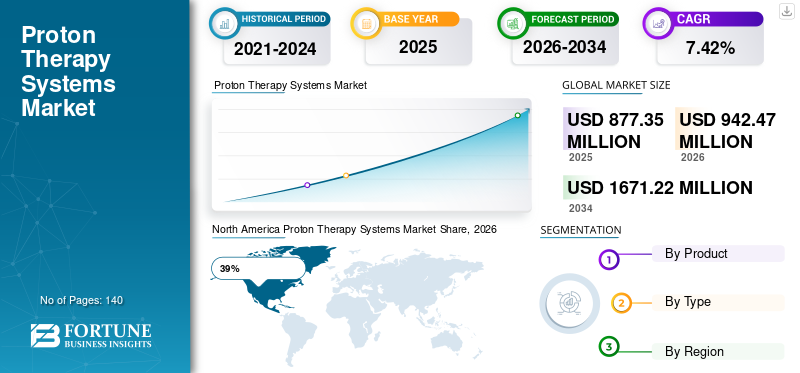
The global proton therapy systems market size was valued at USD 877.35 Million in 2025. The market is projected to grow from USD 942.47 Million in 2026 to USD 1671.22 Million by 2034, exhibiting a CAGR of 7.42% during the forecast period.

The proton therapy systems market is gaining strong momentum as healthcare providers focus on advanced radiation oncology technologies that improve treatment precision while reducing exposure to healthy tissues. Proton therapy systems are increasingly adopted for pediatric cancers, brain tumors, prostate cancer, and complex oncological conditions requiring targeted radiation delivery. Growing installation of compact systems, advancements in pencil beam scanning technology, and increasing investments in specialized cancer treatment centers continue to shape proton therapy systems market growth. Healthcare institutions are expanding proton therapy infrastructure to address rising cancer incidence and growing demand for personalized treatment pathways. The proton therapy systems market report highlights increasing collaboration between hospitals, research institutes, and equipment manufacturers.
The USA proton therapy systems market represents a significant portion of global demand due to advanced healthcare infrastructure and strong adoption of radiation oncology technologies. The country hosts a large number of operational proton therapy centers, supporting continuous demand for equipment upgrades, treatment planning software, and maintenance services. Growing prevalence of pediatric cancer treatments, favorable clinical research activity, and increasing awareness among oncologists contribute to market expansion. Several healthcare systems are investing in compact proton therapy installations to improve accessibility and patient throughput. The proton therapy systems market analysis for the United States indicates increasing utilization of image-guided treatment systems and adaptive therapy technologies across major cancer treatment facilities.
Download Free sample to learn more about this report.
proton therapy systems market Key Takeaways
 Global Market Size & Forecast
- 2025 Market Size: USD 877.35 Million
- 2026 Market Size: USD 942.47 Million
- 2034 Forecast Market Size: USD 1,671.22 Million
- CAGR: 7.42% from 2026-2034
 Market Share
- North America dominated with a regional market share of 39% in 2025.
- Equipment led by product with approximately 72% market share.
- Multi-room systems led by type with approximately 62% market share.
 Key Regional Highlights
North America
North America held the largest regional share at 39% of the global market.
Europe
Europe accounted for 28% of the global market, supported by advanced oncology infrastructure.
Asia-Pacific
Asia-Pacific represented 25% of the global market, driven by increasing investments in cancer treatment facilities.
U.S
The U.S. remains a major market, supported by advanced healthcare infrastructure and growing adoption of proton therapy.
Japan
Japan accounted for 32% of the Asia-Pacific market, supported by advanced oncology capabilities and proton therapy adoption.
Read More

proton therapy systems market Latest Trends
The proton therapy systems market trends indicate a transition from large multi-room facilities toward compact single-room solutions that reduce installation complexity and operational costs. Healthcare providers increasingly prefer systems that occupy smaller footprints while maintaining high treatment accuracy. Pencil beam scanning technology continues to gain traction because it enables precise dose distribution and minimizes radiation exposure to surrounding healthy tissues. Manufacturers are integrating artificial intelligence into treatment planning workflows to improve efficiency and support personalized cancer treatment approaches.
Download Free sample to learn more about this report.
Another significant trend in the Proton Therapy Systems Industry Analysis is the adoption of adaptive proton therapy and real-time imaging capabilities. Hospitals are investing in advanced motion management technologies to address tumor movement during treatment. Growing clinical evidence supporting proton therapy for pediatric oncology, head and neck cancers, and central nervous system tumors is encouraging broader adoption. Market participants are also focusing on workflow automation, cloud-based treatment planning platforms, and improved patient positioning systems. The proton therapy systems market outlook further reflects rising demand for high-throughput treatment facilities, expansion of proton therapy centers across emerging economies, and increasing collaboration between academic institutions and technology providers to develop next-generation treatment solutions.
proton therapy systems market Dynamics
DRIVER
Rising demand for precision cancer treatment technologies
The increasing burden of cancer worldwide remains one of the strongest growth drivers for the proton therapy systems market. Healthcare providers are actively seeking radiation treatment technologies capable of delivering highly targeted therapy while reducing damage to healthy tissues. Proton therapy offers significant advantages in treating pediatric cancers, brain tumors, spinal tumors, and other complex malignancies where treatment precision is critical. Growing awareness among oncologists regarding long-term clinical benefits is accelerating adoption. The proton therapy systems market Research Report indicates increasing installation of advanced particle therapy facilities in developed healthcare systems. Improvements in imaging integration, treatment planning software, and beam delivery systems are further strengthening demand. Expansion of specialized oncology centers and rising investment in radiation oncology infrastructure continue supporting market development across multiple regions.
RESTRAINT
High installation and operational expenses
The substantial capital investment required for proton therapy facility development remains a major restraint for market expansion. Construction of proton therapy centers involves significant expenditure related to particle accelerators, shielding infrastructure, treatment rooms, and specialized clinical equipment. Operational costs associated with maintenance, staffing, and technical support further increase financial burden for healthcare institutions. Smaller hospitals often face challenges in justifying such investments due to patient volume requirements. Reimbursement limitations in certain healthcare systems also affect adoption rates. The proton therapy systems market analysis identifies lengthy regulatory approval processes and facility construction timelines as additional barriers. Although compact systems are reducing infrastructure requirements, cost-related concerns continue influencing purchasing decisions among healthcare providers in developing and emerging economies.
OPPORTUNITY
Expansion of compact single-room proton therapy centers
Growing availability of compact proton therapy systems presents significant opportunities for industry participants. Single-room installations require less physical space, lower infrastructure investment, and reduced operating costs compared to traditional multi-room facilities. This development enables regional hospitals and mid-sized cancer centers to consider proton therapy implementation. The proton therapy systems market opportunities landscape is further strengthened by increasing government support for advanced cancer treatment programs and rising private healthcare investments. Emerging economies are demonstrating growing interest in establishing localized proton therapy facilities to reduce dependence on overseas treatment options. Manufacturers are also exploring modular facility designs and scalable treatment platforms that allow healthcare providers to expand capacity gradually. These developments create favorable conditions for long-term market penetration and broader accessibility.
CHALLENGE
Limited availability of trained specialists
One of the primary challenges affecting the proton therapy systems market is the shortage of experienced professionals capable of operating sophisticated proton therapy equipment. Successful treatment delivery requires collaboration among radiation oncologists, medical physicists, dosimetrists, and highly trained technical personnel. Many regions lack sufficient educational programs focused on proton therapy technologies, limiting workforce availability. The Proton Therapy Systems Industry Report highlights that facility expansion often depends on recruitment and training capabilities. Differences in treatment protocols and evolving technological requirements create additional complexity. Healthcare providers must invest heavily in professional development programs to maintain treatment quality and patient safety. The challenge is particularly evident in emerging markets where adoption is increasing faster than specialist workforce development.
proton therapy systems market Segmentation
By Product
Equipment accounts for approximately 72% market share within the proton therapy systems market. Demand remains strong for cyclotrons, synchrotrons, gantries, treatment planning software, beam delivery systems, and patient positioning technologies. Hospitals continue investing in advanced proton therapy equipment to improve treatment accuracy and enhance clinical outcomes. Technological improvements in pencil beam scanning and image-guided therapy systems are contributing to segment expansion. The proton therapy systems market forecast indicates sustained procurement activity among newly established cancer centers. Equipment manufacturers are focusing on compact designs, enhanced automation capabilities.
Services represent nearly 28% market share in the proton therapy systems market. This segment includes installation support, maintenance contracts, software upgrades, staff training, system calibration, and technical consulting services. Growing complexity of proton therapy operations increases dependence on specialized service providers. Hospitals require ongoing support to maintain treatment accuracy and regulatory compliance. The proton therapy systems market Insights reveal increasing adoption of long-term service agreements that ensure equipment reliability and minimize operational disruptions. As the installed base of proton therapy systems expands globally, demand for maintenance and lifecycle management services continues rising.
To know how our report can help streamline your business, Speak to Analyst
By Type
Single-Room System: Single-room systems account for approximately 38% market share and represent one of the fastest-growing application segments in the proton therapy systems market. Healthcare providers increasingly favor compact installations because they require lower capital expenditure and reduced facility space. Single-room systems enable regional hospitals and independent oncology centers to access advanced proton therapy capabilities. Manufacturers are introducing highly efficient designs that maintain treatment precision while improving affordability. The proton therapy systems market growth within this segment is supported by increasing demand for decentralized cancer treatment infrastructure.
Multi-Room System: Multi-room systems hold nearly 62% market share and continue to dominate installed capacity within the proton therapy systems market. Large academic hospitals and specialized cancer centers prefer multi-room facilities because they support higher patient throughput and greater operational efficiency. These installations allow simultaneous treatment across multiple rooms while sharing central accelerator infrastructure. The Proton Therapy Systems Industry Analysis indicates continued investment in large-scale proton therapy centers serving regional and national patient populations. Multi-room systems remain particularly attractive for institutions conducting clinical research and advanced oncology programs.
proton therapy systems market Regional Outlook
North America
North America Proton Therapy Systems Market Share, 2025 (%)
To get more information on the regional analysis of this market, Download Free sample
North America accounts for approximately 39% of the proton therapy systems market share and continues to lead the global industry due to its advanced oncology infrastructure and strong adoption of innovative cancer treatment technologies. The region benefits from a large number of operational proton therapy centers, particularly in the United States, which serves as the primary contributor to regional demand. Hospitals and specialized cancer institutes are increasingly investing in treatment upgrades, imaging integration, and precision radiation platforms to improve clinical outcomes. Growing prevalence of pediatric cancers, brain tumors, and prostate cancer is supporting patient volume growth across proton therapy facilities. Academic research institutions actively collaborate with manufacturers to develop next-generation treatment solutions. Expanding reimbursement coverage and favorable clinical evidence are encouraging wider utilization. Healthcare providers are also focusing on compact proton therapy installations to improve accessibility in regional markets. Continuous technological advancements and infrastructure investments strengthen North America's position in the proton therapy systems market.
Europe
Europe holds nearly 28% of the proton therapy systems market share and remains one of the most established regions for advanced radiation oncology services. The region benefits from strong public healthcare systems, increasing cancer treatment investments, and growing adoption of precision medicine approaches. Countries across Western and Northern Europe continue expanding proton therapy capacity to meet rising patient demand. Government support for cancer research and advanced treatment technologies plays a significant role in market expansion. Healthcare providers are increasingly implementing adaptive proton therapy techniques and sophisticated treatment planning systems. Research collaborations between universities, oncology centers, and technology developers are accelerating innovation. Growing awareness of proton therapy benefits among clinicians supports patient referrals. Pediatric oncology applications continue to generate strong demand throughout the region. Ongoing modernization of cancer treatment infrastructure and increased access to specialized centers are expected to sustain market growth across Europe.
Germany Proton Therapy Systems Market
Germany represents approximately 24% of the European proton therapy systems market and serves as one of the region’s leading adopters of advanced oncology technologies. The country benefits from a highly developed healthcare system, extensive cancer research activities, and strong investments in medical innovation. German hospitals and cancer centers continue expanding access to proton therapy for complex and difficult-to-treat cancers. Demand is increasing for advanced treatment planning software, image-guided therapy solutions, and precision beam delivery technologies. Research institutions play an important role in evaluating clinical outcomes and supporting technological advancements. Growing emphasis on personalized medicine further contributes to proton therapy adoption. Healthcare providers are investing in infrastructure modernization to improve treatment efficiency and patient care. Collaboration between medical institutions and equipment manufacturers supports continuous innovation. Germany remains a key market for both existing and future proton therapy installations.
United Kingdom Proton Therapy Systems Market
The United Kingdom accounts for approximately 18% of the European proton therapy systems market and continues to strengthen its position through ongoing investments in advanced cancer care infrastructure. The expansion of specialized proton therapy centers has significantly improved patient access to precision radiation treatments. Healthcare authorities are supporting domestic treatment capabilities to reduce dependence on overseas referrals. Increasing awareness among oncologists regarding the benefits of proton therapy is contributing to higher utilization rates. Clinical research programs and academic collaborations are helping expand evidence-based applications for proton therapy. Hospitals are integrating advanced imaging and treatment planning technologies to enhance treatment accuracy. Demand is particularly strong for pediatric cancer and central nervous system tumor treatments. Continuous modernization of oncology services and growing patient acceptance support market growth. The United Kingdom remains an important contributor to the European proton therapy systems market outlook.
Asia-Pacific
Asia-Pacific holds approximately 25% of the proton therapy systems market share and is widely recognized as the fastest-growing regional market. Rising cancer incidence, expanding healthcare infrastructure, and increasing government support for advanced oncology treatments are driving demand throughout the region. Countries such as China, Japan, South Korea, and India are investing heavily in specialized cancer treatment facilities. Growing awareness of precision radiation therapy among healthcare professionals is encouraging broader adoption. Regional governments are supporting infrastructure development through funding programs and healthcare modernization initiatives. Demand for compact proton therapy systems is increasing due to their lower space and operational requirements. Local manufacturing capabilities and technology partnerships are contributing to market expansion. Academic institutions are actively participating in clinical research and training activities. Continued improvements in healthcare accessibility are expected to create significant growth opportunities across Asia-Pacific.
Japan Proton Therapy Systems Market
Japan accounts for approximately 32% of the Asia-Pacific proton therapy systems market and remains one of the most technologically advanced markets in the world. The country has a long history of particle therapy research and clinical implementation, making it a major center for innovation. Healthcare providers continue investing in sophisticated proton therapy systems equipped with advanced imaging and beam delivery technologies. Demand is supported by a growing elderly population and increasing cancer treatment requirements. Hospitals are adopting highly precise treatment planning platforms to improve patient outcomes. Strong collaboration between research institutions and equipment manufacturers drives continuous technological development. Government support for advanced healthcare services further strengthens market growth. Japan also serves as an important hub for clinical studies evaluating proton therapy effectiveness. Ongoing investments in oncology infrastructure continue supporting market expansion.
China Proton Therapy Systems Market
China represents approximately 26% of the Asia-Pacific proton therapy systems market and is experiencing rapid growth due to large-scale healthcare infrastructure development. Rising cancer prevalence and increasing demand for advanced treatment options are encouraging investment in proton therapy facilities. Major metropolitan areas are witnessing the construction of new proton therapy centers to meet growing patient requirements. Government initiatives promoting advanced medical technology adoption are accelerating market development. Domestic manufacturers are increasingly participating in proton therapy equipment production, enhancing industry competitiveness. Healthcare institutions are investing in modern treatment planning and imaging technologies to improve treatment precision. Clinical research activities are expanding as awareness of proton therapy benefits grows. Improved healthcare accessibility and rising healthcare expenditure continue supporting adoption. China is expected to remain a major growth engine within the global proton therapy systems market.
Rest of World
The Rest of World region accounts for approximately 8% of the proton therapy systems market share and includes emerging markets across Latin America, the Middle East, and Africa. Although adoption levels remain lower than in developed regions, significant opportunities exist due to ongoing healthcare modernization initiatives. Governments are increasingly recognizing the importance of advanced cancer treatment technologies to address rising oncology burdens. Investments in specialized cancer centers are supporting the gradual introduction of proton therapy services. International collaborations and technology transfer agreements are helping improve regional expertise and infrastructure capabilities. Private healthcare providers are playing a crucial role in expanding access to advanced radiation therapy solutions. Demand for training programs, maintenance services, and technical support continues to increase as new facilities become operational. Growing awareness among healthcare professionals and patients supports future adoption. The region is expected to witness steady development as healthcare systems continue evolving.
List of Top Proton Therapy Systems Companies
- IBA Worldwide
- Optivus Proton Therapy, Inc.
- Mevion Medical Systems
- Advanced Oncotherapy plc
- Varian Medical Systems, Inc
- ProTom International, Inc
- Hitachi, Ltd.
- Mitsubishi Corporation
- ProNova Solutions, LLC
- Sumitomo Heavy Industries, Ltd
Top Two Companies with Highest Market Share
- IBA Worldwide – approximately 31% market share
- Varian Medical Systems, Inc – approximately 22% market share
Investment Analysis and Opportunities
The proton therapy systems market is attracting substantial investment from healthcare organizations, private equity groups, medical technology companies, and government healthcare agencies. Rising demand for precision oncology treatment is encouraging construction of new proton therapy facilities across developed and emerging markets. Investment activity is increasingly focused on compact single-room systems because they reduce capital requirements while improving accessibility. The proton therapy systems market opportunities landscape is expanding through strategic partnerships between equipment manufacturers and healthcare providers seeking long-term infrastructure development.
Research funding for adaptive proton therapy, image-guided treatment systems, and artificial intelligence integration continues increasing. Investors are also supporting software development initiatives that improve treatment planning efficiency and workflow automation. Growing clinical acceptance of proton therapy for pediatric and complex cancer cases strengthens confidence in long-term market potential. Expansion of cancer treatment networks, rising patient awareness, and technological innovation continue creating attractive opportunities for both established industry participants and new market entrants.
New Product Development
Innovation remains a major focus within the proton therapy systems market as manufacturers pursue higher treatment precision, improved workflow efficiency, and lower operating costs. New product development efforts increasingly target compact accelerator systems capable of reducing facility footprints without compromising clinical performance. Advanced pencil beam scanning technologies are enhancing dose accuracy and supporting treatment of complex tumor geometries. Manufacturers are introducing integrated imaging platforms that improve tumor visualization and adaptive treatment planning capabilities.
Artificial intelligence is becoming a critical component of next-generation proton therapy systems. AI-driven software assists clinicians in treatment planning, patient positioning, and dose optimization. Real-time motion management technologies are also receiving significant attention to address challenges associated with respiratory movement during treatment. The proton therapy systems market trends further indicate growing development of modular treatment platforms that allow healthcare providers to expand capacity incrementally. Innovations in gantry design, energy delivery systems, and automated quality assurance processes are helping improve operational efficiency while reducing treatment times. These technological advancements continue reshaping the competitive landscape and supporting broader clinical adoption.
Five Recent Developments (2023-2025)
- IBA Worldwide expanded deployment of compact proton therapy solutions designed to improve accessibility for regional cancer centers during 2024.
- Varian Medical Systems enhanced integration capabilities between proton therapy platforms and advanced oncology software systems in 2025.
- Mevion Medical Systems introduced upgrades to single-room proton therapy technology focused on workflow efficiency and treatment precision in 2024.
- Hitachi, Ltd. advanced development of image-guided proton therapy technologies supporting adaptive treatment approaches during 2025.
- Sumitomo Heavy Industries expanded proton therapy project collaborations across Asia-Pacific healthcare institutions between 2023 and 2025.
Report Coverage
The proton therapy systems market report provides comprehensive evaluation of industry developments, technological advancements, competitive positioning, and regional growth patterns. The report examines market dynamics including drivers, restraints, opportunities, and challenges influencing adoption across healthcare systems. Detailed segmentation analysis covers equipment and services as well as single-room and multi-room system applications. The proton therapy systems market Research Report evaluates demand trends across hospitals, cancer treatment centers, and specialized oncology facilities.
Request for Customization to gain extensive market insights.
The study further analyzes regional performance across North America, Europe, Asia-Pacific, and Rest of World markets while highlighting country-level developments in major healthcare economies. Competitive landscape assessment includes profiles of leading manufacturers, product innovation strategies, facility expansion initiatives, and partnership activities. The proton therapy systems market Insights section explores emerging technologies such as adaptive proton therapy, artificial intelligence integration, advanced imaging systems, and automated treatment planning platforms. Market coverage also includes investment trends, infrastructure development activities, regulatory influences, clinical adoption patterns, and future opportunities expected to shape the Proton Therapy Systems Industry Outlook during the forecast period.
Frequently Asked Questions
Fortune Business Insights says that the global market value stood at USD 877.35 billion in 2025 and is projected to reach USD 1,671.22 billion by 2034.
The market is expected to exhibit a CAGR of 7.42% during the forecast period of 2026-2034.
Equipment was the leading product segment, accounting for approximately 72% of the market, driven by continued investments in advanced proton therapy equipment and treatment precision technologies.
Key players include IBA Worldwide, Optivus Proton Therapy, Inc., Mevion Medical Systems, Advanced Oncotherapy plc, Varian Medical Systems, Inc., and ProTom International, Inc.
Major trends include the shift toward compact single-room systems and increasing adoption of pencil-beam scanning and image-guided technologies. North America leads with approximately 39% market share, supported by advanced oncology infrastructure and strong adoption of proton therapy.



- 2021-2034
- 2025
- 2021-2024
- 140
-

(Offer valid till 30th Sep 2026)
Get 30-60 hrs Free Customization
Expand Regional and Country Coverage, Segments Analysis, Company Profiles, Competitive Benchmarking, and End-user Insights.













.webp)






-
US +1 833 909 2966 ( Toll Free )
-
Get In Touch With Us