Skincare Market Size, Share & Industry Analysis, By Product Type (Cleansers, Toners, Moisturizers [Creams and Lotions], Serums [Hydrating and Anti-aging Serums], Facial Oils, Face Masks, Exfoliators, Sunscreen, and Eye Care Products), By Skin Type (Normal, Dry, Oily, Combination, and Sensitive Skin), By Consumer Group (Women, Men, Unisex, and Kids and Teenagers), By Nature (Natural or Organic and Synthetic), By Price Range (Mass Market, Premium, Prestige, and Luxury), By Distribution Channel (Cosmetic Stores, Supermarket/Hypermarket, and Online Stores), and Regional Forecast, 2026-2034
 Download Free Sample

(Offer valid till 15th Nov 2026)

Skincare Market Size and Future Outlook
 Listen to Audio Version
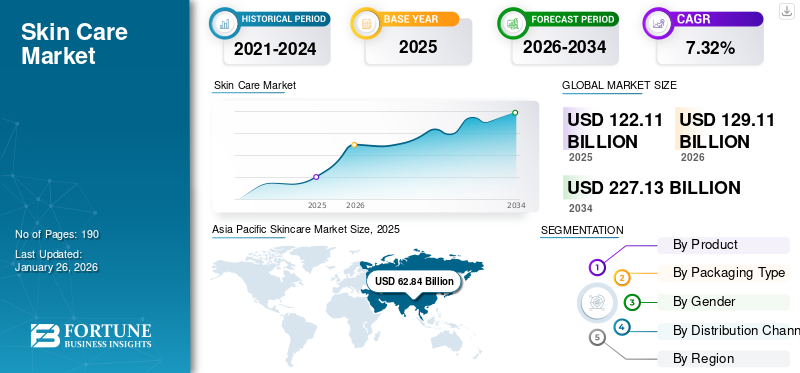
The global skincare market size was valued at USD 122.11 billion in 2025. The market is projected to grow from USD 129.11 billion in 2026 to USD 227.49 billion by 2034, exhibiting a CAGR of 7.34% during the forecast period.
Self-caring products include creams, lotions, and powders, which improve the quality and health of the skin and provide nourishment. These products are used daily by several women and men for various purposes, such as moisturizing, hydrating, and cleansing, and others. The trend for organic and herbal skin care has recently been in demand as people are aware of the adverse effects of synthetic chemicals on the skin. Ingredients derived from natural products, such as leaf extracts and root extracts, are safe for use on the skin as they do not show any side effects. Therefore, companies such as Avon and Garnier use natural ingredients and label their products as ‘Avon Naturals’ and ‘Garnier Organic’ to attract consumers. This is consequently expected to propel the demand for skin nourishment products and boost the market size.
Prominent companies in the global market include L’Oréal S.A., Unilever Plc., The Procter & Gamble Company, Estee Lauder Companies, Inc., and Beiersdorf AG.
Download Free sample to learn more about this report.
SKINCARE MARKET TRENDS
Rising Demand for Personalized Formulation-based Skincare Products to Favor Market Growth
Consumers seek skin healthcare products made of personalized formulations to upgrade their beauty care routines with products based on their skin types, age, lifestyle, skin sensitivity level, and other specific concerns, including pigmentation, dryness, dullness, or wrinkles. Rising demand for such products is favoring the global market growth. In addition, the growing number of brands offering virtual try-on tools, skin quizzes, virtual consultations, dermatologist-backed recommendations, and customized product bundles, enabling consumers to identify suitable products as per their facial health, is augmenting the global market expansion.
MARKET DYNAMICS
MARKET DRIVERS
Download Free sample to learn more about this report.
Increasing Awareness of Personal Care among All Age Groups to Drive Demand
Rising concerns regarding skin nourishment due to many factors, such as acne, black spots, scars, dullness, and tanning, have increased the demand for skin nourishment products. Skin brightening products, toners, and scrubs are witnessing higher demand from the younger population. In contrast, products that provide the solution to wrinkles or cracked heels are gaining significant traction owing to their increasing demand from the aged population. Changing lifestyles and consumer spending patterns on premium beauty care products are projected to support the skincare market growth. Besides, consumers are becoming more informed about skincare ingredients and their effects on the skin. This awareness drives the demand for products with specific ingredients, such as antioxidants, hyaluronic acid, and retinol, known for their skincare benefits. Moreover, the demand for sunscreen lotions and creams is increasing due to the rising awareness of the adverse effects of continuous exposure to the sun.
Increasing Demand for Sustainable Products is Expected to Fuel Market Growth
Consumers now focus on their healthcare with skin nourishment products and are inclined to use environmentally friendly products. For instance, exfoliating personal grooming products contain plastic beads, a significant concern for plastic pollution; therefore, consumers are inclined toward using products that do not contain plastic beads. Companies such as BioPowder are taking initiatives to develop biodegradable microbeads intended to be used in exfoliating products, which will not lead to waste generation. Moreover, manufacturers are focusing on reducing the carbon footprint by adopting improved manufacturing technologies where low energy and resources are required.
Furthermore, innovative and eco-friendly product packaging, which is recyclable or refillable, is also in high demand. Also, due to rising awareness regarding animal rights, consumer preference has shifted toward vegan ingredients, entirely derived from only plant-based products. Therefore, players operating in the market focus on developing vegan products to attract more customers and increase their revenue.
MARKET RESTRAINTS
Excessive Use and Misuse Can Cause Cell Damage and Obstruct Growth
Regular use of cosmetic products for an extended time can damage the skin, resulting in skin irritation, redness, burning sensation, discoloration, and rapid ageing of skin cells. Some skin nourishment products are only meant to be used for particular skin types, such as dry or oily skin. However, consumers tend to purchase products by focusing on brand names and ignoring other product details, which tends to damage their skin. Moreover, few products can also show allergic reactions and the development of pimples due to certain ingredients that are unsuitable for the particular individual. Furthermore, excessive use can lead to severe issues, including skin cancer and melanoma. Therefore, these are some major restraining factors hampering the market growth.
MARKET OPPORTUNITIES
Increasing Population Aging and Rising Demand for Advanced Anti-aging Beauty Care Products to Create New Market Growth Opportunities
Increasing population aging and rising demand for anti-aging skincare products made of advanced formulations and science-backed innovations are creating newer market growth opportunities. According to the World Health Organization, worldwide, the total number of people aged 60 years and above reached around 1.1 billion in 2023. The number is expected to increase up to 1.4 billion by 2030. In addition, the growing popularity of anti-aging serums, eye creams, and premium moisturizers offering benefits of wrinkle reduction, improved firmness, hydration, and radiance is driving the product revenues across many countries. Furthermore, consistent brands’ investments in R&D activities to produce luxury skincare products are augmenting the global market growth.
MARKET CHALLENGES
Increasing Raw Material and Packaging Cost to Challenge Brands’ Profit Margins
Increasing prices of raw materials used in manufacturing cosmetics and facial care products, including botanical extracts, oils, active ingredients, emulsifiers, fragrances, and others, are hampering the profit margins of brands from skin healthcare product categories. In addition, the growing procurement cost of jars, tubes, and other packaging materials and increasing transportation & fuel prices are choking the profit margins, posing challenges to the cosmetics industry's growth.
Segmentation Analysis
By Product Type
Significant Skin Moisturization Need and Product Usage in Daily Beauty Routines Led To Dominance of Moisturizers Segment
Based on product type, the market is segmented into cleaners, toners, moisturizers, serums, facial oils, essences, ampoules, face masks, exfoliators, sunscreens, eye care products, lip care, face packs, and others.
The moisturizers segment accounted for the leading global skincare market share of 16.85% in 2025. The segment is projected to grow at a CAGR of 6.59% from 2026 to 2034. Moisturizers are daily-use beauty products and are available in broader categories, including dry skin moisturizers, aging skin moisturizers, and others. Significant consumer demand for such products in daily healthcare routines generates considerable revenues from such a segment. In addition, advancements in the development of moisturizers with enhanced skin health benefits, including treatments for eczema-prone skin, sensitive skin, post-treatment care, dryness, and damaged skin barriers, are positively contributing to the segmental growth.
The moisturizers segment is further sub-segmented into creams, lotions, gels, and others. The creams segment is expected to hold a significant share. They are used for various applications, such as moisturizing, brightening, tan removal, acne removal, oil reduction, dark circle removal, night cream, and sun protection.
The sunscreen segment is projected to grow at the fastest CAGR of 9.15% during 2026-2034. Consistent brands’ launches of sunscreens with invisible finish, non-greasy textures, high SPF, blue-light protection, and dermatologically tested claims are encouraging consumers toward product purchase decisions, driving the segment’s growth. The sunscreen segment is further sub-segmented into mineral sunscreen, chemical sunscreen, and hybrid sunscreen. The chemical sunscreen sub-segment exhibited a leading share within the sunscreen segment. Lighter chemical sunscreens help consumers use SPF under foundation, primers, or serums without pilling or greasiness, driving the product adoption rate.
To know how our report can help streamline your business, Speak to Analyst
By Skin Type
Consumers Seeking Skincare Products for Treating Sensitive Skin Problems to Drive Segment Growth
Based on skin type, the market is divided into normal skin, dry skin, oily skin, combination skin, sensitive skin, acne-prone skin, and others.
The sensitive skin segment exhibited a leading global market share of 19.51% in 2025. The segment is projected to grow at the fastest CAGR of 8.10% from 2026 to 2034. The rising number of consumers seeking beauty products to treat their sensitive skin problems, including redness, dryness, irritation, itching, burning sensation, and weakened skin barriers, is driving product demand and favoring the sensitive skin segment’s growth. In addition, advancements in the development of hypoallergenic, non-comedogenic, and barrier-repair products for sensitive skin healthcare conditions are augmenting the segmental revenue growth.
The acne-prone skin segment is projected to grow at the fastest CAGR of 7.87% from 2026 to 2034. Increasing prevalence of acne among teenagers and growing availability of beauty products effective for addressing acne skin conditions are driving the segment’s growth.
By Consumer Group
Greater Women's Consciousness about Personal Grooming Led to Dominance of Women Segment
Based on consumer group, the market is divided into women, men, unisex, and kids & teenagers.
The women's segment exhibited a leading global market share of 43.79% in 2025. The segment is projected to grow at a CAGR of 6.88% from 2026 to 2034. The female population is more aware of available products in the market for various applications, which is, in turn, boosting product demand. High female consumers’ consciousness about personal grooming and hygiene is encouraging them to buy cosmetics, generating considerable revenues from the women's segment. However, factors such as changing consumer trends and rising awareness regarding grooming, skin maintenance, and willingness to look better among women have led to the development and launch of new products.
The men's segment is projected to grow at the fastest CAGR of 8.17% from 2026 to 2034. Growing consciousness about personal grooming and health care and the rising interest in face products have supported the men's segment’s growth.
By Nature
Synthetic Segment Led due to its Effectiveness in Formulation Control and Cost-efficiency
Based on nature, the market is bifurcated into natural or organic and synthetic.
The synthetic segment exhibited a leading global market share in 2025. The segment is growing at a CAGR of 6.84% from 2026 to 2034. The segments’ leading share is due to the effectiveness of synthetic products in providing a better combination of formula control, stability, scalability, and cost-efficiency over natural products. In addition, the growing number of brands producing products made of lab-developed ingredients to enhance product performance across different climate conditions, skin types, and shelf-life requirements is positively contributing to the synthetic segment’s growth.
The natural or organic segment is projected to grow at the fastest rate of 8.55% during the forecast period. Rising adoption of cosmetics made of plant-based extracts, botanical oils, natural butters, organic-certified ingredients, and mineral-based actives are driving the sales of naturally derived cosmetics, favoring the segment’s growth.
By Price Range
Significant Demand for Affordable and Value-added Skin Care Products Led to Dominance of Mass Market Segment
Based on the price range, the market is divided into mass market, premium, prestige, and luxury.
The mass market segment exhibited a leading global market share of 45.75% in 2025. The segment is growing at a CAGR of 6.40% from 2026 to 2034. A broader base of middle-income beauty consumers seeking affordable cosmetics is generating considerable revenues from the segment. In addition, expanding infrastructure of pharmacy outlets and supermarkets offering mass-produced cosmetics at affordable prices is positively contributing to the segment’s growth.
The premium segment is projected to grow at the fastest rate of 8.35% during the forecast period. The growing number of consumers willing to spend on premium products that offer visible results, superior skin textures, clinical support, and advanced ingredients is driving the segment’s growth.
By Packaging Type
Significant Usage of Bottles in Packaging Cosmetics Led to Dominance of Bottles Segment
Based on the packaging type, the market is divided into tubes, bottles, pumps, jars, sachets, and others.
The bottles segment exhibited a leading global market share of 29.77% in 2025. The segment is growing at a CAGR of 7.15% from 2026 to 2034. Significant usage of bottles in the packaging of high-volume skincare products such as cleansers, toners, moisturizers, lotions, facial mists, sunscreens, body care products, and liquid exfoliators is generating considerable revenues from the bottles segment. In addition, consistent manufacturers’ efforts to procure recycled materials for the bottle packaging of cosmetics are positively contributing to the segment’s growth.
The pumps segment is projected to grow at the fastest rate of 8.65% during the forecast period. Increasing youngsters’ preference for pumps to avoid direct hand contact with the formula and maintain product cleanliness and stability is driving the segment’s growth.
By Formulation
Most Common Use of Cream Formulation across a Variety of Cosmetic Products Led to Dominance of Cream Segment
Based on the formulation, the market is divided into cream, lotion, gel, serum, oil, and others.
The cream segment exhibited a leading global market share of 28.98% in 2025. The segment is growing at a CAGR of 6.82% from 2026 to 2034. Consumers prefer skincare creams as such products provide rich hydration, longer skin contact, and better nourishment compared to lighter formats such as gels, lotions, and oils. Significant use of cream formulation in developing cosmetic products is generating considerable revenues from the cream segment. In addition, consistent manufacturers’ development of creams made of active cosmeceutical ingredients is positively contributing to the segment’s growth.
The serum segment is projected to grow at the fastest CAGR of 8.78% during the forecast period. Advancements in the development of serums made of Vitamin C, retinol, niacinamide, hyaluronic acid, peptides, salicylic acid, ceramides, and antioxidants for enhanced skincare needs are augmenting the segment’s growth.
By Distribution Channel
Cosmetic Stores Segment Led the Market Backed by Availability of Customized Kits
On the basis of distribution channel, the market is categorized into cosmetic stores, supermarkets/ hypermarkets, online channels, and others.
The cosmetic stores segment exhibited a leading global market share of 21.92% in 2025. The segment is growing at a CAGR of 6.56% from 2026 to 2034. Cosmetic stores are projected to lead the market as they are specialty stores where all the cosmetic products are made available and facilitate customers to check the product details physically. These stores offer customized kits containing many cosmetic products packed together for consumers, and the kit is being provided at a discounted price to attract customers. Newly launched and latest products are readily available in cosmetic stores compared to hypermarkets and supermarkets. Additionally, cosmetic store attendants are trained to guide the customer to buy specific products as per their requirements. Therefore, these factors are expected to boost the growth of the cosmetic stores' segment.
Supermarkets/hypermarkets are also anticipated to contribute a significant share of the market owing to the wide availability of different categories of personal care products under a single roof. The convenience and the ease of shopping such products from supermarkets/hypermarkets are expected to uplift the segmental growth.
The online channels segment is projected to grow at the fastest CAGR of 7.76% during the forecast period. Online channels also play a crucial role in contributing toward the segment’s growth due to the wide presence of branded skin support products in online shopping sites such as Myntra, Amazon, and Flipkart. The products are readily available on multiple shopping platforms at discounted offers and are subjected to cashback and easy return policies, favoring the segment’s growth.
Skincare Market Regional Outlook
By region, the market is categorized into North America, Europe, Asia Pacific, South America, and the Middle East & Africa.
Asia Pacific
Asia Pacific Skincare Market Size, 2025 (USD Billion)
To get more information on the regional analysis of this market, Download Free sample
The Asia Pacific market is projected to grow at the rate of 7.22% from 2026 to 2034. The region held a leading global market share of 51.46% and a market size of USD 62.84 billion in 2025. The region’s major market share owing to the rising standard of living, increasing the working-class population coupled with the increasing spending power of the populace in the region. Additionally, the changing lifestyle and increasing disposable income of the populace in countries such as China, India, Japan, and others have increased spending on well-being and personal care products, fostering product demand.
- In December 2022, Kao Corporation launched a cosmetics collection for Gen Z Men, ‘UNLICS’, mainly to cater to the men population's demand.
China Skincare Market
China’s market is projected to be one of the largest in the Asia Pacific, with revenues of around USD 24.61 billion in 2025, representing roughly 20.16% of global product sales.
India Skincare Market
The Indian market in 2025 stood at around USD 9.28 billion, accounting for roughly 7.60% of global market revenues.
Japan Skincare Market
The Japanese market stood at around USD 6.27 billion in 2025, accounting for roughly 5.14% of global revenues.
North America
The North America region held the second-largest global market share of 19.65% in 2025. The region’s market is expected to grow at the second-highest rate of 7.66% during 2026 to 2034. The North American market size is estimated to reach USD 25.52 billion by 2026. In North America, the increasing awareness regarding skin nourishment products owing to increased access to a wide range of brands is expected to propel the market growth in countries such as the U.S., Canada, and Mexico. Moreover, renowned brands such as MAC, E.l.f., Olay, Morphe, and others in the U.S. have further created beneficial opportunities in the region.
- In November 2022, MAC launched a new beauty care product collection, ‘Hyper Real’, which was formed to improve the skin quality of women.
U.S. Skincare Market
The U.S. market size reached USD 18.36 billion in 2025, accounting for around 15.03% of the global sales.
Europe
The European region is expected to maintain its third-leading global market position during the forecast period. The European market size reached USD 21.61 billion in 2025, accounting for approximately 17.69% of the global product sales. The region’s market is projected to grow at 7.51% during 2026-2034. European males and females are more concerned about their looks and therefore pay more attention to improving the overall quality of their skin. Additionally, the greater spending power of the populace in the region, coupled with the strong presence of key players operating in the market, is also boosting the market growth.
U.K. Skincare Market
The U.K.’s market reached around USD 3.51 billion in 2025, representing approximately 2.87% of global sales.
Germany Skincare Market
Germany’s market reached approximately USD 4.80 billion in 2025, equivalent to around 3.93% of global sales.
South America and Middle East & Africa
The market in the South American region is expected to grow at a moderate CAGR of 7.13% from 2026 to 2034. The South American market in 2025 reached a valuation of USD 9.97 billion. The hot and arid climates in many parts of the Middle East and certain areas in South America can lead to skin-related challenges such as dehydration, sun damage, and dryness. This necessitates the use of skincare products for protection and hydration in those regions. Furthermore, economic growth in certain countries in these regions has led to an increase in disposable income. As a result, consumers have more purchasing power, which enables them to invest in skincare products as part of their beauty and wellness routines. In the Middle East & African region, the UAE reached a valuation of USD 0.30 billion in 2025.
South Africa Skincare Market
The South African market reached approximately USD 0.63 billion in 2025, accounting for roughly 0.51% of global market revenues.
COMPETITIVE LANDSCAPE
Key Industry Players
Key Players Focus on the Introduction of Sustainable Products to Compete in the Market
Worldwide, the key players in the market are L’Oréal S.A., Unilever Plc., The Procter & Gamble Company, Estee Lauder Companies, Inc., and Beiersdorf AG. These manufacturers are focusing on introducing sustainable ingredients, such as organic and vegan products, and eco-friendly packaging solutions to reduce their carbon footprint. To meet increasing consumer demand for safe and less toxic products, manufacturers focus on using various botanical extracts as raw materials, thereby attracting a consumer base.
LIST OF KEY SKINCARE COMPANIES PROFILED
- L’Oréal S.A. (France)
- Unilever Plc. (U.K.)
- The Procter & Gamble Company (U.S.)
- Estee Lauder Companies, Inc. (U.S.)
- Beiersdorf AG (Germany)
- Shiseido Co., Ltd. (Japan)
- Coty Inc. (U.S.)
- Natura & Co. (Brazil)
- Kao Corporation (Japan)
- Avon Products Inc. (U.K.)
KEY INDUSTRY DEVELOPMENTS
- November 2022: Avon partnered with Perfect Corp., a leading AI-based beauty tech solutions provider, to improve the virtual makeup technology system and help consumers choose suitable product types.
- November 2022: kao Corporation Collaborated with Daiichi Sankyo, a leading healthcare company, to develop new products and improve their skincare business revenue.
- July 2022: Johnson & Johnson launched a new range of new skincare brands, ‘VIVVI & BLOOM’, for kids. This can be suitable for the skin as well as hair.
- July 2022: The Estée Lauder Companies (ELC) collaborated with Nyka and launched ‘BEAUTY & YOU INDIA’scheme to support the next-generation investments in the Indian beauty care industry.
- July 2022: Beiersdorf launched its first ‘Climate Care Moisturizer’ for men, manufactured with recycled CO2., beneficial for both skin and environment.
REPORT COVERAGE
The global skincare market analysis provides an in-depth study of regional insights, size, and forecast by business model and all other market segments included in the report. In addition, the report provides details on the market outlook, market dynamics, and trends expected to drive the market during the forecast period. The market report includes information on technological advancements, new product launches, key industry developments, partnerships, mergers & acquisitions. The market research report also includes a detailed competitive landscape, with market share and profiles of key players.
Request for Customization to gain extensive market insights.
Report Scope & Segmentation
| ATTRIBUTE | DETAILS |
| Study Period | 2021-2034 |
| Base Year | 2025 |
| Estimated Year | 2026 |
| Forecast Period | 2026-2034 |
| Historical Period | 2021-2024 |
| Growth Rate | CAGR of 7.34% from 2026 to 2034 |
| Unit | Value (USD Billion) |
| Segmentation | By Product Type, Skin Type, Consumer Group, Nature, Price Range, Packaging Type, Formulation, Distribution Channel, and Region |
| By Product Type |
|
| By Skin Type |
|
| By Consumer Group |
|
| By Nature |
|
| By Price Range |
|
| By Packaging Type |
|
| By Formulation |
|
| By Distribution Channel |
|
| By Region |
|
Frequently Asked Questions
Fortune Business Insights says that the global market value stood at USD 122.11 billion in 2025 and is projected to reach USD 227.49 billion by 2034.
In 2025, the market value stood at USD 62.84 billion.
At a CAGR of 7.34%, the global market is forecasted to grow from 2026 to 2034.
By product type, the moisturizer segment is projected to hold the leading global market share throughout the forecast period.
The increasing awareness of personal care among all age groups is driving the product demand and favoring the global market growth.
L’Oréal S.A., Unilever Plc., The Procter & Gamble Company, Estee Lauder Companies, Inc., and Beiersdorf AG are the leading players in the global market.
Asia Pacific dominated the market in 2025.
The increasing population aging and rising demand for advanced anti-aging beauty care products is expected to create new market growth opportunities.



- 2021-2034
- 2025
- 2021-2024
- 190
-
(Offer valid till 15th Nov 2026)
Get 30-60 hrs Free Customization
Expand Regional and Country Coverage, Segments Analysis, Company Profiles, Competitive Benchmarking, and End-user Insights.



















Related Reports
-
US +1 833 909 2966 ( Toll Free )
-
Get In Touch With Us