Quantum Navigation Systems Market Size, Share & Industry Analysis, By Technology Type (Cold-Atom Interferometry Accelerometers, Cold-Atom Interferometry Gyroscopes, Atomic/Quantum Clocks, Quantum Magnetometers, Quantum Gravimeters, and Hybrid Quantum Navigation Stacks), By Product Type (Quantum IMU / Quantum INS (Q-INS) Units, Quantum Timing Modules, Quantum Field-Sensing Navigation Modules, Integrated Q-PNT Navigation Suites, Navigation-Grade Fusion Software, and Calibration, & Ohers), By Platform (Air, Maritime Surface, Land, and Space), By End User, and Regional Forecast, 2026-2034
 Download Free Sample
Quantum Navigation Systems Market Size and Future Outlook
 Listen to Audio Version
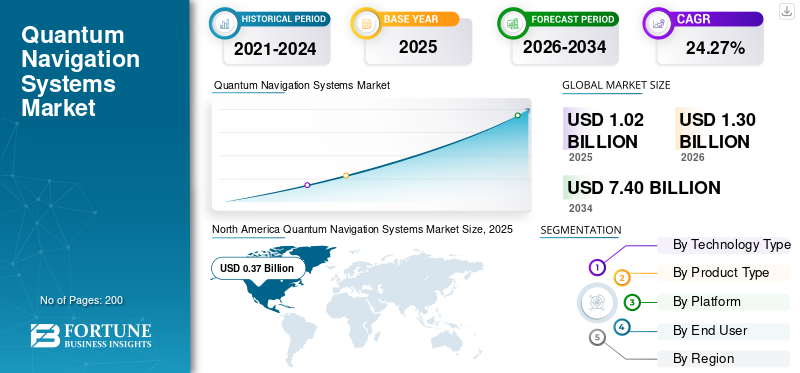
The global quantum navigation systems market size was valued at USD 1.02 billion in 2025. The market is projected to grow from USD 1.30 billion in 2026 to USD 7.40 billion by 2034, exhibiting a CAGR of 24.27% during the forecast period. North America dominated the quantum navigation systems market with a market share of 36.27% in 2025.
Quantum navigation systems use quantum sensors such as atom interferometers, gyroscopes, accelerometers, magnetometers, and gravimeters to enable precise positioning without GPS by detecting Earth's magnetic and gravitational fields or inertial changes for resilient PNT. They are deployed in GPS-denied environments such as military aircraft, ships, UAVs, submarines, autonomous vehicles, space missions, underground, deep-sea ops, and aviation amid jamming. Driving factors include rising GPS vulnerabilities from jamming/spoofing in conflicts and the need for unjammable autonomy, among others.
Key players include Q-CTRL, Infleqtion, and Lockheed Martin, among others. These players offer Ironstone Opal, field-validated quantum assured systems for air, sea, and land and develop stable inertial sensors for defense/space GPS-free navigation, among others.
Download Free sample to learn more about this report.
Quantum Navigation Systems Market KEY TAKEAWAYS
 Market Size & Forecast
- 2025 Market Size: USD 1.02 billion
- 2026 Market Size: USD 1.30 billion
- 2034 Forecast Market Size: USD 7.40 billion
- CAGR: 24.27% from 2026–2034
 Market Share
- North America dominated the global market with a 36.27% share in 2025.
- Hybrid Quantum Navigation Stacks expected to hold the largest technology-type share.
- Integrated Q-PNT Navigation Suites dominated the product-type segment in 2025.
 Key Regional Highlights
North America
North America dominated the market with USD 0.37 billion in 2025.
Europe
Europe is projected to reach USD 0.37 billion in 2026, supported by EU Quantum Flagship.
Asia Pacific
Asia Pacific is projected to reach USD 0.37 billion in 2026 and is expected to be the fastest-growing region.
U.S.
The market is estimated at approximately USD 0.29 billion in 2026.
Japan
The market is estimated at approximately USD 0.07 billion in 2026.
Read More

QUANTUM NAVIGATION SYSTEMS MARKET TRENDS
Miniaturization of Sensor Types is a Market Trend
Miniaturization of quantum navigation sensors is the latest trend, shrinking bulky lab systems into compact, low-power units via photonic integrated circuits, microfabricated vacuum cells, and hybrid classical-quantum designs. This reduces size/weight/power (SWaP) for integration into drones, UAVs, submarines, small aircraft, and wearables, preserving sensitivity through shorter interrogation times and smaller atom clouds while balancing tradeoffs in stability.
Download Free sample to learn more about this report.
MARKET DYNAMICS
MARKET DRIVERS
Escalating GPS Jamming and Spoofing Threats to Drive Market Growth
Escalating GPS jamming and spoofing threats from state actors in conflict zones drive quantum navigation systems market growth as they sabotage satellite dependent positioning systems. These attacks disrupt military operations, aviation flights, maritime shipping, and unmanned vehicles, exposing overreliance on vulnerable GNSS signals easily overwhelmed by low-cost emitters or deceptive spoofing. The trend drives defense forces and mission critical infrastructure to seek jam proof alternatives such as quantum inertial and gravimetric sensors, which maintain precision without external signals.
MARKET RESTRAINTS
High Development Costs and Technical Complexity is a Market Restraint
High development costs and technical complexity are likely to restrain market growth. Quantum sensors require expensive cryogenic cooling, vacuum chambers, stable lasers, and rare materials, making scalable production prohibitive without massive government funding. Technical hurdles include preserving atomic coherence against vibrations, temperature fluctuations, and interference in dynamic environments such as aircraft or ships, demanding years of R&D for ruggedization.
MARKET OPPORTUNITIES
Rise in Defense Programs for Integration of Quantum Sensor Technology Creates New Market Opportunities
A surge in defense programs for quantum sensor integration creates new market opportunities by accelerating resilient PNT for GPS-denied operations. DARPA's RoQS program funds rugged quantum sensors tested on helicopters and vehicles, overcoming environmental disruptions for assured navigation across air, sea, and land domains. These initiatives bridge lab-to-field gaps, enabling integration into military platforms amid jamming threats, while fostering allied exports and hybrid GNSS-quantum systems.
MARKET CHALLENGES
Environmental Constraints to Present Major Market Challenges
Environmental constraints create significant market challenges for quantum navigation systems, as sensors are highly sensitive to vibrations, turbulence, temperature variations, and electromagnetic interference prevalent in military aircraft, ships, and vehicles. These factors disrupt atomic coherence essential for precision measurements, requiring extensive shielding, cooling, and stabilization impractical for dynamic platforms.
Segmentation Analysis
By Technology Type
Improved and Long term Stability to Boost the Hybrid Quantum Navigation Stacks Segmental Growth
Based on technology type, the market is segmented into cold-atom interferometry accelerometers, cold-atom interferometry gyroscopes, atomic/quantum clocks, quantum magnetometers, quantum gravimeters, and hybrid quantum navigation stacks.
The hybrid quantum navigation stacks segment is anticipated to account for the largest market share. The segmental share is driven by its capacity to combine the high-bandwidth, real time tracking of traditional inertial navigation systems (INS) with the extraordinary, long term stability of quantum sensors.
The atomic/quantum clocks segment is anticipated to rise at a CAGR of 24.41% over the forecast period.
By Product Type
Application in Defense Sector to Boost Integrated Q-PNT Navigation Suites Segment Growth
Based on product type, the market is segmented into Quantum IMU / Quantum INS (Q-INS) units, quantum timing modules, quantum field-sensing navigation modules, integrated Q-PNT navigation suites, navigation-grade fusion software, and calibration, alignment & metrology toolchains.
In 2025, the integrated Q-PNT navigation suites segment dominated the global market. The segmental growth is mainly due to the essential nature of these systems for high security military, naval, and aerial applications since they do not rely on external, susceptible satellite signals.
The navigation-grade fusion software segment is projected to grow at a high CAGR of 25.01% over the forecast period.
By Platform
Active Testing and Commercialization to Boost Air Segment Growth
Based on platform, the market is segmented into air, maritime surface, land, and space.
The air segment is anticipated to witness a dominating quantum navigation systems market share over the forecast period. With firms such as SandboxAQ and Boeing completing successful flights, the air segment has witnessed tremendous advancement from lab to flight. For navigation, these devices rely on the Earth's magnetic field.
The space segment is projected to grow at a high CAGR of 8.68% over the forecast period.
By End User
High Security Requirements to Boost the Defense Ministries Segment
Based on end user, the market is segmented into defense ministries, intelligence / SIGINT authorities, civil space & navigation agencies, critical infrastructure operators, and commercial autonomy operators.
The defense ministries segment dominated the global market share in 2025. Defense ministries are adopting Quantum Navigation Systems (QNS) for higher, unjammable security precision due to the growing GPS-denied conditions and sophisticated spoofing threats.
In addition, the commercial autonomy operators segment is projected to grow at a high CAGR of 25.96% during the study period.
To know how our report can help streamline your business, Speak to Analyst
Quantum Navigation Systems Market Regional Outlook
By geography, the market is categorized into Europe, North America, Asia Pacific, and the rest of the world.
North America
North America Quantum Navigation Systems Market Size, 2025 (USD Billion)
To get more information on the regional analysis of this market, Download Free sample
North America held the dominant share in 2024, valuing at USD 0.29 billion, and also maintained the leading share in 2025, with USD 0.37 billion. North America spearheads quantum navigation through DARPA's RoQS program. Moreover, NASA/USGS applications in space/geophysical mapping boost hybrid GNSS resilience amid jamming threats.
U.S. Quantum Navigation Systems Market
Based on North America’s strong contribution and the U.S. dominance within the region, the U.S. market can be analytically approximated at around USD 0.29 billion in 2026, accounting for a CAGR of 24.73% over the analysis period. The U.S. leads with DARPA funding Q-CTRL and Safran for quantum PNT on defense platforms. Lockheed Martin integrates quantum INS, leveraging expertise in GPS/quantum tech.
Europe
The Europe market is projected to record a steady growth rate of 23.95% during the forecast period, which is the second highest among all regions. The market is poised to reach a valuation of USD 0.37 billion by 2026. Europe advances via EU Quantum Flagship and EDA quantum PNT projects for dual-use navigation. The region also depicts focus on gravimeters for maritime/autonomy amid GNSS vulnerabilities.
U.K. Quantum Navigation Systems Market
The U.K. market is estimated to touch around USD 0.11 billion in 2026 and exhibit a CAGR of 24.36% during the study period. Quantum navigation technologies in the U.K. are developing quickly due to the urgent requirement to protect infrastructure against GPS spoofing and jamming.
Germany Quantum Navigation Systems Market
The Germany market is projected to reach approximately USD 0.09 billion in 2026. The demand for quantum navigation sensor and systems (QMNS) is expanding quickly in Germany owing to significant federal support, solid industry-academic collaborations, and a calculated desire for technological independence.
Asia Pacific
The Asia Pacific region is estimated to reach USD 0.37 billion in 2026 and secure the position of the third-largest region in the market. The region is set to emerge as the fastest growing region during the study period. The market is driven by significant investment from South Korea, Australia, India, Japan (which leads in governmental funding), and China (under the "Made in China" initiative).
Japan Quantum Navigation Systems Market
The Japan market is estimated to touch around USD 0.07 billion in 2026, accounting for roughly a CAGR of 25.04% during the forecast period. Japan's strategic, government-led initiatives aimed at achieve economic and national security advantages by 2030 are driving the country's rapid advancement in quantum navigation and sensing technology.
China Quantum Navigation Systems Market
The China market is projected to be one of the largest in Asia Pacific, with 2026 revenues estimated at around USD 0.11 billion. China's state driven, goal oriented approach to achieving military superiority and lowering dependency on weak, GPS-dependent technology is the reason for its quick progress in quantum navigation.
India Quantum Navigation Systems Market
The India market is estimated to reach around USD 0.09 billion in 2026. India is rapidly developing its own quantum systems to provide GPS-independent, secure navigation for defense and strategic applications.
Rest of the World
The rest of the world comprises the Middle East and Africa and Latin America. Owing to reliance on mining and oil and gas, the Middle East and Africa and Latin America require sophisticated high-precision magnetic sensors for mapping and exploration. The Middle East & Africa and Latin America markets are set to reach USD 0.06 billion and USD 0.03 billion, respectively, in 2026.
COMPETITIVE LANDSCAPE
Key Industry Players
Strategic Partnerships by Leading Players to Fuel Market Expansion
The quantum navigation systems market shows moderate consolidation led by specialized quantum sensing firms such as Q-CTRL, Infleqtion, and Safran Federal Systems, securing DARPA RoQS contracts and conducting defense trials for assured PNT primacy.
Partnerships drive growth as Q-CTRL teams up with the U.S. Department of Defense on Ironstone Opal airborne/maritime validations, Infleqtion advances inertial sensors via U.K. MoD HARLEQUIN sea trials, and Safran/Lockheed integrate quantum gyros within NSSL equivalent Phase 3 programs. These collaborations enhance environmental ruggedization amid GPS jamming proliferation and contested domain threats.
LIST OF KEY QUANTUM NAVIGATION SYSTEMS COMPANIES PROFILED
- Q-CTRL (Australia)
- Infleqtion (U.S.)
- Lockheed Martin Corporation (U.S.)
- Safran (U.S.)
- AOSense (U.S.)
- Muquans (France)
- Teledyne e2v (U.K.)
- iXblue (France)
- Honeywell International Inc. (U.S.)
- Northrop Grumman (U.S.)
KEY INDUSTRY DEVELOPMENTS
- October 2025: The Robust Quantum Sensor (RoQS) program awarded Safran Federal Systems a contract from the Defense Advanced Research Projects Agency (DARPA). RoQS is a major effort assisting the Department of Defense in delivering assured Position, Navigation, and Timing (PNT) in contested and GPS-denied environments,
- August 2025: For the DARPA Robust Quantum Sensors (RoQS) initiative, Lockheed Martin announced plans to collaborate with Q-CTRL to leverage their experience in both quantum and GPS technologies to produce next-generation quantum sensors for navigation on advanced defense platforms.
- March 2025: The U.S. Department of Defense's Innovation Unit (DIU) granted a contract to Lockheed Martin and Q-CTRL to develop a quantum-enabled Inertial Navigation System (INS) prototype.
- June 2024: The French Navy received its first serially manufactured quantum technology sensor, a quantum gravimeter for seabed mapping. Furthermore, the future uses of such sensors could be for navigation or detecting enemy submarines.
- May 2024: The first commercial flight trials of an advanced quantum based navigation system were successfully completed in the U.K. by an alliance led by the quantum technology company Infleqtion, in collaboration with BAE Systems and QinetiQ.
REPORT COVERAGE
The global quantum navigation systems industry analysis includes a comprehensive study of the market size & forecast by all the market segments included in the report. It includes details on the market dynamics and market trends expected to drive the market over the forecast period. It provides information on key aspects, including an overview of technological advancements, the regulatory environment, Porter’s five forces analysis, company profiles, and retrofitting program. Additionally, it details partnerships, mergers & acquisitions, as well as key industry developments and prevalence by key regions. The global market research report also provides an in-depth competitive landscape with information on the market share and profiles of key operating players.
Request for Customization to gain extensive market insights.
Report Scope & Segmentation
| ATTRIBUTE | DETAILS |
| Study Period | 2021-2034 |
| Base Year | 2025 |
| Estimated Year | 2026 |
| Forecast Period | 2026-2034 |
| Historical Period | 2021-2024 |
| Growth Rate | CAGR of 24.27% from 2026-2034 |
| Unit | Value (USD Billion) |
| By Technology Type |
|
| By Product Type |
|
| By Platform |
|
| By End User |
|
| By Region |
|
Frequently Asked Questions
According to Fortune Business Insights, the global market value stood at USD 1.02 billion in 2025 and is projected to reach USD 7.40 billion by 2034.
In 2025, the North America market value stood at USD 0.37 billion.
The market is expected to exhibit a CAGR of 24.27% during the forecast period of 2026-2034.
By technology type, the hybrid quantum navigation stacks segment is expected to dominate the market.
Escalating GPS jamming and spoofing threats are key factors driving market growth.
Q-CTRL, Infleqtion, and Safran Federal Systems are few key players in the global market.
North America dominated the market in 2025.



- 2021-2034
- 2025
- 2021-2024
- 200
Get 30-60 hrs Free Customization
Expand Regional and Country Coverage, Segments Analysis, Company Profiles, Competitive Benchmarking, and End-user Insights.




















Related Reports
-
US +1 833 909 2966 ( Toll Free )
-
Get In Touch With Us