 Download Free Sample



Get a Quote
Receive a tailored pricing based on your needs.
- Choose license type
- Multiple user options
- Custom scope & coverage
- Fast turnaround
"Designing Growth Strategies is in our DNA"
The radiation oncology market size was valued at USD 14.19 billion in 2025. The market is projected to grow from USD 15.84 billion in 2026 to USD 38.00 billion by 2034, exhibiting a CAGR of 11.56% during the forecast period.

The global radiation oncology market is expanding due to increasing cancer prevalence, advancements in cancer treatment technologies, and rising demand for precise and effective radiation-based therapies. Radiation oncology plays an important role in cancer management by using high-energy radiation to destroy cancer cells while minimizing damage to surrounding healthy tissues. The market includes external beam radiation therapy, internal radiation therapy, systemic targeted radiation therapy, and advanced treatment planning technologies. The radiation oncology market report highlights growing adoption of image-guided radiation therapy, intensity-modulated radiation therapy, proton therapy, and artificial intelligence-based treatment planning solutions. Healthcare providers are investing in advanced radiation systems to improve treatment accuracy and patient outcomes.
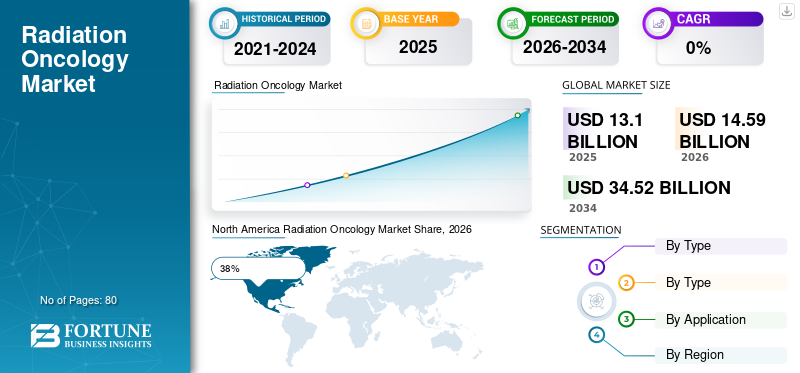
The USA radiation oncology market is growing due to advanced healthcare infrastructure, high adoption of innovative cancer treatment technologies, and increasing demand for precision oncology solutions. The United States has a strong network of cancer centers, hospitals, and research institutions using advanced radiation therapy systems for cancer treatment. The market is supported by increasing cancer care investments, technological advancements, and growing preference for minimally invasive treatment approaches. The USA accounts for approximately 38% of the global radiation oncology market share due to widespread adoption of advanced radiation equipment, strong research capabilities, and established healthcare facilities.
Download Free sample to learn more about this report.
 Global Market Size & Forecast
 Market Share
 Key Regional Highlights
North America
North America led the market with a 38% regional share, supported by advanced oncology infrastructure.
Asia-Pacific
Asia-Pacific accounted for 29% of the market, driven by rising cancer treatment demand and healthcare investments.
Europe
Europe held 27% share, supported by advanced radiotherapy technologies and cancer care systems.
U.S.
The U.S. remains a major market, supported by advanced radiation therapy adoption and strong oncology infrastructure.
Japan
Japan accounted for 22% of the Asia-Pacific market, supported by advanced cancer care and radiotherapy technologies.
Read More

The radiation oncology market trends are influenced by rapid technological advancements, increasing adoption of precision medicine, and growing demand for personalized cancer treatment approaches. Healthcare providers are focusing on improving radiation delivery accuracy while reducing treatment side effects through advanced technologies. A major trend highlighted in the Radiation Oncology Industry Report is the increasing adoption of image-guided radiation therapy and artificial intelligence-based treatment planning systems. These technologies allow physicians to accurately identify tumor locations, optimize radiation doses, and improve treatment outcomes. Proton therapy and other particle-based radiation treatments are gaining attention due to their ability to target tumors more precisely while reducing radiation exposure to healthy tissues.
Download Free sample to learn more about this report.
Advanced cancer centers are investing in these technologies for complex cancer cases. The integration of automation and digital technologies is also transforming radiation oncology workflows. Automated treatment planning, real-time imaging, and advanced patient monitoring systems are improving efficiency and clinical decision-making. The radiation oncology market Analysis indicates that combination therapies involving radiation oncology with immunotherapy and targeted therapies are becoming increasingly important. These approaches are helping healthcare professionals develop more effective cancer treatment strategies. Growing demand for outpatient cancer care is also influencing market development. Radiation therapy centers are adopting compact and efficient systems to improve accessibility and patient convenience.
Increasing global cancer burden and rising demand for advanced treatment solutions
The increasing incidence of cancer worldwide is a major driver of the radiation oncology market growth. Cancer remains one of the leading healthcare challenges globally, creating continuous demand for effective treatment technologies. Radiation therapy is widely used for managing various cancer types, including breast cancer, prostate cancer, lung cancer, head and neck cancer, and brain tumors. The radiation oncology market Analysis indicates that healthcare providers are increasingly adopting advanced radiation technologies to improve treatment precision and patient outcomes. Modern radiation systems allow physicians to deliver targeted radiation doses while minimizing exposure to surrounding healthy tissues. Technological advancements are significantly supporting market expansion. Innovations such as image-guided radiation therapy, intensity-modulated radiation therapy, stereotactic radiosurgery, and proton therapy are improving the effectiveness of cancer treatment. The growing focus on personalized cancer care is also increasing demand for advanced radiation oncology solutions. Physicians are adopting treatment approaches based on tumor characteristics, patient conditions, and individual response patterns. Expansion of cancer care infrastructure in emerging markets is creating additional growth opportunities. Hospitals and specialized cancer centers are investing in radiation therapy equipment to improve access to advanced treatment options. Government healthcare initiatives, increased cancer awareness, and investments in oncology research are further supporting market development. As healthcare systems continue prioritizing cancer treatment capabilities, demand for advanced radiation oncology technologies is expected to increase.
High equipment costs and complex treatment infrastructure requirements
High investment requirements associated with radiation oncology equipment represent a major restraint affecting market expansion. Advanced radiation therapy systems require significant capital investment, specialized facilities, and highly trained healthcare professionals for installation and operation. The Radiation Oncology Industry Analysis highlights that smaller hospitals and healthcare facilities may face challenges adopting advanced radiation technologies due to limited financial resources. The cost of maintaining sophisticated equipment and upgrading treatment infrastructure can also affect adoption. Radiation oncology procedures require specialized expertise, including radiation oncologists, medical physicists, and radiation therapists. Shortages of trained professionals in certain regions can limit effective utilization of advanced systems. Regulatory requirements and safety standards also increase complexity. Healthcare providers must follow strict guidelines related to radiation safety, equipment performance, and patient protection. The long installation and implementation timelines associated with advanced radiation systems can create additional challenges. Hospitals need proper planning, infrastructure modifications, and staff training before introducing new technologies. Limited access to advanced cancer treatment facilities in developing regions remains another barrier. Many healthcare systems lack adequate radiation therapy infrastructure, affecting patient access to modern treatment options. Addressing these restraints requires investment in affordable technologies, workforce development, and improved healthcare infrastructure.
Growth in precision oncology and advanced radiation technologies
The increasing adoption of precision oncology creates significant opportunities in the radiation oncology market. Healthcare providers are moving toward personalized treatment approaches that use advanced imaging, data analysis, and targeted radiation delivery methods. The radiation oncology market opportunities are expanding through innovations in artificial intelligence, machine learning, and automated treatment planning. These technologies help physicians analyze patient data, optimize radiation doses, and improve treatment accuracy. Proton therapy and particle-based radiation treatments represent important opportunity areas. These technologies provide highly targeted radiation delivery and are gaining adoption for treating complex tumors and pediatric cancer cases. The development of compact radiation therapy systems is creating opportunities for smaller hospitals and regional cancer centers. Manufacturers are focusing on creating efficient systems that require less infrastructure while maintaining treatment effectiveness. Emerging markets provide additional growth potential due to increasing cancer awareness and healthcare modernization programs. Governments and healthcare organizations are investing in oncology infrastructure to improve access to advanced treatment. Integration of radiation therapy with immunotherapy and targeted therapies is another important opportunity area. Combination treatment approaches are creating new possibilities for improving cancer management. Companies investing in innovative technologies, affordable solutions, and expanded healthcare access are positioned to benefit from future radiation oncology market growth.
Shortage of skilled professionals and technology adoption barriers
The shortage of skilled radiation oncology professionals represents a major challenge for the radiation oncology market. Advanced radiation therapy systems require specialized expertise from radiation oncologists, medical physicists, and trained technicians to ensure safe and effective treatment delivery. The radiation oncology market Outlook indicates that workforce limitations can affect adoption of advanced technologies, particularly in developing regions. Healthcare facilities may struggle to operate sophisticated radiation equipment without adequate training and technical support. Rapid technological changes also create challenges for healthcare providers. Hospitals must continuously upgrade equipment and train staff to keep pace with advancements in radiation oncology. High maintenance requirements and equipment complexity can create operational challenges. Healthcare facilities need reliable technical support and service networks to maintain treatment systems effectively. Unequal access to cancer treatment infrastructure remains another challenge. While developed regions have advanced radiation facilities, many developing areas continue facing limited availability of modern oncology services. Patient affordability and healthcare access issues can also influence treatment availability. Expanding access to radiation oncology requires investment in healthcare infrastructure and supportive policies. Manufacturers and healthcare organizations must focus on training programs, affordable technologies, and simplified treatment solutions to overcome these challenges.
Internal Beam Radiation Therapy, also known as brachytherapy, represents approximately 35% market share in the radiation oncology market. This treatment approach involves placing radioactive sources directly inside or near the tumor area to deliver targeted radiation. The radiation oncology market Research Report highlights that internal beam radiation therapy is widely used for treating cancers such as prostate cancer, cervical cancer, breast cancer, and skin cancer. The technique allows physicians to deliver high radiation doses directly to tumors while limiting exposure to surrounding tissues. Brachytherapy is valued for its precision and effectiveness in localized cancer treatment. Healthcare providers use this approach when tumors require concentrated radiation delivery over a limited area. Technological advancements are improving internal radiation therapy procedures. Modern systems provide better imaging guidance, improved radioactive source placement, and enhanced treatment planning capabilities. The growing demand for minimally invasive cancer treatments is supporting adoption of internal beam radiation therapy. Patients often benefit from shorter treatment durations and targeted radiation delivery. Cancer centers and specialized hospitals are investing in advanced brachytherapy systems to expand treatment capabilities. The increasing prevalence of prostate and gynecological cancers is contributing to segment demand. Manufacturers are developing improved applicators, treatment planning software, and automated delivery systems to enhance precision and safety. The segment is also benefiting from increased awareness among healthcare professionals regarding the advantages of localized radiation therapy. Integration with imaging technologies is improving treatment accuracy and clinical outcomes.
Systemic Targeted Radiation Therapy accounts for approximately 25% market share in the radiation oncology market. This treatment approach uses radioactive substances delivered through the bloodstream to target specific cancer cells throughout the body. The Radiation Oncology Industry Report highlights that systemic targeted radiation therapy is gaining importance due to advancements in radiopharmaceutical technologies. These treatments allow selective targeting of cancer cells while reducing damage to normal tissues. This approach is particularly valuable for cancers that spread to multiple areas of the body, including certain thyroid cancers, neuroendocrine tumors, and metastatic cancers. The increasing adoption of personalized medicine is supporting demand for systemic targeted radiation therapies. Physicians are using molecular imaging and diagnostic techniques to identify suitable patients for targeted treatments. Radiopharmaceutical development is becoming a major innovation area. Companies are investing in new radioactive agents designed to improve targeting efficiency and treatment effectiveness. The growth of nuclear medicine infrastructure is also supporting market development. Hospitals and cancer centers are expanding capabilities to provide advanced radiopharmaceutical treatments. The segment is expected to benefit from increasing research activities and collaboration between oncology, pharmaceutical, and medical technology companies.
To know how our report can help streamline your business, Speak to Analyst
The radiation oncology market Analysis highlights that external beam radiation therapy remains a primary treatment approach due to its effectiveness, flexibility, and ability to treat complex tumor locations. Advanced systems such as intensity-modulated radiation therapy, image-guided radiation therapy, and stereotactic radiation therapy are improving treatment precision. Healthcare providers are increasingly adopting advanced external beam systems because they allow accurate radiation targeting while minimizing damage to surrounding healthy tissues. These systems are widely used in hospitals, cancer centers, and specialized oncology facilities. Artificial intelligence integration is becoming an important trend within external beam radiation therapy. AI-based treatment planning tools help physicians optimize radiation doses, improve workflow efficiency, and reduce treatment preparation time. Image-guided radiation therapy is gaining adoption because it enables real-time monitoring of tumor position during treatment. This improves accuracy, especially for tumors affected by patient movement. The increasing number of cancer treatment facilities worldwide is supporting demand for external beam radiation equipment. Hospitals are investing in advanced systems to improve cancer care capabilities and expand treatment options. Manufacturers are focusing on developing compact systems, improved automation features, and user-friendly interfaces to make radiation therapy more accessible. The segment is also benefiting from the growing demand for outpatient cancer treatment services. Efficient external beam systems allow healthcare providers to manage more patients while maintaining treatment quality. The radiation oncology market Research Report indicates that proton therapy is increasingly used for complex cancers, pediatric oncology, and tumors located near sensitive organs. The ability to control radiation dose distribution makes proton therapy an attractive option for specific patient groups.
Cancer centers are investing in proton therapy facilities due to increasing demand for advanced treatment options. Although the technology requires specialized infrastructure, its clinical benefits are supporting adoption among leading oncology institutions. Advancements in proton therapy equipment are focusing on reducing system size, improving treatment efficiency, and lowering operational complexity. Compact proton therapy systems are creating opportunities for wider adoption. Research institutions are also exploring the use of proton therapy in combination with other cancer treatment approaches. These developments are supporting innovation within the segment. The growing emphasis on precision medicine and personalized cancer care is expected to increase interest in proton therapy technologies. The Radiation Oncology Industry Analysis highlights that stereotactic radiation therapy is widely used for brain tumors, lung cancer, spinal tumors, and metastatic cancers. The approach provides effective treatment while reducing exposure to surrounding tissues. The increasing demand for minimally invasive cancer treatment methods is supporting adoption of stereotactic technologies. Patients often benefit from shorter treatment schedules and improved treatment accuracy. Healthcare providers are integrating stereotactic systems with advanced imaging technologies to improve tumor targeting and treatment planning. The segment is benefiting from technological advancements in motion management, automated positioning, and real-time imaging systems.
Breast cancer represents a major application segment in the radiation oncology market, accounting for approximately 25% market share. Radiation therapy is widely used in breast cancer treatment, especially after surgery, to eliminate remaining cancer cells and reduce recurrence risks. The radiation oncology market Insights indicate that advanced radiation techniques are improving treatment outcomes for breast cancer patients. Technologies such as intensity-modulated radiation therapy and image-guided radiation therapy allow more precise radiation delivery. Healthcare providers are increasingly adopting shorter treatment schedules and targeted radiation approaches to improve patient convenience. Breast cancer treatment centers are investing in advanced radiation systems to provide personalized care based on tumor characteristics and patient requirements. The increasing availability of screening programs and early diagnosis is supporting demand for radiation oncology services. The radiation oncology market Forecast highlights increasing adoption of advanced radiation techniques for prostate cancer treatment. Image-guided systems, stereotactic radiation, and brachytherapy are improving treatment precision. Internal beam radiation therapy is particularly important in prostate cancer management because it allows targeted radiation delivery directly to the tumor region. Healthcare providers are focusing on reducing treatment side effects while maintaining therapeutic effectiveness.
Advanced planning systems and improved imaging technologies are supporting these goals. The aging population and increasing prostate cancer diagnosis rates are contributing to continued demand for radiation oncology solutions. The radiation oncology market Analysis shows that stereotactic radiation therapy is becoming increasingly important for treating small lung tumors. This approach provides high-dose radiation with improved accuracy. Motion management technologies are critical in lung cancer treatment because breathing movements can affect tumor positioning. Advanced imaging and tracking systems are helping physicians improve treatment accuracy. The development of personalized treatment approaches is creating new opportunities for lung cancer radiation therapy solutions. The radiation oncology market Trends indicate that radiation therapy continues to be an essential treatment option across various cancer types. Advances in treatment planning and delivery technologies are improving outcomes across multiple applications. Healthcare providers are increasingly adopting combination approaches involving radiation therapy with immunotherapy and targeted treatments. Research activities focused on expanding radiation therapy applications are creating new opportunities for technology providers.
Academic and research cancer centers account for approximately 30% market share in the radiation oncology market. These institutions focus on cancer research, clinical trials, and development of advanced treatment methods. Research centers are adopting advanced radiation technologies to study new therapeutic approaches and improve treatment outcomes. The Radiation Oncology Industry Report highlights that collaborations between research institutions and technology companies are accelerating innovation. Academic centers play an important role in developing next-generation radiation therapy systems, including AI-based treatment planning and advanced particle therapies.
North America Radiation Oncology Market Share, 2026 (%)
To get more information on the regional analysis of this market, Download Free sample
North America represents the largest region in the radiation oncology market, accounting for approximately 39% market share. The region benefits from advanced healthcare infrastructure, high cancer treatment awareness, strong research activities, and widespread adoption of advanced radiation technologies. The United States is the primary contributor due to its extensive network of cancer hospitals, specialized oncology centers, and research institutions. Healthcare providers in the region are early adopters of advanced technologies such as image-guided radiation therapy, proton therapy, and artificial intelligence-based treatment planning. The radiation oncology market Report highlights that North American healthcare organizations are continuously investing in improving cancer care infrastructure. Increasing demand for personalized treatment approaches is encouraging adoption of precision radiation technologies. The presence of leading medical technology companies supports innovation within the regional market. Manufacturers are developing advanced systems that improve accuracy, efficiency, and patient outcomes. Canada is also contributing to regional development through increasing healthcare investments and expansion of oncology services. Growing demand for outpatient cancer care is influencing technology adoption. Radiation centers are investing in efficient systems that improve workflow and patient accessibility. The region’s strong focus on research, clinical trials, and advanced cancer treatment approaches continues supporting market development.
Europe represents a significant region in the radiation oncology market, accounting for approximately 30% market share. The region is supported by advanced healthcare systems, increasing cancer treatment demand, strong oncology research activities, and widespread adoption of modern radiation therapy technologies. Countries including Germany, the United Kingdom, France, Italy, and Spain are major contributors due to their developed healthcare infrastructure and investment in cancer care facilities. The radiation oncology market Analysis highlights that European healthcare providers are increasingly adopting precision radiation technologies to improve treatment outcomes and reduce side effects. Image-guided radiation therapy, intensity-modulated radiation therapy, and stereotactic radiation solutions are becoming more common across specialized cancer centers. Europe has a strong focus on improving access to advanced cancer treatments through healthcare modernization programs. Hospitals are investing in upgraded radiation equipment, advanced treatment planning systems, and digital healthcare solutions to enhance oncology services. The region’s aging population is contributing to increased demand for cancer treatment services. Older populations have higher risks of developing cancer, creating a need for effective radiation oncology solutions. Germany, the United Kingdom, and France are leading markets due to strong research capabilities, specialized cancer hospitals, and adoption of innovative treatment approaches. Academic institutions and cancer research centers are also contributing to technology advancement through clinical studies and collaborations. The Radiation Oncology Industry Report highlights growing interest in proton therapy and other advanced radiation technologies in Europe. Healthcare organizations are exploring these solutions for complex cancers and cases requiring high treatment precision. The integration of artificial intelligence and automation into radiation oncology workflows is another important trend. European cancer centers are adopting digital technologies to improve treatment planning, workflow efficiency, and patient management.
Germany is one of the leading markets within Europe’s radiation oncology market due to its advanced healthcare infrastructure, strong medical technology industry, and high adoption of innovative cancer treatment solutions. Germany represents approximately 35% of Europe’s radiation oncology market share. The country has a well-established network of hospitals, university clinics, and specialized cancer centers offering advanced radiation therapy services. German healthcare providers are investing in modern radiation equipment to improve cancer treatment accuracy and patient outcomes. The radiation oncology market Research Report highlights that Germany has strong adoption of image-guided radiation therapy, intensity-modulated radiation therapy, and stereotactic treatment systems. These technologies are increasingly used for treating complex tumors while reducing radiation exposure to healthy tissues. Germany’s focus on research and innovation supports the development and adoption of next-generation radiation oncology solutions. Collaboration between medical institutions, research organizations, and technology companies is helping improve treatment methods. The increasing prevalence of cancer and growing demand for personalized treatment approaches are supporting market development. Healthcare providers are focusing on patient-specific treatment planning and advanced imaging technologies. Proton therapy is gaining attention in Germany, particularly for pediatric cancers and tumors located near sensitive organs. Specialized centers are investing in particle-based radiation technologies to expand treatment options. The country’s strong reimbursement framework and healthcare quality standards support access to advanced oncology treatments. Hospitals continue upgrading radiation therapy systems to maintain high standards of cancer care. The adoption of artificial intelligence-based treatment planning is also increasing in Germany. These technologies help improve workflow efficiency and support radiation oncologists in making accurate treatment decisions.
The United Kingdom radiation oncology market is expanding due to increasing cancer care demand, healthcare modernization, and adoption of advanced radiation therapy technologies. The United Kingdom contributes approximately 28% of Europe’s radiation oncology market share. The UK has a strong healthcare system with specialized cancer centers providing radiation therapy services across the country. Hospitals are investing in advanced equipment to improve treatment accessibility and patient outcomes. The radiation oncology market Trends indicate growing adoption of image-guided radiation therapy, stereotactic radiation systems, and advanced treatment planning technologies in the United Kingdom. Cancer research institutions and academic centers play an important role in advancing radiation oncology practices. Clinical research activities are supporting innovation in radiation delivery methods and combination therapies. The increasing focus on personalized cancer care is influencing treatment approaches in the UK. Healthcare providers are using advanced imaging and planning technologies to develop individualized radiation treatment strategies. The adoption of proton therapy is increasing as specialized treatment centers expand their capabilities. This technology is particularly valuable for treating complex cancers where precision is critical. Digital transformation is also shaping the UK radiation oncology market. Artificial intelligence, automated planning systems, and electronic treatment management tools are improving operational efficiency. The growing demand for outpatient cancer treatment is encouraging healthcare providers to adopt efficient radiation therapy solutions. Advanced systems that reduce treatment time and improve patient convenience are gaining importance.
Asia-Pacific is one of the fastest-growing regions in the radiation oncology market, accounting for approximately 24% market share. The region is supported by increasing cancer incidence, expanding healthcare infrastructure, rising healthcare investments, and growing adoption of advanced treatment technologies. Countries including China, Japan, India, South Korea, and Australia are contributing significantly to regional growth. Healthcare systems across Asia-Pacific are investing in oncology facilities to improve access to cancer treatment. The radiation oncology market Analysis indicates that increasing awareness about cancer diagnosis and treatment is encouraging demand for radiation therapy services. Governments and private healthcare organizations are expanding cancer centers and upgrading treatment infrastructure. China represents one of the largest markets due to its large patient population and increasing investment in advanced healthcare technologies. Hospitals are adopting modern radiation systems to improve cancer treatment capabilities. Japan is another important market because of its advanced healthcare system, aging population, and focus on precision medicine. Japanese hospitals are adopting advanced radiation technologies to provide high-quality cancer care. India is experiencing increasing demand due to rising cancer awareness, expanding healthcare facilities, and growing availability of specialized oncology services. The development of medical technology infrastructure and increasing partnerships between healthcare organizations are supporting regional growth. Manufacturers are also focusing on affordable radiation therapy solutions suitable for emerging markets. Artificial intelligence-based treatment planning and digital oncology solutions are gaining interest across Asia-Pacific. These technologies help improve treatment accuracy and healthcare efficiency.
Japan represents a developed market within Asia-Pacific due to advanced healthcare infrastructure, strong technology adoption, and increasing demand for cancer treatment solutions. Japan accounts for approximately 34% of the Asia-Pacific radiation oncology market share. The aging population in Japan is contributing to increased demand for oncology services. Healthcare providers are investing in advanced radiation technologies to manage growing cancer treatment requirements. The Radiation Oncology Industry Analysis highlights that Japanese hospitals are adopting image-guided radiation therapy, stereotactic radiation systems, and advanced treatment planning technologies. Japan has strong research capabilities in medical technology and oncology. Universities and cancer research centers are contributing to innovation in radiation treatment approaches. The country is also focusing on improving treatment precision and reducing side effects. Advanced imaging and automation technologies are becoming important components of radiation oncology workflows. Proton therapy and particle-based treatments are gaining attention in Japan for treating complex cancer cases. Specialized centers are expanding capabilities to provide advanced treatment options.
China is one of the fastest-growing markets in the radiation oncology market due to increasing cancer cases, expanding healthcare infrastructure, and rising investment in advanced medical technologies. China represents approximately 38% of the Asia-Pacific market share. The country’s large population and increasing healthcare demand are driving expansion of oncology services. Hospitals are investing in radiation therapy equipment to improve cancer treatment availability. The radiation oncology market Insights indicate that China is adopting advanced technologies such as image-guided radiation therapy, stereotactic systems, and digital treatment planning platforms. Government healthcare modernization programs are supporting the development of cancer treatment facilities. Public and private hospitals are increasing their adoption of advanced radiation equipment. Domestic medical technology companies are also contributing to market development by developing cost-effective radiation oncology solutions. The growth of specialized cancer centers and increasing collaboration between research institutions and healthcare providers are creating new opportunities in China.
The Rest of World region is gradually developing within the radiation oncology market, accounting for approximately 7% market share. The region includes Latin America, the Middle East, and Africa, where increasing cancer awareness, healthcare investments, and expansion of oncology infrastructure are supporting market development. Latin America is experiencing growing demand for radiation oncology solutions due to increasing cancer treatment requirements and healthcare modernization programs. Countries such as Brazil, Mexico, and Argentina are investing in cancer centers and advanced treatment equipment. The radiation oncology market Forecast highlights that improving healthcare accessibility is creating opportunities for radiation therapy providers in emerging markets. Hospitals are seeking affordable and reliable treatment technologies to expand cancer care services. The Middle East is witnessing increasing investment in advanced healthcare infrastructure. Countries in the region are developing specialized oncology centers equipped with modern radiation therapy systems. Africa represents an emerging opportunity area due to increasing cancer awareness and gradual improvement in healthcare facilities. International collaborations and healthcare investments are supporting expansion of oncology services. Challenges such as limited skilled professionals, infrastructure gaps, and high equipment costs continue affecting adoption in some regions. However, growing healthcare investments and increasing demand for cancer treatment are creating opportunities for market participants. Manufacturers focusing on cost-effective systems, training support, and regional partnerships are positioned to benefit from future market development.
Investment opportunities in the radiation oncology market are increasing as healthcare organizations focus on improving cancer treatment capabilities, adopting precision medicine approaches, and expanding access to advanced radiation technologies. Investors are showing strong interest in companies developing innovative radiation therapy systems, treatment planning software, and digital oncology solutions. The radiation oncology market Opportunities are expanding through artificial intelligence integration, automation, and advanced imaging technologies. Companies developing AI-powered treatment planning systems are attracting investment because these solutions improve workflow efficiency and enhance treatment accuracy. Proton therapy and particle-based radiation technologies represent important investment areas. Although these systems require specialized infrastructure, growing demand for highly precise cancer treatments is encouraging healthcare organizations to invest in advanced facilities. Emerging markets provide significant growth opportunities due to increasing cancer cases, healthcare infrastructure development, and rising government investment in oncology services. Companies offering affordable radiation therapy solutions can expand their presence in developing regions. Investment in software-based oncology solutions is also increasing. Digital treatment planning, patient monitoring platforms, and data-driven oncology tools are becoming essential components of modern radiation therapy workflows. Strategic partnerships between medical technology companies, research institutions, and healthcare providers are supporting innovation. These collaborations are helping accelerate development of next-generation radiation oncology technologies. The growing adoption of outpatient cancer treatment centers is creating additional opportunities for compact and efficient radiation therapy systems. Manufacturers focusing on accessibility, cost efficiency, and advanced clinical performance are positioned to benefit from future market expansion.
New product development in the radiation oncology market is focused on improving treatment precision, workflow efficiency, patient safety, and accessibility. Manufacturers are introducing advanced systems that combine imaging, automation, artificial intelligence, and precision delivery technologies. Artificial intelligence-based treatment planning is one of the major innovation areas. AI technologies are being integrated into radiation oncology workflows to automatically analyze patient data, optimize treatment plans, and improve clinical decision-making. Advanced image-guided radiation therapy systems are being developed to enhance tumor targeting accuracy. These systems allow real-time monitoring of tumor position and improve radiation delivery precision. Compact radiation therapy systems are another important area of innovation. Manufacturers are developing smaller and more efficient equipment designs to enable adoption in regional hospitals and smaller cancer centers. Proton therapy technology is also advancing through efforts to reduce system size, improve efficiency, and increase accessibility. New developments are focused on making particle-based treatments more practical for healthcare facilities. Radiopharmaceutical advancements are supporting growth in systemic targeted radiation therapy. Companies are developing new radioactive agents designed for improved tumor targeting and treatment effectiveness. Automation is becoming increasingly important in radiation oncology. Robotic patient positioning systems, automated quality control tools, and integrated treatment platforms are improving operational efficiency. The radiation oncology market Trends indicate that future product development will focus on combining advanced technologies with personalized cancer care approaches.
The radiation oncology market report provides comprehensive analysis of market trends, growth factors, challenges, segmentation, regional performance, competitive landscape, technological advancements, and future opportunities. The report evaluates the increasing adoption of radiation therapy solutions for cancer treatment across hospitals, cancer centers, and research institutions. The radiation oncology market Research Report covers treatment segments including internal beam radiation therapy and systemic targeted radiation therapy. It analyzes how different radiation approaches are being adopted for various cancer applications. The report evaluates technology segments including external beam radiation therapy, proton therapy, stereotactic radiation technology, and advanced treatment planning solutions. It examines the impact of artificial intelligence, imaging technologies, and automation on radiation oncology development.
Request for Customization to gain extensive market insights.
Application analysis includes breast cancer, prostate cancer, lung cancer, and other cancer treatments. The report also evaluates target customer segments including hospitals, cancer treatment centers, academic institutions, and research organizations. Regional analysis covers North America, Europe, Asia-Pacific, and Rest of World markets. Country-level insights include Germany, the United Kingdom, Japan, and China to understand regional adoption patterns and market opportunities. The Radiation Oncology Industry Report highlights leading companies, competitive strategies, product innovations, and investment trends shaping the industry. The radiation oncology market outlook focuses on opportunities created by increasing cancer prevalence, precision medicine adoption, advanced radiation technologies, and expansion of oncology healthcare infrastructure. The report provides detailed insights into emerging technologies, market trends, and strategic opportunities influencing the future direction of the radiation oncology market.
Fortune Business Insights says that the global Radiation Oncology Market was valued at USD 13.09 billion in 2025 and is projected to reach USD 34.52 billion by 2034.
The market is expected to exhibit a CAGR of 11.37% during the forecast period of 2026–2034.
External beam radiation therapy was the leading type segment, accounting for approximately 72% of the market, driven by the increasing adoption of image-guided, intensity-modulated, and stereotactic radiation therapies.
Key players include Varian Medical Systems, Inc., Elekta AB, Accuray Incorporated, IBA Radiopharma Solutions, BD (Becton, Dickinson and Company), and Mevion Medical Systems.
Major trends include the growing adoption of AI-powered treatment planning and adaptive radiotherapy, along with the rapid expansion of proton therapy and robotic radiosurgery. North America led the market with approximately 38% of the market share.


(Offer valid till 31st Oct 2026)
Get 30-60 hrs Free Customization
Expand Regional and Country Coverage, Segments Analysis, Company Profiles, Competitive Benchmarking, and End-user Insights.













.webp)






Get In Touch With Us
US +1 833 909 2966 ( Toll Free )
Receive a tailored pricing based on your needs.
Discuss your questions with our industry experts.
Have questions? Get quick answers before you purchase.

