Railway Multiple Units Market Size, Share & Industry Analysis by Propulsion (DMUs, EMUs, and Hybrid), By Train Set (Up to 2 Cars, 3-6 Cars, and 7 Cars & Above), By Application (Rapid Transit/Metro, Suburban & Commuter Rail, and Intercity Rail), By Component (Propulsion & Power, Carbody & Structures, Bogies & Running Gear, Electrical & Control, Passenger Interior, Braking Systems, Doors & Access, Couplers & Gangways, and Auxiliaries), and Regional Forecast, 2026-2034
 Download Free Sample
(Offer valid till 15th Oct 2026)

Railway Multiple Units Market Size and Future Outlook
 Listen to Audio Version
The global railway multiple units market size was valued at USD 15.03 billion in 2025 and is projected to grow from USD 15.96 billion in 2026 to USD 23.79 billion by 2034, exhibiting a CAGR of 5.11% during the forecast period. Asia Pacific dominated the ailway multiple units market with a market share of 47.87% in 2025.
Railway multiple units (RMUs) are self-propelled train sets consisting of multiple carriages powered by onboard traction systems, eliminating the need for a separate locomotive. They can operate as Electric Multiple Units (EMUs), Diesel Multiple Units (DMUs), or hybrid sets, depending on the propulsion. Designed for efficiency, flexibility, and rapid acceleration, railway multiple units are widely used in urban, regional, and intercity passenger transport, offering scalable capacity through coupling and uncoupling of trainsets.
The market is witnessing steady growth, fueled by rapid urbanization, modernization of rail infrastructure, and the rising need for efficient mass transit systems. The electrification of rail networks, government investments in clean mobility, and growing environmental concerns are accelerating the adoption of EMUs and hybrid units. Additionally, increasing passenger demand for reliable, fast, and sustainable transport solutions and technological advancements are bolstering market expansion across both developed and emerging regions.
Download Free sample to learn more about this report.
Key players in the railway multiple units market include global rolling stock manufacturers such as Alstom, Siemens, CRRC, Hitachi, Stadler, Hyundai Rotem, CAF, and Kawasaki, among others. These companies lead with advanced EMU, DMU, and hybrid technologies, focusing on energy efficiency, digital integration, and sustainable mobility. Their market position is reinforced through large-scale contracts with national rail operators, continuous innovation, and strategic expansions to meet growing demand in urban and regional passenger transport worldwide.
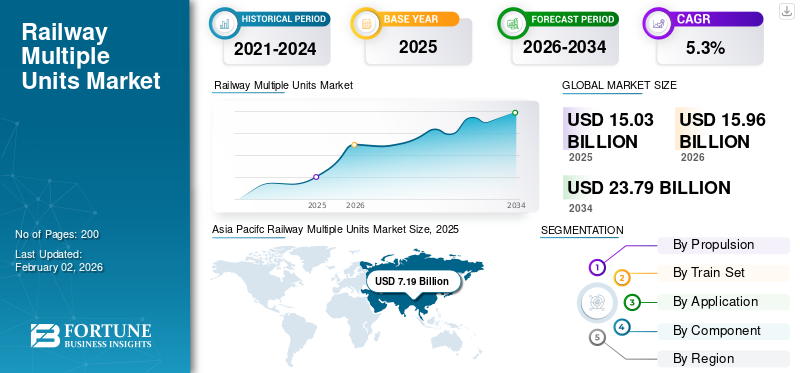
Download Free sample to learn more about this report.
Railway Multiple Unit Market Key Takeaways
 Global Market Size & Forecast
- 2025 Market Size: USD 15.03 billion
- 2026 Market Size: USD 15.96 billion
- 2034 Forecast Market Size: USD 23.79 billion
- CAGR: 5.11% from 2026–2034
 Market Share
- Asia Pacific dominated the railway multiple units market with a 47.87% share in 2025.
- The EMUs segment is projected to account for 85.84% of the market share in 2026.
- The 3-6 cars segment is expected to contribute 44.77% of the global market in 2026.
 Key Regional Highlights
Asia Pacific
Asia Pacific led the market with USD 7.19 billion in revenue and a 47.87% share in 2025.
Europe
Europe accounted for 31.38% of the global market, reaching USD 4.72 billion in 2025.
North America
North America maintained a smaller market share but is supported by rail modernization investments.
U.S.
The railway multiple units market is projected to reach USD 0.60 billion by 2026.
Japan
The railway multiple units market is anticipated to reach USD 0.92 billion by 2026.
Read More

Market Dynamics
Market Drivers
Government Investments in Rail Electrification to Drive Market Growth
Government investments in rail electrification represent a major factor impelling railway multiple units market growth. Countries across Asia, Europe, and the Middle East are prioritizing electrified rail networks to reduce carbon emissions, enhance energy efficiency, and meet sustainability targets. Electrification projects directly increase the demand for global electric multiple units (EMUs) as they are more cost-effective, environmentally friendly, and capable of higher performance compared to diesel-powered alternatives. Large-scale funding programs, subsidies, and long-term infrastructure modernization plans encourage railway operators to procure new EMU fleets or upgrade existing stock. This sustained government support significantly boosts railway multiple units’ adoption, creating strong market growth opportunities globally.
- In July 2025, Mexico unveiled its National Railway Plan, incorporating USD 7.15 billion in investment in rail infrastructure, including 70 km of freight tracks on the Yucatán’s Mayan Train corridor. This massive effort aims to restore over 3,400 km of passenger routes using dedicated rights-of-way and modern systems.
Sustainability and Emission Control Goals to Fuel Market Demand
Sustainability and emission control goals are playing a pivotal role in driving the market. With governments and rail operators committed to reducing greenhouse gas emissions, Electric Multiple Units (EMUs) are increasingly favored as zero-emission alternatives to diesel locomotives. Their ability to operate efficiently on electrified tracks makes them essential to achieving climate targets and complying with strict environmental regulations. Policies promoting decarbonization of transport, combined with growing public awareness of eco-friendly mobility, are accelerating investments in EMUs and hybrid models. This transition toward greener rail solutions supports sustainable urban modes of transport and also fuels long-term market growth globally.
- In April 2025, Czech Railways (ČD) launched a public tender for up to 133 new EMU 400 electric multiple units, marking a significant step in the country's rail modernization efforts. The tender aims to replace aging fleets and enhance regional connectivity, particularly in the Prague metropolitan area.
Market Restraints
High Initial Capital Requirements May Hamper Market Expansion
High initial capital requirements act as a significant restraint on the market for railway multiple units. Procuring EMUs involves substantial costs for both the trainsets themselves and supporting electrified infrastructure, including substations, overhead catenary lines, and advanced signaling systems. For many developing economies and smaller rail operators, these upfront expenses create financial barriers, delaying adoption despite long-term operational benefits. Budget constraints, competing infrastructure priorities, and lengthy return-on-investment cycles further limit large-scale deployments. Even in developed regions, governments and operators must balance modernization goals with fiscal feasibility, making high capital intensity a critical challenge that slows the overall pace of market expansion.
Market Opportunities
Rise of High-Speed and Regional Commuter EMUs Provides Significant Growth Opportunities
The rise of high-speed and regional commuter EMUs presents a significant growth opportunity in the railway multiple units market. Increasing urbanization and intercity travel demand are pushing governments and operators to adopt faster, more efficient transport solutions. High-speed EMUs reduce travel times while offering superior passenger comfort, making them attractive alternatives to short-haul air travel and private vehicles. Regional commuter EMUs enhance connectivity between cities and suburban areas, supporting economic integration and daily mobility needs. Investments in high speed rail corridors and the modernization of regional rail networks worldwide are boosting the procurement of advanced EMUs, creating strong opportunities for manufacturers to expand their portfolios and market presence.
- In October 2024, CRRC Changchun Railway Vehicles introduced a revolutionary built-in high-speed bogie for Electric Multiple Units (EMUs), enabling speeds of up to 400 km/h. This innovation reduces train weight by 20%, lowers energy consumption by 15%, cuts wheel-rail wear by 30%, and diminishes noise by 2 dB.
Market Challenges
Limited Adoption in Underdeveloped Regions to Create Challenges for Market Expansion
Limited adoption in underdeveloped markets presents a key challenge for the market. Many regions, particularly in parts of Africa, Latin America, and Southeast Asia, face inadequate rail infrastructure and low levels of electrification, restricting the deployment of EMUs. Without sufficient investment in modern tracks, substations, and electrified corridors, operators in these areas continue relying on diesel locomotives and traditional rail systems. Additionally, limited government funding, competing transport priorities, and lower passenger demand hinder large-scale modernization. This infrastructure gap slows the global penetration of EMUs, creating uneven market growth where advanced economies progress rapidly while underdeveloped markets lag, challenging global market expansion.
Railway Multiple Units Market Trends
Technological Advancements in Propulsion and Efficiency is a Key Market Trend
Technological advancements in propulsion and efficiency are shaping a key trend in the market. Manufacturers are increasingly adopting lightweight materials to reduce overall train weight, thereby improving energy efficiency and lowering operating costs. The use of advanced SiC-based VVVF inverters enhances traction system performance, while synchronous reluctance motors deliver higher reliability and reduced maintenance needs. Additionally, regenerative braking systems enable energy recovery, further cutting emissions and power consumption. These innovations improve sustainability and also enhance train speed, durability, and passenger comfort. As operators prioritize efficiency and eco-friendly solutions, such technologies are becoming industry standards, influencing the long-term adoption of railway multiple units.
- In August 2023, JR Central announced plans to develop a prototype of the Series 385 Electric Multiple Unit (EMU) featuring next-generation tilting technology. This new system aims to enhance ride comfort by accurately detecting curve entry points using gyro sensors, reducing reliance on traditional beacons and wheel rotation data. The prototype is scheduled for testing in fiscal year 2026, with commercial deployment anticipated around 2029. The Series 385 will also integrate advanced safety features, including remote monitoring systems and CCTV, aligning with the design of the HC85 hybrid trains.
Trend of Smart and Connected Train Systems to Augment Market Growth
Smart and connected train systems represent a major trend in the market, driven by the integration of IoT, AI, and advanced data analytics. These technologies enable condition-based monitoring, allowing operators to predict failures and optimize maintenance schedules, which reduces downtime and lifecycle costs. Enhanced connectivity also supports real-time safety systems, improving operational reliability and passenger security. For commuters, digital features such as smart ticketing, onboard connectivity, and personalized travel information elevate the overall journey experience. As rail networks modernize, the adoption of intelligent EMUs is expanding globally, setting new benchmarks for efficiency, safety, and passenger-centric services in the market.
- In October 2024, CRRC Changchun Railway Vehicles introduced a high-speed bogie for Electric Multiple Units (EMUs), enabling speeds of up to 400 km/h. It is equipped with a big-data platform, which enhances equipment utilization by 10% and trimmed operational costs by RMB 5 million (USD 700,830 annually). These advancements mark significant progress in China’s energy-efficient rail transit evolution.
Impact of Tariffs
U.S. Tariffs Escalate the Costs for Manufacturers, Impacting Product Adoption
The U.S. tariffs impact the railway multiple units market by increasing costs for manufacturers and operators that rely on imported components, raw materials, or complete trainsets. The tariffs on steel, aluminum, and electronic systems raise production expenses, directly affecting procurement prices for EMUs, DMUs, and hybrid units. This can discourage rail operators from investing in new fleets or delay planned modernization projects. Moreover, tariffs on imported rolling stock from global suppliers such as Siemens, Alstom, or CRRC limit competitive pricing, potentially reducing product availability in the U.S. market. As a result, tariffs create cost pressures and uncertainty, challenging global market growth and product adoption.
Segmentation Analysis
By Propulsion
EMUs Segment to Expand as Governments Prioritize their Adoption
By vehicle type, the market is segmented into DMUs, EMUs, and hybrid.
The EMUs segment is projected to dominate the market with a share of 85.84% in 2026 and is the fastest-growing segment, supported by global investments in rail electrification and decarbonization. Governments are prioritizing EMUs to cut greenhouse gas emissions, improve efficiency, and support high-capacity passenger movement in urban and intercity routes. Their zero-emission performance, reduced operating and maintenance costs, and compatibility with high-speed rail corridors strengthen adoption. Additionally, advanced features such as regenerative braking, lightweight designs, and smart connectivity enhance passenger comfort and sustainability. With major projects underway across Europe, Asia, and the Middle East, EMUs are becoming the backbone of modern rail transport systems worldwide.
- In April 2025, Bulgaria signed a USD 580.7 million contract with Alstom for 35 zero-emission EMUs. Twelve units will be financed through EU recovery funds, the remainder by Bulgaria. Deliveries will begin by August 2026, as the plan includes restructuring the national railway and preparing infrastructure for the new fleet.
The DMUs segment holds the second-largest railway multiple units market share, primarily driven by their relevance in regions with low electrification and challenging geographies. They remain critical for rural, regional, and cross-border routes where electrified infrastructure is limited or economically impractical. DMUs provide operational flexibility, lower upfront infrastructure requirements, and reliable service in non-electrified areas, ensuring mobility for underserved regions. While stricter emission policies slow growth, manufacturers are developing cleaner diesel engines and hybrid models to extend their market presence. Fleet replacement programs, particularly in North America, Southeast Asia, and parts of Europe, continue to support DMU gaining traction, even as EMUs dominate global adoption trends.
To know how our report can help streamline your business, Speak to Analyst
By Train Set
Widespread Use in Regional and Suburban Commuter Services Pushes the Dominance of the 3-6 Cars Segment
Based on the train set, the market is up to 2 cars, 3-6 cars, and 7 cars & above.
The 3-6 cars segment is expected to lead the market, contributing 44.77% globally in 2026, due to its versatility and widespread use in regional and suburban commuter services. These configurations offer optimal capacity for medium passenger volumes, balancing efficiency and affordability for operators. Their shorter length allows greater operational flexibility on existing rail infrastructure, making them suitable for frequent services in urban and semi-urban corridors. Governments and operators prefer 3-6 car EMUs and DMUs for daily passenger flows, particularly in Europe and Asia. Their ease of coupling and decoupling also enables scalability, ensuring that this segment maintains the largest share in the market.
- In November 2024, Regionalverkehr Bern-Solothurn (RBS) awarded Stadler a contract to supply twenty three-car multiple units for the Solothurn-Bern RegioExpress (RE5). Deliveries are aimed to begin in 2026 with entry into service between 2028 and 2030. The trains are 60m, operable in triple formation to boost peak capacity by 50%, and include accessibility, modern passenger amenities, and lower maintenance needs.
The 7 cars & above segment is the fastest-growing segment, driven by the rising demand for high-capacity, long-distance, and high-speed services. The increasing urbanization and intercity connectivity needs are pushing operators to adopt longer trainsets that can carry more passengers efficiently. These configurations are widely used in high-speed rail networks, such as those in China, Japan, and Europe, where large-scale passenger movement requires higher seating capacity. Government investments in new high-speed rail corridors and the modernization of existing intercity networks further accelerate this segment’s growth. Longer EMU formations also benefit from advanced technologies that enhance performance, making them ideal for future mobility expansion.
By Application
Rapid Urbanization, Rising Population Density, and Surging Demand for Efficient Urban Mobility Solutions to Drive Rapid Transit/Metro Demand
Based on application, the market is divided into rapid transit/metro, suburban & commuter rail, and intercity rail.
The rapid transit/metro segment will account for 59.52% market share in 2026, fueled by rapid urbanization, rising population density, and growing demand for efficient urban mobility solutions. Governments are heavily investing in metro networks to reduce road congestion, cut emissions, and improve connectivity within major cities. EMUs configured for metro services offer high frequency, quick acceleration, and large passenger capacity, making them ideal for urban commuting. With expanding metro rail projects in Asia, the Middle East, and Europe, coupled with smart train technologies enhancing safety and passenger experience, this segment is expected to maintain strong, sustained growth globally.
- In July 2025, Alstom and SYTRAL Mobilités signed a EUR 303 million (USD 332 million) contract to modernize Lyon Metro Line D, including the supply of 26 new-generation automatic MPL25 multiple units. These rubber-tyred driverless trainsets will enhance capacity, accessibility, and energy efficiency while incorporating eco-design and advanced automation. The investment marks a major upgrade to France’s busiest metro line.
The suburban & commuter rail segment holds the second-largest share in the market, supported by the demand for regional connectivity between city centers and surrounding suburban areas. These services are essential for daily commuters, offering faster, more reliable, and environmentally friendly alternatives to road transport. EMUs and DMUs in this segment balance medium to high passenger volumes while ensuring operational efficiency across varied distances. Investments in modernizing suburban networks, particularly in North America, Europe, and the Asia Pacific, are sustaining demand. Additionally, upgrades in rolling stock, improved comfort, and integration with urban transport systems further drive this segment’s continued relevance and expansion.
By Component
Advancements in Traction Technologies, Energy Efficiency, and Electrification Initiatives Impel the Propulsion & Power Segment Growth
By component, the market is segmented into propulsion & power, carbody & structures, bogies & running gear, electrical & control, passenger interior, braking systems, doors & access, couplers & gangways, and auxiliaries.
- In July 2025, India successfully tested its first hydrogen-powered train coach (Driving Power Car) at the Integral Coach Factory in Chennai. This marks a major step in sustainable rail transport as India’s ambition to develop a 1,200 HP hydrogen train progresses. This transition from DEMU (Diesel Electric Multiple Unit) to hydrogen fuel cells demonstrates India’s commitment to zero-emission rail innovation.
The carbody and structures segment represent the second-largest segment, driven by the need for lightweight, durable, and aerodynamic train designs. The increasing use of aluminum alloys, stainless steel, and composite materials reduces train weight, thereby improving energy efficiency and lowering operational costs. Strong passenger demand for safety, comfort, and high-capacity travel also drives innovation in carbody design. Manufacturers focus on modular, flexible structures to allow easier customization for different applications such as metro, commuter, or high-speed services. With growing emphasis on crashworthiness, passenger safety, and aesthetic appeal, this segment remains vital in shaping overall train performance, operational efficiency, and long-term sustainability of railway multiple units.
Railway Multiple Units Regional Outlook
By region, the market is categorized into North America, Europe, Asia Pacific, and the rest of the world.
Asia Pacific
Asia Pacifc Railway Multiple Units Market Size, 2025 (USD Billion)
To get more information on the regional analysis of this market, Download Free sample
Asia Pacific dominates the railway multiple units market, driven by rapid urbanization, population growth, and massive government investments in rail infrastructure. Asia Pacific accounted for USD 7.19 billion in 2025, representing 47.87% of the global market share, and is projected to reach USD 7.66 billion in 2026. China, Japan, and India lead the region with large-scale metro, commuter, and high-speed rail projects. Extensive electrification initiatives, gaining traction for sustainable urban transport, and strong government funding fuel EMU adoption. China’s dominance in high-speed EMU deployment and India’s expanding metro networks significantly boost market share. Furthermore, regional manufacturing capacity and technological advancements enhance affordability and availability. With the ongoing expansion of urban and regional networks, the Asia Pacific is expected to maintain its leadership position in the market. The Japan market is anticipated to reach USD 0.92 billion by 2026. The China market is expected to achieve USD 4.81 billion by 2026. The India market is projected to reach USD 1.05 billion by 2026.
- In October 2023, Indonesia inaugurated the Jakarta-Bandung High-Speed Railway, Southeast Asia's first, featuring domestically manufactured Electric Multiple Units (EMUs) based on China's Fuxing platform. These EMUs, designed for 350 km/h operation, are equipped with CTCS-3 train control systems and regenerative braking for energy efficiency. The service, known as "Whoosh," has significantly reduced travel time between Jakarta and Bandung to 46 minutes, enhancing regional connectivity and supporting Indonesia's green transportation initiatives.
Europe
Europe contributed 31.38% to the global market in 2025, with a valuation of USD 4.72 billion, and is projected to reach USD 4.94 billion in 2026. Europe holds the second-largest share, supported by well-established electrified networks, strong regulatory frameworks, and ambitious decarbonization targets. Countries such as Germany, France, and the U.K. are continuously investing in EMUs for metro, commuter, and high-speed rail services. The European Union’s Green Deal and sustainability initiatives further accelerate EMU procurement, replacing older diesel fleets with zero-emission alternatives. Advanced infrastructure, mature rolling stock markets, and high passenger demand drive consistent growth. Additionally, the strong presence of major players such as Alstom, Siemens Mobility, and Stadler Rail supports innovation and adoption. With a strong emphasis on environmental policies, Europe remains a highly influential market. The Germany market is forecasted to reach USD 1.05 billion by 2026.
· In July 2025, Akiem entered the German passenger rail leasing market by signing a EUR 100 million (USD 108 million) 13-year lease for 14 Stadler FLIRT Akku BEMUs with ODEG. The battery-electric multiple units would begin delivery in 2027 for operation on non-electrified lines in Mecklenburg-Western Pomerania, backed by federal and EU funding and including a EUR 11 million upgrade to maintenance facilities in Parchim.
Rest of the World
In 2025, the Rest of the World market stood at USD 2.44 billion, representing 16.22% of global demand, and is projected to grow to USD 2.64 billion in 2026. The rest of the world market is the fastest-growing, supported by increasing investments in rail modernization across the Middle East, Africa, and South America. Governments are prioritizing urban transit solutions and electrification to address congestion, reduce emissions, and enhance regional connectivity. High-profile projects, such as metro expansions in Saudi Arabia and Egypt, along with commuter rail modernization in Brazil drive the demand for EMUs and DMUs. Although the current market size is smaller compared to Asia and Europe, rising funding, infrastructure development, and adoption of sustainable transport solutions are accelerating growth. This region presents strong long-term opportunities for global railway multiple unit manufacturers.
- In November 2023, CRRC secured a landmark contract with Argentina's national railway company, Trenes Argentinos Operaciones (SOFSE), to supply 50 new diesel multiple units (DMUs) for regional services. This deal is the largest of its kind in Argentina's history, surpassing a previous 2015 order of 27 DMUs.
North America
North America holds the least share in the market due to its reliance on traditional locomotive-hauled trains and limited electrification. However, gradual investments in commuter rail modernization, sustainability goals, and urban transit projects are creating opportunities for EMU and DMU adoption. Ongoing fleet replacement programs in cities such as New York, Boston, and Toronto are driving low but steady demand. Additionally, the U.S. initiatives focused on reducing emissions and improving regional mobility are expected to encourage future EMU deployment. Although the market remains relatively small compared to other regions, incremental infrastructure upgrades and policy support sustain growth prospects.
The U.S. dominates the North American market, driven by growing investments in modernizing commuter and regional rail systems. Large metropolitan areas, including New York, Boston, Chicago, and Los Angeles, are expanding and upgrading EMU and DMU fleets to enhance capacity, reduce emissions, and improve reliability. Federal and state funding initiatives, alongside sustainability targets, are encouraging the replacement of aging diesel locomotives with cleaner EMUs. Infrastructure projects such as Amtrak’s Northeast Corridor modernization further fuel demand. Although North America’s overall market share is smaller globally, the U.S. leads the region in railway multiple units’ adoption through continuous upgrades and rail electrification efforts. The U.S. market is projected to reach USD 0.6 billion by 2026. The UK market is expected to attain USD 0.59 billion by 2026.
· In February 2024, Caltrans announced a USD 127 million agreement with Stadler for six additional zero-emission hydrogen trainsets, boosting the North American intercity ZEMU fleet to ten. Funded partly through California’s USD 10 billion zero-emission vehicle package and federal hydrogen hub grants, the FLIRT-based trains are expected in revenue service by 2027 to support Valley Rail and statewide demonstrations.
Competitive Landscape
Key Market Players
Advancements in Propulsion Systems, Lightweight Materials, Digital Integration, and Passenger Comfort Drive Competitive Edge
The competitive landscape of the global railway multiple units market is characterized by the presence of leading multinational manufacturers alongside regional players. Key players such as Alstom, Siemens, CRRC, Hitachi, Stadler, Hyundai Rotem, CAF, and Kawasaki, among others, dominate through diverse product portfolios, technological innovation, and strong global footprints. Competition is driven by large-scale government contracts, investments in high-speed and metro networks, and the demand for sustainable, energy-efficient trainsets. Players are focusing on advanced propulsion systems, lightweight materials, digital integration, and passenger comfort to gain an edge. Strategic collaborations, mergers, and regional expansions are common as manufacturers compete to secure long-term contracts and strengthen market presence across both developed and emerging regions.
In November 2023, Siemens launched the Mireo Smart standard multiple-unit family for Germany and Austria, offering three configurations (three-car EMU, two-car BEMU, and two-car HEMU). Standardization and pre-approval cut lead times to about 18 months, simplify pricing, enable small or large orders, and provide 30-year design life with optional maintenance packages, speeding deployment for regional and commuter operators.
List of Key Railway Multiple Units Companies Profiled in the Report:
- Alstom (France)
- Siemens Mobility (Germany)
- CRRC Corporation (China)
- Hitachi Rail (Japan)
- Stadler Rail (Switzerland)
- Hyundai Rotem (South Korea)
- CAF (Spain)
- Kawasaki Heavy Industries (Japan)
- Pesa Bydgoszcz (Poland)
Key Industry Developments
- In June 2025, GRAMPET Group unveiled "Leon," Romania’s first domestically built Diesel Multiple Unit (DMU) in eight decades. Manufactured entirely by Electroputere VFU Pașcani, the unit, CE-certified after 30,000 km of testing, achieves 120 km/h with two 390 kW power packs. It targets the 62% of Romanian lines lacking electrification and debuted with a demo trip between Bucharest North and Băneasa stations.
- In October 2024, HÜBNER revealed a contract signed at InnoTrans with Siemens Mobility to supply 1,080 gangways (option for 1,080 more) for Munich’s new 202m suburban trains. The program, which is set to be operational at the end of 2028, supports 90 trains seating 1,841 passengers each, enables movement between 13-car units, improves comfort, provides continuous interiors for DB Regio, and reduces congestion.
- In August 2024, Swiss Federal Railways (SBB) awarded Stadler a contract valued at CHF 140 million (USD 156 million) for the delivery of 11 new single-deck multiple units, designated “Seetaler,” for regional transport in the Seetal region. These trains are scheduled for deployment starting December 2029 and will replace the aging fleet of 15 Seetal articulated multiple units (GTWs).
- In June 2024, San Bernardino County welcomed ZEMU, North America’s first federally-compliant self-powered zero-emission passenger trainset built by Stadler. The two-car hydrogen-battery Zero Emission Multiple Unit completed testing and will run on the Arrow line; water vapor is its only emission. The arrival caps a multi-year development effort with final certification pending for service.
- In November 2023, Türkiye’s TÜRASAŞ advanced the National Suburban Multiple Unit project with prototypes aimed for completion in 2024. The domestically produced four-car units will serve Gaziray in Gaziantep, reduce imports, simplify maintenance, and support export ambitions. These units have a max operating speed 90 km/h (design 120 km/h), with key control systems being developed nationally.
Investment Analysis and Opportunities
Urbanization, Sustainability Goals, and Large-Scale Rail Infrastructure Projects Attract Investment Opportunities
The railway multiple units market highlights significant opportunities driven by urbanization, sustainability goals, and large-scale rail infrastructure projects. Governments worldwide are prioritizing electrification and high-speed rail development, creating steady demand for EMUs. Emerging markets in Asia Pacific, the Middle East, and Latin America present strong growth potential as they expand metro and commuter networks. Opportunities also lie in technological advancements such as hybrid propulsion, battery-powered EMUs, and smart train systems integrating IoT and AI. Investors benefit from long-term government contracts, public-private strategic partnerships, and consistent passenger demand. With rising environmental regulations and global funding for clean mobility, the railway multiple units sector offers attractive, resilient, and scalable investment opportunities across multiple regions.
April 2025, construction commenced on Mexico's flagship Mexico City Querétaro passenger rail, a 226 km double-track system expected to ferry six million annual passengers in two-hour journeys. The project, valued at approximately MXN 144 billion (around USD 7.5 billion, based on 2025 rates), includes major infrastructure elements such as tunnels, viaducts, and multimodal integration.
Request for Customization to gain extensive market insights.
Report Coverage
The global market report analyzes the market in depth. It highlights crucial aspects such as prominent companies, market scope, competitive landscape, propulsion, train set, application, and component. Besides this, the market research reports provide insights into the market trends and highlight significant industry developments. In addition to the aspects mentioned earlier, the report encompasses several factors contributing to the market growth over recent years.
Report Scope & Segmentation
|
ATTRIBUTES |
DETAILS |
|
Study Period |
2021-2034 |
|
Base Year |
2025 |
|
Estimated Year |
2026 |
|
Forecast Period |
2026-2034 |
|
Historical Period |
2021-2024 |
|
Growth Rate |
CAGR of 5.11% from 2026 to 2034 |
|
Unit |
Value (USD Billion) |
|
Segmentation |
By Propulsion
By Train Set
By Application
By Component
|
|
By Region North America (By Propulsion, By Train Set, By Application, By Component, By Country)
Europe (By Propulsion, By Train Set, By Application, By Component, By Country)
Asia Pacific (By Propulsion, By Train Set, By Application, By Component, By Country)
Rest of the World (By Propulsion, By Train Set, By Application, By Component, By Country) |
Frequently Asked Questions
Fortune Business Insights says that the global market was valued at USD 15.03 billion in 2025 and is anticipated to reach USD 23.79 billion by 2034.
The market is anticipated to exhibit a CAGR of 5.11% over the forecast period (2026-2034).
The EMUs segment leads the market by propulsion.
The market is driven by urbanization, electrification of rail networks, and the push for sustainable transport solutions.
Alstom, Siemens, CRRC, Hitachi, Stadler, Hyundai Rotem, CAF, and Kawasaki are the leading players in the global market.
The Asia Pacific region leads the global market, with China dominating the region.



- 2021-2034
- 2025
- 2021-2024
- 200
-
(Offer valid till 15th Oct 2026)
Get 30-60 hrs Free Customization
Expand Regional and Country Coverage, Segments Analysis, Company Profiles, Competitive Benchmarking, and End-user Insights.




















-
US +1 833 909 2966 ( Toll Free )
-
Get In Touch With Us