Raman Spectroscopy Market Size, Share & Industry Analysis, By End-user (Food & Beverages, Agriculture, Healthcare, Manufacturing, Oil & gas, Chemical, and Others), By Component (Hardware and Software), and Regional Forecast, 2026-2034
 Download Free Sample
KEY MARKET INSIGHTS
 Listen to Audio Version
The global raman spectroscopy market size was valued at USD 3.66 billion in 2025 and is projected to grow from USD 4.46 billion in 2026 to USD 19.71 billion by 2034, exhibiting a CAGR of 20.42% during the forecast period. North America dominated the raman spectroscopy market with a market share of 14.94% in 2025.
Pharmaceuticals are one of the key applications employing Raman spectroscopy for drug identification, polymorph screening, and detecting counterfeits due to their high resolution and non-destructive analysis nature. Market growth is significant, with applications expanding into forensic science and field use. Currently, North America holds the dominating position in the market, with Asia Pacific following closely behind and experiencing the fastest growth due to increased spending on research and manufacturing. Despite such growth patterns, the market is restrained by factors such as high instrument prices and a requirement for competent individuals. By and large, the precision and adaptability of products are driving its industrial application and supporting its healthy market growth.
The Raman spectroscopy industry involves the design, manufacturing, and application of this spectroscopy instruments and methods. This spectroscopy is a non-destructive analytical tool used to investigate vibrational modes of molecules. It provides precise structural information about chemical structure, phases, and polymorphism. This technique is extensively applied in pharmaceuticals, life sciences, materials science, and forensic science for drug identification, quality testing, and material analysis. Top players in the market are Thermo Fisher Scientific (U.S.), Anton Paar (Austria), and B&W Tek (U.S.).
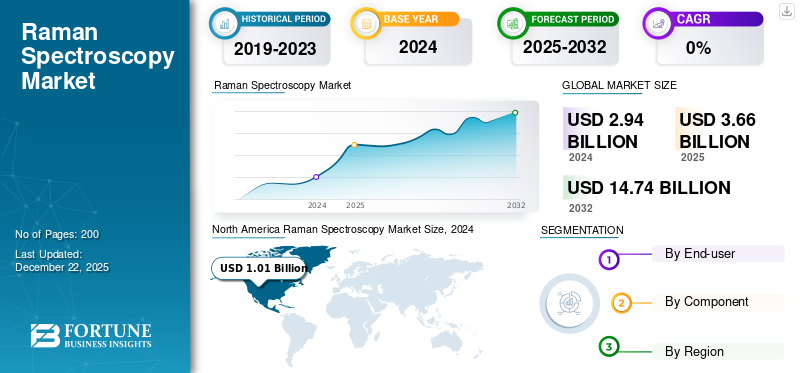
Download Free sample to learn more about this report.
RAMAN SPECTROSCOPY MARKET KEY TAKEAWAYS
 Global Market Size & Forecast
- 2025 Market Size: USD 3.66 billion
- 2026 Market Size: USD 4.46 billion
- 2034 Forecast Market Size: USD 19.71 billion
- CAGR: 20.42% from 2026–2034
 Market Share
- North America dominated the raman spectroscopy market with a market share of 14.94% in 2025.
- The healthcare segment accounted for a considerably larger share of the global market.
- The hardware segment accounted for a larger market share in 2024 and is anticipated to grow at the highest CAGR during the forecast period.
 Key Regional Highlights
North America
The region accounted for USD 1.27 billion in 2025, supported by extensive R&D activities, pharmaceutical advancements, and strong adoption of Raman technologies.
Europe
The market reached USD 1.03 billion in 2025, driven by increasing investments in life sciences research, environmental monitoring, and laboratory technologies.
Asia Pacific
The region generated USD 0.87 billion in 2025 and is witnessing rapid growth due to expanding pharmaceutical manufacturing and research activities.
U.S.
The market is supported by strong research infrastructure, government funding, and the presence of major companies such as Thermo Fisher Scientific and Bruker.
Japan
Growth is driven by advancements in scientific research, analytical technologies, and increasing adoption of Raman spectroscopy in healthcare and industrial applications.
Read More

MARKET DYNAMICS
MARKET DRIVERS
Expanding Pharmaceutical Applications to Lead to Substantial Market Growth
The Raman spectroscopy market share is experiencing strong growth due to its increasing use in the pharmaceutical sector. A greater focus on drug development and quality testing is among the major drivers. This spectroscopy enables precise, non-destructive quantitation of drug forms, aiding in drug quality testing as well as pharma authenticity. It can be used in drug identification, polymorph work, and counterfeiting detection, all of which are vital for the pharmaceutical industry. The capability of this spectroscopy to examine a sample in its natural state without the need for labeling is beneficial for identifying pharmaceutical formulations and monitoring the stability of drugs over time. Moreover, the rising interest in precision medicine increases product demand in the diagnosis and quantification of biomolecules.
MARKET RESTRAINTS
High Instrument Costs and Lack of Skilled Personnel to Limit Market Expansion
Trained personnel and equipment costs are one of the main constraints in the Raman spectroscopy market growth. High-resolution Raman spectrometers with high signal-to-noise ratios are often very costly and largely inaccessible for the majority of potential users, especially in developing nations and small laboratories. Apart from that, the use and application of this technology require highly skilled personnel, which is something hard to achieve due to a shortage of qualified individuals. This skill barrier, along with the associated costs, hinders market development as most potential consumers are deterred by the requirement of human capital to use this spectroscopy effectively.
MARKET OPPORTUNITIES
Expansion of Emerging Markets and Novel Applications is Expected to Impact Market Growth Positively
Raman spectroscopy possesses huge prospects in emerging economies, such as Asia Pacific, Latin America, and Africa. These economies are rapidly advancing in industrial and technological sectors, leading to a significant demand for high-tech analytical techniques in the pharmaceutical, food security, and environmental monitoring industries. In addition to this, novel developments are being pursued for developing new applications outside the traditional industries, such as nanotechnology, food safety, and cultural heritage preservation. Through the development of new applications and specialized systems, companies are obtaining new opportunities for market entry and product diversification.
Raman Spectroscopy Market Snapshot & Highlights
Market Size & Forecast:
- 2025 Market Size: USD 3.66 billion
- 2026 Market Size: USD 4.46 billion
- 2034 Forecast Market Size: USD 19.71 billion
- CAGR: 20.42% from 2026–2034
Market Share:
- North America dominated the Raman spectroscopy market with a 14.94% share in 2025, driven by advanced pharmaceutical research, high adoption in life sciences, and strong presence of leading market players.
- By end-user, the healthcare segment is expected to retain the largest market share in 2025, supported by rising demand for non-invasive diagnostic techniques, early disease detection, and pharmaceutical quality control applications.
Key Country Highlights:
- United States: Leads due to extensive R&D initiatives, government funding for life sciences, and strong presence of companies like Thermo Fisher Scientific and Bruker.
- China: Rapid industrialization and significant investment in pharmaceutical and materials science research are accelerating adoption of Raman spectroscopy systems.
- India: Growing pharmaceutical manufacturing and increasing focus on food safety and forensic applications boost market growth.
- Europe (Germany, U.K., France): Driven by life sciences research, environmental monitoring programs, and adoption of hyperspectral Raman imaging in clinical diagnostics.
RAMAN SPECTROSCOPY MARKET TRENDS
Expansion in Biomedical Research and Testing is Expected to Impact Market Growth Positively
Raman spectroscopy is gaining significant momentum in healthcare since it is a non-destructive and label-free examination, which is essential for biomedical research and clinical diagnosis. This technology helps with the determination of the atomic composition of biological samples and hence can identify infections early, especially cancers. It is also fundamental for real-time tissue analysis amid surgery, where it helps the specialist distinguish between healthy and cancerous tissues, eventually leading to better surgical results. Additionally, the product finds a major use in drug design to help researchers track drug formulations and interactions on the atomic level, thereby maximizing pharmaceutical viability.
- North America witnessed raman spectroscopy market growth from USD 0.80 Billion in 2019 to USD 1.01 Billion in 2024.
Advances such as hyperspectral Raman imaging allow for the procurement of spatially resolved spectral data through samples, giving detailed data on the chemical species dispersion in heterogeneous organic tissues. Strategies such as stimulated Raman scattering (SRS) imaging progress sensitivity and resolution with the capability for deeper infiltration into tissues without disrupting biological integrity. These advances not only upgrade demonstrative accuracy but also open up modern investigative applications in cellular science, pathology, and individualized medicine. Thus, this spectroscopy is advancing modern healthcare, fueling developments in diagnosis and treatment protocols.
Download Free sample to learn more about this report.
Segmentation Analysis
By End-user
Rise in Non-Invasive Examination Boosted Healthcare Segment Growth
Based on end-user, the market is classified into food & beverages, agriculture, healthcare, manufacturing, oil & gas, chemical, and others.
The healthcare segment accounted for a considerably larger share of the global market. There is an increased product usage in medical sciences due to its non-invasive examination capabilities. This technique provides quantitative data about the atomic structure and biochemical composition of biological samples, making it a potential diagnostic tool for the early detection of diseases and monitoring of conditions. Raman spectroscopy is being researched for its potential in identifying cardiovascular diseases, cancers, and infectious diseases such as COVID-19. With the integration of new technologies such as nanoparticles and machine learning, the specificity and sensitivity of this spectroscopy are improved, enhancing its accuracy in diagnostics and precision medicine.
On the other hand, the food & beverages segment is expected to witness steady growth over the forecast period. The advancement of spectroscopy in the food industry is significant as it allows for rapid, non-destructive testing of food quality and safety. This spectroscopy can detect contaminants, determine spoilage, and verify the composition of food products without damaging the samples. This capability helps ensure consumer safety and compliance with regulations. Additionally, this kind of spectroscopy can analyze complex food matrices, enabling manufacturers to monitor production processes and maintain consistent quality in their products.
By Component
Rising Focus on Enhancing Instrument Sensitivity Boosted Hardware Segment Growth
Based on component, the market is divided into hardware and software.
The hardware segment accounted for a larger market share in 2024 and is anticipated to grow at the highest CAGR during the forecast period. The advancement of Raman spectroscopy equipment is significantly driven by innovative progress that enhances instrument sensitivity and patient convenience. Modern Raman spectrometers are more versatile and sensitive, equipped with high-resolution optics and advanced detectors, such as charge-coupled devices (CCDs). These technologies enable the detection of extremely weak Raman signals and facilitate the analysis of a broader range of samples, including those with complex systems.
The software segment is expected to continue to account for a substantial share in the forthcoming years. The product is further enhanced by the advancement of software that supports data analysis. Advanced software packages utilize Artificial Intelligence (AI) and machine learning (ML) algorithms to improve spectral analysis, allowing for the rapid and accurate identification of chemical compounds. For instance, software such as LabSpec6 offers robust data processing capabilities that optimize workflow and enhance the user experience. These advancements enable researchers to manage large datasets effectively, facilitating detailed analyses that were previously time-consuming.
Raman Spectroscopy Market Regional Outlook
By region, the market is categorized into North America, Europe, Asia Pacific, and the Rest of the World.
North America
North America Raman Spectroscopy Market Size, 2025 (USD Billion)
To get more information on the regional analysis of this market, Download Free sample
The market in North America reached USD 1.27 billion in 2025, representing 14.94% of total market revenue, and is projected to reach USD 1.55 billion in 2026. The U.S. boasts numerous research centers, government laboratories, and private organizations that contribute to advancements in Raman innovation. The extensive research and development efforts in both the public and private sectors are particularly impactful in the pharmaceutical and life sciences industries. The presence of industry leaders fosters competitiveness and innovation, which drives the adoption of advanced Raman spectrometers across various sectors.
Europe
Europe contributed approximately USD 1.03 billion to the global market in 2025, accounting for 14.05% share, and is expected to reach USD 1.25 billion in 2026. In Europe, the development of Raman spectroscopy is being driven by increased investment in research and development across various countries. Countries such as Germany, the U.K., and France are focusing on enhancing their laboratory capabilities and expanding their technological infrastructure. The growing product demand in life sciences, materials science, and environmental monitoring is propelling market growth.
Asia Pacific
In 2025, the Asia Pacific market stood at USD 0.87 billion, representing 13.66% of global demand, and is projected to grow to USD 1.07 billion in 2026. The Asia Pacific region is experiencing rapid growth in the market, driven by increasing demand from key sectors such as pharmaceuticals, biotechnology, and environmental research. Nations such as China and India are increasingly adopting Raman spectroscopy for various applications, including drug development, quality control, and materials science. The expansion of industrial sectors and significant investments in research and development are enhancing the demand for these advanced analytical techniques. Moreover, the growing emphasis on scientific research in universities and research institutions positions Asia Pacific as a vital area for market expansion, with a strong potential for future growth.
Rest of the World
Rest of the World recorded a market size of USD 0.49 billion in 2025, capturing 13.65% of the global market share, and is projected to reach USD 0.58 billion in 2026. The Rest of the World encompasses regions such as the Middle East & Africa, and Latin America. The product development is driven by increased adoption among research organizations and universities. As these regions contribute to scientific research and innovation, there is a growing need for advanced analytical techniques.
COMPETITIVE LANDSCAPE
Key Industry Players
Continuous Development and Introduction of New Products by Key Companies Resulted in Their Dominating Position in Market
The global market is concentrated, with major companies such as Align Technology, Inc., Ormco Corporation, Institut Straumann AG, and 3M contributing significantly to its growth.
The competitive landscape of the market features a mix of established multinational corporations and emerging startups. Key players include Thermo Fisher Scientific Inc., Mettler Toledo, Agilent Technologies Inc., Bruker, and Renishaw Plc, all of which have a global presence. These companies utilize both organic growth strategies, such as product launches and technological advancements, as well as inorganic strategies, such as mergers and acquisitions, to strengthen their market positions.
Various companies are competing in different sectors, including pharmaceuticals, life sciences, materials science, and natural sciences. The growing demand for non-destructive, label-free atomic testing across these fields is driving competition. Additionally, the development of surface-enhanced Raman spectroscopy (SERS) technology is gaining momentum due to its ultra-high sensitivity and wide range of applications.
North America currently leads the market due to significant investments in research and development (R&D) and the strong presence of major industry players. However, Asia Pacific is expected to experience the fastest growth, driven by increasing demand in the pharmaceutical and biotechnology sectors.
LIST OF KEY RAMAN SPECTROSCOPY COMPANIES PROFILED
- Bruker (U.S.)
- Thermo Fisher Scientific (U.S.)
- Anton Paar (Austria)
- B&W Tek (U.S.)
- Agilent Technologies (U.S.)
- Horiba Scientific (U.S.)
- IS-Instruments (U.K.)
- Renishaw PLC (U.K.)
- Perkin Elmer (U.S.)
- Metrohm (Switzerland)
KEY INDUSTRY DEVELOPMENTS
- October 2024: The Institute for Photon Science and Technology at the University of Tokyo increased the estimation rate of Raman spectroscopy by 100-fold. This method is commonly used to measure the "vibrational unique fingerprint" of atoms, enabling their distinction.
- June 2024: Canon Inc. unveiled the launch of new plastic sorting equipment featuring innovative material identification technology. This device utilizes Raman spectroscopy on moving objects, with a tracking component that allows it to accurately detect the types of plastic fragments, even when dark pieces are mixed with other colors, something that has been challenging in the past.
- April 2024: Researchers from the Korea Advanced Institute of Science and Technology (Republic of Korea) and the Massachusetts Institute of Technology (MIT, U.S.) developed a compact swept-source Raman (SS-Raman) spectroscopy system.
- April 2024: Metrohm unveiled the launch of its OMNIS platform, enhanced with near-infrared spectroscopy (NIRS) capabilities. The updated OMNIS NIRS increases the platform's flexibility, enabling comprehensive chemical analysis from a single system. This launch includes three specialized configurations to accommodate different types of samples.
- February 2024: Engineers working on NASA's Perseverance Mars rover made significant progress in addressing an issue affecting the SHERLOC instrument's Autofocus Context Imager (ACI). However, the instrument's Raman spectroscopic capability is still offline.
REPORT COVERAGE
The global Raman Spectroscopy market analysis provides market size & forecast by all the segments included in the report. It includes details on the market dynamics and market trends expected to drive the market in the forecast period. It offers information on the prevalence of malocclusion in key regions/countries, key industry developments, new product launches, details on partnerships, mergers & acquisitions, and the number of orthodontists in key countries. The report covers a detailed competitive landscape with information on the market share and profiles of key players.
Request for Customization to gain extensive market insights.
Report Scope & Segmentation
|
ATTRIBUTE |
DETAILS |
|
Study Period |
2021-2034 |
|
Base Year |
2025 |
|
Estimated Year |
2026 |
|
Forecast Period |
2026-2034 |
|
Historical Period |
2021-2024 |
|
Growth Rate |
CAGR of 20.42% from 2026-2034 |
|
Unit |
Value (USD Billion) |
|
Segmentation |
By End-user
|
|
By Component
|
|
|
By Region
|
Frequently Asked Questions
Fortune Business Insights says that the global market value stood at USD 3.66 billion in 2025 and is projected to record a valuation of USD 19.71billion by 2034.
In 2025, the North America market value stood at USD 1.27 billion.
The market is expected to exhibit a CAGR of 20.42% during the forecast period of 2026-2034.
The hardware segment led the market by component.
The key factor driving the market growth is the increasing pharmaceutical use in the healthcare sector.
Align Technology, Inc., Ormco Corporation, Institut Straumann AG, and 3M are the top players in the market.
North America dominated the market in 2025.



- 2021-2034
- 2025
- 2021-2024
- 200
Get 30-60 hrs Free Customization
Expand Regional and Country Coverage, Segments Analysis, Company Profiles, Competitive Benchmarking, and End-user Insights.




















Related Reports
-
US +1 833 909 2966 ( Toll Free )
-
Get In Touch With Us