Rammers Market Size, Share, and Industry Analysis, By Type (Sand Rammer and Soil Rammer), By Product Type (Pneumatic, Battery Powered, Diesel Powered, and Gasoline), By End User (Construction, Municipal, and Industrial), and Regional Forecast, 2026-2034
 Download Free Sample
KEY MARKET INSIGHTS
The global rammers market is witnessing significant growth due to rapid urbanization in emerging economies, leading to increased construction activities and significant government investments in infrastructure projects, including bridges, roads, and public buildings, which enhance the demand for rammers and drive the market's growth.

- For instance, according to the source of the European Investment Bank, the European government planned to invest around USD 662.1 million in infrastructure projects in sectors such as telecom, energy, and utilities.
- Moreover, according to PWC, the global infrastructure investment reaches upto USD 3,900 billion annually, which caters to the market's growth.
Rammers Market Driver
Growth in Infrastructure Investment to Trigger Market Growth
Rising government investment in the construction sector, including residential and commercial construction activities, drives the growth of the rammers market. Moreover, the rising expansion of industries, such as oil & gas, mining, and manufacturing, requires robust infrastructure activities to drive the need for soil and sand compaction equipment, which fuels the market growth.
- For instance, according to the Ceramic World Web source, the construction sector in India grew by 13.3% in 2023 compared to 2022.
Rammers Market Restraint
High Capital Investment to Hinder Market Growth
Purchasing advanced rammer equipment can be prohibitive for small and medium-sized construction companies. High initial investment may deter potential buyers, especially in developing regions with budget constraints. Rammers require regular maintenance to ensure optimal performance, which can add to the overall cost of ownership.
- This system requires cost ranges from USD 1,000 to USD 7,000. Additionally, it requires period and annual maintenance requires for operation. This huge cost is not bearable for small and medium-scale enterprises and restricts market growth.
Rammers Market Opportunity
Technological Advancements in Rammers to Provide Lucrative Opportunity for the Market
Major key players introduced new technological advancements in rammers such as electric and battery-powered models, low emission, long, durable, and robust technology, enabling new lucrative opportunities for market growth.
- In March 2021, Sandvik Mining and Rock Technology, a subsidiary of Sandvik AB, introduced a new R45P rammer for the construction sector. It offers high torque capacity, high productivity, reliability, and durability.
Segmentation
|
By Type |
By Product Type |
By End User |
By Geography |
|
|
|
|
Key Insights
The report covers the following key insights:
- Micro Macro Economic Indicators
- Drivers, Restraints, Trends, and Opportunities
- Business Strategies Adopted by the Key Players
- Consolidated SWOT Analysis of Key Players
Analysis by Type
By type, the market is classified into sand rammer and soil rammer.
Sand rammers show significant growth owing to their use in the foundries, construction, and infrastructure development. The ongoing growth in construction and infrastructure-related activities across the globe, which, in turn, is a rising demand for rammers to drive the growth of this segment.
- For instance, according to the source of Construction Briefing, the construction industry investment in the U.S. is projected to grow by 30% from 2022 to 2037. This huge growth in the construction sector uplifts the growth of the market.
Analysis by Product Type
In terms of product type, the market is segmented into pneumatic, battery powered, diesel powered, and gasoline.
Gasoline-powered rammers dominate the market owing to their versatility and broad applicability. Moreover, this product is widely adopted in residential projects, small- and medium-scale construction projects, and stringent government regulations.
- For instance, in March 2024, Wacker Neuson SE launched a new WP1550e rammer for construction sites. It is a battery-powered rammer with features, such as zero-emission, long battery running time, and maintenance-free devices.
Analysis by End User Analysis
By end user, the market is segmented into construction, municipal, and industrial.
The construction sector dominates the market owing to the rising adoption of rammers for residential and commercial projects. The rising use of battery-powered rammers for reduced noise and emissions in urban areas drives the growth of the market.
- For instance, according to the Global Office Buildings Report report, the growth in office building projects globally increased by 1.9% in 2024 compared to 2023.
Regional Analysis
Request for Customization to gain extensive market insights.
In terms of geography, the global market is segmented into North America, Europe, Asia Pacific, South America, and Middle East & Africa.
Asia Pacific registered the largest market share of the global rammers market in 2023. The market growth in the region is attributed to rising demand for construction and infrastructure-related projects, along with significant investments made by government authorities to uplift the market growth.
- For instance, according to the source of the Asian Development Bank, the construction industry in Southeast Asia will need USD 210 billion for construction development from 2016 to 2030. Such favorable investment drives the market growth.
North America ranks as the second largest market shareholder, owing to rising commercial and residential project growth and key players' technological advancement.
- For instance, in October 2022, Bobcat, a subsidiary of Doosan Corporation, launched two new models of rammers such as R60P and R68P, for the construction market. This machine has high performance, is environment friendly, and handles end-to-end construction projects.
Key Players Covered
The global rammers market is moderately fragmented, with a large number of key players and local players. In the Asia Pacific, the top 5 players account for only around 40% of the market.
The report includes the profiles of the following key players:
- Wacker Neuson SE (Germany)
- Doosan Corporation (Bobcat) (South Korea)
- Sandvik AB (Sweden)
- Ammann Group (Switzerland)
- The Toro Company (U.S.)
- Multiquip Inc (U.S.)
- Weber MT (Michigan)
- JCB (U.S.)
- Husqvarna Group (Sweden)
- Atlas Copco (Sweden)
Key Industry Developments
- In June 2023, Ammann Group launched a new eATR 68 rammer for the market. It is an electrically driven machine that generates zero emissions. It offers variable speed, zero-emission, long, durable, and precise weight balance features.
- In March 2023, Multiquip Inc. launched a new MQ Mikasa MTS Series of rammers for the construction industry. It captures 98% airborne dust particles, is durable, and has a long battery life.


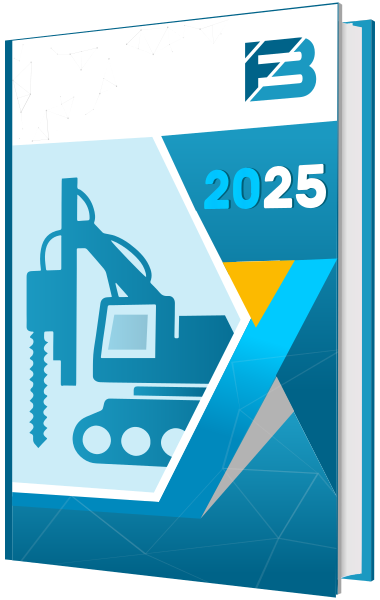
- 2021-2034
- 2025
- 2021-2024
- 80
-

(Offer valid till 30th Sep 2026)
Get 30-60 hrs Free Customization
Expand Regional and Country Coverage, Segments Analysis, Company Profiles, Competitive Benchmarking, and End-user Insights.









-
US +1 833 909 2966 ( Toll Free )
-
Get In Touch With Us