Recreational Vehicles (RVs) Batteries Market Size, Share & Industry Analysis, By Battery Type (Lead-Acid Batteries { Flooded Lead-Acid (FLA), Absorbent Glass Mat (AGM), and Gel Batteries} and Lithium-ion Batteries), By Voltage (12V, 24V, and 48V), By Sales Channel (OEM and Aftermarket), By Application (Starter Batteries and House (Deep Cycle) Batteries), and Regional Forecast, 2026-2034
 Download Free Sample
Recreational Vehicles (RVs) Batteries Market Size and Future Outlook
 Listen to Audio Version
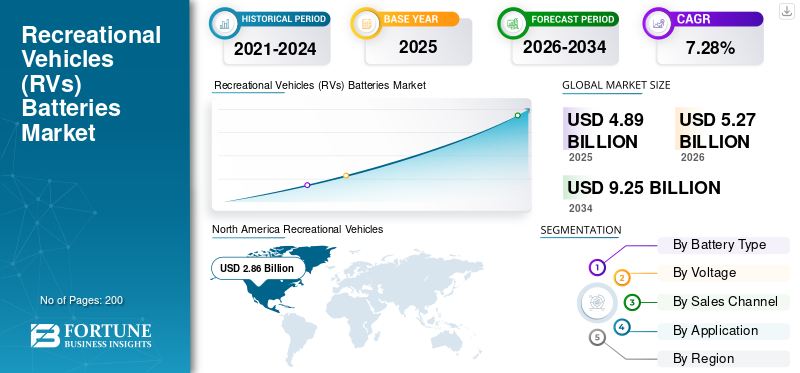
The global Recreational Vehicles (RVs) batteries market size was valued at USD 4.89 billion in 2025. The market is projected to grow from USD 5.27 billion in 2026 to USD 9.25 billion by 2034, exhibiting a CAGR of 7.28% during the forecast period. North America dominated the recreational Vehicles (RVs) batteries market with a market share of 58.48% in 2025.
Recreational Vehicle (RV) batteries are energy storage systems used to power both the engine (starter batteries) and onboard electrical systems (house/deep-cycle batteries) in motorhomes and towable RVs. These batteries enable lighting, appliances, HVAC, and off-grid functionality, making them essential for modern mobile living and travel. The increasing popularity of outdoor travel and RV ownership is a major driver for RV battery demand. According to the RV Industry Association (RVIA), the U.S. recorded 600,240 RV shipments in December 2021, marking the highest annual shipments on record (RVIA, 2021). This growing adoption is further supported by rising interest in off-grid travel and camping, which increases reliance on deep-cycle batteries and advanced lithium systems. As more consumers seek flexible, self-sufficient travel options, demand for reliable, long-lasting RV batteries continues to grow globally.
- For instance, in March 2024, Dragonfly Energy Corp. (Battle Born Batteries) announced the expansion of its U.S.-based lithium battery manufacturing capacity to meet rising demand from the RV sector. The company highlighted increasing adoption of LiFePO₄ batteries in motorhomes and camper vans, driven by the need for longer lifespan, lightweight systems, and off-grid capability. This development reflects the broader industry shift toward lithium ion batteries, particularly in North America, where RV use and solar-integrated systems continue to grow.
Some of the leading companies operating in the industry include Clarios, EnerSys, East Penn Manufacturing, Exide Technologies, and others. Clarios is a global leader in advanced energy storage solutions, supplying a wide range of lead-acid batteries (including AGM and flooded types) widely used in the market. The company supports both starter and auxiliary battery applications, catering to OEMs and aftermarket demand across North America and Europe.
Download Free sample to learn more about this report.
Recreational Vehicles (RVs) Batteries Market Key Takeaways
 Global Market Size & Forecast
- 2025 Market Size: USD 4.89 billion
- 2026 Market Size: USD 5.27 billion
- 2034 Forecast Market Size: USD 9.25 billion
- CAGR: 7.28% from 2026–2034
 Market Share
- North America dominated the market with a 58.48% share in 2025.
- Lead-acid batteries segment held the largest market share with 81.54% in 2025 due to their affordability and widespread availability.
- House (Deep Cycle) Batteries segment dominated the market owing to strong demand for continuous onboard power and off-grid applications.
 Key Regional Highlights
North America
The market reached USD 2.86 billion in 2025, driven by high RV ownership and strong replacement battery demand.
Asia Pacific
The market reached USD 0.53 billion in 2025, supported by growing campervan adoption and off-grid travel demand.
Europe
The market reached USD 1.22 billion in 2025, driven by rising campervan usage and adoption of lithium-ion batteries.
U.S.
The market reached USD 2.65 billion in 2025, supported by widespread RV ownership and increasing use of solar-powered systems.
Japan
The market reached USD 0.08 billion in 2025, driven by demand for compact campervans and lightweight battery solutions.
Read More

RECREATIONAL VEHICLES (RVS) BATTERIES MARKET TRENDS
Increasing Integration of Solar-Ready Battery Systems for Off-Grid Recreational Activities is the Key Market Trend
The market is increasingly driven by the integration of solar-compatible battery systems, enabling users to support extended recreational activities without reliance on external power sources. As RV travelers seek energy independence, demand for batteries that can efficiently store solar energy, particularly lithium-based systems, has grown significantly. Modern RVs are now being designed with pre-installed solar charging infrastructure and smart battery management systems, enhancing energy optimization and monitoring.
For instance, in September 2023, Winnebago Industries highlighted the expansion of solar-enabled RV models equipped with advanced battery storage systems to support off-grid usage. This trend reflects a broader shift toward sustainable travel and self-sufficient mobility solutions. As more consumers prioritize long-duration travel and remote camping, solar-integrated battery systems are expected to become a standard feature in RVs globally.
MARKET DYNAMICS
MARKET DRIVERS
Download Free sample to learn more about this report.
Increasing Demand for Off-Grid Travel and Energy Independence in Recreational Activities to Drive Market Growth
The growing preference for off-grid travel and energy-independent lifestyles is a major driver for the market, particularly as consumers increasingly engage in outdoor recreational activities such as remote camping and long-distance road trips. Modern RV users are seeking reliable onboard power systems capable of supporting appliances, electronics, and climate control without dependence on grid connectivity.
According to the European Caravan Federation (ECF), new registrations of motor caravans in Europe exceeded 181,000 units in 2022, reflecting sustained demand for RV usage across the region. This expansion in RV adoption directly increases demand for advanced battery systems, especially deep-cycle and lithium-based solutions that support extended off-grid operations. Additionally, improvements in battery technology, including higher energy density and faster charging capabilities, are enabling longer travel durations and enhanced user convenience. These factors drive the Recreational Vehicles (RVs) batteries market growth.
MARKET RESTRAINTS
High Initial Cost of Advanced Battery Technologies Limits Adoption to Hamper the Market Demand
One of the key market restraints is the high upfront cost of advanced battery technologies, particularly lithium-ion systems. While these batteries offer superior performance, longer lifespan, and higher efficiency than traditional lead-acid batteries, their significantly higher initial investment can discourage adoption among cost-sensitive consumers.
Many entry-level RV users and rental operators continue to rely on conventional battery solutions due to budget constraints, thereby limiting the pace of the transition to newer technologies. Additionally, the cost of integrating advanced batteries with compatible systems such as inverters, battery management systems, and solar setups further increases the total ownership cost. This becomes especially challenging in price-sensitive markets where RV adoption itself is still emerging.
MARKET OPPORTUNITIES
Growing Adoption of Smart Battery Management and Connected RV Systems to Present Market Opportunities
The increasing integration of smart Battery Management Systems (BMS) and connected technologies in recreational vehicles presents a significant opportunity for the market. Modern RV users are increasingly demanding real-time monitoring of battery performance, state of charge, and energy consumption to enhance efficiency and reliability during travel and recreational activities. This has led manufacturers to incorporate advanced features such as Bluetooth-enabled monitoring, remote diagnostics, and predictive maintenance into battery systems.
According to the U.S. Department of Energy, in 2023, advancements in battery management technologies improved battery lifespan and operational efficiency in mobile energy applications. These innovations enable users to optimize power usage, prevent battery failures, and extend travel durations without interruptions. Additionally, the rise of connected RV ecosystems, where batteries interact with solar panels, inverters, and onboard electronics, is further enhancing system efficiency.
MARKET CHALLENGES
Raw Material Price Volatility and Supply Chain Constraints Impacting Battery Production Present Significant Challenges for Market Growth
One of the key market challenges is the volatility in raw material prices and supply chain disruptions, particularly for materials such as lithium, lead, nickel, and cobalt. Fluctuations in the prices of these critical inputs directly affect battery manufacturing costs, making it difficult for manufacturers to maintain stable pricing and margins.
According to the U.S. Geological Survey (USGS), lithium prices experienced sharp increases during 2022 due to supply-demand imbalances, highlighting the sensitivity of battery markets to raw material availability. Additionally, global supply chain disruptions, including logistics bottlenecks and geopolitical tensions, have further impacted the timely procurement of components and materials. These challenges can lead to production delays and increased costs for both OEMs and aftermarket suppliers.
Segmentation Analysis
By Battery Type
Lead-Acid Batteries Segment Dominated Owing to its Low Cost and Established Supply Chain Dominance
Based on battery type, the market is classified into lead-acid batteries and lithium-ion batteries. The lead-acid batteries are further classified into Flooded Lead-Acid (FLA)
Absorbent Glass Mat (AGM), and gel batteries.
In 2025, the lead-acid batteries segment dominated with the largest Recreational Vehicles (RVs) batteries market share at 81.54%. The growth of this segment is driven by its cost-effectiveness and widespread availability. Compared to lithium-ion alternatives, lead-acid batteries have a significantly lower upfront cost, making them more accessible to a broad range of RV users, especially in entry-level and mid-range segments. Additionally, they benefit from a well-established global manufacturing and distribution network, ensuring easy availability and replacement.
The lithium-ion batteries segment is experiencing the highest growth and is expected to grow at a CAGR of 8.58% over the forecast period.
To know how our report can help streamline your business, Speak to Analyst
By Voltage
12V Segment Dominated the Market Due to Widespread Compatibility Across Vehicles and Electrical Systems
Based on voltage, the market is classified into 12V, 24V, and 48V.
The 12V segment remains dominant due to its long-standing standardization across automotive and small electrical applications. Most conventional vehicles, including internal combustion engines and many hybrid models, rely on 12V architectures to power lighting, infotainment, and auxiliary systems. Its cost-effectiveness, ease of maintenance, and established supply chain further support widespread adoption.
The 48V segment is expected to grow at a CAGR of 10.08% during the forecast period.
By Sales Channel
Aftermarket is Dominant Due to Frequent Replacements and Large Existing Vehicle Base
On the basis of sales channel, the market is classified into OEM and aftermarket.
The aftermarket segment dominated the market due to the continuous need for battery replacement across a vast global vehicle fleet. As batteries have a limited lifespan, recurring demand is generated irrespective of new vehicle sales. Additionally, the growing average age of vehicles increases replacement frequency, further boosting aftermarket sales.
The OEM segment is expected to grow at a CAGR of 6.33% over the forecast period.
By Application
House (Deep Cycle) Batteries Dominated the Market, High Energy Intensity, and Continuous Operations
On the basis of application, the market is classified into starter batteries and house (deep cycle) batteries.
In 2025, the house (deep cycle) batteries segment dominates due to their ability to provide sustained power over longer durations, making them ideal for auxiliary applications in RVs and off-grid setups. Unlike starter batteries, they are designed for repeated deep discharge cycles without significant performance degradation. Their reliability in powering appliances, lighting, and onboard systems enhances their demand.
The starter batteries segment is expected to grow at a CAGR of 6.47% during the forecast period.
Recreational Vehicles (RVs) Batteries Market Regional Outlook
By geography, the market is categorized into North America, Europe, Asia Pacific, Latin America, and the Middle East & Africa.
North America
North America Recreational Vehicles (RVs) Batteries Market Size, 2025 (USD Billion)
To get more information on the regional analysis of this market, Download Free sample
North America held the largest share in 2025, valued at USD 2.86 billion, and is expected to maintain its leading position in 2026, with USD 3.09 billion. North America dominates the market due to its structurally large motorhome and travel trailer parc, which drives sustained replacement demand rather than just new sales. The region also indicates higher adoption of energy-intensive onboard systems such as HVAC units, inverters, and solar-integrated setups, increasing battery capacity requirements per vehicle. Additionally, seasonal usage patterns lead to more frequent battery wear and replacement cycles, while a strong network of RV service centers and specialized retailers ensures easy availability of advanced battery types, including AGM and lithium-ion variants.
U.S. Recreational Vehicles (RVs) Batteries Market
Based on North America’s strong contribution and the U.S. dominance within the region, the U.S. market was valued at USD 2.65 billion in 2025, accounting for roughly 54.15% of the global market size.
Europe
Europe is projected to record a growth rate of 6.81% in the coming years, which is the second-highest among all regions. The region reached a valuation of USD 1.22 billion in 2025. Europe’s market is driven by a growing base of campervans and caravans designed for compact, multi-functional travel, which increases reliance on efficient energy storage systems. The region indicates strong adoption of lithium-ion batteries driven by stringent emissions norms and a preference for lightweight components that improve fuel efficiency. Additionally, widespread integration of solar panels in RVs across countries such as Germany and the Netherlands raises demand for high-performance deep-cycle batteries, supporting longer off-grid travel and energy independence.
Germany Recreational Vehicles (RVs) Batteries Market
The Germany’s market in 2025 was valued at USD 0.40 billion in 2025 and is estimated to reach USD 0.43 billion in 2026, representing roughly 8.20% of the global revenues.
Asia Pacific
Asia Pacific was valued at USD 0.53 billion in 2025. The regional market is expanding as the popularity of compact campervans and van-life conversions grows, particularly in countries such as Australia, Japan, and South Korea. Unlike traditional large RVs, these vehicles require space-efficient and lightweight battery systems, driving demand for lithium-ion variants. Additionally, increasing adoption of solar-assisted charging in remote travel applications supports the need for reliable deep-cycle batteries.
Japan Recreational Vehicles (RVs) Batteries Market
The Japanese market in 2025 was valued at USD 0.08 billion, accounting for roughly 1.70% of global revenues. Japan’s demand is driven by compact campervan designs requiring lightweight, high-efficiency battery systems for space-constrained applications.
China Recreational vehicles (RVs) batteries Market
China’s market is projected to be significant worldwide, with 2025 revenues valued at around USD 0.20 billion, representing roughly 4.04% of the global market.
Australia Recreational Vehicles (RVs) Batteries Market
The Australia’s market in 2025 was valued at around USD 0.14 billion, accounting for roughly 2.67% of global revenues.
Latin America
Latin America is expected to witness moderate growth in this market during the forecast period. The region reached a valuation of USD 0.19 billion in 2025. Latin America’s RV battery demand is supported by growing campervan tourism in countries such as Brazil and Chile, where long-distance travel requires reliable energy storage. Limited charging infrastructure in remote areas further increases reliance on durable deep-cycle batteries for off-grid applications.
Brazil Recreational vehicles (RVs) batteries Market
Brazil's market reached around USD 0.09 billion in 2025, representing roughly 1.76% of the global market.
Middle East & Africa
The Middle East & Africa are expected to witness significant growth in this market during the forecast period. The region reached a valuation of USD 0.09 billion in 2025. The Middle East & Africa market is driven by increasing adoption of RVs for desert tourism and long-distance travel, particularly in the UAE and South Africa. High temperatures in the region create a preference for batteries with strong thermal stability and longer life cycles. Off-grid travel conditions and limited charging infrastructure further boost demand for high-capacity deep-cycle and lithium-based batteries.
GCC Recreational vehicles (RVs) batteries Market
The GCC market is projected to be around USD 0.05 billion in 2025, representing roughly 0.94% of the global market.
COMPETITIVE LANDSCAPE
Key Industry Players
Major Players Expand their Rvs Battery Market Share Via Partnerships, Business Expansion, and Technological Advancements
The global recreational vehicles (RVs) batteries market holds a consolidated market structure, constituting prominent players such as Clarios, EnerSys, East Penn Manufacturing, and others. Companies operating in the market are adopting targeted growth strategies focused on strengthening their product portfolio, technical capability, expanding manufacturing presence, and other areas.
- For instance, in June 2023, Clarios expanded its low-voltage range battery portfolio with advanced AGM batteries tailored for recreational vehicles, focusing on enhanced cycle life and improved performance for auxiliary power applications. The initiative also emphasized strengthening distribution networks across North America to serve the growing RV aftermarket segment.
Other key players in the global market include Exide Technologies, Crown Battery Manufacturing Company, GS Yuasa Corporation, Trojan Battery Company, and others. These companies are expected to prioritize new product launches and collaborations to increase their global market share during the forecast period.
LIST OF KEY RECREATIONAL VEHICLES (RVS) BATTERIES COMPANIES PROFILED
- Clarios (Ireland)
- EnerSys (U.S.)
- East Penn Manufacturing (U.S.)
- Exide Technologies (U.S.)
- Crown Battery Manufacturing Company (U.S.)
- GS Yuasa Corporation (Japan)
- Trojan Battery Company (U.S.)
- Samsung SDI (South Korea)
- LG Energy Solution (South Korea)
- RELiON Battery (U.S.)
KEY INDUSTRY DEVELOPMENTS
- April 2024: East Penn enhanced its Deka deep-cycle battery line for RV applications by improving plate construction and electrolyte optimization to extend cycle life. The initiative aimed to support consistent power delivery for onboard appliances and solar-integrated RV systems. The company also expanded its distribution footprint across specialty RV dealers and service providers, ensuring the availability of robust battery solutions designed for frequent discharge and recharge cycles common in recreational vehicle usage.
- September 2023: EnerSys expanded its lithium battery offerings for mobile applications, including RVs, under its NexSys portfolio. The initiative emphasized high energy density, fast charging, and integration with energy management systems used in modern recreational vehicles. EnerSys also focused on enabling longer off-grid capabilities and reducing the total cost of ownership for RV users.
- August 2023: Exide Technologies introduced upgraded AGM and gel batteries under its marine and leisure segment, targeting RV and caravan users across Europe. The initiative focused on improved vibration resistance, longer service life, and compatibility with solar charging systems. Exide also emphasized sustainability by enhancing recyclability and reducing environmental impact.
- July 2023: GS Yuasa advanced its lithium-ion battery development for mobility and leisure applications, including compact RVs and campervans. The initiative focused on lightweight battery modules with high energy efficiency and enhanced safety features. GS Yuasa also explored integration with solar charging and smart battery management systems to support off-grid travel.
- May 2023: Crown Battery expanded its deep-cycle battery lineup for RV and renewable energy applications by introducing products with thicker plates and advanced paste formulations. The initiative aimed to deliver extended battery life and improved performance under deep discharge conditions. Crown also strengthened its presence in the aftermarket by collaborating with RV dealers and distributors, ensuring replacement batteries are readily available to consumers seeking durable, long-lasting energy storage solutions.
REPORT COVERAGE
The global Recreational Vehicles (RVs) batteries market analysis provides an in-depth study of the market size and forecast for all the market segments included in the report. It includes details on the market dynamics and trends expected to drive the market over the forecast period. It offers information on the technological advancements, new product launches, key industry developments, and details on partnerships, mergers, and acquisitions. The market research report also encompasses a detailed competitive landscape with information on the market share and profiles of key operating players.
Request for Customization to gain extensive market insights.
Report Scope & Segmentation
| ATTRIBUTE | DETAILS |
| Study Period | 2021-2034 |
| Base Year | 2025 |
| Estimated Year | 2026 |
| Forecast Period | 2026-2034 |
| Historical Period | 2021-2024 |
| Growth Rate | CAGR of 7.28% from 2026 to 2034 |
| Unit | Value (USD Billion) |
| Segmentation | By Battery Type, Voltage, Sales Channel, Application, and Region |
| By Battery Type |
|
| By Voltage |
|
| By Sales Channel |
|
| By Application |
|
| By Geography |
|
Frequently Asked Questions
Fortune Business Insights says that the global market value stood at USD 4.89 billion in 2025 and is projected to reach USD 9.25 billion by 2034.
In 2025, the North American market value stood at USD 2.86 billion.
The market is expected to exhibit a CAGR of 7.28% during the forecast period.
The house (deep cycle) batteries segment led the market by application.
Rising RV ownership, increasing off-grid travel, and growing adoption of high-capacity lithium and solar-integrated battery systems are key market drivers.
Clarios, EnerSys, and East Penn Manufacturing are some of the prominent players in the market.
North America dominated the market in 2025 with the largest share.
Increasing electrification of RV systems, demand for longer off-grid capability, and shift toward lightweight, high-efficiency lithium batteries are expected to favor product adoption.



- 2021-2034
- 2025
- 2021-2024
- 200
Get 30-60 hrs Free Customization
Expand Regional and Country Coverage, Segments Analysis, Company Profiles, Competitive Benchmarking, and End-user Insights.



















Related Reports
-
US +1 833 909 2966 ( Toll Free )
-
Get In Touch With Us