Retail Oil and Gas Logistics Market Size, Share & Industry Analysis, By Transportation Mode (Roadways, Railways, Maritime, Airways, and Multimodal), By Service Type (Transportation, Warehousing & Storage, Freight Forwarding, Project Logistics, and Others), By Operation Type (Domestic Logistics and International Logistics), By Cargo (Gasoline/Petrol, Diesel, LPG, Aviation Fuel, and Others), and Regional Forecast, 2026-2034
 Download Free Sample
 Retail Oil and Gas Logistics Market Size and Future Outlook
 Listen to Audio Version
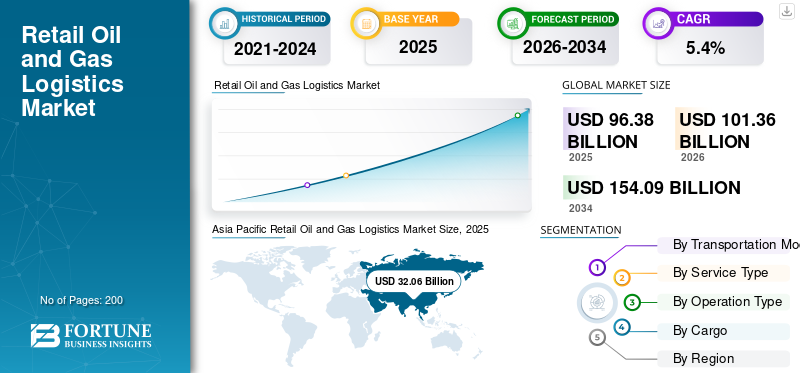
The global retail oil and gas logistics market size was valued at USD 96.38 billion in 2025. The market is projected to grow from USD 101.36 billion in 2026 to USD 154.09 billion by 2034, exhibiting a CAGR of 5.4% during the forecast period.
The market represents the downstream movement, storage, handling, and distribution of fuels from terminals, depots, refineries, and import points to retail and commercial consumption locations. It mainly covers gasoline/petrol, diesel, LPG, aviation fuel, lubricants, and other refined petroleum products. These services are aimed at ensuring that retail fuel stations, airports, commercial fleets, industrial users, and local fuel distributors receive products safely, on time, and in the right quantity.
The market is closely linked with fuel consumption, road transport activity, fuel station density, depot infrastructure, tanker-truck fleets, retail fuel networks, and last-mile distribution. It also includes supply chain management, inventory planning, route optimization, compliance with fuel-handling regulations, and emergency replenishment during demand spikes or supply disruption. The market is especially important in countries with large vehicle fleets, expanding highway networks, growing aviation activity, and wide rural fuel distribution requirements.
In the future, the industry will evolve toward safer, digitized, and more efficient fuel distribution. Logistics providers are expected to use telematics, automated loading systems, digital dispatching, real-time fuel inventory tracking, and carbon-reduction technologies. The shift toward alternative fuels will make the network more complex as fuel retailers manage petrol, diesel, LPG, biofuels, EV charging support, and non-fuel retail operations together.
The services are used in fuel station replenishment, commercial fleet refueling, aviation fuel supply, LPG cylinder and bulk distribution, lubricant delivery, and emergency fuel supply. Key companies such as DB Schenker, CEVA Logistics, and Noatum Holdings are strengthening supply chain solutions, digital supply chains, and low-carbon road transport to maintain their market share in this changing gas logistics industry.
Download Free sample to learn more about this report.
RETAIL OIL & GAS LOGISTICS MARKET TRENDS
Low-Carbon Road Transport to Influence the Evolution of Fuel Distribution Networks
A key gas logistics market trend is the use of lower-emission road fleets and cleaner distribution models. Since retail fuel logistics depends heavily on road tankers and regional transport, logistics providers are adopting HVO, biofuels, telematics, route optimization, and fleet-efficiency tools. This helps reduce emissions while maintaining delivery reliability for petrol, diesel, LPG, and lubricant distribution.
- For instance, in June 2025, CEVA Logistics made HVO100 biofuel available across its U.K. road network, targeting 450 vehicles by end-2025.
MARKET DYNAMICS
MARKET DRIVERS
Download Free sample to learn more about this report.
Rising Retail Fuel Consumption to Support Last-Mile Fuel Logistics Growth
The surging demand for diesel, petrol, LPG, and aviation fuel is increasing the need for reliable retail fuel distribution, propelling retail oil and gas logistics market growth. Expanding vehicle fleets, freight transport, aviation recovery, urbanization, and commercial fuel demand are pushing companies to improve depot-to-station logistics. This supports investment in tanker fleets, terminal connectivity, digital dispatch systems, and integrated supply chain solutions across the retail gas logistics industry.
- In 2025, the International Energy Agency (IEA) projected the global oil demand to rise by 2.5 mb/d from 2024 to 2030, reaching around 105.5 mb/d.
MARKET RESTRAINTS
Energy Transition and Retail Site Rationalization May Limit Fuel Logistics Growth
The market faces restraint from EV adoption, fuel-efficiency gains, urban emission rules, and restructuring of traditional service-station networks. As fuel retailers shift toward charging, convenience retail, and low-carbon energy, some conventional fuel sites may be closed, sold, or converted. This can reduce petroleum delivery frequency in mature markets and pressure logistics providers serving petrol and diesel networks.
MARKET OPPORTUNITIES
Fuel Retail Modernization to Create Opportunities for Integrated Logistics Services
Retail fuel networks are becoming more complex as operators add convenience stores, LPG, lubricants, EV charging, digital payments, and fleet-card services. This creates opportunities for logistics providers that can manage fuel delivery, inventory visibility, warehouse support, and multi-product distribution together. Modernized stations require more frequent, data-led replenishment and stronger supply chains, especially in high-growth Asian and African markets.
MARKET CHALLENGES
Fuel Demand Volatility Creates Challenges for Retail Distribution Planning
Retail fuel logistics is sensitive to price changes, economic activity, EV adoption, weather, and policy shifts. Sudden demand drops or product-mix changes can disrupt route planning, tank utilization, depot scheduling, and working capital. Logistics providers must maintain service levels even when diesel, petrol, or LPG consumption changes unevenly across cities, industrial zones, and rural markets.
- In March 2025, the IEA reported that China’s gasoline, diesel, and jet fuel demand fell marginally in 2024. The oil-based fuel use was 8.1 million b/d, 2.5% below 2021.
Segmentation Analysis
By Transportation Mode
Roadways Segment Dominated the Market due to High Use of Road Transport for Retail Fuel Delivery
On the basis of transportation mode, the market is segmented into roadways, railways, maritime, airways, and multimodal.
The roadways segment dominated the market in 2025 as oil and gas logistics relies on tanker trucks moving fuel from depots, terminals, and refineries to fuel stations and commercial users. Road transport offers route flexibility, faster replenishment, and access to rural and urban retail networks. It is also critical for diesel, petrol, LPG, lubricants, and emergency fuel delivery.
- In July 2025, Top Line acquired a 2-million-liter depot and 15 fuel tanker trucks, expanding road-based fuel delivery capacity in the Philippines.
To know how our report can help streamline your business, Speak to Analyst
The multimodal segment is expected to grow at a CAGR of 8.1% over the forecast period.
By Service Type
Transportation Segment Leads the Market Owing to Regular Deliveries to Fuel Stations
On the basis of service type, the market is segmented into transportation, warehousing & storage, freight forwarding, project logistics, and others.
The transportation segment dominates the market as core activity is moving refined fuel from storage points to retail and commercial consumption sites. Fuel stations depend on regular deliveries to avoid stockouts, while industrial users need predictable diesel, LPG, and lubricant supply. Transportation also accounts for high operating costs due to vehicles, drivers, safety systems, route planning, and compliance.
The project logistics segment is expected to grow at a CAGR of 8.6% over the forecast period.
By Operation Type
Domestic Logistics Segment Holds Major Share due to In-Country Fuel Distribution
On the basis of operation type, the market is segmented into domestic logistics and international logistics.
The domestic logistics segment dominates the market given that most retail fuel movement takes place within national distribution networks. Petrol, diesel, LPG, and aviation fuel are moved from local refineries, import terminals, depots, and storage facilities to retail stations and commercial users. This gives domestic logistics a higher market share than international logistics in the retail-focused market.
- In June 2025, Dangote announced nationwide petrol and diesel distribution in Nigeria using 4,000 CNG-powered tankers, strengthening domestic fuel logistics.
The international logistics segment is expected to grow at a CAGR of 2.4% over the forecast period.
By Cargo
Diesel Segment Dominates the Market due to Commercial, Industrial, and Freight Fuel Demand
On the basis of cargo, the market is segmented into gasoline/petrol, diesel, LPG, aviation fuel, and others.
The diesel segment holds a dominant retail oil and gas logistics market share as it is widely used in freight transport, buses, agriculture, construction, mining, backup power, and industrial operations. These end users require frequent bulk deliveries and reliable depot-to-customer logistics. Diesel also has strong demand in developing economies where commercial vehicles and off-road machinery remain central to economic activity and retail fuel distribution.
- For instance, in June 2026, India’s PPAC (Petroleum Planning & Analysis Cell) reported monthly POL (petroleum, oil, and lubricants) consumption growth owing to surge in motor spirit at 3.4% and high-speed diesel at 1.6%.
The others segment is expected to grow at a CAGR of 9.1% over the forecast period.
Retail Oil and Gas Logistics Market Regional Outlook
By geography, the global market is categorized into North America, Europe, Asia Pacific, Latin America, and the Middle East & Africa.
Asia Pacific
Asia Pacific Retail Oil and Gas Logistics Market Size, 2025 (USD Billion)
To get more information on the regional analysis of this market, Download Free sample
Asia Pacific held the dominant share in 2025, valuing at USD 32.06 billion. The regional market also recorded a leading share in 2024, with a valuation of USD 30.88 billion. Asia Pacific dominates due to large fuel-consuming economies, dense vehicle populations, expanding retail fuel networks, and rising commercial transport demand in China, India, Japan, South Korea, Australia, and Malaysia. The region requires extensive road tanker movement, depot operations, fuel station replenishment, LPG distribution, and lubricant logistics. Growing aviation activity and industrial fuel use also support demand.
- For instance, in 2024, Shanghai Futures Exchange reported that China had around 120,000 gas stations, while gasoline, diesel, and kerosene remained major refined fuel outputs.
China Retail Oil and Gas Logistics Market
The China market is projected to be one of the largest markets worldwide. The 2025 revenues of this country market touched a value of around USD 11.50 billion, representing roughly 11.9% of the global market.
India Retail Oil and Gas Logistics Market
The India market reached a value of around USD 7.73 billion in 2025, accounting for roughly 8.0% of global revenues.
North America
North America is estimated to reach USD 24.78 billion in 2026 and secure the position of the second-largest region in the market. The regional market will grow steadily due to mature fuel retail networks, high vehicle ownership, freight movement, aviation demand, and strong commercial diesel consumption. The U.S. appears highly developed, with large-scale fuel distribution, branded retail chains, convenience-store integration, and advanced fleet logistics. The market is anticipated to expand with improvements in optimization, digital dispatch, cleaner fleets, and last-mile fuel efficiency.
U.S. Retail Oil and Gas Logistics Market
Based on North America’s strong contribution and the U.S. dominance within the region, the U.S. market reached a valuation of around USD 16.84 billion in 2025, representing roughly 24.8% of the global market.
Middle East & Africa
The Middle East & Africa market is projected to record a growth rate of 5.5% during the forecast period and reach a valuation of USD 16.14 billion by 2026. The regional market is poised to grow with expanding service-station networks, urban mobility, LPG use, airport fuel demand, and downstream retail investment. Gulf countries are modernizing fuel retail formats, while African markets need wider distribution coverage. Growth remains positive, although infrastructure gaps and fuel-price regulation can affect logistics efficiency.
Saudi Arabia Retail Oil and Gas Logistics Market
In 2025, the Saudi Arabia market reached a valuation of around USD 5.59 billion, accounting for roughly 5.8% of global revenues.
UAE Retail Oil and Gas Logistics Market
The UAE market touched a value of around USD 3.04 billion in 2025, accounting for roughly 3.2% of global revenues.
Europe
The Europe market will grow moderately as fuel demand matures and energy transition policies reshape retail networks. Logistics providers are anticipated to focus on safer distribution, cleaner tanker fleets, EV-linked service stations, and fuel-site modernization. The service demand will remain supported by diesel fleets, aviation fuel, LPG, and cross-border retail fuel supply chains.
Latin America
The Latin America market will expand, driven by growing fuel consumption in Brazil, Argentina, Guyana, and nearby economies. Retail fuel logistics will benefit from road freight, urban mobility, aviation recovery, and fuel station modernization. However, inflation, infrastructure gaps, and regulatory changes can slow logistics investment.
COMPETITIVE LANDSCAPE
Key Industry Players
Pivotal Companies to Invest in Digital Platforms for Enhancing their Distribution Capabilities
In the global retail oil and gas logistics market, the competitive landscape comprises fuel retailers, downstream logistics companies, tanker fleet operators, storage providers, freight forwarders, and integrated energy groups. Competition is based on delivery reliability, safety compliance, depot access, route coverage, digital visibility, fleet scale, and the ability to serve both urban and remote retail fuel networks. Large fuel retailers have an advantage given that they control retail stations, terminals, and customer data, while logistics specialists compete by offering efficient transportation and outsourced supply chain management.
Major players are developing several strategies to gain a competitive advantage. They are investing in digital planning platforms to improve vehicle utilization, reduce empty miles, and monitor fuel inventory at retail sites. In addition, companies are expanding road tanker networks and regional distribution hubs to improve delivery speed. Many players are combining fuel logistics with convenience retail, EV charging, lubricants, LPG, and non-fuel services. This helps them remain relevant as customer demand changes. Furthermore, companies are using alternative fuels such as HVO, biofuels, and lower-emission trucks to reduce emissions from road distribution.
The market includes global logistics groups such as CEVA Logistics, DHL, DSV, Kuehne+Nagel, DB Schenker, and Noatum Holdings SLU, along with regional firms such as Reliance Logistics Group, Riada Shipping and Logistics, Halcon Primo Logistics Pte, and Tudor International Freight. These companies support fuel retailers through transportation, warehousing, documentation, forwarding, and regional distribution.
- In February 2024, CMA CGM completed its EUR 4.85 billion (~USD 5.24 billion) acquisition of Bolloré Logistics, strengthening CEVA’s global freight, contract logistics, and supply chain capabilities.
LIST OF KEY RETAIL OIL AND GAS LOGISTICS COMPANIES PROFILED
- DHL Group (Germany)
- Kuehne+Nagel International AG (Switzerland)
- DSV A/S (Denmark)
- CEVA Logistics (France)
- DB Schenker (Germany)
- CMA CGM Group (France)
- DP World (UAE)
- AD Ports Group (UAE)
- ADNOC Logistics & Services (UAE)
- Agility Logistics (Kuwait)
- Aramex (UAE)
- FedEx Logistics (U.S.)
- Noatum Holdings (Spain)
- Expeditors International (U.S.)
- H. Robinson (U.S.)
KEY INDUSTRY DEVELOPMENTS
- June 2026: The ACCC (Australian Competition & Consumer Commission) approved Ampol’s acquisition of EG Australia, subject to the divestment of 41 retail fuel sites. The deal strengthens Ampol’s fuel retail and distribution footprint across Australia
- May 2026: EG On The Move announced the acquisition of MPK Garages Limited, covering 27 petrol forecourt sites in the U.K. The sites operate under Valero, Texaco, and Gulf fuel brands.
- February 2026: ADNOC Distribution announced record network expansion, increasing its retail footprint to 1,010 service stations by the end of 2025, a 13% increase year-over-year. The company added 119 new stations during the year, strengthening fuel distribution coverage across the UAE and international markets while supporting higher fuel volumes, convenience retail sales, and downstream logistics activity.
- January 2026: Circle K Germany acquired three fuel depots from TotalEnergies followed by the 2024 takeover of nearly 2,200 TotalEnergies service stations. The deal supports fuel supply control and logistics integration across its European retail network.
- December 2025: Snam agreed to acquire Igneo’s 48.2% stake in OLT Offshore LNG Toscana for about EUR 126 million. The deal strengthens LNG terminal control in Italy.
- September 2025: Nasan Energies Namibia agreed to acquire 53 Engen and Shell-branded fuel service stations from Vivo Energy Namibia. The transaction strengthens local ownership in Namibia’s fuel retail and logistics market.
- August 2025: Ampol entered an agreement to acquire EG Australia for approximately AUD 1.1 billion (USD 720 million), adding around 500 fuel and convenience retail sites to its network. The acquisition significantly expands Ampol’s retail fuel distribution footprint, strengthens supply chain integration, increases logistics efficiency across Australia, and enhances its position in the country's downstream fuel retail market.
REPORT COVERAGE
The global retail oil and gas logistics market analysis provides an in-depth study of market size & forecast by all the market segments included in the report. It includes details on the market dynamics and market trends expected to drive the market over the forecast period. It offers information on the technological advancements, new product launches, key industry developments, and details on partnerships, mergers, and acquisitions. The research report also encompasses detailed competitive landscape with information on the market share and profiles of key operating players.
Request for Customization to gain extensive market insights.
Report Scope & Segmentation
| ATTRIBUTE | DETAILS |
| Study Period | 2021-2034 |
| Base Year | 2025 |
| Estimated Year | 2026 |
| Forecast Period | 2026-2034 |
| Historical Period | 2021-2024 |
| Growth Rate | CAGR of 5.4% from 2026-2034 |
| Unit | Value (USD Billion) |
| Segmentation | By Transportation Mode, Service Type, Operation Type, Cargo, and Region |
| By Transportation Mode |
|
| By Service Type |
|
| By Operation Type |
|
| By Cargo |
|
| By Geography |
|
Frequently Asked Questions
Fortune Business Insights says that the global market value stood at USD 96.38 billion in 2025 and is projected to reach USD 154.09 billion by 2034.
In 2025, the Asia Pacific market value stood at USD 32.06 billion.
The market is expected to exhibit a CAGR of 5.4% during the forecast period of 2026-2034.
The roadways segment led the market by transportation mode in 2025.
The expanding LNG trade and refinery activity is a key factor driving the global market.
DHL, Kuehne+Nagel, DSV A/S, and CEVA Logistics are the top players in the market.
Asia Pacific dominated the market in 2025.



- 2021-2034
- 2025
- 2021-2024
- 200
Get 30-60 hrs Free Customization
Expand Regional and Country Coverage, Segments Analysis, Company Profiles, Competitive Benchmarking, and End-user Insights.




















Related Reports
-
US +1 833 909 2966 ( Toll Free )
-
Get In Touch With Us