Reusable Shopping Bag Market Size, Share & Industry Analysis, By Material (Polypropylene (PP), Cotton, Canvas, Jute, Polyester, and Others), By Product Type (Tote Bags, Grocery Bags, Foldable/Collapsible Bags, Drawstring Bags, Promotional Bags, and Others), By End Use (Grocery & Food, Apparel & Fashion, Consumer Goods, Promotional & Advertising, E-commerce, and Others), and Regional Forecast, 2026-2034
 Download Free Sample
(Offer valid till 15th Oct 2026)

Reusable Shopping Bag Market Size and Future Outlook
 Listen to Audio Version
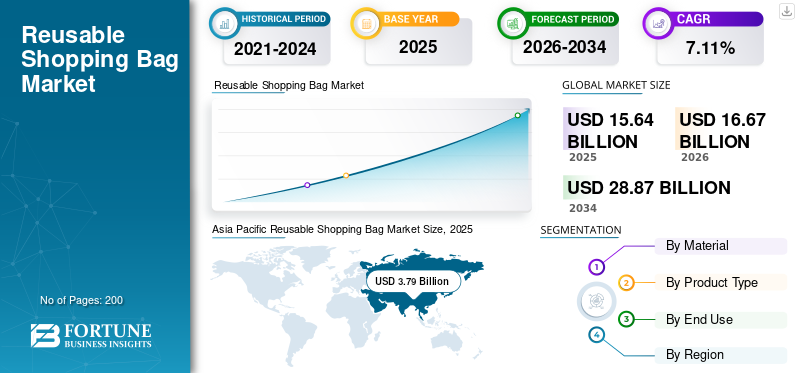
The global reusable shopping bag market size was valued at USD 15.64 billion in 2025. The market is projected to grow from USD 16.67 billion in 2026 to USD 28.87 billion by 2034, exhibiting a CAGR of 7.11% during the forecast period. Asia Pacific dominated the reusable shopping bag market with a market share of 24.23% in 2025.
The global reusable shopping bag market includes the manufacturing, distribution, and sale of sturdy bags intended for multiple uses in transporting groceries, retail items, and various consumer products. The growing government regulations on single-use plastic bags, along with heightened consumer consciousness regarding environmental sustainability and waste minimization, are fueling the demand for the product. Additionally, retailers and brands are advocating for reusable options to achieve sustainability objectives and enhance their eco-friendly brand image, thus driving market growth.
Key industry players, such as Vicbag Group, BAGGU, and Envirosax, operating in the market, are focusing on developing innovative products and conducting R&D to strengthen their market position.
Download Free sample to learn more about this report.
Reusable Shopping Bag Market KEY TAKEAWAYS
 Global Market Size & Forecast
- 2025 Market Size: USD 15.64 Billion
- 2026 Market Size: USD 16.67 Billion
- 2034 Forecast Market Size: USD 28.87 Billion
- CAGR: 7.11% from 2026-2034
 Market Share
- Asia Pacific dominated with a market share of 24.23% in 2025.
- The grocery bags segment is projected to grow at a CAGR of 7.25% during the forecast period.
- The apparel & fashion segment is projected to grow at a CAGR of 7.46% during the forecast period.
 Key Regional Highlights
North America
Held a leading position, reaching USD 3.79 billion in 2025, driven by plastic reduction regulations and sustainability awareness.
Europe
Reached USD 2.24 billion in 2025 and is projected to grow at a 7.06% rate, supported by environmental regulations.
Asia Pacific
Dominated the market at USD 3.79 billion in 2025, supported by urbanization, organized retail, and plastic pollution initiatives.
U.S
The market was approximately USD 2.90 billion in 2025, driven by plastic bag bans, bag-fee initiatives, and sustainability programs.
Japan
The market reached approximately USD 0.73 billion in 2025, supported by waste reduction efforts and mandatory single-use bag fees.
Read More

REUSABLE SHOPPING BAG MARKET TRENDS
Rising Adoption of Sustainable and Recycled Materials is a Prominent Trend Observed in the Market
A notable trend influencing the market is the growing adoption of recycled and sustainable materials in the production of bags. Brands and retailers are increasingly utilizing reusable bags as a visible part of their strategies for environmental responsibility. Consumers are progressively assessing products according to their environmental effects, prompting manufacturers to provide reusable bags that feature reduced carbon footprints and enhanced recyclability. This trend is fostering product innovation, which includes lightweight designs, improved durability, and visually attractive bags that merge functionality with sustainability, thereby expanding their appeal across various retail sectors.
MARKET DYNAMICS
MARKET DRIVERS
Download Free sample to learn more about this report.
Growing Regulatory Restrictions on Single-Use Plastics are Driving Market Growth
A significant factor propelling the global market is the rising enforcement of regulations that restrict or prohibit single-use plastic bags. Governments across both developed and developing nations are implementing policies designed to decrease plastic waste, alleviate the burden on landfills, and reduce environmental pollution. These initiatives encompass bans on plastic bags, obligatory fees for disposable bags, and extended producer responsibility programs that promote reusable, sustainable packaging options. As retailers and consumers adjust to these regulatory shifts, reusable shopping bags are increasingly becoming the preferred choice for everyday shopping. The growing synergy between environmental impact policies and corporate sustainability efforts is further driving market demand, positioning reusable grocery bags as a vital element of contemporary retail and consumer behavior.
MARKET RESTRAINTS
Higher Initial Cost Compared with Disposable Alternatives Hampers Market Growth
The relatively higher initial expense associated with reusable shopping bags poses a significant barrier to market expansion, especially in regions sensitive to pricing. Although reusable bags provide long-term financial advantages through their repeated utilization, their acquisition cost is considerably greater than that of traditional single-use plastic bags. Small retailers and consumers in developing economies may hesitate to embrace reusable options due to financial constraints and a lack of awareness regarding long-term economic benefits. Furthermore, some businesses persist in covering the costs of disposable packaging to ensure customer convenience. These elements can hinder the rate of adoption, particularly in areas where regulatory enforcement is weak. As a result, the price difference between reusable and disposable bags continues to affect purchasing choices across diverse markets.
MARKET OPPORTUNITIES
Expansion of Reusable Bag Programs in Emerging Economies Offers Potential Growth Opportunities
Emerging economies offer significant growth potential for the market as urbanization, the expansion of organized retail, and environmental consciousness continue to rise. As contemporary retail formats such as supermarkets, hypermarkets, and convenience store chains grow, the demand for sustainable shopping alternatives is anticipated to increase. Moreover, the rise of middle-class populations and greater consumer awareness of sustainability initiatives foster favorable conditions for the adoption of reusable bags. Manufacturers can take advantage of this opportunity by providing affordable, durable, and locally sourced reusable bags that cater to regional preferences, thereby aiding in the expansion of the market in underserved regions and propelling long-term reusable shopping bag market growth.
MARKET CHALLENGES
Ensuring Consistent Consumer Reuse Behavior Poses a Critical Challenge to Market Growth
A significant obstacle confronting the reusable shopping bag industry is motivating consumers to regularly utilize bags over a prolonged duration. The ecological advantages of reusable bags are largely contingent upon their frequent use; however, numerous consumers tend to forget to bring them along during shopping excursions or gather several bags without fully utilizing them. This behavior can diminish the anticipated sustainability benefits and raise issues related to resource efficiency. Furthermore, consumer preferences related to cleanliness, convenience, and storage may affect long-term usage trends. Stakeholders in the market, including retailers and policymakers, need to commit to awareness initiatives, incentive schemes, and educational programs that encourage responsible reuse practices to guarantee that reusable shopping bags achieve their desired environmental and economic outcomes.
Segmentation Analysis
By Material
Cost Efficiency, Durability, and Scalability are Likely to Drive the Polypropylene (PP) Segment Growth
Based on material, the market is divided into polypropylene (PP), cotton, canvas, jute, polyester, and others.
The polypropylene (PP) segment is expected to account for the largest reusable shopping bag market share. The segment dominates the global market due to its favorable balance of affordability, durability, and manufacturing efficiency. Its relatively low production cost compared with natural materials such as cotton or jute makes PP an attractive option for retailers seeking cost-effective, sustainable alternatives. Additionally, polypropylene can be easily customized through printing, coloring, and branding, making it widely preferred for promotional and retail applications. The material’s moisture resistance, long service life, and compatibility with large-scale production processes further strengthen its market position, allowing widespread adoption across supermarkets, grocery chains, and retail stores worldwide.
The cotton segment is expected to grow at a CAGR of 7.19% over the forecast period.
By Product Type
Versatility, User-Friendliness, and Broad Consumer Appeal Boosted the Tote Bags Segment Growth
Based on product type, the market is segmented into tote bags, grocery bags, foldable/ collapsible bags, drawstring bags, promotional bags, and others.
In 2025, the tote bags segment dominated the global market. The segment leads owing to its remarkable versatility, user-friendliness, and broad acceptance among both consumers and retailers. Moreover, tote bags provide significant customization and branding opportunities, rendering them a favored option for retailers, supermarkets, promotional activities, and corporate sustainability efforts. Offered in a variety of materials such as polypropylene, cotton, jute, and recycled fabrics, tote bags meet the diverse preferences of consumers. Their blend of practicality, cost-effectiveness, and adaptability across various shopping and lifestyle applications continues to strengthen their dominant position in the market.
The grocery bags segment is projected to grow at a CAGR of 7.25% over the forecast period.
By End Use
To know how our report can help streamline your business, Speak to Analyst
High Shopping Frequency and Regulatory Compliance to Drive the Grocery and Food Segment Growth
Based on end use, the market is segmented into grocery & food, apparel & fashion, consumer goods, promotional & advertising, e-commerce, and others.
The grocery & food segment is expected to hold a dominant market share over the forecast period. The segment leads the market, as it accounts for the highest volume of shopping transactions and bag utilization across the globe. Consumers frequently buy groceries, fresh produce, packaged goods, and household necessities, which creates a persistent demand for robust and reusable carrying options. Moreover, supermarkets, hypermarkets, and grocery chains have been among the first to adopt reusable bag initiatives in response to governmental regulations limiting single-use plastics. The combination of consistent consumer demand, extensive retail adoption, and growing environmental consciousness continues to reinforce the segment’s dominant position in the market.
The apparel & fashion segment is projected to grow at a CAGR of 7.46% over the forecast period.
Reusable Shopping Bag Market Regional Outlook
By geography, the market is categorized into Europe, North America, Asia Pacific, Latin America, and the Middle East & Africa.
North America
Asia Pacific Reusable Shopping Bag Market Size, 2025 (USD Billion)
To get more information on the regional analysis of this market, Download Free sample
North America held the second-dominant share in 2024, valued at USD 3.52 billion, and maintained its leading position, reaching USD 3.79 billion in 2025. The market in North America is mainly propelled by regulations at the state and municipal levels aimed at reducing single-use plastics, coupled with heightened consumer awareness regarding sustainability. Prominent retailers have broadened their initiatives for reusable bags to fulfill their environmental obligations, while the growing acceptance of eco-friendly options fosters consistent demand in both grocery and retail industries.
U.S. Reusable Shopping Bag Market
Based on North America's strong contribution and the U.S. dominance within the region, the U.S. market can be analytically approximated at around USD 2.90 billion in 2025, accounting for roughly 18.56% of global sales. In the U.S., the expansion of the market is driven by the implementation of plastic bag bans and mandatory bag-fee initiatives across various states and cities. Major retail chains are actively encouraging the use of reusable bags through loyalty programs and sustainability initiatives. The increasing consumer inclination toward environmentally friendly products is further propelling their adoption in both urban and suburban areas.
Europe
Europe is projected to grow at 7.06% over the coming years, the third-highest among regions. The market reached a valuation of USD 2.24 billion in 2025. The market in Europe is influenced by strict environmental regulations, initiatives promoting a circular economy, and ambitious goals for waste reduction. Consumers demonstrate a strong awareness of environmental issues, which promotes the extensive use of reusable shopping bags. Retailers and brands are progressively implementing sustainable packaging strategies to comply with regulatory standards and meet corporate sustainability goals across the region.
U.K Reusable Shopping Bag Market
The U.K. market stood at USD 0.40 billion in 2025, representing approximately 2.58% of global revenues.
Germany Reusable Shopping Bag Market
Germany's market reached approximately USD 0.47 billion in 2025, equivalent to around 3.03% of global sales.
Asia Pacific
Asia Pacific dominated the market, reaching USD 3.79 billion in 2025. The market is propelled by swift urbanization, the growth of organized retail, and heightened governmental initiatives aimed at mitigating plastic pollution. Increasing disposable incomes and a rising consciousness regarding environmental issues are motivating consumers to transition toward reusable options. Substantial populations and the proliferation of supermarket chains generate considerable demand in both developing and developed economies.
Japan Reusable Shopping Bag Market
The Japanese market reached around USD 0.73 billion in 2025, accounting for roughly 4.65% of global revenues. Japan's market for reusable shopping bags is bolstered by a robust consumer commitment to minimizing waste and conserving resources. The implementation of mandatory fees for single-use shopping bags has hastened the uptake of these alternatives. Consumers are progressively incorporating reusable bags into their daily shopping routines, while retailers persist in advocating for sustainable consumption practices across the country.
China Reusable Shopping Bag Market
China's market is projected to be one of the largest worldwide, with 2025 revenues standing at around USD 1.22 billion, representing roughly 7.77% of global sales.
India Reusable Shopping Bag Market
The Indian market stood at around USD 1.00 billion in 2025, accounting for roughly 6.39% of Asia Pacific high-revenue markets.
Latin America
The Latin America region is expected to witness moderate growth in this market during the forecast period. The Latin American market reached a valuation of USD 3.55 billion in 2025. Growth in the region is driven by expanding environmental regulations and heightened public awareness concerning plastic waste management. Numerous countries have implemented restrictions on single-use plastics, prompting both retailers and consumers to embrace reusable alternatives.
Middle East & Africa
In the Middle East & Africa, South Africa reached USD 0.77 billion in 2025. The MEA market is propelled by new sustainability initiatives, government-driven environmental programs, and the progressive enactment of plastic reduction policies. The increasing development of retail, particularly in Gulf nations, fosters the acceptance of reusable bags.
Saudi Arabia Reusable Shopping Bag Market
The Saudi Arabian market reached USD 0.88 billion in 2025, accounting for roughly 5.60% of global revenues.
COMPETITIVE LANDSCAPE
Key Industry Players
Key Players Focus on Expanding Product Launch to Increase their Global Market Shares
The global market has a semi-consolidated structure, with prominent players including Vicbag Group, BAGGU, and Envirosax. The significant market shares of these packaging companies are due to numerous strategic initiatives, including collaborations among operating entities to advance research.
- For instance, in August 2025, BAGGU launched a limited-edition collection that showcases internationally acclaimed Sanrio characters across its range of reusable shopping bags and accessories. This launch features iconic reusable bags, compact pouches, and lifestyle accessories with prints inspired by the popular characters.
Other notable players in the global market include ChicoBag, Earthwise Bag Company, and 1 Bag at a Time. These companies are expected to prioritize new product launches, strategic partnerships, and collaborations to increase their global market shares during the forecast period.
LIST OF KEY REUSABLE SHOPPING BAG COMPANIES PROFILED
- Vicbag Group (Australia)
- BAGGU (U.S.)
- Envirosax (Australia)
- ChicoBag (U.S.)
- Earthwise Bag Company (U.S.)
- 1 Bag at a Time (U.S.)
- Bags Direct (Australia)
- Earth Care Bags (India)
- CPC Vietnam (Vietnam)
- Supreme Creations (U.K.)
- EcoDuka (Kenya)
- Srinath Packaging (India)
- Essen Speciality (India)
- The Clever Baggers Ltd. (U.K.)
- Lotus Sustainables (India)
KEY INDUSTRY DEVELOPMENTS
- October 2025: Supreme Creations declared the enhancement of its sustainable bag production capabilities throughout South Asia to meet the rising demand from international retailers and consumer brands. This expansion emphasizes the production of reusable cotton, recycled polyester, and promotional shopping bags.
- June 2025: Vicbag Group broadened its range of reusable bags by launching new shopping bags made from recycled materials, aimed at retailers, grocery chains, and promotional merchandise initiatives. The products incorporate recycled polypropylene and post-consumer recycled content, assisting customers in meeting their sustainability goals.
- March 2025: BAGGU launched a new collection inspired by Miffy, the internationally recognized Dutch character brand. The range included reusable shopping bags, lunch bags, pouches, and other everyday carry products incorporating Miffy-themed graphics. The collection was distributed through BAGGU’s online platform and selected retail partners, including Urban Outfitters.
- February 2025: Lotus Sustainables broadened exports of reusable and environmentally friendly shopping bags to North America and Europe. The company has ramped up the production of non-woven, woven, and recycled-material bags to satisfy the rising demand from the retail and promotional industries.
- September 2024: Earth Care Bags unveiled an enhanced selection of reusable shopping bags made from recycled, eco-friendly materials and produced through environmentally conscious methods. This launch targeted retailers and corporate clients seeking sustainable options for promotional and shopping bags. The new collection highlighted durability, reusability, and a minimized environmental footprint.
REPORT COVERAGE
Request for Customization to gain extensive market insights.
The market analysis includes a comprehensive study of market size & forecast across all market segments included in the report. It includes details on the market dynamics and market trends expected to drive the market over the forecast period. It provides information on key aspects, including technological advancements, pipeline candidates, the regulatory environment, and product launches. Additionally, it details partnerships, mergers & acquisitions, and key industry developments, and their prevalence by key regions. The global market research report also provides a detailed competitive landscape, including market share and profiles of key operating players.
Report Scope & Segmentation
| ATTRIBUTE | DETAILS |
| Study Period | 2021-2034 |
| Base Year | 2025 |
| Estimated Year | 2026 |
| Forecast Period | 2026-2034 |
| Historical Period | 2021-2024 |
| Growth Rate | CAGR of 7.11% from 2026-2034 |
| Unit | Value (USD Billion) |
| Segmentation | By Material, Product Type, End Use, and Region |
| By Material |
|
| By Product Type |
|
| By End Use |
|
| By Region |
|
Frequently Asked Questions
According to Fortune Business Insights, the global market value stood at USD 15.64 billion in 2025 and is projected to reach USD 28.87 billion by 2034.
In 2025, the market value stood at USD 3.79 billion.
The market is expected to grow at a CAGR of 7.11% over the forecast period.
By material, the polypropylene (PP) segment is expected to lead the market.
Growing regulatory restrictions on single-use plastics are a key factor driving market growth.
Vicbag Group, BAGGU, and Envirosax are the major players in the global market.
Asia Pacific dominated the market in 2025.



- 2021-2034
- 2025
- 2021-2024
- 200
-
(Offer valid till 15th Oct 2026)
Get 30-60 hrs Free Customization
Expand Regional and Country Coverage, Segments Analysis, Company Profiles, Competitive Benchmarking, and End-user Insights.








Related Reports
-
US +1 833 909 2966 ( Toll Free )
-
Get In Touch With Us